The Dismembered Soldier in Guernica
A closer look at this element in Pablo Picasso's 1937 masterpiece
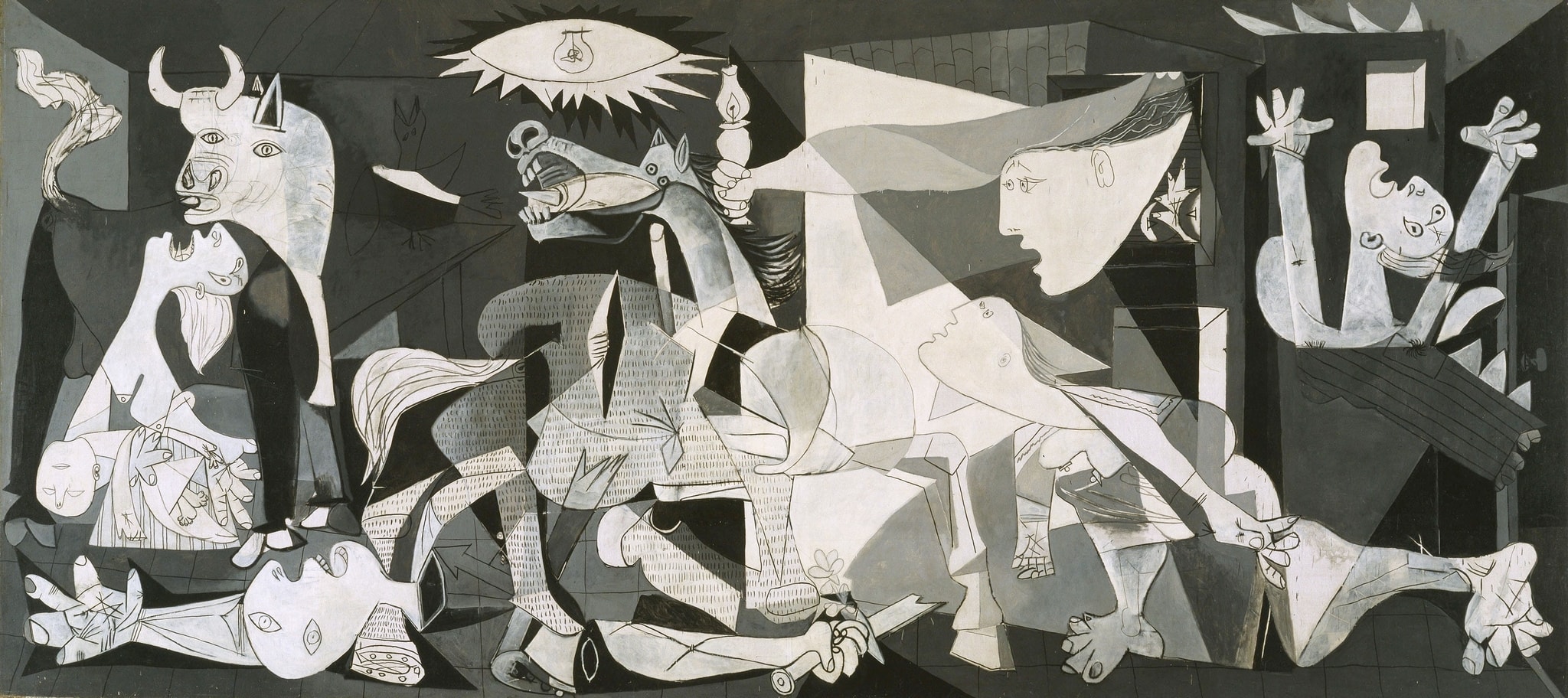
At the base of Guernica, Picasso scatters the head and arms of a fallen warrior; a severed hand still grips a broken sword as a tiny flower springs beside it. This compressed emblem of defeat and fragile endurance anchors the mural’s outcry against mechanized war and keeps a thread of human hope alive.
Historical Context
Picasso painted Guernica between May 1 and June 4, 1937 for the Spanish Pavilion at the Paris World’s Fair, responding directly to the Luftwaffe-assisted bombing of the Basque town of Gernika on April 26. Within this commission, the dismembered soldier at the painting’s base personifies the human cost of the attack and the collapse of conventional resistance in the face of modern warfare 1.
Picasso refined the motif with unusual precision. On 13 May he drew a focused study, Hand with Broken Sword, isolating the emblematic right hand that clutches a snapped blade—an image he would carry intact into the final canvas. The drawing shows that the soldier’s fragment was conceived as a discrete visual sign and a narrative hinge rather than incidental debris, ensuring its clarity amid the mural’s compressed, tumultuous space 2.
Symbolic Meaning
The soldier’s broken sword is a plain declaration of defeat and the obsolescence of chivalric, hand‑to‑hand heroism before aerial bombardment. Next to it, a tiny flower introduces a counter‑current—endurance, renewal, a minimal sign that life persists even as arms fail 34. Together they stage the painting’s moral dialectic: ruin set against a stubborn flicker of hope.
Picasso heightens the figure’s sacrificial charge by marking the open left palm with a puncture that recalls the stigmata, aligning the fallen fighter with traditions of martyrdom and witness 6. Critics have also read the male body as a shattered classical statue, turning the language of heroic antiquity into an image of civilization literally smashed by modern violence 5. These readings cohere into a tight symbolic cluster—defeat, martyrdom, and frail rebirth—delivered with the blunt legibility of a poster. The soldier is not an anecdotal casualty; he is a condensed allegory of the fate of old ideals under fascist terror, answered only by the seedling promise of that single flower 3456.
Artistic Technique
Picasso renders the soldier within a stark grisaille palette—black, white, and gray—whose newspaper-like austerity strips away sentiment and makes the flower’s meaning conceptual rather than chromatic 7. The body is fragmented into head and forearms; dismemberment reads both literally and as a Cubist unmaking of heroic form, tightening the symbol to a few high-contrast shapes 3.
The emblem’s clarity was engineered through preparatory work: the 13 May study fixes the hand–sword–flower triad as a self-sufficient sign, later slotted into the mural’s base. Dora Maar’s working photographs show Picasso pruning competing details so this motif would register instantly amid the painting’s angled tumult 28.
Connection to the Whole
Placed along the lower center, the fallen soldier acts as the mural’s ground line and moral baseline. Its jagged diagonals point upward toward the shrieking horse and the clash of lights above, propelling the eye through the painting’s crisis. The compact hand–sword–flower emblem sets the stakes for everything that unfolds in the register above it 3.
Process photos confirm that Picasso stabilized this figure as one of the mural’s principal icons alongside the bull, horse, and lamp-bearer, so that a fragile human sign (flower, oil lamp) confronts the cold glare of the electric bulb and the machinery of destruction. The soldier thus ties the composition’s lower and upper zones into a single argument: human life persists, but only as a tenuous light against overwhelming force 83.
Explore More from This Painting
This detail is one part of Guernica. Use the links below to return to the full interpretation, browse the full set of details, or view the painting's valuation if available.
Sources
- Museo Reina Sofía – Guernica object page
- Rethinking Guernica (Reina Sofía) – Hand with Broken Sword (13 May 1937)
- Smarthistory – Pablo Picasso, Guernica
- American Academy of Arts & Sciences (Daedalus) – "Picasso’s Guernica"
- The Guardian – Jonathan Jones, "The shame and the glory"
- Wikipedia – Guernica (Picasso) overview
- Britannica – Guernica | Description, History, & Facts
- Museo Reina Sofía – Dora Maar, Photo Report of the Evolution of Guernica