The Weeping Mother in Guernica
A closer look at this element in Pablo Picasso's 1937 masterpiece
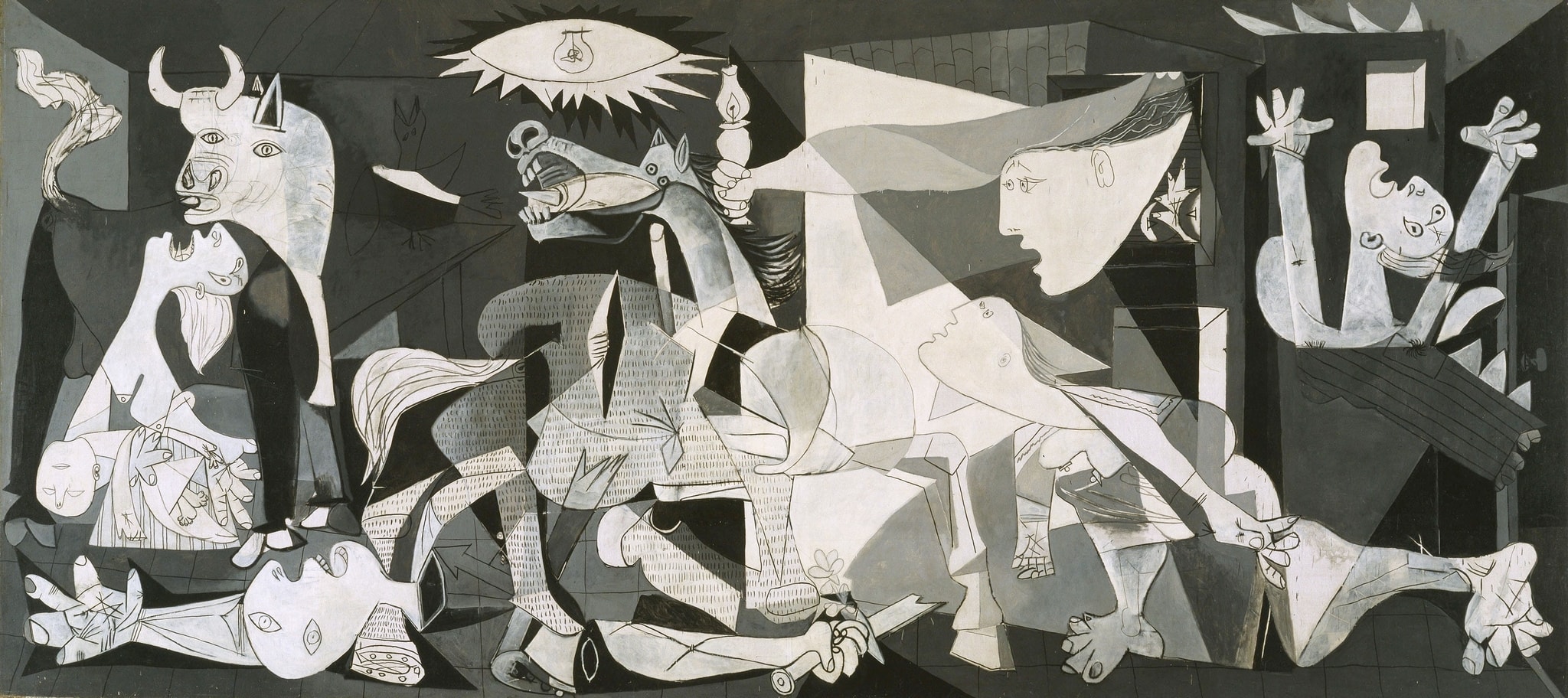
At the far left of Guernica, a mother kneels, head flung back, screaming as she clutches her dead child—a modern Pietà that condenses the mural’s grief into a single, unforgettable cry. Picasso makes her the work’s human ground zero, a figure forged in May 1937 studies and later distilled into the Weeping Woman series.
Historical Context
Picasso painted Guernica in response to the aerial destruction of the Basque town on April 26, 1937, during the Spanish Civil War. Already commissioned by the Spanish Republic to create a large work for the Paris Exposition, he redirected his mural to confront the atrocity, stripping it of heroics and centering civilian suffering. The weeping mother with her dead child, placed at the painting’s far left, embodies this pivot with searing immediacy. Prado’s curatorial entry identifies the group as a pathetic Pietà and underscores how women, children, and animals become the protagonists of this tragedy, a radical focus for a history painting of the 1930s 1.
Smarthistory situates this decision within Picasso’s rapid response and notes how the painting’s formal language—its fragmentation, high-contrast grisaille, and screaming mouths—was marshaled to broadcast the horror to an international public at the World’s Fair 2. Preparatory drawings from early–late May confirm that the mourning mother was central from the outset, not an afterthought in the evolving composition 3.
Symbolic Meaning
Picasso casts the left-hand group as a modern Pietà: a mother cradling the lifeless child while howling upward, secularizing the Virgin-and-Christ lament into the universal grief of bombed civilians. Prado explicitly names the figure a Pietà, aligning it with Spain’s devotional image of the Mater Dolorosa—the Sorrowful Mother—now transposed into the language of Cubism and war 1. Reina Sofía’s interpretive frame likewise places the painting’s women within a Mater Dolorosa lineage, which Picasso would soon refine into standalone heads and busts 8.
This “weeping mother” also seeds the post–Guernica Weeping Woman cycle, where the lament shifts from participant to witness. Museums and scholars note how these later portraits—often modeled on Dora Maar—condense the same national mourning into a single, mask-like face, directly tracing their origin to the Guernica motif 564. A further art-historical echo runs to Eisenstein’s Odessa Steps sequence, where a mother hoists her dead child; Reina Sofía records the parallel as compelling in its visual rhetoric of public grief, even if not documentary proof of source 4. In Guernica, the symbol’s charge is unequivocal: private loss elevated to a civic cry.
Artistic Technique
Picasso renders the figure in stark grisaille—blacks, whites, and grays that recall newspaper photography—so that form, value, and line carry the emotion without distraction. The mother’s head snaps back; her mouth opens into a triangular, dagger-like tongue, one of the painting’s signature signs of agony 2. Angular planes fracture her body and the child’s limp form into hard, sculptural masses, catching the light-dark chiaroscuro that Prado notes within the mural’s classical triangular scaffolding 1.
Up close, the surface mixes brushwork, scraped lines, and sharp contours; technical imaging from Reina Sofía’s Rethinking Guernica project documents varied paint handling and incisions that give the cry its cutting edge in both drawing and paint 9.
Connection to the Whole
Compositionally, the mother-and-child anchors the mural’s left terminus beneath the impassive bull, counterbalancing the rearing, eviscerated horse at center and the burning figures at right. Prado describes this frieze-like array within a triangular scheme; the mother’s vertical thrust and upturned howl start the painting’s chain of cries that ricochet across the canvas 1.
Her presence crystallizes the mural’s anti-heroic ethos: Guernica is a history painting where civilians—not generals—bear the meaning. Smarthistory underlines how the monochrome palette and fragmented bodies broadcast a universal, anti-war indictment; the left mother is its most concentrated human emblem 2. Picasso’s immediate “postscripts” to Guernica, including Mother with Dead Child II, affirm the motif’s generative role beyond the mural, distilling its grief into independent works that extend the painting’s voice into the broader culture 4.
Explore More from This Painting
This detail is one part of Guernica. Use the links below to return to the full interpretation, browse the full set of details, or view the painting's valuation if available.
Sources
- Museo del Prado – Encyclopedia entry on Guernica (Pietà identification, composition)
- Smarthistory – Picasso’s Guernica (context, palette, fragmentation, “dagger” tongues)
- Museo Reina Sofía – Mother with Dead Child I (Preparatory drawing, English page)
- Museo Reina Sofía – Mother with Dead Child II (Postscript to Guernica, English)
- LACMA – Weeping Woman with Handkerchief (link to Guernica studies and motif)
- NGV – Patrick McCaughey, A witness to Guernica: Picasso’s Weeping Woman
- UC Press – Rudolf Arnheim, The Genesis of a Painting: Picasso’s Guernica
- Museo Reina Sofía – Mater Dolorosa: The Women of Guernica (gallery text)
- Apollo Magazine – Rethinking Guernica: technical imaging at the Reina Sofía
- Wikipedia – Guernica (Picasso) overview