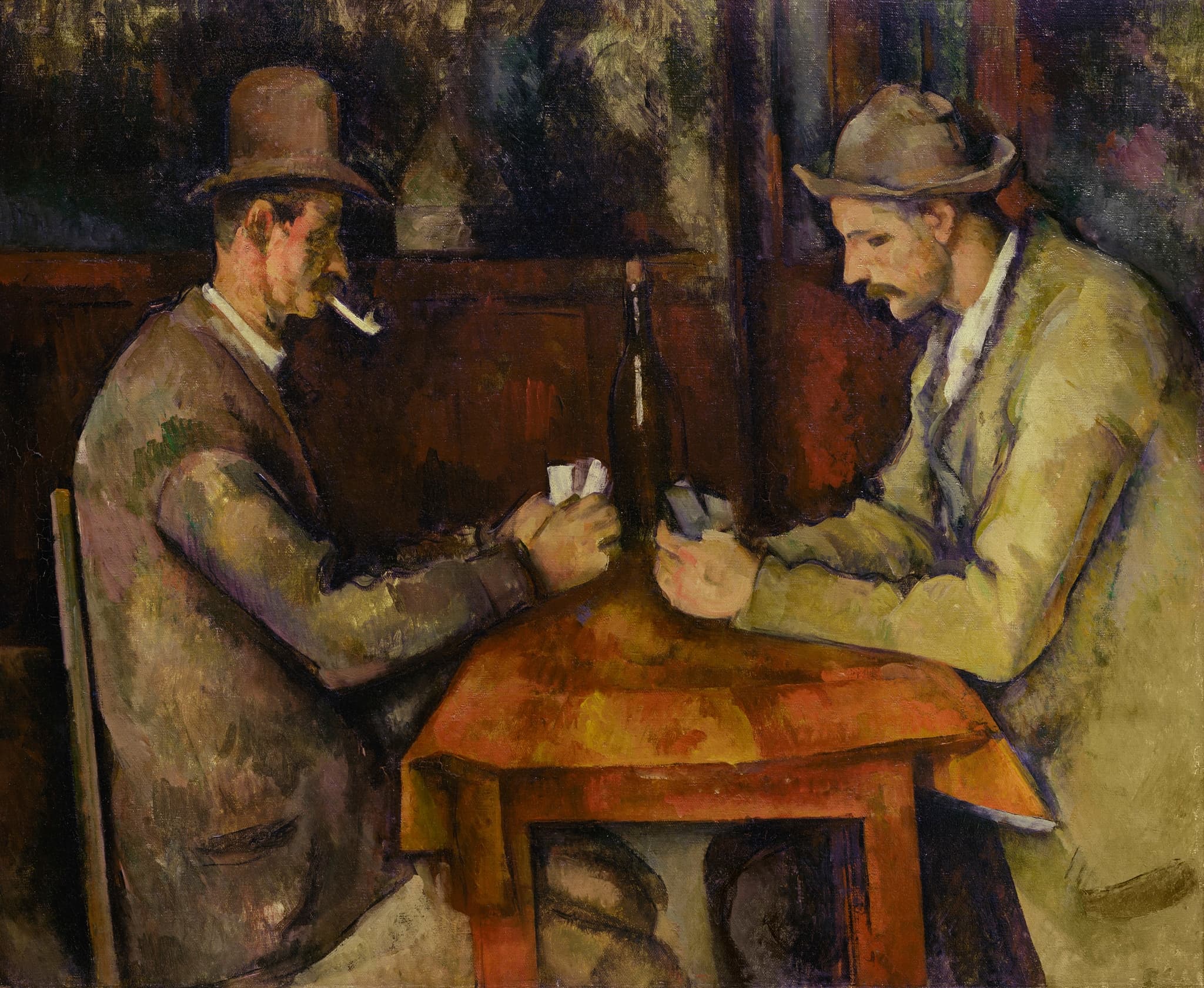
The Card Players by Paul Cézanne | Equilibrium and Form Auction History
This Met version of Cézanne’s The Card Players has no public auction record. Traced from Ambroise Vollard to Bernheim‑Jeune (1900), it was acquired by Stephen C. Clark in 1931 and bequeathed to The Met in 1960. Its market relevance is anchored by the series’ rarity and nine‑figure benchmarks achieved by other Cézannes.
- Artwork
- The Card Players by Paul Cézanne | Equilibrium and Form
- Artist
- Paul Cézanne
- Best-known sale or transfer
- No public auction; museum-held since 1960
- Sale type
- No known public sale
- Current location / owner
- The Metropolitan Museum of Art, New York
Auction and Ownership Timeline
Painted circa 1890–92
Cézanne paints the multi‑figure Card Players canvas, dated circa 1890–92; The Met identifies this version within the five‑painting series [1][9].
Ambroise Vollard sells to Bernheim‑Jeune
Paris
Vollard’s stockbook (no. 3488) records the sale of a multi‑figure Card Players (c. 65 × 81 cm) to Galerie Bernheim‑Jeune; the dimensions and description align with The Met canvas [2][1].
Acquired by Stephen C. Clark
New York
Stephen C. Clark purchases the painting by 1931; The Met notes his 1931 acquisition [3].
Exhibited at A Century of Progress
Art Institute of Chicago, Chicago
Lent by Stephen C. Clark to the Art Institute of Chicago’s A Century of Progress exhibition, corroborating his ownership by this date [4].
Exhibited at MoMA, Modern Masters
Museum of Modern Art, New York
Clark lends the painting to MoMA’s Modern Masters from European and American Collections, further documenting continuous private ownership [5].
Bequeathed to The Met
The Metropolitan Museum of Art, New York
Stephen C. Clark bequeaths the painting to The Metropolitan Museum of Art; accession number 61.101.1 [1].
Featured in Cézanne’s Card Players exhibition
The Courtauld Gallery, London; The Metropolitan Museum of Art, New York
The work is included in the focused exhibition Cézanne’s Card Players, organized by The Courtauld Gallery and shown at The Met [6].
Provenance and Ownership
Chain of ownership: Paul Cézanne → Ambroise Vollard (dealer) → Galerie Bernheim‑Jeune, Paris (acquired from Vollard on 19 Feb 1900) → Stephen C. Clark, New York (purchased 1931) → The Metropolitan Museum of Art, New York (bequest, 1960; acc. 61.101.1) [2][3][1].
Corroboration: Clark is recorded as lender to major exhibitions in 1933 (Art Institute of Chicago) and 1940 (MoMA), supporting continuous private ownership prior to the 1960 bequest [4][5].
Quick Facts
- Last known sale
- 1931
- Known sale price
- Not publicly reported
- Sale type
- Private sale
- Venue / institution
- Not publicly reported
- Current owner or location
- The Metropolitan Museum of Art, New York
- Publicly viewable?
- Yes
Why This Sale Matters
The Metropolitan Museum of Art’s multi‑figure Card Players has no public auction history. Its path from Ambroise Vollard’s stock to Galerie Bernheim‑Jeune in 1900, then to Stephen C. Clark by 1931, and finally to The Met via bequest in 1960, is well documented in primary sources [2][3][1]. As a museum‑held masterpiece, it functions as a reference point for scholarship and connoisseurship rather than as an active market comparable.
Series significance: The Card Players is among Cézanne’s most studied bodies of work; The Met’s curators have positioned this canvas within the five‑painting series, and it featured prominently in the 2011 focus exhibition organized with The Courtauld Gallery [1][6][9]. The rarity of these canvases—concentrated in major museums and distinguished collections—constrains supply and makes direct market comparisons exceptional.
Market benchmarks for context (not this work): Another Card Players version (two‑figure composition) reportedly sold privately for over $250 million around 2011, a price widely covered by major media and at the time a record for a painting in a private transaction [7]. Public‑auction demand for Cézanne remains extremely strong, exemplified by the 2022 $137,790,000 result for La Montagne Sainte‑Victoire at Christie’s Paul G. Allen sale—his auction record to date [8].
Implication: While the Met canvas is unlikely to trade, its impeccable provenance (Vollard → Bernheim‑Jeune → Clark → The Met) and its central place in a canonical series underscore Cézanne’s standing at the top of the global market. Price discovery for comparable works relies on the broader Cézanne record and the series’ landmark private sale, rather than on any auction record for this specific painting [1][2][7][8].
Related Pages
Other auction histories by Paul Cézanne
Sources
- The Card Players (Accession 61.101.1) — Object page — The Metropolitan Museum of Art
- Cézanne Catalogue Raisonné — Ambroise Vollard Stockbooks — Cézanne Catalogue Raisonné
- The Clark Brothers Collect — Photo Gallery (notes on 1931 purchase) — The Metropolitan Museum of Art
- A Century of Progress Exhibition of Painting and Sculpture (1933) — Catalogue (PDF) — Art Institute of Chicago
- Modern Masters from European and American Collections (1940) — Exhibition Catalogue (PDF) — The Museum of Modern Art
- Cézanne’s Card Players — Exhibition — The Courtauld Gallery
- Oil-rich Qatar pays record $250 million for painting — Los Angeles Times
- Visionary: The Paul G. Allen Collection Part I totals $1.5 billion in a single night — Christie’s
- Cézanne’s Card Players — Met Essay — The Metropolitan Museum of Art