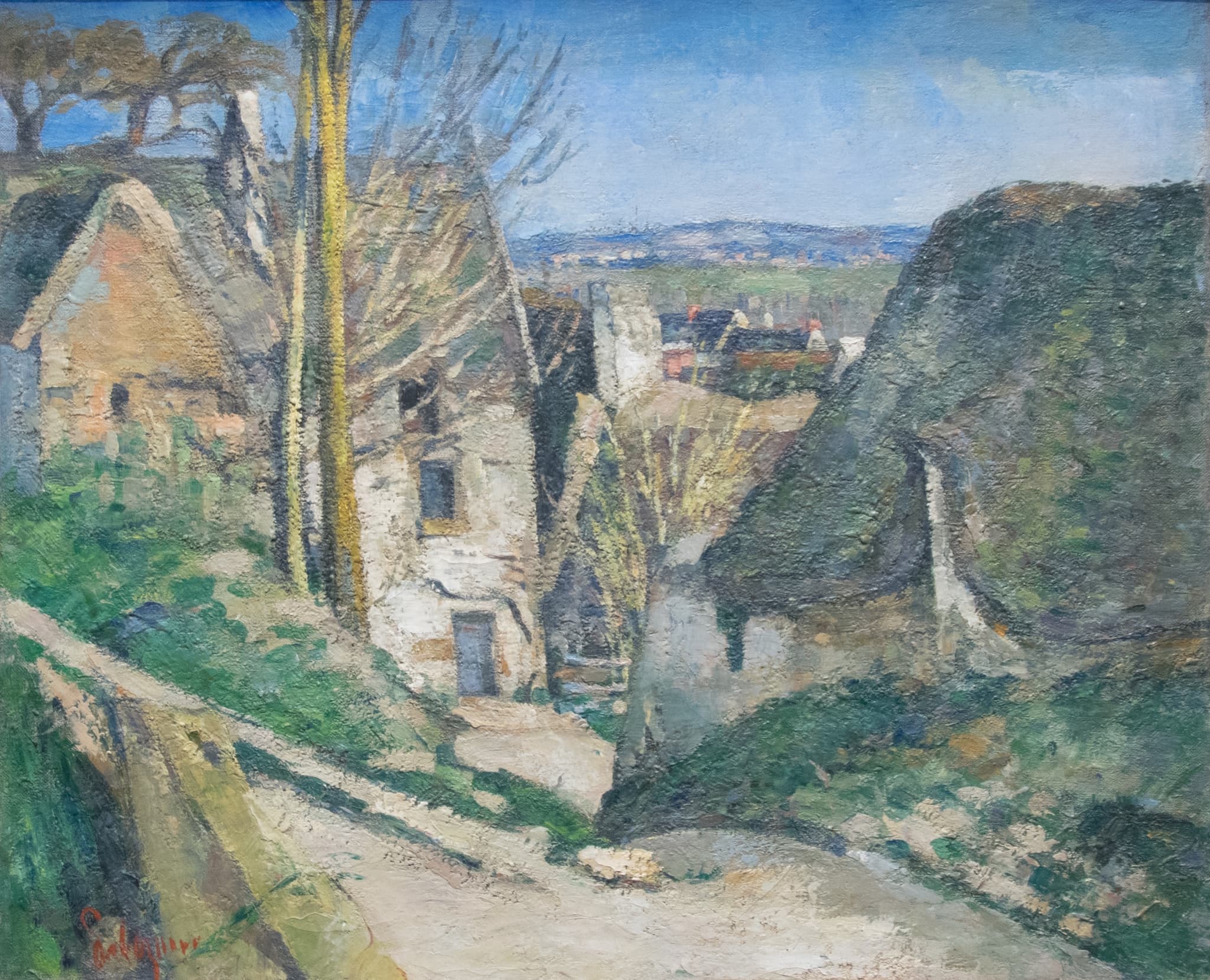
The House of the Hanged Man Auction History
After debuting at the 1874 Impressionist exhibition, this canvas was sold to Comte Armand Doria, then exchanged to Victor Chocquet. At the 1899 Veuve Chocquet sale it was bought by Isaac de Camondo for a reported 6,200 francs, and in 1911 he bequeathed it to the French State; it is now at the Musée d’Orsay.
- Artwork
- The House of the Hanged Man
- Artist
- Paul Cézanne
- Best-known sale or transfer
- 1899 Veuve Chocquet sale: 6,200 francs
- Sale type
- Public auction
- Current location / owner
- Musée d’Orsay, Paris (French State)
Auction and Ownership Timeline
Work created
Auvers‑sur‑Oise
Cézanne paints The House of the Hanged Man (La Maison du pendu, Auvers‑sur‑Oise). [1]
Shown in the First Impressionist Exhibition
Paris
Exhibited in the landmark 1874 Impressionist exhibition (catalogue no. 42). [1]
Purchased by Comte Armand Doria
Paris
Acquired after the 1874 exhibition; Orsay notes it was the first Cézanne the artist sold to a private amateur. [1][4]
Exchange to Victor Chocquet
Paris
Doria exchanged the painting to Victor Chocquet for Cézanne’s Neige fondante; it remained with the Chocquets until 1899. [1][3]
Veuve Chocquet sale; bought by Isaac de Camondo
6,200 francs · Galerie Georges Petit, Paris
Sold at Galerie Georges Petit in the Veuve Chocquet sale (within mixed lot 106) and acquired by Comte Isaac de Camondo; reported price 6,200 francs. Monet urged the purchase; Durand‑Ruel reportedly intermediated. [1][3][8]
Bequeathed to the French State
Paris
Camondo’s bequest to the French State for the Musée du Louvre was accepted by decree on 23 November 1911. [1][2]
Displayed at the Musée du Louvre
Musée du Louvre, Paris
Placed on view at the Louvre following the 1911 bequest. [1]
Transfer to the Galerie du Jeu de Paume
Galerie du Jeu de Paume, Paris
From 1947, housed in the Louvre’s Galerie du Jeu de Paume. [1]
Provenance and Ownership
Paul Cézanne painted the work in 1873 and showed it in the First Impressionist Exhibition in 1874; soon after, Comte Armand Doria purchased it—identified by the Musée d’Orsay as the first Cézanne sold to a private amateur. [1][4]
In 1889 Doria exchanged the canvas with Victor Chocquet for Cézanne’s Neige fondante, and it remained with the Chocquets until the 1899 “Vente Veuve Chocquet” at Galerie Georges Petit, where Comte Isaac de Camondo acquired it for a reported 6,200 francs; Monet urged Camondo to buy, reportedly via Durand‑Ruel. [1][3][8]
In 1911 Camondo bequeathed the painting to the French State for the Musée du Louvre (accepted by decree on 23 November 1911). It was shown at the Louvre from 1914, then at the Galerie du Jeu de Paume from 1947, and has been assigned to the Musée d’Orsay since 1986 (inventory RF 1970). [1][2]
Quick Facts
- Last known sale
- 1899
- Known sale price
- 6,200 French francs
- Sale type
- Public auction
- Venue / institution
- Galerie Georges Petit, Paris
- Current owner or location
- Musée d’Orsay, Paris (French State)
- Publicly viewable?
- Yes
Why This Sale Matters
This canvas occupies a pivotal place in Cézanne’s market narrative. The Musée d’Orsay notes it was the first work the artist succeeded in selling to a private amateur—Comte Armand Doria—following its appearance in the 1874 Impressionist exhibition, marking the very start of the painter’s commercial acceptance. [1]
The subsequent chain of enlightened patrons—Doria, the great Cézanne champion Victor Chocquet, and the collector Isaac de Camondo—reads like a who’s who of late‑19th‑century taste. The 1899 “Vente Veuve Chocquet” at Galerie Georges Petit provides the work’s key public market data point: a reported 6,200‑franc price when Camondo purchased it from a mixed lot, with Monet encouraging the acquisition (Durand‑Ruel reportedly intermediating). While the lot structure complicates precision, the event is well‑documented and anchors the painting’s historical market valuation. [1][3][8]
No public sale followed: Camondo’s 1911 bequest transferred the picture to the French State, removing it permanently from the commercial market. It entered the Louvre, later the Jeu de Paume, and has been assigned to the Musée d’Orsay since 1986 (RF 1970). This secure museum status underscores the work’s canonical importance and explains the absence of modern pricing. [1][2]
For broader context, Cézanne’s market has since achieved blue‑chip heights: the auction record stands at $137.79 million for La Montagne Sainte‑Victoire (Christie’s, 2022), while The Card Players reportedly sold privately for more than $250 million in 2011; a major still life fetched $59.3 million in 2019. These benchmarks frame the artist’s overall demand, even though this particular painting is not tradable as state property. [5][6][7]
Related Pages
Other auction histories by Paul Cézanne
Sources
- Musée d’Orsay — La Maison du pendu (Auvers‑sur‑Oise), 1873 — Musée d’Orsay
- POP/Joconde — RF 1970 (Paul Cézanne, La Maison du pendu) — Ministère de la Culture (France)
- Société Cézanne — 1899: Vente Veuve Chocquet — Société Cézanne
- Société Cézanne — 1874: Première exposition impressionniste — Société Cézanne
- Christie’s Press Release — Visionary: The Paul G. Allen Collection Part I totals $1.5 billion — Christie’s
- Vanity Fair — Qatari Royals Buy Cézanne’s ‘The Card Players’ — Vanity Fair
- The Art Newspaper — New records at Christie’s with a peachy Cézanne — The Art Newspaper
- Galerie Georges Petit — Vente Veuve Chocquet (catalogue listing) — Pôle Courbet / Ma Bibliothèque