Still Life with Apples and Oranges Auction History
This Cézanne has no auction history. It changed hands privately in 1907 before entering the French State through Count Isaac de Camondo’s 1911 bequest, and it is now held at the Musée d’Orsay. Under French law the work is inalienable and not market‑exposed, though comparable Cézannes have set record prices.
- Artwork
- Still Life with Apples and Oranges
- Artist
- Paul Cézanne
- Best-known sale or transfer
- 1907 private sale to Count Isaac de Camondo
- Sale type
- No known public sale
- Current location / owner
- Musée d’Orsay, Paris
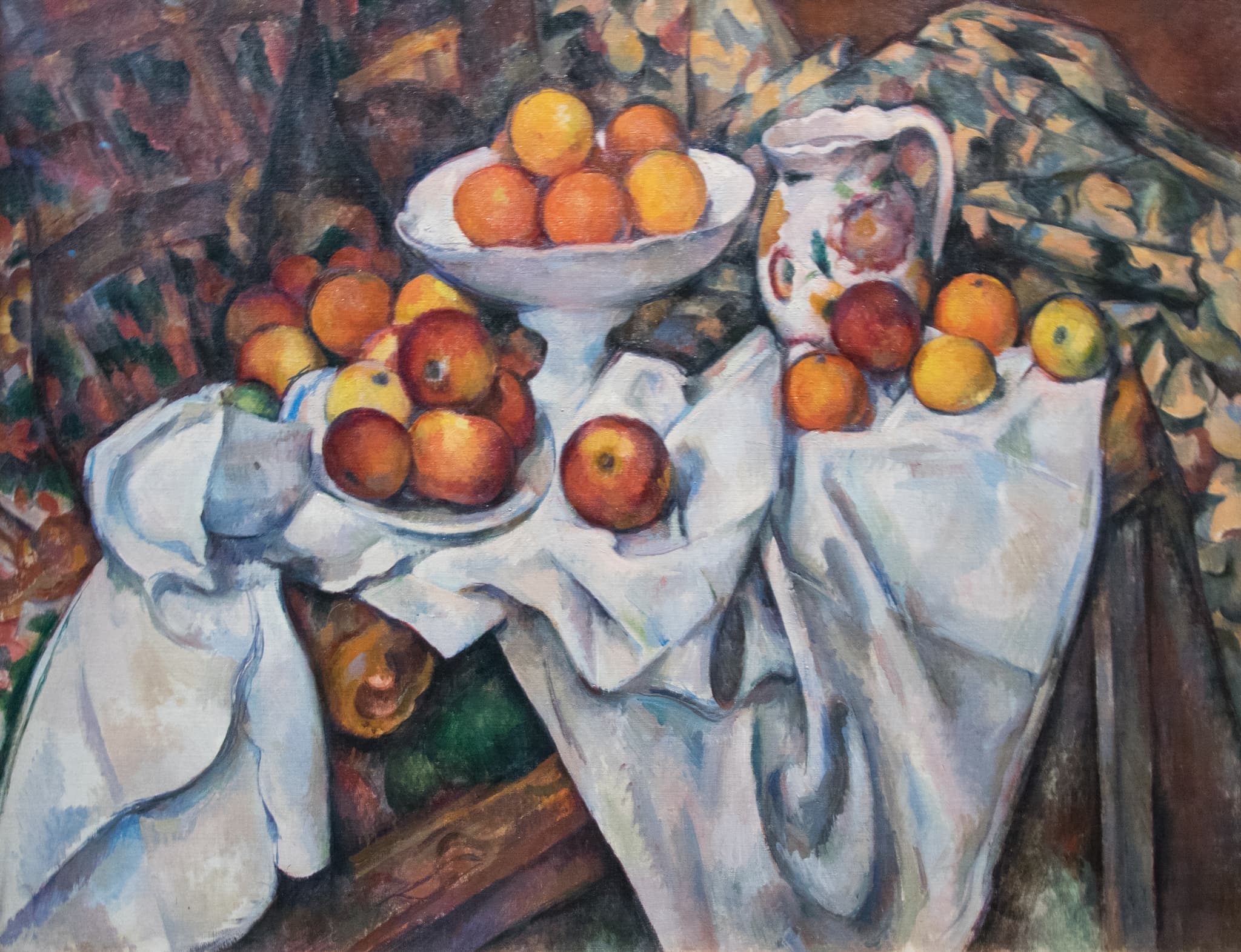
Auction and Ownership Timeline
Gustave Geffroy collection, Paris
Paris
By 1907 the painting was in the collection of critic Gustave Geffroy; RMN–Grand Palais notes he acquired it directly from Cézanne [1][9].
Galerie Bernheim‑Jeune acquires the work
Paris
Bernheim‑Jeune, Paris, purchased the painting from Geffroy (stock book no. 15,604) on 28 January 1907 [1].
Sold to Count Isaac de Camondo
Paris
On 4 May 1907 Bernheim‑Jeune sold the canvas to Count Isaac de Camondo, Paris [1].
Camondo bequest to the French State (for the Louvre)
Paris
Bequeathed by Isaac de Camondo to the Musées nationaux; accepted in 1911 and entering the Louvre collections [1].
Displayed at the Louvre
Paris
Recorded as on view at the Louvre by 1914, confirming museum custody [1].
At Galerie du Jeu de Paume
Paris
From 1947 the work was held/displayed at the Louvre’s Galerie du Jeu de Paume [1].
Assigned to Musée d’Orsay
Paris
Assigned to the newly created Musée d’Orsay; the painting remains French State property (inv. RF 1972) [1][2].
Loan to Fondation Beyeler, Cezanne exhibition
Riehen/Basel
Included as a loan in the Fondation Beyeler exhibition “Cezanne” (Jan 25–May 25, 2026) [4].
Not on view at Musée d’Orsay
Paris
The Musée d’Orsay record lists the painting as “not on view” in 2026 [1].
Provenance and Ownership
c.1899: Painted by Paul Cézanne [1].
By 1907: In the collection of Gustave Geffroy, Paris; RMN–Grand Palais notes Geffroy acquired the picture directly from Cézanne [1][9].
28 Jan 1907: Purchased by Galerie Bernheim‑Jeune, Paris (stock no. 15,604) from Geffroy [1].
4 May 1907: Sold privately by Bernheim‑Jeune to Count Isaac de Camondo, Paris [1].
1911: Bequeathed by Camondo to the French State for the Louvre (Musées nationaux); later shown at the Louvre and the Galerie du Jeu de Paume [1].
1986–present: Assigned to the Musée d’Orsay, Paris; property of the French State and part of the inalienable national collections [1][2][3].
Quick Facts
- Last known sale
- 1907-05-04
- Known sale price
- Not publicly reported
- Sale type
- Private sale
- Venue / institution
- Galerie Bernheim‑Jeune (to Count Isaac de Camondo), Paris
- Current owner or location
- Musée d’Orsay, Paris (French State)
- Publicly viewable?
- Sometimes
Why This Sale Matters
This painting has no public auction record; its key market moments were two private transactions in 1907 followed by Count Isaac de Camondo’s 1911 bequest to the French State, placing it in the Louvre and, since 1986, at the Musée d’Orsay [1]. As an object of the French national collections, it is inalienable under the Code du patrimoine, meaning it cannot be sold and is not market‑exposed [3][2].
To gauge market significance, comparable Cézannes provide context. The artist’s auction record stands with La Montagne Sainte‑Victoire, which realized $137.79 million at Christie’s in 2022 [5]. Still‑life benchmarks are also high: Rideau, cruchon et compotier brought $60.5 million at Sotheby’s in 1999, cited as a record still life at the time [7], and Fruits et pot de gingembre achieved $38.935 million at Christie’s in 2023 [6]. At the pinnacle of private valuations, a version of The Card Players reportedly sold for more than $250 million in 2011, underscoring Cézanne’s status among the most valuable painters in the market [8].
Within that spectrum, Still Life with Apples and Oranges is a canonical late still life—one of the genres most coveted by collectors—yet its public‑collection status removes it from price discovery. Its early provenance through Gustave Geffroy and Bernheim‑Jeune to Camondo aligns it with prominent champions of Cézanne’s work [1][9]. Continued museum stewardship and international loans, such as to the Fondation Beyeler in 2026, reinforce its art‑historical importance rather than its tradability [4][1]. In short, while top‑tier Cézannes command exceptional prices, this canvas is legally and institutionally placed outside the market.
Related Pages
Other auction histories by Paul Cézanne
Sources
- Musée d’Orsay — Pommes et oranges object record — Musée d’Orsay
- Joconde — French national collections record (Pommes et oranges) — Ministère de la Culture
- Code du patrimoine, Article L451‑5 (inalienability) — Légifrance
- Fondation Beyeler — Cezanne press kit (loan listing) — Fondation Beyeler
- Paul G. Allen Collection sale results (Cézanne record) — Christie’s
- Christie’s press release — 20th Century Evening Sale, Nov 9, 2023 — Christie’s
- Most expensive still life at auction (1999) — Guinness World Records
- How Qatar bought Cézanne’s The Card Players — Vanity Fair
- Panorama de l’art — Pommes et oranges (analysis and provenance note) — RMN–Grand Palais