How Much Is Portrait of Pope Paul III Worth?
Last updated: July 4, 2026
Quick Facts
- Methodology
- comparable analysis
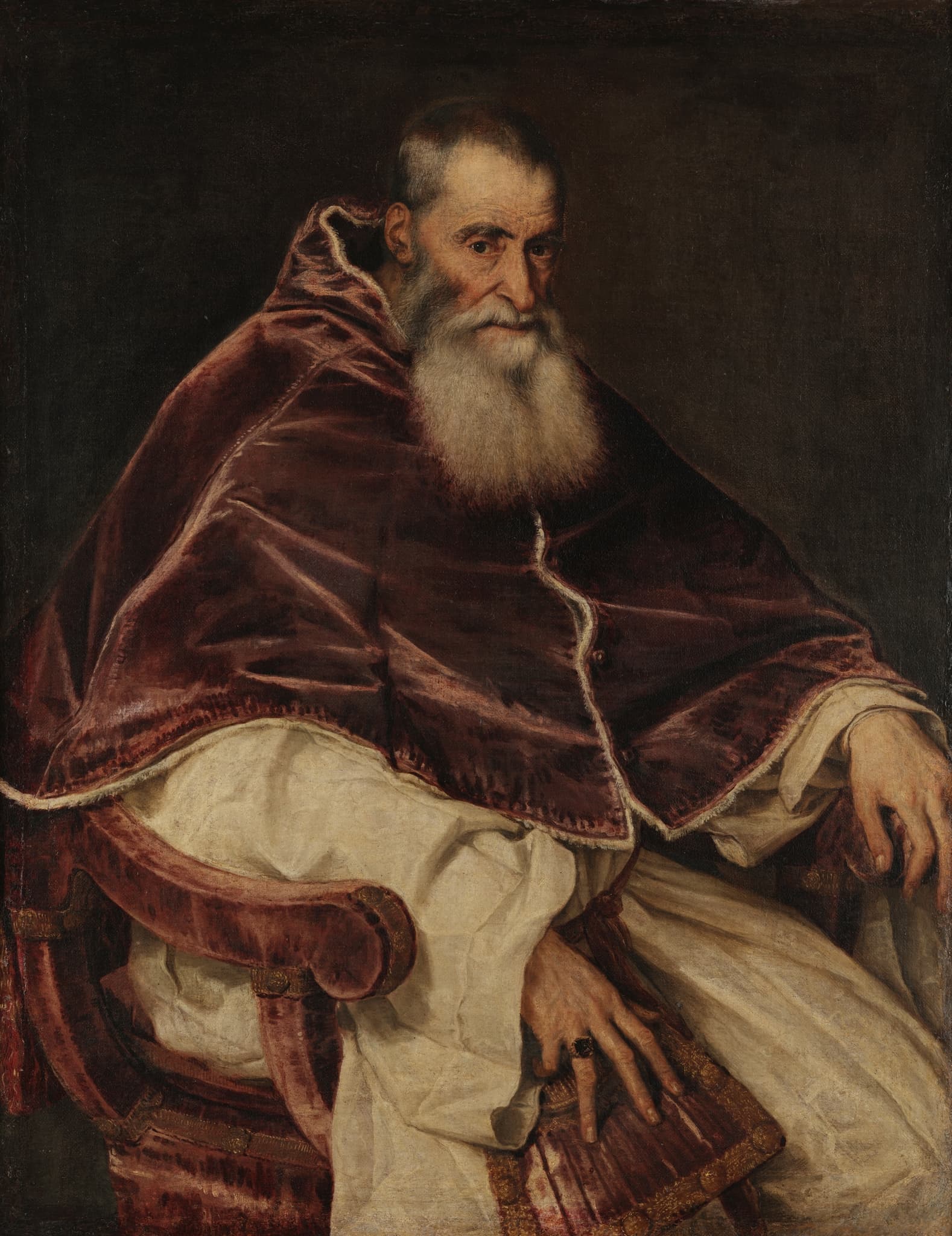
A prime, fully accepted autograph Portrait of Pope Paul III by Titian would command approximately $120–200 million in a lawful private sale with export clearance. This range is grounded in top-tier Titian private-treaty benchmarks and nine-figure Old Master portrait comparables, adjusted for the subject’s singular papal importance and extreme rarity.
Valuation Analysis
Estimated fair‑market value (hypothetical, assuming lawful private sale and export): $120–200 million. Titian’s Portrait of Pope Paul III sits at the apex of High Renaissance state portraiture and of the artist’s oeuvre, on par with his most consequential commissions. The range synthesizes direct Titian benchmarks and cross‑artist portrait comparables, while recognizing the unique prestige of a papal image by the Venetian master.
Core Titian benchmarks. The closest modern datapoints for top‑tier Titian masterpieces are the National Gallery/National Galleries of Scotland’s private‑treaty acquisitions of Diana and Actaeon (£50m, 2009) and Diana and Callisto (£45m, 2012), with the institutions noting pricing below open‑market levels [1][2]. Indexed to today’s market, these transactions anchor a nine‑figure expectation for the very best Titian. Public‑auction evidence was reset in 2024, when Christie’s sold the small, early Rest on the Flight into Egypt for $22.18m with fees—now the artist’s auction record—establishing a modern floor for autograph works far beneath a sovereign papal portrait [3].
Cross‑category portrait comparables. In Old Master portraiture, nine‑figure outcomes are established for singular, state‑level images, most notably the Rijksmuseum/Louvre joint acquisition of Rembrandt’s pendant portraits of Maerten Soolmans and Oopjen Coppit for approximately $180m (pair), or c.$90m each at the time [6]. This confirms institutional and private capacity for landmark portrait pictures and supports a low‑to‑mid nine‑figure level for a canonical Titian papal likeness.
Subject, authorship, and prestige. Pope Paul III (Alessandro Farnese) was Titian’s pivotal Roman patron, and the Capodimonte portraits are among the most published images of sixteenth‑century papal rule. As with Titian’s Charles V portraits, they define the visual language of power in the High Renaissance. Their long Farnese provenance and current status at the Museo e Real Bosco di Capodimonte further underscore canonical stature [5].
Legal/market context and assumptions. The autograph Paul III portraits are Italian state property; under Italy’s Cultural Heritage Code, museum holdings are inalienable, making a normal sale/export effectively impossible [4][5]. The valuation here expressly assumes a hypothetical scenario in which the work is privately saleable with perfect title and export—standard practice when insuring or benchmarking blue‑chip but non‑market institutional masterpieces.
Conclusion. Weighing the artist’s private‑treaty benchmarks, the established nine‑figure appetite for iconic Old Master portraits, and the exceptional subject and rarity, a prime, fully accepted Portrait of Pope Paul III by Titian is best placed at $120–200 million today. Works of lesser autograph status or condition would fall materially below this band.
Key Valuation Factors
Art Historical Significance
High ImpactTitian’s portraits of Pope Paul III are touchstones of High Renaissance state portraiture, synthesizing penetrating psychological insight with a new visual rhetoric of power. Alongside Titian’s Charles V images, they codified how rulers and popes were seen for centuries. The subject (Alessandro Farnese, a reform-era pope central to mid-16th-century politics) magnifies the art-historical weight. Scholarly attention, extensive publication, and frequent inclusion in surveys of Renaissance portraiture cement the composition’s canonical status. For valuation, this significance supports placement at the very top of the Old Master hierarchy, where singular historical subjects by apex artists command nine-figure outcomes when available.
Rarity and Supply Constraints
High ImpactAutograph Titian portraits of this caliber are exceptionally scarce, and prime examples are overwhelmingly in museums. The specific Pope Paul III compositions are part of the historic Farnese nucleus at Capodimonte, further emphasizing their non-replicable stature. Recent market cycles confirm that when compelling, securely attributed Renaissance masterworks appear, competition is intense and prices separate sharply from workshop or follower material. The 2024 auction record for an autograph Titian at $22.18m reflected a relatively modest early panel, underscoring how little true top-tier material reaches market. This scarcity is the decisive driver of a low-to-mid nine-figure valuation for a sovereign papal portrait.
Subject Prestige and Provenance
High ImpactA papal portrait by Titian sits at the pinnacle of subject desirability in Old Masters, combining spiritual authority, temporal power, and statecraft. Pope Paul III’s pivotal role—Council of Trent, Farnese dynasty consolidation—gives the image exceptional historical gravity. The composition’s long-standing association with the Farnese collection and its anchoring at Capodimonte confer a gold-standard provenance narrative. For ultra-high-net-worth buyers and institutions, this blend of subject and pedigree is precisely what justifies premiums above more generic mythologies or devotional works, placing a fully accepted Paul III portrait comfortably in nine-figure territory, conditions and market access permitting.
Market Benchmarks and Demand
Medium ImpactTwo modern benchmarks define the pricing logic: (1) Titian’s poesie acquired privately by UK national collections at £50m (2009) and £45m (2012), acknowledged as below full market value; and (2) nine-figure institutional appetite for landmark Old Master portraits, as with Rembrandt’s Marten and Oopjen pair acquired jointly by the Rijksmuseum and the Louvre. Together with Titian’s refreshed 2024 auction record at $22.18m for a small autograph work, these data points frame a rational valuation corridor. They indicate that a museum-caliber, state-level Titian portrait can justify a significant premium to public-auction precedents and align with low-to-mid nine-figure private-treaty pricing.
Legal/Exportability and Market Access
High ImpactThe autograph Paul III portraits are held by an Italian state museum; Italian cultural-heritage law renders such works inalienable and normally non-exportable. In the real world, that makes a market transaction extraordinarily unlikely. Valuation practice for iconic institutional works, however, often models a counterfactual in which title is perfect and export is granted, to benchmark fair-market or insurance values. If a sale/export restriction were to apply, price discovery would be theoretical or depressed; if lawfully transferable with a valid export license, competition from both private collectors and institutions would be expected to propel bidding into the proposed nine-figure range.
Sale History
Portrait of Pope Paul III has never been sold at public auction.
Titian's Market
Titian is among the most coveted Old Masters, with a tiny supply of securely attributed works in private hands. Public auction peaks were historically modest relative to his stature until 2024, when Christie’s set a new auction record at $22.18m for Rest on the Flight into Egypt. The true apex of his market largely trades via private treaty: the National Gallery/National Galleries of Scotland acquisitions of Diana and Actaeon (2009) and Diana and Callisto (2012) at £50m and £45m established modern nine-figure equivalents for museum-caliber masterpieces. Collectors and institutions prize Titian’s authorship, condition, and subject; prime portraits and poesie-caliber works can justify step-change premiums.
Comparable Sales
The Rest on the Flight into Egypt
Titian
Same artist; rare autograph work at public auction; establishes Titian’s current public-auction ceiling and a modern floor versus a museum-caliber state portrait.
$22.2M
2024, Christie's London
~$22.8M adjusted
A Sacra Conversazione: The Madonna and Child with Saints Luke and Catherine of Alexandria
Titian
Same artist; major autograph religious painting; earlier benchmark auction price for a substantial Titian, useful for long-run indexation.
$16.9M
2011, Sotheby's New York
~$24.3M adjusted
Diana and Actaeon
Titian
Same artist; universally recognized masterpiece from the poesie; museum acquisition at £50m sets a modern private-treaty benchmark for top-tier Titian.
$72.0M
2009, Private treaty (National Gallery, London & National Galleries of Scotland)
~$108.6M adjusted
Diana and Callisto
Titian
Same artist; companion poesie acquired at £45m; confirms high private-treaty pricing for canonical Titian masterpieces.
$71.0M
2012, Private treaty (National Gallery, London & National Galleries of Scotland)
~$99.9M adjusted
Portrait of a Young Man Holding a Roundel
Sandro Botticelli
Top-tier Italian Renaissance portrait at public auction; demonstrates nine‑figure demand for iconic Renaissance portraiture, a close subject-matter proxy for a papal portrait.
$92.2M
2021, Sotheby's New York
~$115.3M adjusted
Portraits of Maerten Soolmans and Oopjen Coppit (pair)
Rembrandt van Rijn
Peer-market anchor for marquee Old Master state-level portraiture acquired by museums; calibrates nine‑figure pricing for singular, historically pivotal portraits (pair price; ≈$123m each in 2025 dollars).
$180.0M
2016, Private treaty (Rijksmuseum & Musée du Louvre, joint acquisition)
~$245.9M adjusted
Current Market Trends
The high end of the Old Master market has shown resilience and selectivity, with capital concentrating on canonical names and fresh-to-market property. Recent headline results and institutional acquisitions affirm deep demand for best-in-class Renaissance and Baroque works, particularly portraits with storied provenance. Supply remains thin, amplifying competition when blue-chip works surface. Pricing bifurcation persists: autograph masterpieces achieve outsized outcomes while workshop or follower material trades far lower. In this context, a sovereign Titian portrait with unimpeachable status aligns with the cohort of works capable of low-to-mid nine-figure prices in private treaty, especially when supported by museum interest and robust third‑party guarantees.
Sources
- National Gallery, London — Press release: Diana and Actaeon is secured for the nation (2009)
- National Gallery, London — Press release: Titian’s Diana and Callisto is secured for the public (2012)
- The Washington Post — Report on Christie’s 2024 Titian sale (price $22.18m incl. fees)
- European University Institute — Italian Cultural Heritage Code (D.Lgs. 42/2004)
- Museo e Real Bosco di Capodimonte — Farnese Collection overview
- Rijksmuseum — Press release on joint acquisition of Rembrandt’s Marten and Oopjen (2016)