How Much Is Bild mit Weissen Linien (Painting with White Lines) Worth?
Last updated: April 13, 2026
Quick Facts
- Last Sale
- $41.6M (2017, Sotheby's, London — Impressionist & Modern Evening Sale)
- Methodology
- recent sale
Anchored to the documented Sotheby’s sale of Bild mit weissen Linien (1913) on 21 June 2017 (price realized £33,008,750 ≈ $41.6M), an authenticated, museum‑quality example is estimated at US$35–60 million. The range reflects the direct sale benchmark, inflation/market movement since 2017, and an uplift for outstanding provenance, condition and exhibition history.
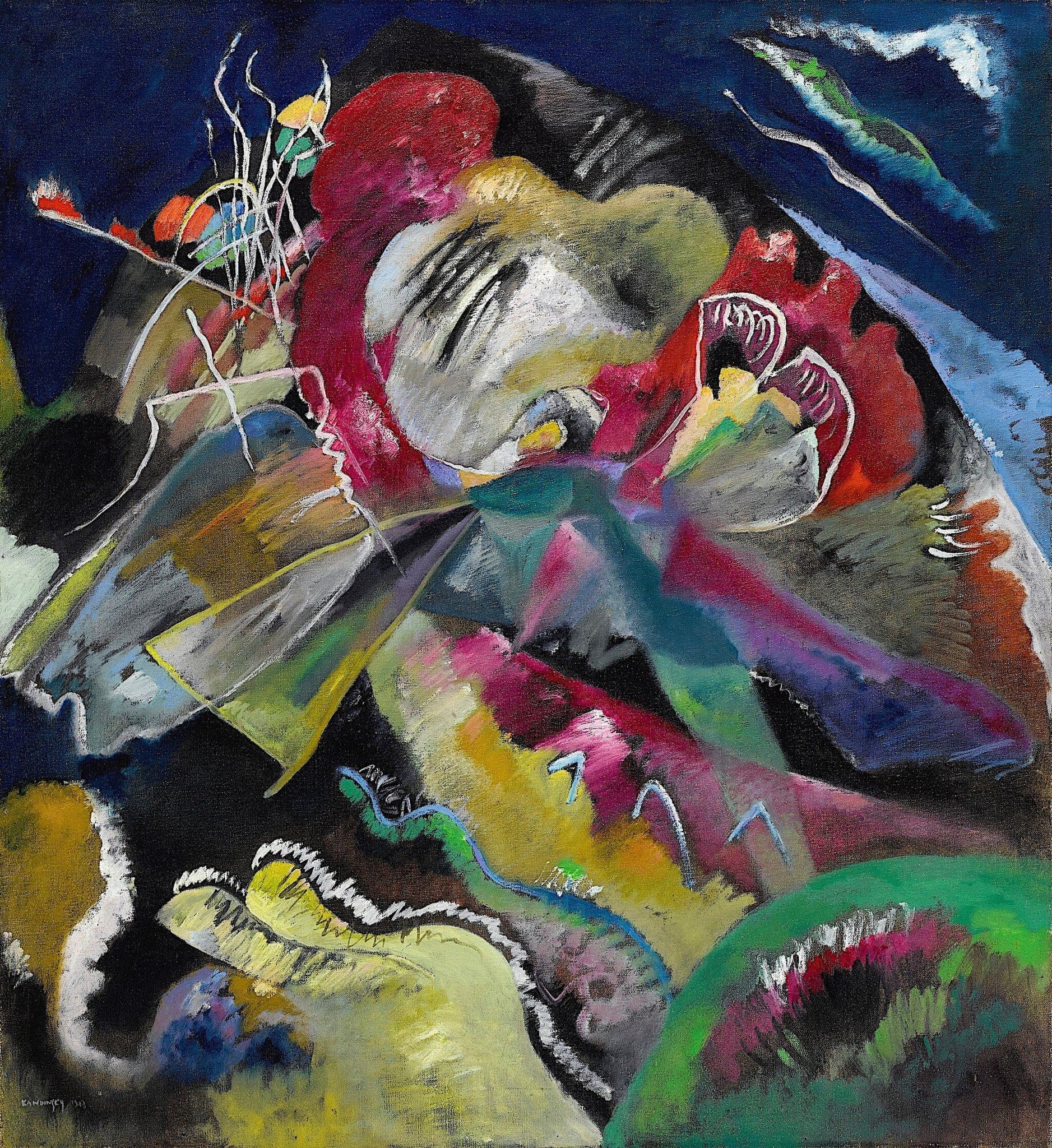
Bild mit Weissen Linien (Painting with White Lines)
Wassily Kandinsky, 1913 • Oil on canvas
View more by Wassily Kandinsky →Valuation Analysis
Valuation conclusion: Using a recent‑sale anchor, the best current market estimate for an authenticated, museum‑quality Bild mit Weissen Linien (1913) is US$35,000,000–US$60,000,000. The principal benchmark is the painting’s documented public sale at Sotheby’s London on 21 June 2017 (price realized £33,008,750, ≈ US$41.6M), which demonstrates clear top‑tier demand for this titled composition in an open market context [1].
Comparables and adjustments: The 2017 sale is a direct, like‑for‑like datum for this title; modern auction comparables for Kandinsky’s early, pre‑WWI works (notably the 2023 Murnau sale) confirm that early‑period canvases remain the artist’s most valuable segment and that top results continue in the low‑to‑mid‑eight‑figure range [2]. Adjusting the 2017 result for inflation and market momentum produces an indicatively higher figure in today’s dollars, but the realized 2017 price remains the most reliable single data point for this specific work.
Key value drivers: The painting’s final market value will be driven by authentication certainty, the completeness of provenance and exhibition/publishing history, condition/technical analysis, scale and whether the work is recognized in major Kandinsky scholarship. The existence of an extant preparatory study attributed to Kandinsky (e.g., the Lenbachhaus study titled Entwurf zu “Bild mit weißen Linien”) strengthens the attribution context and scholarly footprint for the composition, which supports a premium where documentation is robust [3].
Risks and discounts: Value can compress materially if provenance is incomplete, if there are unresolved restitution issues, if the work is in poor condition or a studio variant, or if technical study raises authorship questions. In those cases a conservative market outcome (below the low end of the range) is possible; conversely, exemplary provenance and inclusion in major exhibitions or literature can justify results at or above the high end.
Market mechanics: Evening‑sale placement at a top house, active buyer competition, and the availability of guarantees or financial underwriting materially increase the likelihood of achieving the top of the range; regional sale venues or single‑owner auctions without strong marketing will likely produce mid‑ or low‑range results. Given present demand concentration on museum‑quality modernist works, a well‑documented Bild mit Weissen Linien offered in an international evening sale can reasonably expect to realize within the stated range.
Recommended next steps: to tighten this estimate to a transaction‑level appraisal, obtain high‑resolution imagery, an up‑to‑date condition report, full provenance documentation, catalogue‑raisonné citations, and targeted technical analysis (pigment tests, IR/radiography). With those materials I will produce a refined, sale‑ready valuation and short list of closest comparables.
Key Valuation Factors
Art Historical Significance
High ImpactBild mit Weissen Linien (1913) dates to Kandinsky’s critical pre‑WWI abstract phase when his vocabulary of lines, color fields and symbolic forms coalesced. Works from 1912–1914 are widely regarded as seminal in the history of abstraction and therefore attract collector and institutional demand above Kandinsky’s later production. If this painting is a primary, fully finished canvas of substantial scale and appears in catalogue raisonnés or major monographs, it is treated as a flagship early work and will command a premium. Because period and composition drive desirability for Kandinsky, art‑historical significance is a primary, high‑impact factor in valuation.
Provenance & Exhibition History
High ImpactA continuous, documented provenance that includes early museum ownership, major European private collections, or appearances in landmark exhibitions materially increases buyer confidence and price expectations. The 2017 Sotheby’s lot benefitted from a published provenance and literature references; such documentation reduces restitution risk and authentication uncertainty and is often decisive at the top end. Conversely, gaps in ownership history, wartime transfers without documentation, or contested title issues depress marketability and can reduce realized value by a substantial margin. This factor is therefore high‑impact and binary in practice: good provenance → premium; weak provenance → discount.
Condition & Technical Authentication
High ImpactCondition and independent technical authentication (pigment analysis, infrared reflectography, x‑radiography) directly affect value. A stable original canvas with intact paint surface and an expert consensus on attribution will preserve or enhance the estimate; evidence of heavy restoration, overpainting, or later repainting reduces market appetite and may trigger deep discounts. Scientific dating that aligns with Kandinsky’s known materials and techniques for 1913 is a strong positive. Because top buyers (museums and major collectors) prize physical integrity and authorial certainty, this is a high‑impact factor in any final valuation.
Market Comparables & Recent Sales
High ImpactRecent public sales of early Kandinskys provide the clearest pricing benchmarks. The direct sale of this title at Sotheby’s in 2017 demonstrates that a well‑provenanced, exhibited Bild mit Weissen Linien can achieve low‑to‑mid eight‑figure results; comparable early works sold through 2022–2023 confirm that the top of the market remains in the $35–50M+ neighborhood for the strongest examples. Comparable evidence therefore has high impact on the estimate, but outcomes vary by provenance, size and the selling platform's placement (evening sale with guarantees vs. lower profile offering).
Sale Venue & Market Conditions
Medium ImpactWhich auction house, the timing of the sale, the presence of guarantees/third‑party underwriting, and the broader macroeconomic climate all shape the final price. Top international evening sales at Sotheby’s or Christie’s with strong marketing attract global competitive bidders and yield the best outcomes. Market sentiment for blue‑chip modernism is selective but resilient; in strong markets the high estimate is attainable, while in softer windows vendor reserves or guarantees play a larger role. This factor is medium impact because it modulates the price band set by the other, higher‑impact variables.
Sale History
Sotheby's, London — Impressionist & Modern Evening Sale (Lot 53)
Wassily Kandinsky's Market
Wassily Kandinsky is a blue‑chip modernist and a foundational figure in abstract art; his earliest abstractions from the 1910–1914 period are the most sought after and command the highest prices at auction. The market is bifurcated by period: pre‑WWI Murnau/Blue Rider works achieve premium prices and occasional records, while later works trade at lower multiples unless exceptional provenance or rarity is present. Institutional demand, representative museum holdings and landmark auction results sustain strong liquidity for canonical pieces, making Kandinsky a core historical modernist investment for collectors and institutions alike.
Comparable Sales
Bild mit weissen Linien (Painting with White Lines)
Wassily Kandinsky
Direct benchmark — identical title, same 1913 composition sold with strong provenance and literature; largest single public sale for this title.
$41.6M
2017, Sotheby's, London — Impressionist & Modern Evening Sale
~$54.9M adjusted
Murnau mit Kirche II (Murnau with Church II)
Wassily Kandinsky
Early‑period (Murnau/pre‑WWI) Kandinsky of comparable art‑historical importance and scale; 2023 auction record demonstrating top‑end demand for works of this period.
$44.9M
2023, Sotheby's, London — Modern & Contemporary Evening Sale
~$47.6M adjusted
Tiefes Braun
Wassily Kandinsky
High‑value recent Kandinsky sale (1920s work) providing a market benchmark for important but later‑period Kandinskys; useful to gauge downward comparators versus pre‑WWI pieces.
$23.3M
2022, Christie's, New York — The Paul G. Allen Collection
~$24.9M adjusted
Current Market Trends
The market for blue‑chip modernism is concentrated and selective: top examples with museum‑quality provenance continue to outperform, while later or under‑documented works face greater price sensitivity. Guarantees and underwriting are increasingly important for high‑estimate lots. Provenance clarity and restitution screening are central to buyer confidence. Overall, demand remains strongest for canonical early works by Kandinsky, with measured appetite elsewhere; short‑term volatility can affect outcomes, but the long‑term collector base for seminal Kandinskys remains robust.