How Much Is Color Study: Squares with Concentric Circles Worth?
Last updated: April 18, 2026
Quick Facts
- Methodology
- comparable analysis
The sheet recorded as "Color Study: Squares with Concentric Circles" (c.1913) is held in the Lenbachhaus (GMS 446) and is a works‑on‑paper study by Kandinsky [1]. If an identical sheet were offered with firm RK/authentication, sound provenance and good condition, a defensible market range is USD 50,000–1,000,000, with the most likely outcome in the mid‑six‑figure band; absent those attributes, values fall into the lower five‑figure range.
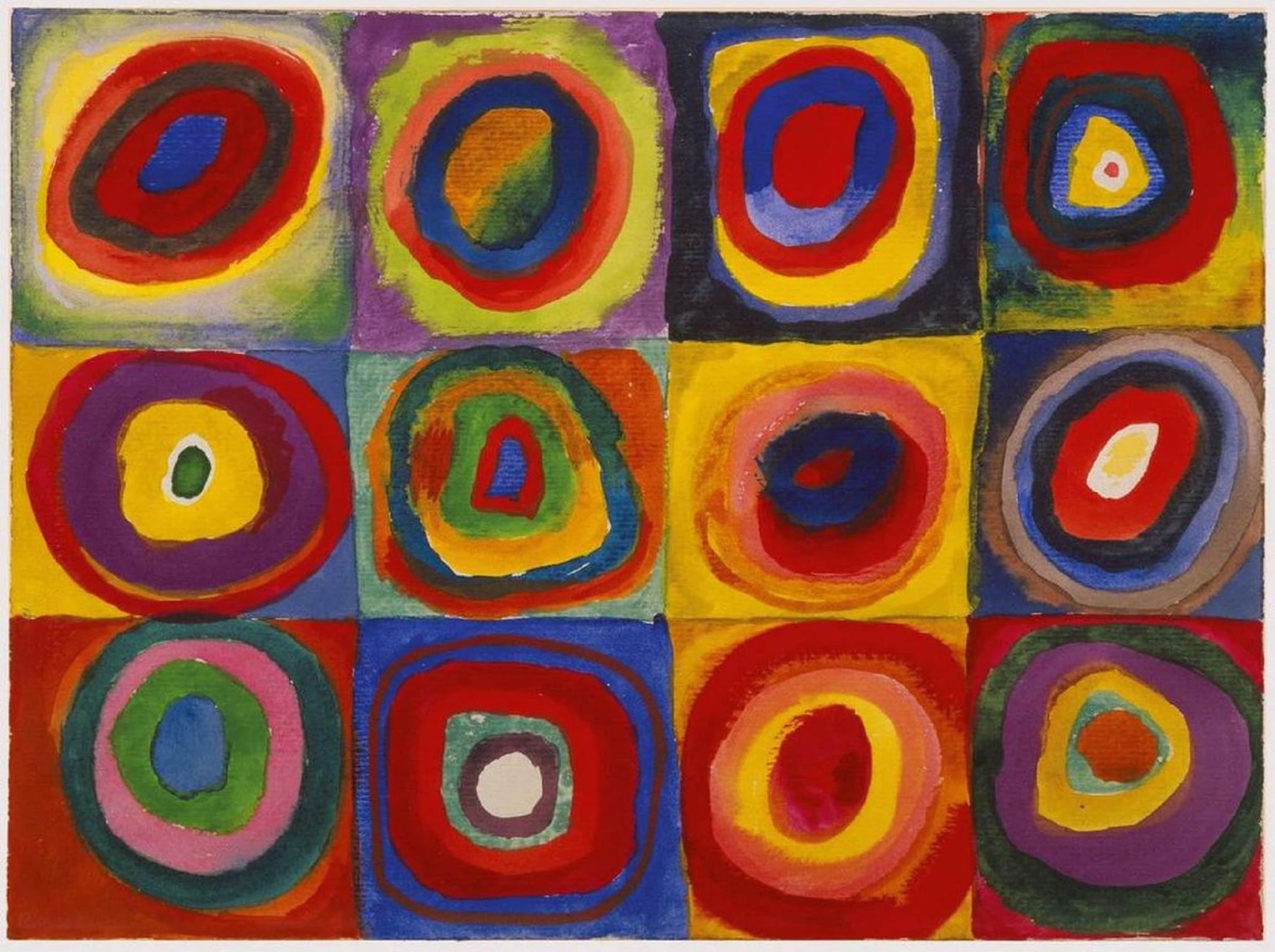
Color Study: Squares with Concentric Circles
Wassily Kandinsky • Mixed technique on paper
View more by Wassily Kandinsky →Valuation Analysis
Valuation conclusion: The sheet titled "Color Study: Squares with Concentric Circles" (c.1913), executed in watercolor, gouache and crayon on paper (23.9 × 31.5 cm), is recorded in the Lenbachhaus collection (inventory GMS 446) and was acquired via the Gabriele Münter Stiftung in 1957 [1]. As a working “color study” by Kandinsky this object is principally a works‑on‑paper category item: it is historically interesting and collectable, but not equivalent in market standing to his major oil canvases. If an identical sheet were offered on the open market with firm authentication, documented provenance and good condition, a defensible market range is USD 50,000–1,000,000, with the modal expectation in the mid‑six‑figure band.
Comparable evidence: Comparable sales support this range: a freshly authenticated Kandinsky watercolor (1927) fetched approximately €1.13M at Ketterer, showing the upside when authentication is fresh and scholarly attention is high [2]; Bonhams’ 1928 gouache "Lila" realised $737,100 in New York, illustrating typical strong mid‑six‑figure outcomes for market‑ready sheets [3]. Major Kandinsky oil paintings, by contrast, have set records in the tens of millions and sit in a different pricing tier altogether [4]. These examples show that while rare paper works can breach the seven‑figure mark, most studies trade in the five‑ to low‑seven‑figure band depending on scholarship and condition.
Key value drivers: The principal determinants of realized price are (1) authentication and Catalogue Raisonné inclusion (Kandinsky Foundation/Barnett), (2) uninterrupted, reputable provenance and exhibition/publication history, (3) condition and conservation history, and (4) sale channel and market timing. Authentication via RK entry or Foundation confirmation converts speculative attribution into marketable status; likewise, museum or gallery provenance and documented exhibition citations improve buyer confidence and broaden the pool of competitive bidders. Condition issues — foxing, losses, over‑cleaning, or disfiguring repairs — can reduce value steeply for works on paper.
Practical note on this object: Because the Lenbachhaus explicitly lists a "Farbstudie — Quadrate mit konzentrischen Ringen" (GMS 446) acquired in 1957, that specific sheet is currently a museum holding and not available for sale [1]. If you are assessing a different, visually identical sheet in private hands, provide high‑resolution recto/verso images, measurements, inscriptions, and any provenance documentation so a specialist can check for RK entry, match to museum records, and advise on authentication steps. A paper conservator report and a formal auction‑house condition note will materially refine any estimate.
Bottom line: The USD 50,000–1,000,000 band is a reasoned, conditional market estimate grounded in recent comps and the standard behaviour of Kandinsky sheets on the secondary market. With firm RK/authentication, sound provenance and strong condition, expect a mid‑six‑figure realisation; without those attributes, expect significantly lower outcomes. For sale readiness, secure expert authentication, conservation documentation and consult major house specialists.
Key Valuation Factors
Art Historical Significance
Medium ImpactThis sheet, dated around 1913, belongs to a critical phase in Kandinsky’s move toward abstraction and experimentation with color and form. As a "color study" it is valuable for process and scholarship — it documents working methods and experiments in palette and composition — but is typically considered a secondary or preparatory object rather than a canonical, exhibition‑defining painting. Unless the sheet can be tied directly to a major finished composition or to contemporary theoretical writings or exhibitions, its art‑historical weight remains moderate. If evidence establishes a direct link to a landmark painting or to a major exhibition, the significance (and market value) would upgrade markedly.
Attribution & Authentication
High ImpactAuthentication is decisive. A confirmed autograph attribution backed by a Catalogue Raisonné entry (e.g., Barnett) or formal confirmation from the Kandinsky Foundation substantially increases marketability and realised price. Authentication work should include high‑resolution imaging, signature analysis, materials/pigment testing where needed, and documentary provenance checks. Auction houses will not present a work as 'Kandinsky' in a high‑value sale without authoritative confirmation; uncertain attribution reduces the object to study/copy status and can shrink value by orders of magnitude. Secure expert opinion before any market transaction.
Provenance & Exhibition/Literature History
High ImpactProvenance materially affects buyer confidence and price. Museum ownership or continuous provenance through reputable galleries and collectors adds a premium and broadens the bidder pool. The Lenbachhaus entry (GMS 446) and 1957 acquisition are examples of top‑tier institutional provenance for the work recorded under this title [1], but institutional holdings are rarely available for sale. Exhibition loans and citations in catalogues or scholarly literature further lift value. Gaps or provenance questions (including potential restitution issues) introduce legal risk, deter institutional buyers, and depress price.
Condition & Medium
Medium ImpactWorks on paper are highly condition‑sensitive. Watercolor, gouache and crayon are vulnerable to light damage, surface abrasion, foxing and paper thinning; previous linings or invasive restorations can materially affect aesthetics and structural stability. Minor issues may reduce value modestly, while serious conservation needs can cut estimates by 30–70% depending on severity. A detailed conservator's report describing pigments' stability, any retouches, backing/lining history and framing will directly influence estimates and buyer willingness to bid at higher levels.
Market Comparables & Demand
High ImpactComparable auction results set practical ceilings and floors. Freshly authenticated Kandinsky watercolours have hit low seven‑figures (e.g., a 1927 watercolour at Ketterer) while many sheets realise in the mid‑six‑figures (Bonhams example), supporting a five‑figure to low‑seven‑figure market band. Demand is strongest when RK status, museum provenance and exhibition history converge. Sale channel (evening sale vs day sale vs private treaty), regional buyer pools, and the presence of related museum exhibitions all materially affect final sale prices.
Sale History
Color Study: Squares with Concentric Circles has never been sold at public auction.
Wassily Kandinsky's Market
Wassily Kandinsky is a blue‑chip, historically pivotal figure in modern abstraction; institutional demand and scholarly interest remain strong. The market is stratified by medium and period: major oils and canonical works reach multi‑million to tens‑of‑millions figures, whereas works on paper, studies and watercolours typically sell in the low five‑figures up to low seven‑figures depending on RK status, condition and provenance. Recent high‑profile sales underscore continued institutional appetite while creating a clear tiering that rewards documented, museum‑quality examples.
Comparable Sales
Gebogene Spitzen (Curved Tips)
Wassily Kandinsky
Watercolour by Kandinsky (1927) — same artist and medium (watercolour/gouache); a rarer, freshly authenticated watercolor that achieved a low seven‑figure price, showing upside for exceptional works on paper.
$1.3M
2021, Ketterer Kunst, Munich
~$1.5M adjusted
Lila
Wassily Kandinsky
Watercolour/gouache (1928) — same medium and a mid‑six‑figure public sale in New York, showing typical realised prices for good Kandinsky sheets that are market‑ready.
$737K
2025, Bonhams, New York
Murnau mit Kirche II
Wassily Kandinsky
Major Kandinsky oil (1910) — same artist but different medium/scale; included as a top‑end anchor to show gap between museum‑quality oils and small works on paper.
$44.9M
2023, Sotheby's, London
~$47.6M adjusted
Current Market Trends
Since 2023 the top end of the art market has been selective: marquee Kandinsky canvases still fetch strong prices but overall liquidity thinned and buyers demand provenance and scholarship. Works on paper remain active in the lower/mid tiers, with occasional outperformance when authentication is fresh and provenance is strong. Auction houses increasingly use private channels and guarantees for very high‑value works, which affects public price discovery; major exhibitions and catalogue scholarship continue to be the primary demand catalysts.
Sources
- Lenbachhaus collection entry: Farbstudie – Quadrate mit konzentrischen Ringen (GMS 446)
- Coverage of Ketterer Kunst sale (freshly authenticated Kandinsky watercolor example)
- Bonhams lot: Wassily Kandinsky, Lila (1928) — realized price example
- Sotheby's coverage of high‑end Kandinsky auctions (context for oil painting price tier)