How Much Is Composition VII Worth?
Last updated: April 13, 2026
Quick Facts
- Methodology
- comparable analysis
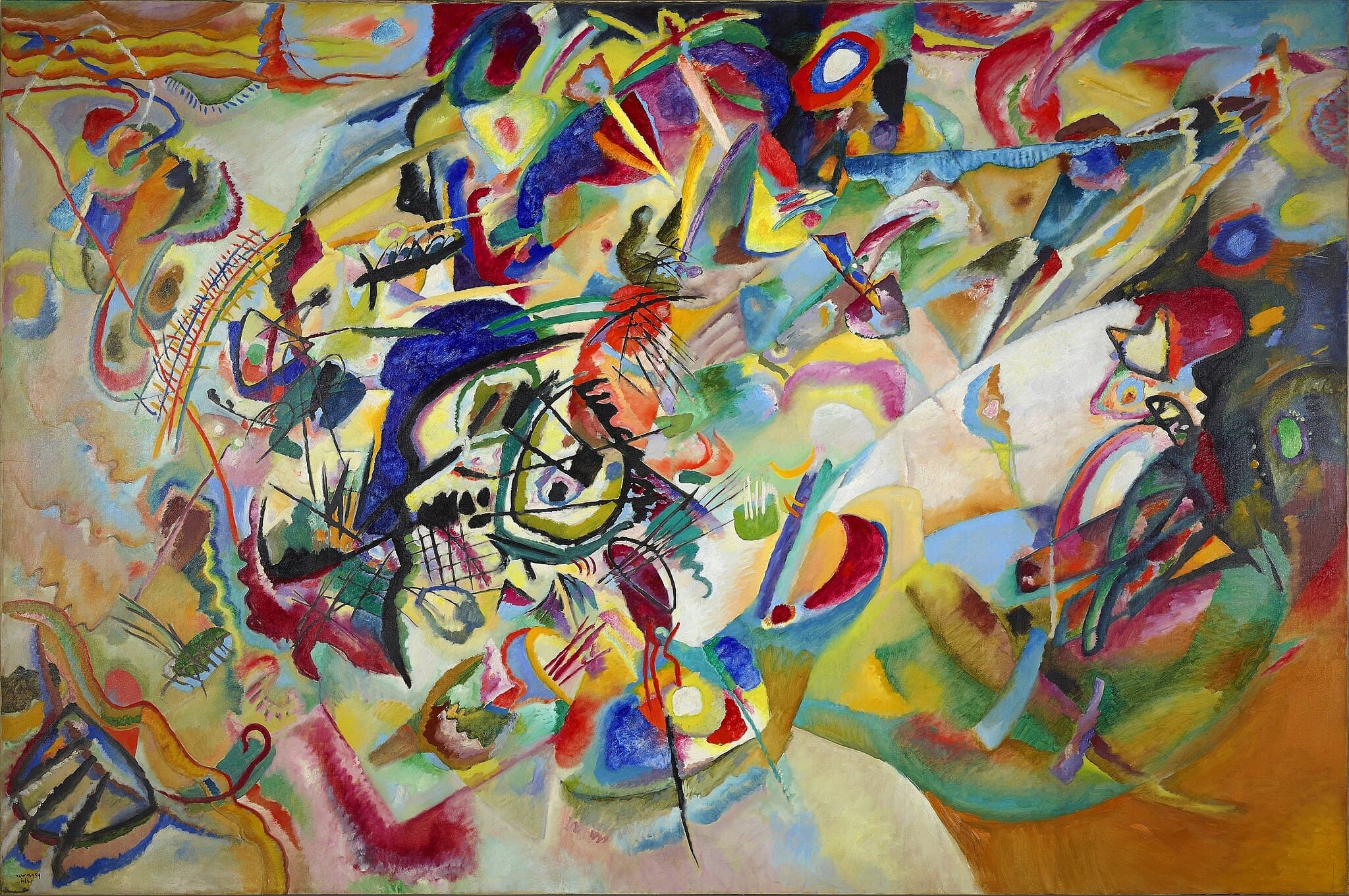
Composition VII (1913) is a canonical, museum‑held Kandinsky masterpiece. If offered on the open market with clear title, export permission and sound condition, a defensible market estimate is USD 30,000,000–80,000,000, based on top public‑auction Kandinsky comparables and premium adjustments for scale and significance.
Valuation Analysis
Valuation conclusion: Composition VII (1913) is estimated at USD 30,000,000–80,000,000 under a hypothetical, well‑managed sale with clear title, normal market access and no legal export restrictions. The work is a large, canonical pre‑WWI Kandinsky and has not been sold publicly; therefore the estimate is derived from high‑end comparables and qualitative premium adjustments rather than any direct sale history for this canvas.
Museum ownership and provenance: The painting is held in the State Tretyakov Gallery’s permanent collection and is published and exhibited as a Tretyakov property [1]. Museum custody confers impeccable provenance and strong institutional validation — factors that normally increase price expectations — but also creates practical barriers to market access (deaccession rules, export permits, political and legal constraints) that materially affect realizability and market timing.
Comparable evidence and benchmarks: Recent public‑auction benchmarks for top, museum‑quality Kandinskys provide the primary market anchors for this estimate. Notably, Sotheby’s London achieved roughly USD 44.9M for Murnau mit Kirche II (1910) in March 2023 and major early‑period works have realized strong multi‑million results in prior years [2]. These sales show an active buyer appetite at the high end; when calibrated to Composition VII’s scale, historical importance and exhibition record, they support a valuation band that begins in the mid‑eight figures and extends upward for exceptional market conditions.
Upward and downward adjustments: Upward pressure comes from Composition VII’s canonical status, large format (200 × 300 cm), long exhibition/publication history and centrality to Kandinsky’s development — all attributes that typically generate a premium above ordinary catalogue lots. Downward pressure arises from the painting’s effective inalienability as a national museum holding: legal, administrative and geopolitical obstacles could deter bidders or require atypical sale mechanisms (private treaty, state‑to‑state arrangements) that influence price discovery. Condition and conservation history — not publicly available in detail — would also materially affect a realized price.
Final practical note: This estimate is conditional and hypothetical. If the painting were to appear on the market under ordinary high‑end auction or controlled private‑sale conditions with clear title and exportability, the USD 30–80M band reflects current comparables, rarity premia for canonical works and a discount for the practical sale friction associated with state museum property. Actual realization could fall outside this range if sale circumstances (guarantees, private guarantees, extraordinary provenance narratives or legal impediments) are atypical.
Key Valuation Factors
Art Historical Significance
High ImpactComposition VII (1913) is widely considered one of Kandinsky’s most important and ambitious canvases from his pre‑WWI abstract period. As a large, visually complex synthesis of his non‑figurative experiments, it is regularly cited in monographs and exhibition histories as a pinnacle of his development toward fully abstract painting. That stature creates both collector and institutional demand that typically pushes pricing above the artist’s mid‑market works. Art‑historical primacy also increases the painting’s cultural value: major museums and blue‑chip collectors prize canonical works, and such status is a durable value driver in the high‑end market.
Provenance & Ownership (State Tretyakov Gallery)
High ImpactThe Tretyakov Gallery ownership provides unambiguous provenance and institutional endorsement, which are positive value drivers in appraisals. However, provenance as a state museum holding also makes deaccession and export legally and politically difficult in practice. If sold, the painting’s museum provenance would usually command a premium for market legitimacy and exhibition history, but the practical reality of Russian museum law and the rarity of sanctioned deaccessions introduces significant liquidity and timing risk — a central constraint on value realization that informed the conservative lower bound of the estimate.
Auction Comparables & Price Benchmarks
High ImpactTop auction results for Kandinsky provide the principal empirical basis for valuation. Recent high‑profile sales (e.g., Sotheby’s Murnau mit Kirche II in 2023) established public auction benchmarks in the high tens of millions for museum‑quality Kandinskys. Comparable canvases from the artist’s early‑period have sold in the low‑to‑mid tens of millions, indicating a market band that supports a USD multi‑tens‑of‑millions valuation for a canonical canvas. The estimate adjusts those comparables for Composition VII’s exceptional status, scale and the friction introduced by museum ownership.
Legal, Export & Practical Sale Constraints
High ImpactBecause Composition VII is in a national museum, sale would be subject to strict legal, administrative and political oversight; Russian museum and cultural property frameworks make deaccessions rare and complex. Such constraints reduce the probability of an open market sale and introduce price uncertainty: buyers may discount for legal risk, or conversely, a uniquely available museum deaccession could attract extraordinary demand. These practical factors are central to the valuation, and they justify conservative bounds and the explicit condition that the estimate assumes clean title and export permission.
Sale History
Composition VII has never been sold at public auction.
Wassily Kandinsky's Market
Wassily Kandinsky occupies a blue‑chip position within the Modernist market. Top public‑auction results for his major early and mid‑career canvases have reached into the tens of millions (with a public high in the mid‑$40M range in recent years), while mid‑tier works show more variability. Strong museum exhibition histories, impeccable provenance and rarity push individual lots into the highest price bands. The market rewards canonical, well‑documented works and is sensitive to provenance narratives and exhibition pedigree.
Comparable Sales
Murnau mit Kirche II (1910)
Wassily Kandinsky
Top public‑auction result for Kandinsky (early pre‑WWI work); high‑profile, museum‑quality example that reset the artist's auction benchmark.
$44.9M
2023, Sotheby's London
~$47.6M adjusted
Bild mit weissen Linien (Painting with White Lines) (1913)
Wassily Kandinsky
Same year (1913) and stylistic moment as Composition VII; major pre‑WWI Kandinsky that realized a very strong auction price—one of the closest period comparables.
$41.6M
2017, Sotheby's London
~$52.7M adjusted
Tensions calmées (1937)
Wassily Kandinsky
Major mid‑career Kandinsky sale showing demand for museum‑quality works across periods; useful for gauging investor appetite and price bands though later in date than Composition VII.
$29.5M
2021, Sotheby's London
~$33.2M adjusted
Current Market Trends
The Modern/early‑20th‑century market has shown selective strength at the top end: collectors concentrate on the best‑provenanced, museum‑quality works while mid‑tier material remains more price‑sensitive. Auction houses use guarantees and private channels to manage risk; institutional exhibitions and provenance narratives continue to drive buyer interest. Overall, headline results can skew perception but established masterpieces remain sought after.