How Much Is Improvisation 31 (Sea Battle) Worth?
Last updated: April 18, 2026
Quick Facts
- Methodology
- comparable analysis
Held by the National Gallery of Art (accession 1978.48.1), Kandinsky's Improvisation 31 (Sea Battle), 1913, would, if hypothetically offered, be reasonably valued at approximately $15–45M. This range is driven by its date/scale, institutional provenance and direct comparables at the top end of Kandinsky's market (notably the 2023 Sotheby’s result).
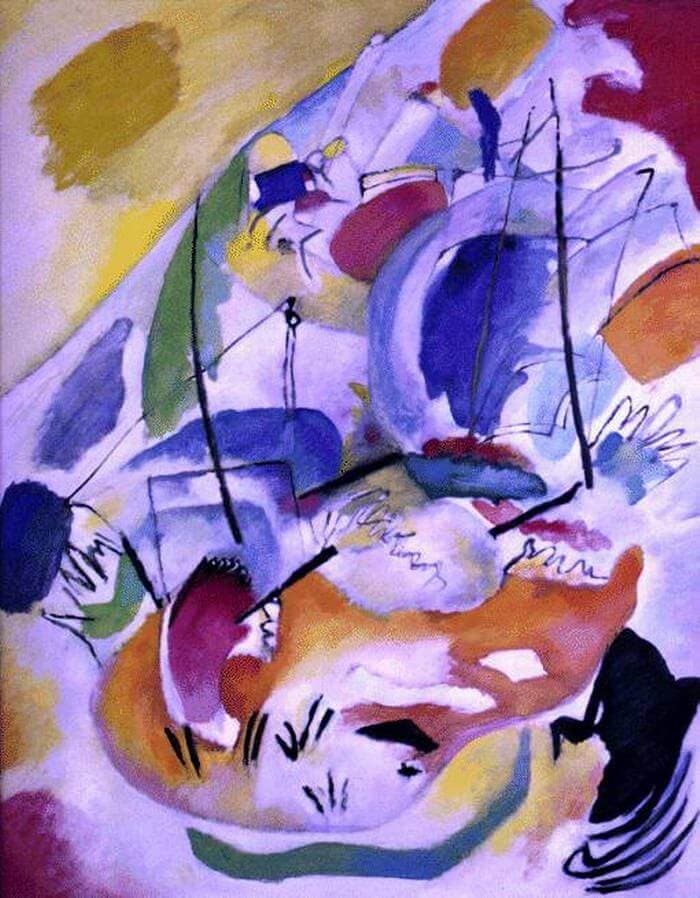
Improvisation 31 (Sea Battle)
Wassily Kandinsky, 1913 • Oil on canvas
View more by Wassily Kandinsky →Valuation Analysis
Improvisation 31 (Sea Battle) (1913) is a large, museum‑quality oil currently in the National Gallery of Art (accession 1978.48.1; 140.7 × 119.7 cm). On a hypothetical market offering the painting would command substantial collector and institutional interest because it sits in Kandinsky's pivotal pre‑WWI 'Improvisations' phase and benefits from continuous, published provenance from the artist to Joseph Müller and ultimately to the NGA [1]. Taking established auction comparables and the scarcity of large, securely‑provenanced Improvisations into account, a defensible market bracket is $15–45 million.
Method and comparables: the upper bound is informed by the Sotheby’s London March 2023 sale of a major pre‑1914 Kandinsky (Murnau mit Kirche II), which realized roughly £37.2m (~$44.9M) and demonstrates the ceiling for museum‑quality early canvases in a competitive evening sale [2]. Other evening‑sale results for significant Kandinskys in recent years cluster in the low‑to‑mid‑$20M band, which supports a pragmatic mid‑range expectation for very strong examples. The NGA provenance and exhibition history would ordinarily place this work toward the top half of that spectrum if offered.
Assumptions and sensitivities: this valuation assumes: (a) the attribution and 1913 dating are secure, (b) there are no outstanding restitution or legal encumbrances, and (c) the condition is consistent with institutional conservation standards. Adverse discoveries—conservation concerns, provenance gaps, or legal claims—would materially reduce value; conversely, fresh scholarship, a linked major exhibition, or a sale presented with strong institutional validation could push a result toward the high end.
Sale strategy and practical considerations: because the work is in a public collection and not currently on the market, this appraisal is hypothetical. A sale that realizes the upper part of the range would require an evening sale at a top house (New York or London), aggressive marketing to major collectors and institutions, and full publication of provenance and condition documentation. For insurance or transactional use, obtain a formal written appraisal from a specialist and a current conservator’s report; consult the NGA research files for supporting documentation prior to any valuation refinement [1].
Key Valuation Factors
Art Historical Significance
High ImpactImprovisation 31 dates to 1913, squarely within Kandinsky's most collectible early‑abstraction period when his experiments with color, musical analogy and near‑pure abstraction crystallized. Works from the 1910–1914 Improvisations group are central to Kandinsky scholarship and appear frequently in major exhibitions and catalogues raisonnés; they therefore carry outsized cultural and curatorial value. That intellectual importance translates directly into market value because collectors and museums prize canonical, formative works tied to a pivotal moment in an artist's development. The Sea Battle motif also contributes iconographic interest within his oeuvre, increasing its desirability to specialists and institutions.
Provenance & Museum Ownership
High ImpactThe documented chain (artist → Joseph Müller → Galerie Beyeler → National Gallery of Art acquisition 1978) is a major value enhancer. Museum ownership effectively certifies the work's authenticity, exhibition history, and stewardship—attributes that reduce buyer risk and expand the buyer pool (institutions and well‑informed private collectors). However, museum ownership also means the work is unlikely to appear on the market; when museum pieces do come to market they typically achieve premium pricing due to the 'institutional imprimatur' and the concentrated buyer interest it generates. Clear, continuous provenance minimizes discounting from disputed title or provenance gaps.
Condition & Conservation
High ImpactCondition is a primary determinant of sale outcome. Because the painting is held by the NGA, it is presumed to have been stored and conserved to institutional standards, which supports the high valuation assumption. A formal condition report is nevertheless essential: evidence of heavy overpainting, structural instability, or invasive restoration would materially lower competitive bidding and could shift the work into a lower pricing tier. Conversely, an exemplary conservation record and recent treatment notes would be bullet points in marketing materials and can positively influence buyer confidence and price realization.
Size, Rarity & Composition
Medium ImpactAt approximately 140.7 × 119.7 cm the canvas is a large, ambitious work—size that favors visibility in exhibitions and presence in the market. Large pre‑WWI Improvisations by Kandinsky are relatively scarce in private hands, which enhances rarity value. The dynamic compositional language and Sea Battle subject also have collector appeal. While size and rarity are important, they usually act as amplifiers of provenance and condition rather than independent primary drivers of multimillion‑dollar prices.
Market Comparables & Sale Context
High ImpactTop‑end comparables establish the workable range: the 2023 Sotheby’s London sale that produced the artist record (~$44.9M) defines the ceiling for exceptional pre‑1914 canvases. Other evening‑sale results clustered in the low‑to‑mid‑$20M zone provide substantiation for the mid‑range. Sale context (evening sale at a premier house, strong pre‑sale press, and a single‑owner narrative or exhibition tie‑in) can move a lot significantly within that band. Absence of those conditions or presence of legal/conditional risk will push realization toward the lower bound.
Sale History
Improvisation 31 (Sea Battle) has never been sold at public auction.
Wassily Kandinsky's Market
Wassily Kandinsky is a blue‑chip, highly collectible figure in early 20th‑century abstraction. His market demonstrates a clear top‑end appetite for pre‑WWI masterpieces and consistent demand for museum‑quality works across his career. The artist’s auction record (established by a pre‑1914 canvas in 2023) established a ceiling in the tens of millions; many other significant paintings achieve high seven to low eight figures. Market interest skews to works with secure provenance, documented exhibition histories, and institutional validation—factors that materially increase the probability of strong sale outcomes.
Comparable Sales
Murnau mit Kirche II
Wassily Kandinsky
Pre‑WWI Kandinsky (1910); large, museum‑quality canvas and market‑moving sale that establishes the ceiling for early Kandinskys.
$44.9M
2023, Sotheby's London (Evening Sale)
~$47.1M adjusted
Rigide et courbé
Wassily Kandinsky
Major evening‑sale Kandinsky (1935) showing strong demand for museum‑quality works in the low‑to‑mid $20M range.
$23.3M
2016, Christie's New York (Evening Sale)
~$29.1M adjusted
Weisses Oval (White Oval)
Wassily Kandinsky
Post‑WWI abstract Kandinsky (1921); a recent high‑profile sale that corroborates mid‑$20M market levels for important canonical works.
$21.6M
2024, Sotheby's (Evening Sale)
~$22.2M adjusted
Current Market Trends
The market for canonical Modernist abstraction remains two‑tiered: the top end is strong, with marquee works attracting competitive bidding, while the mid‑market is selective and price‑sensitive. Institutional exhibitions, scholarly attention, and provenance narratives (including restitution stories) concentrate buyer interest and can materially uplift prices for museum‑quality pieces. Timing a sale to coincide with major Kandinsky/Bauhaus programming or a focused evening sale will maximize realization.