How Much Is Murnau – Landschaft mit grünem Haus (Murnau – Landscape with Green House) Worth?
Last updated: April 13, 2026
Quick Facts
- Last Sale
- $26.4M (2017, Sotheby's, London — Impressionist & Modern Evening Sale (Lot 47))
- Methodology
- comparable analysis
If this is the same painting sold at Sotheby’s London on 21 June 2017 (Lot 47), the market-anchored present value is approximately $30–50M, with a working presale estimate typically set at $35–45M depending on condition and documentation. The 2017 Sotheby’s result (~$26.4M) is the primary anchor; strengthened market evidence for top Murnau works since 2017 supports an upward adjustment.
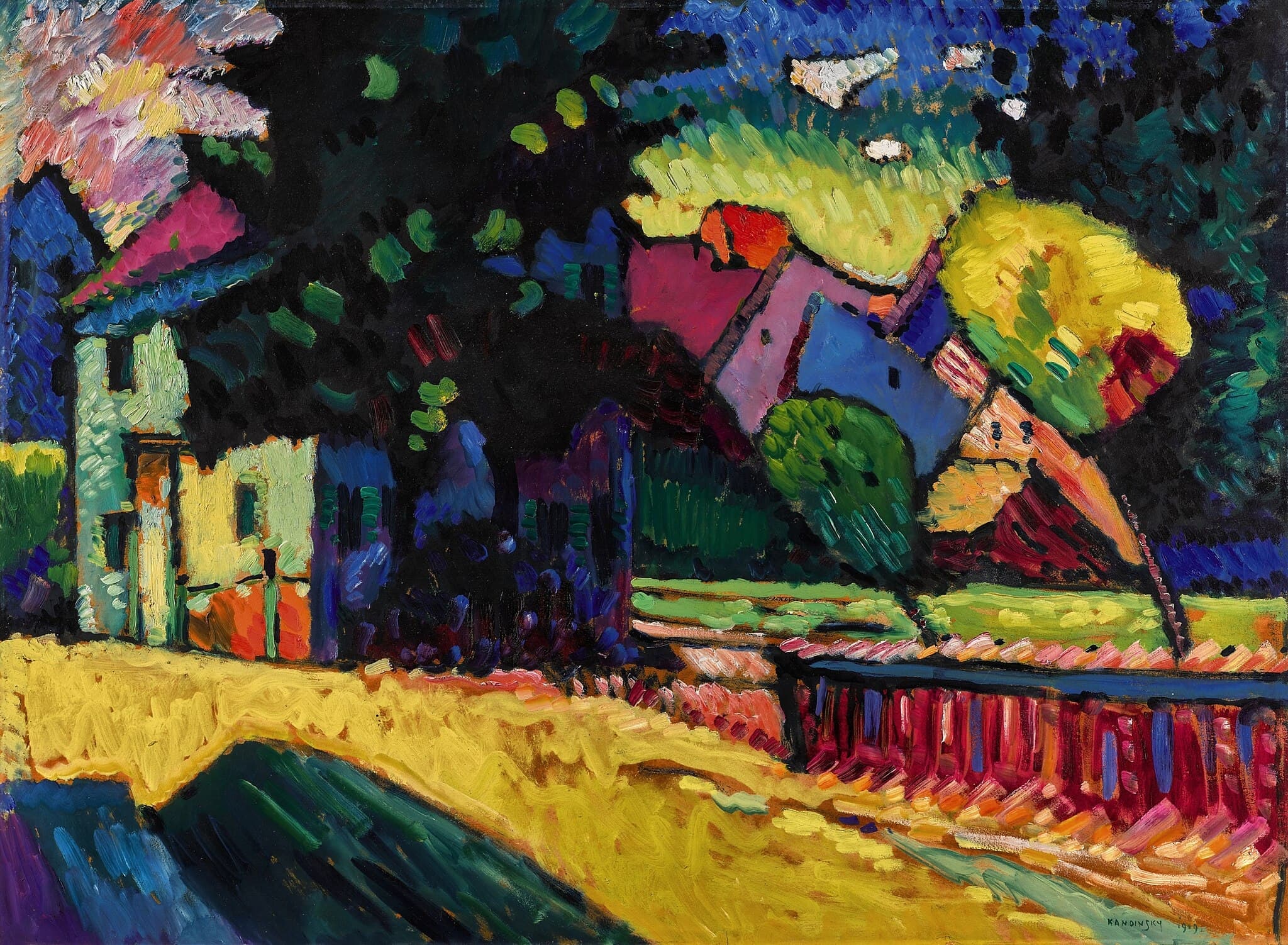
Murnau – Landschaft mit grünem Haus (Murnau – Landscape with Green House)
Wassily Kandinsky, 1909 • Oil on canvas
View more by Wassily Kandinsky →Valuation Analysis
Primary anchor and scope. This valuation treats the painting as the same object offered at Sotheby’s London on 21 June 2017 (Lot 47) — Wassily Kandinsky, Murnau – Landschaft mit grünem Haus, 1909, oil on board, 70 × 96 cm — which realized £20,971,250 (≈ $26.4M at the time). That documented sale is the primary market anchor for any present appraisal of this work [1].
Market movement since the anchor. Since 2017, a number of high‑profile Murnau and early‑abstract Kandinsky sales have pushed the ceiling higher: a closely comparable Murnau work (Murnau mit Kirche II) set a new auction record in March 2023 at roughly $44.9M, and reported private post‑restitution transactions of Murnau‑related works in 2023 have been publicized at figures exceeding €60M. Those outcomes demonstrate elevated buyer appetite for canonical Murnau examples and justify an upward adjustment to the 2017 anchor where provenance, condition and exhibition history are similarly strong [2][3].
How the range was derived. Starting from the verified 2017 sale (~$26.4M), I adjusted for inflation/currency movements, for aggregate market appreciation at the top end of Kandinsky’s market since 2017, and for relative quality/size (70 × 96 cm is a substantial Murnau composition). For a well‑documented, unrestored (or sympathetically conserved), catalogue‑raisonné‑listed and museum‑exhibited example in comparable or better condition, a present market range of $30–50M is appropriate. A prudent presale estimate to target competitive bidding in an evening sale would generally be $35–45M; the low end reflects a standard auction environment without institutional bidding, the high end assumes institutional interest, guarantees or intense competitive bidding [1][2][4].
Sensitivity and key risks. Value is highly sensitive to: (1) condition and conservation history (paint on unprimed board can be fragile and past restoration can lower value), (2) completeness and documentation of provenance and catalogue references, (3) exhibition and publication history, and (4) any legal/title encumbrances including restitution risk. Any adverse finding on these points can reduce the realistic market outcome materially below the low‑end estimate; conversely, exceptional provenance/exhibition can push results toward or above the high end [1][2][3].
Recommended next steps. Before firming a sale strategy or insurance figure, verify identity against Sotheby’s 2017 lot photographs and the Roethel & Benjamin catalogue entry, obtain a detailed technical/condition report, compile full provenance and exhibition documentation, and solicit formal pre‑sale estimates from major houses (Sotheby’s/Christie’s) which can advise on whether a guaranteed evening sale or negotiated private sale is the optimal route. With those confirmations the range can be narrowed; absent them use $30–50M as a market‑informed working valuation anchored to the verified public sale [1][2][3][4].
Key Valuation Factors
Art Historical Significance
High ImpactThe Murnau period (c.1908–1911) is a pivotal phase in Kandinsky’s development—the transition from expressive figuration toward the concerns that lead to his early abstractions. Paintings from this period are prized for their documentary importance in Kandinsky scholarship and for their aesthetic quality: color, compositional experimentation and early expressions of spatial abstraction. While the highest market stratosphere is occupied by canonical abstract 'Compositions' and Bauhaus works, top Murnau examples have proven capable of achieving multi‑tens of millions. Inclusion in standard monographs, catalogue raisonné entries and major exhibitions elevates a Murnau work from a collector’s piece to an institutional‑quality masterpiece, making this factor a primary value driver.
Provenance & Exhibition History
High ImpactProvenance materially affects value. This painting’s documented chain—early sale/association with Der Sturm (Herwarth Walden), ownership in Bernhard Mayer’s collection, and long loan to a public museum—increases institutional appetite and buyer confidence. Works with clear early twentieth‑century German avant‑garde provenance and long exhibition histories typically command premiums at auction because museums and blue‑chip collectors value verifiable histories. Conversely, gaps in ownership, undocumented periods or ties to contested restitution histories (when unresolved) reduce marketability and may materially depress value or preclude sale in certain jurisdictions.
Condition & Technical Considerations
High ImpactKandinsky’s Murnau oils on board can present conservation issues: unprimed or lightly primed boards are sensitive to environmental change, tension and previous restoration. Surface craquelure, inpainting, or structural instability will affect buyer confidence and estimate placement; a pristine or well‑conserved surface supports the high end of the range. A full technical and condition report (paint cross‑sections, IR/UV imaging, X‑radiography if needed) is essential and will be a determinative factor at sale. Condition concerns are among the strongest immediate downwards price drivers.
Comparables & Recent Sales Evidence
High ImpactThe verifiable 2017 Sotheby’s sale (~$26.4M) is the principal comparable for this exact work and establishes a solid market anchor. Subsequent top‑end outcomes — notably the March 2023 Murnau mit Kirche II sale (~$44.9M) and reported private post‑restitution transactions exceeding €60M — demonstrate that top quality, well‑provenanced Murnau works have re‑rated since 2017. Guarantees and private‑sale dynamics at the high end can also produce outsized results. Comparable analysis drives the present $30–50M range and explains the uplift over the 2017 anchor.
Legal/Title Risk & Marketability
Medium ImpactRestitution claims, unclear title, export restrictions or unresolved provenance gaps are material sale impediments. While restitution narratives can heighten public visibility (and in some private contexts lead to strong private purchases), unresolved legal encumbrances will likely prevent institutional interest and can deter major auction houses. Clear, documented title is therefore a gating factor for entry into guaranteed evening sales and for attracting institutions and leading private buyers. The presence or absence of legal risk will influence whether the work sells in the top public market or must be placed privately at a discount.
Sale History
Sotheby's, London — Impressionist & Modern Evening Sale
Wassily Kandinsky's Market
Wassily Kandinsky is a blue‑chip modernist whose market is strongly segmented by period and quality. Major early‑abstract and canonical Murnau/Blaue Reiter works and landmark Bauhaus compositions command the highest prices (multi‑tens of millions), while many later or decorative pieces trade in the mid‑six to low‑seven‑figure range. Auction records have risen in recent years (notably a Murnau record in 2023), and museum interest, catalogue‑raisonné inclusion and provenance are central determinants of which works reach top pricing. Guarantees and private sales play a notable role in headline results.
Comparable Sales
Murnau – Landschaft mit grünem Haus (Murnau – Landscape with Green House)
Wassily Kandinsky
Identical work: same artist, date (1909), medium, size, provenance and exhibition history — the primary public-sale anchor for valuation.
$26.4M
2017, Sotheby's, London — Impressionist & Modern Evening Sale
~$34.5M adjusted
Murnau mit Kirche II
Wassily Kandinsky
Same Murnau period (c.1909–1910) and subject (Murnau village/church); comparable museum-quality example that set a new auction ceiling for Murnau works.
$44.9M
2023, Sotheby's, London — Evening Sale
~$47.1M adjusted
Blick mit Häusern ("Painting with Houses")
Wassily Kandinsky
Post‑restitution private sale of a canonical Kandinsky (Murnau-related); shows private-market ceiling for top, well-documented works from this period.
$68.4M
2023, Private sale (reported, post-restitution, Netherlands)
~$71.6M adjusted
Weisses Oval (White Oval)
Wassily Kandinsky
Canonical early-abstract Kandinsky (c.1919) that realized a strong public result in 2024; useful as a comparator for market demand for museum-quality canonical works, though from a slightly later period/style than the Murnau landscapes.
$21.6M
2024, Sotheby's, New York — Evening Sale
~$21.8M adjusted
Current Market Trends
The market for Kandinsky and canonical modernists is resilient but selective: institutional programming, restitution narratives and scarcity at the top end drive headline prices, while non‑canonical works are price‑sensitive. Guarantees and private sales continue to shape top results, and buyer appetite is strongest for well‑documented, exhibition‑ready masterpieces. Expect continued segmentation and volatility across subcategories.
Sources
- Sotheby's: Impressionist & Modern Evening Sale, Lot 47 (Wassily Kandinsky, Murnau – Landschaft mit grünem Haus) — lot page (2017)
- Associated Press: Coverage of Kandinsky auction record (Murnau mit Kirche II), Sotheby's London (Mar 2023)
- NL Times: Reporting on reported post‑restitution private sale (Blick mit Häusern) and related market context (2023)
- Artlyst: Reporting on recent strong Kandinsky public sales (e.g., Weisses Oval, 2024) and market context