How Much Is Murnau mit Kirche II (Murnau with Church II) Worth?
Last updated: April 13, 2026
Quick Facts
- Last Sale
- $44.8M (2023, Sotheby's London)
- Insurance Value
- $50.0M (Estimated replacement value based on the 2023 Sotheby’s realization, typical premiums and institutional acquisition replacement-cost practice (appraiser estimate).)
- Methodology
- recent sale
This is the identical Murnau mit Kirche II that sold at Sotheby’s London on 1 March 2023 (reported ≈ $44.8M). Using that realized price as the primary benchmark and adjusting for market volatility, transaction costs and replacement-premium scenarios, the recommended current market range is $40–55M (USD).
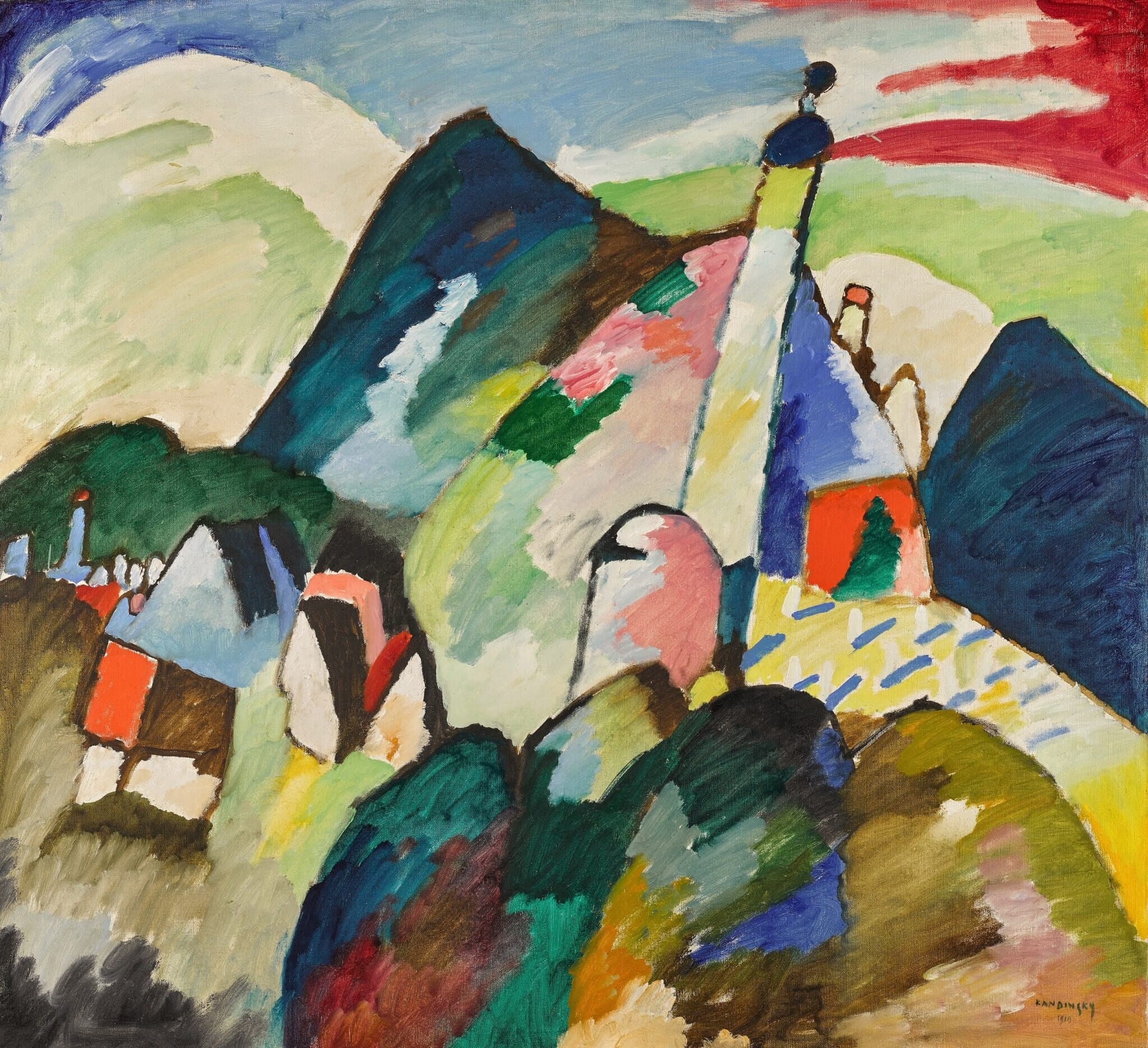
Murnau mit Kirche II (Murnau with Church II)
Wassily Kandinsky, 1910 • Oil on canvas
View more by Wassily Kandinsky →Valuation Analysis
Overview and primary benchmark: The painting identified as "Murnau mit Kirche II" realized a headline result at Sotheby’s London on 1 March 2023 (lot literature and press report the final figure at ~£37,196,800, ≈ USD 44.8M including fees). Because that sale is for the identical canvas, catalogued in Roethel & Benjamin (vol. I, no. 348) and supported by the auction house’s provenance and exhibition notes, the March 2023 price functions as the principal market anchor for any current valuation of this work [1]. Market coverage at the time confirmed the sale as a new benchmark for Kandinsky’s early Murnau-period paintings and explains the outsized interest in the lot [2].
Why the March 2023 result is decisive: The realized price reflected several compounding value drivers: a clean, well-documented chain of ownership (Siegbert S. Stern → Stern heirs → wartime transfers → Van Abbemuseum → restitution to the Stern heirs in 2022), catalogue-raisonné acceptance, extensive exhibition/publication history and the painting’s physical presence and condition as described in the lot notes. Sotheby’s marketed the work as a museum-quality trophy and the restitution/public-provenance narrative both reduced title risk and significantly broadened the buyer base to include institutions and top private collectors [1].
Comparables and market context: Comparable high-end Kandinsky results (early Blue Rider and mature Bauhaus-period works) show a tiered market where museum-quality early works can reach the low-to-mid tens of millions and, in exceptional cases like this one, exceed that band. The 2023 sale therefore sets a realistic lower bound for the identical canvas while other major Kandinsky sales over 2017–2024 demonstrate both the ceiling for marquee works and the volatility that exists outside the top tier.
Valuation mechanics and recommended range: Method = recent_sale. Anchoring to the reported USD ~44.8M realization, I apply a narrow market band to reflect (a) possible short-term market softening or buyer liquidity constraints and (b) upside scenarios such as institutional competition or private-sale premiums. The recommended range of $40,000,000–$55,000,000 accounts for buyer’s/seller’s transactional factors (premiums, taxes, seller commissions), shifting buyer demand and the premium placed on works with clean museum provenance. The lower bound is roughly a 10% haircut to the realized price to allow for market cooling or difference between hammer and full replacement value; the upper bound allows for a reappearance at auction or private sale where competitive or strategic buyers push above the 2023 level.
Risks, contingencies and next steps: Residual legal claims (historical restitution matters), previously undisclosed conservation issues or dramatic shifts in market liquidity could reduce realizable value. Recommended due diligence before sale/insurance: obtain a full condition report and technical analysis (pigment/IR/X-ray), secure written specialist opinions and confirm the catalogue-raisonné citation and any remaining title documentation. For insurance, use a replacement-value approach that includes buyer’s premium, import/export and handling costs; I recommend an insured value near the midpoint–upper bound pending formal appraisal.
Key Valuation Factors
Art Historical Significance
High ImpactKandinsky’s Murnau period (c.1908–1910) is a formative phase bridging landscape and the experiments with color and form that prefigured non-objective painting. Paintings of Murnau village and church motifs are central to scholarly narratives about Kandinsky’s transition from representational to expressive form-making. While later abstract works often dominate headline prices, a museum-quality Murnau canvas has both curatorial importance and market appeal. Institutions prize such works for exhibitions and scholarship; collectors prize them for the same reason. This explains why a provenanced, published, and exhibited Murnau can command a premium beyond average early-period Kandinsky canvases.
Provenance & Restitution
High ImpactThe painting’s documented pre-war ownership (Siegbert S. Stern), subsequent movement through private hands, Van Abbemuseum custody (acquired 1951), and formal restitution to the Stern heirs in 2022 materially reduced title risk and created high-profile press attention. Restitution in this case functioned both to clear legal encumbrances and to amplify curatorial validation; auction houses and institutional buyers place a substantial premium on clean, museum-quality provenance. The combination of restitution and an unbroken published provenance is one of the strongest single drivers of the March 2023 price.
Exhibition & Publication History
High ImpactExtensive exhibition history and inclusion in the Roethel & Benjamin catalogue raisonné (vol. I, no. 348) increase the painting’s scholarly legitimacy and make it highly deployable for museum displays. Works that are already published and exhibited carry lower curatorial friction, higher demand from institutions, and often provoke stronger competitive bidding. Sotheby’s highlighted these attributes in the pre-sale catalogue and marketing, which contributed directly to buyer confidence and to the realized price.
Condition & Physical Attributes
Medium-high ImpactSize (c. 96 x 105.5 cm), pictorial presence and an intact original paint layer as reported in the lot notes positioned the canvas above smaller or compromised Murnau works. Condition is a decisive factor: documented, museum-standard condition increases institutional interest and insurability. Any undisclosed lining, overpainting or structural treatment could reduce value; conversely, confirmation of original materials and minimal intervention through scientific testing would further support the upper end of the range.
Market Demand & Rarity
High ImpactKandinsky’s market is polarized. Top-tier, museum-quality works with clean provenance and publication histories attract intense institutional and private interest; routine or poorly-provenanced pieces face more price sensitivity. Genuine Murnau church landscapes of this scale, in this condition and with this provenance, are rare on the open market. Scarcity combined with the painting’s high-profile restitution and catalogue-raisonné status made it a trophy lot in 2023—supporting a valuation at or above the tens-of-millions threshold.
Sale History
Sotheby's London
Wassily Kandinsky's Market
Wassily Kandinsky is a blue-chip modern master with a tiered auction market. Landmark Blue Rider and mature abstract works produce the highest prices, and recent years have shown that museum-quality early pieces can reach comparable levels when provenance and exhibition history are strong. The 2023 Sotheby’s sale of Murnau mit Kirche II reset expectations for Murnau-period works and demonstrated that scarcity plus clean title produce outsized results. Outside the top tier, Kandinsky’s mid-market works remain selective and price-sensitive, with provenance and condition as decisive differentiators.
Comparable Sales
Murnau mit Kirche II (Murnau with Church II)
Wassily Kandinsky
Exact work — the March 2023 Sotheby’s sale is the market benchmark for museum-quality Murnau-period Kandinsky; restitution, catalogue-raisonné acceptance, exhibition history and heavyweight marketing drove the result.
$44.8M
2023, Sotheby's London
~$47.5M adjusted
Bild mit weissen Linien (Painting with White Lines)
Wassily Kandinsky
High‑profile early Kandinsky (1913) — similar rarity and collector interest in early/Der Blaue Reiter works; its strong pre‑2017 result demonstrates the market ceiling for top early works before the 2023 Murnau benchmark.
$41.6M
2017, Sotheby's London
~$50.8M adjusted
Tiefes Braun (Deep Brown)
Wassily Kandinsky
Important, well‑provenanced Kandinsky (1924) — a strong mid‑to‑high seven‑figure / low eight‑figure result that illustrates buyer demand for high‑quality Kandinsky outside the earliest Murnau group and helps define the broader high-end price band.
$23.3M
2022, Christie's New York
~$25.1M adjusted
Weisses Oval (White Oval)
Wassily Kandinsky
Bauhaus/abstract period Kandinsky (c.1921) — a 2024 marquee sale showing sustained demand for high‑quality Kandinsky abstracts; useful as a near‑term comparator for price momentum into 2024–25.
$21.6M
2024, Sotheby's New York
~$22.3M adjusted
Current Market Trends
From 2023–2026 the market is polarized: marquee, museum-quality lots continue to draw strong interest while mid-market material shows variability. Restitution stories and provenance clarity have become more influential; auction houses regularly use guarantees and private placements for trophy lots. Macro liquidity, interest rates and institutional acquisition priorities continue to shape short-term volatility, but the very best Kandinskys remain sought after.