How Much Is Painting with White Border Worth?
Last updated: April 18, 2026
Quick Facts
- Methodology
- comparable analysis
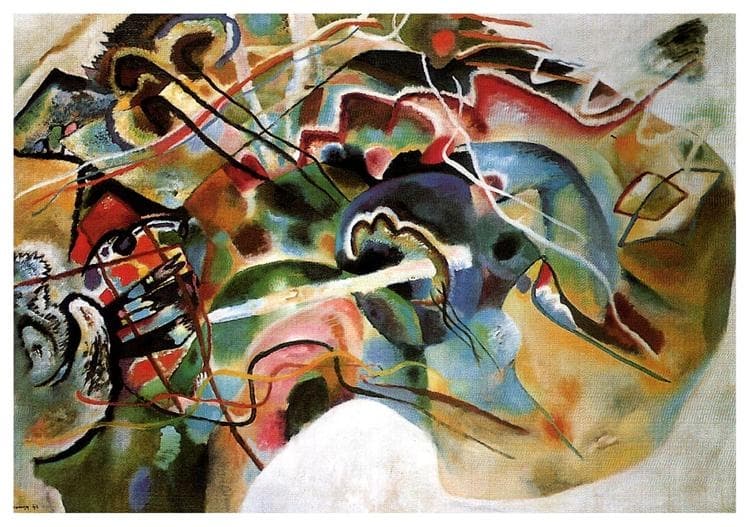
Painting with White Border (May 1913), a large Guggenheim-held Kandinsky canvas (accession 37.245), would likely realize in the range of $20–45 million if offered on the open market. This range is derived from high‑end comparables for museum‑quality Kandinskys of the 1910s–1920s and reflects scarcity, provenance, and recent record sales.
Valuation Analysis
Overview: The painting "Painting with White Border" (May 1913), oil on canvas, 140.3 × 200.3 cm, is in the Solomon R. Guggenheim Founding Collection (accession 37.245) and therefore has no recent auction record because it is museum‑held [1]. For a hypothetical open‑market sale, the recommended valuation range is $20–45 million. That range is produced by a direct comparable analysis of large, well‑documented Kandinskys from the 1910s and early Bauhaus period, adjusted for scale, date, provenance and exhibition history [2][3].
Comparables & rationale: Key comparables include Sotheby’s 2017 sale of a 1913 Kandinsky (Bild mit weissen Linien / Painting with White Lines) and the 2023 Sotheby’s sale of Murnau mit Kirche II (1910), both of which traded in the high multi‑million to low double‑digit million band and set recent artist benchmarks [2][3]. These sales demonstrate active bidding and institutional buyer participation for prime, museum‑quality early works. Given the subject painting’s size and secure Guggenheim provenance, it would likely fall at the mid‑to‑upper end of that market band if offered in a marquee evening sale, subject to condition and catalogue positioning.
Upward / downward adjustments: The principal upsides are strong institutional provenance, clear attribution, and potential inclusion in museum catalogues/exhibitions — all of which increase buyer confidence and willingness to bid aggressively. Downside adjustments would follow from condition issues, restoration history, incomplete catalogue raisonné citation or unclear title/ownership history. Legal or restitution exposure (rare but precedent exists in Kandinsky cases) would materially suppress value until resolved. Market context (trophy lot evening sale vs. private treaty or small sale) also shifts realized price significantly.
Practical sale considerations: If the Guggenheim painting were to come to market, the optimal route for maximising proceeds would be a top‑house evening sale with comprehensive cataloguing, a condition report and technical authentication, and active pre‑sale marketing to institutions and blue‑chip collectors. Guarantees or third‑party underwriting could alter seller net proceeds and pricing dynamics. Replacement/insurance valuations typically exceed auction estimates and are set privately; no public insurance figure was found for this accession [1].
Conclusion & next steps: The $20–45 million range is a market‑informed, conservative‑to‑realistic estimate for a large, well‑catalogued 1913 Kandinsky from a major museum collection. To tighten the opinion to a sale‑ready estimate, obtain the Guggenheim provenance file and catalogue raisonné entry, a formal condition/technical report, and a pre‑sale estimate from Sotheby’s or Christie’s specialists who can assess buyer appetite and guarantee options [2][3].
Key Valuation Factors
Art Historical Significance
High ImpactDating to May 1913, this painting sits at a critical moment in Kandinsky’s transition to non‑objective abstraction and is therefore of high art‑historical importance. Works from 1912–1914 are especially sought by institutions and collectors because they document the formative shift in Kandinsky’s vocabulary from representational Murnau period experiments to increasingly abstract compositions. A clearly attributed, large canvas from 1913 with literature and exhibition history would command a premium over lesser works and studies, as it contributes directly to scholarship and public presentations that museums prize. That significance supports placing the painting in the upper tier of market comparables.
Provenance / Institutional Ownership
High ImpactThe painting is part of the Solomon R. Guggenheim Founding Collection (accession 37.245), which provides exemplary provenance and curatorial documentation. Institutional ownership materially reduces buyer uncertainty and generally enhances market value because the object is likely to be well documented, conserved, and published. However, museum ownership also means the work rarely appears on the market; if it were deaccessioned or offered by the museum (or returned to heirs and sold), the provenance narrative would be an important marketing point and could drive competitive bidding among major institutions and private collectors.
Condition & Authentication
High ImpactA sale‑ready valuation requires a formal condition report and technical authentication (X‑radiography, IRR, pigment analysis) to confirm medium, dating, and paint history. Condition issues such as heavy restorations, relining, or structural problems reduce marketability and can shave millions from an expected result, whereas pristine condition or a well‑documented conservation history can preserve or enhance value. Authentication anchored in catalogue raisonné citation and museum documentation is essential to access top‑end buyers.
Market Comparables & Liquidity
Medium-high ImpactComparable sales for large, early Kandinskys have produced final prices from the low‑tens to mid‑forties of millions in recent years. The rarity of museum‑quality works in the secondary market concentrates demand when a major example appears, which can produce auction records. Liquidity is therefore strong for top examples but thin for secondary or disputed works; successful realization depends on sale placement (evening sale vs. smaller sale), marketing, and the presence of institutional or high‑net‑worth bidders.
Legal / Restitution / Title Risk
Medium ImpactEarly 20th‑century European works can carry provenance complexities; restitution cases involving Kandinsky have reached headlines and can significantly affect marketability and timing (and occasionally produce premium, publicity‑driven results when resolved). Any unresolved ownership disputes or red flags in wartime provenance will depress value and may prevent a sale. A thorough provenance check, including review of museum accession files and wartime ownership history, is therefore a necessary precondition for confident high‑end valuation.
Sale History
Painting with White Border has never been sold at public auction.
Wassily Kandinsky's Market
Wassily Kandinsky is a blue‑chip modernist whose market is defined by scarcity of large, museum‑quality works from the 1910s–1920s and strong institutional demand. Record and near‑record sales in recent years demonstrate that prime early and Bauhaus‑period canvases achieve multi‑million to low double‑digit million results. Price dispersion is wide—top evening‑sale examples can reach or exceed $40M, while lesser studies and later works trade at materially lower levels. Provenance, exhibition history and catalogue raisonné confirmation are decisive in commanding top prices.
Comparable Sales
Murnau mit Kirche II (Murnau with Church II)
Wassily Kandinsky
Major early Murnau-period Kandinsky (c.1910); large, museum-quality work that set a new auction record—useful as a top-of-market comparable for pre-1914 works.
$44.9M
2023, Sotheby's London
~$47.4M adjusted
Bild mit weissen Linien (Painting with White Lines)
Wassily Kandinsky
Same year (1913) and closely related stylistically—one of the most directly comparable auction results for a 1913 Kandinsky.
$41.6M
2017, Sotheby's London
~$54.7M adjusted
Weisses Oval (White Oval)
Wassily Kandinsky
Bauhaus-period Kandinsky (1921) that demonstrates continued appetite for prime abstract works; a mid-market comparable though slightly later in date and different formal type.
$21.6M
2024, Sotheby's New York
~$22.0M adjusted
Rigide et courbé (Rigid and Curved)
Wassily Kandinsky
Later-period (1935) Kandinsky that nonetheless realized a strong price—useful to gauge overall market strength for the artist even though stylistically it is less close to a 1913 canvas.
$23.3M
2016, Christie's New York
~$31.3M adjusted
Current Market Trends
Recent market activity (notably 2023–2025) shows solid appetite for prime Kandinskys, reinforced by high‑profile restitutions and museum programming. Top‑end liquidity remains concentrated among institutions and trophy collectors; buying is selective under current macroeconomic headwinds. Provenance clarity and exhibition worthiness continue to be the primary value drivers.