How Much Is The Ancient of Days (frontispiece to Europe a Prophecy) Worth?
Last updated: May 20, 2026
Quick Facts
- Methodology
- comparable analysis
Estimated market value for a single‑sheet impression of William Blake’s The Ancient of Days is $100,000–$2,000,000. The exact price depends entirely on plate state, whether the colouring is original to Blake, condition (margins/paper), and provenance — early, artist‑coloured, museum‑grade impressions approach the top of the band.
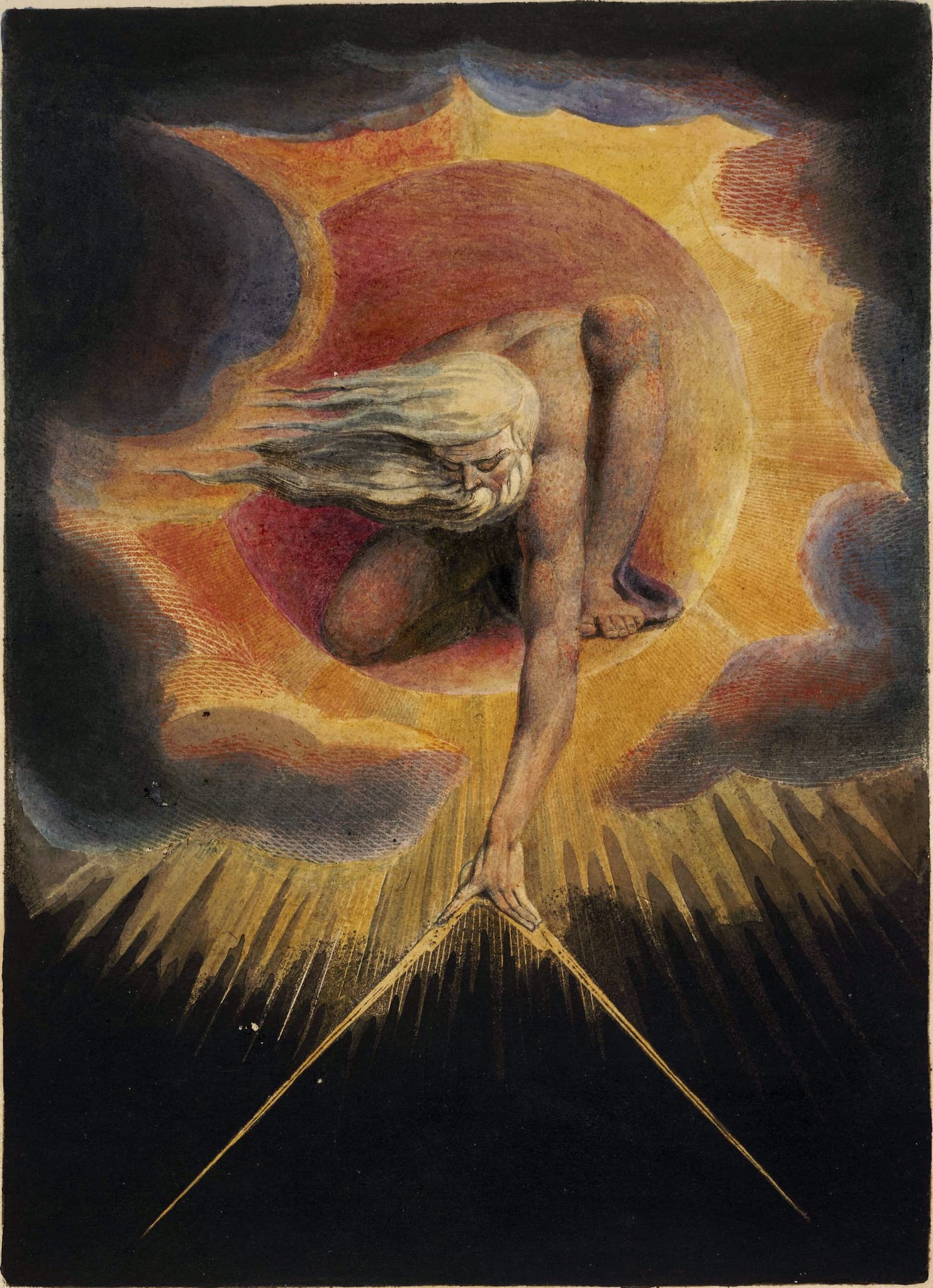
The Ancient of Days (frontispiece to Europe a Prophecy)
William Blake, 1794 • Colour relief etching finished in hand-colour (widely reproduced as a painting motif)
View more by William Blake →Valuation Analysis
Valuation conclusion: For a single‑sheet impression of William Blake’s The Ancient of Days (frontispiece to Europe: A Prophecy), my market range is $100,000–$2,000,000. The lower bound applies to later or uncoloured impressions offered in average condition; the upper bound is reserved for early (1794) strikes with original Blake‑period hand‑colouring, intact margins, and first‑class provenance/exhibition history.
Market context and comparables: Blake’s realised market is bifurcated: unique painted works, monotypes and rare complete illuminated books set the multi‑million ceiling (for example, an important illuminated copy of Songs of Innocence & of Experience sold at Sotheby’s in 2024 for c. $4.32M and an exceptional monotype reached c. $3.14M in 2004), illustrating the ceiling available to unique/rare formats [2][3]. Single relief etchings and separate plates more commonly trade in the low‑to‑mid six‑figure band when they are early and artist‑coloured; recent sales of first‑issue hand‑coloured plates show realized prices in the low‑hundreds of thousands when provenance and plate state are strong [4].
Supply and institutional holdings: Many of the finest impressions of The Ancient of Days are in institutional collections (British Museum, Fitzwilliam, Whitworth, Library of Congress etc.), which reduces the number of high‑quality examples that come to market and supports premiums for the best sheets [1]. However, because Blake produced multiple impressions and later restrikes, any single impression is less unique than a one‑off watercolour; that structural supply moderates prices relative to Blake’s unique works.
Primary value drivers: Critical determinants are plate state/printing date (1794 lifetime impression vs later strike), authorship of the colouring (Blake/close contemporary vs later hand‑colour), paper/watermark and margin integrity, condition (foxing, repairs, trimming), and provenance/exhibition/publication history. Presentation copies and examples with Linnell/Tatham/major‑collection provenance command significant premiums. When several of these factors align, a sale can approach or exceed the top of the stated band.
Practical price matrix & recommendation: As a practical guide: later/plain (uncoloured) impressions generally trade c. $30k–$150k; early impressions with original hand‑colour and good condition typically fall c. $150k–$600k; top‑quality early hand‑coloured impressions with superb provenance and exhibition history can reach $600k–$2M+. My formal working band above ($100k–$2M) is intended for market‑ready, verifiable single‑sheet impressions; facsimiles and late repros fall below the lower bound. To refine to a firm hammer estimate, supply high‑resolution recto/verso photographs, measurements, watermark details and full provenance; for high‑value lots obtain a specialist appraisal from a major auction house Books & Manuscripts or Prints & Drawings department.
Key Valuation Factors
Art Historical Significance
High ImpactThe Ancient of Days is among Blake’s most iconic and widely reproduced images and functions as the frontispiece to his prophetic work Europe: A Prophecy. Its cultural recognition increases desirability across institutional and private collectors. That said, iconography alone does not guarantee the highest prices — uniqueness and condition matter more in the Blake market. Because Blake produced multiple impressions and later restrikes, the image’s broad recognition elevates interest but does not by itself create the scarcity premiums reserved for one‑off watercolours or complete illuminated books. Institutional holdings of key impressions do, however, support the market when a top example becomes available.
Rarity / Plate State / Edition
High ImpactState and printing date are primary price discriminants. A 1794 lifetime impression from Blake’s relief etching plate — especially an early strike with generous margins — is significantly more valuable than later 19th‑century restrikes or facsimile reproductions. Cataloguing (Butlin/Bentley/Essick references) and connoisseurship that confirm plate state materially shift estimates. Because the plate was used to produce multiple impressions, provenance and associated documentation that tie a sheet to Blake’s circle or early circulation increase market confidence and price; conversely, uncertain state attribution or a later restrike will depress value substantially.
Hand‑colouring & Authorship of Colour
High ImpactOriginal hand‑colouring — particularly colouring applied by Blake or an immediate collaborator (Catherine Blake, Linnell’s circle, or another contemporary hand) — is one of the most important value multipliers for this image. Contemporary Blake‑period watercolouring demonstrates direct artist involvement and is scarce; such impressions regularly sell for multiples of uncoloured or later‑coloured counterparts. Later or modern hand‑colouring offers far less premium and may be treated as restoration or reprographic enhancement by specialists. Determining the authorship and period of colouring typically requires expert visual analysis and sometimes pigment testing.
Condition, Paper & Physical State
High ImpactCondition is critical on works‑on‑paper. Foxing, staining, trimming of margins, tears, old repairs and inpainting all substantially reduce market value. Conversely, full margins, an intact watermark consistent with late 18th‑century paper, stable adhesion (where applicable) and a clean surface support higher bids. Collectors and institutions often pay a premium for sheets that require no conservation or only minimal, reversible treatment. Detailed conservation reports and high‑resolution recto/verso imaging meaningfully tighten an appraisal.
Provenance, Exhibition & Publication History
High ImpactA strong provenance chain (notable former owners, inclusion in major collections, sales from recognized Blake collectors) and documentation of exhibition/publication history are decisive value drivers. Presentation copies, examples cited in catalogues raisonnés, or sheets that have been published or lent to major museum exhibitions (Getty, Tate, Yale) command measurable premiums. Provenance reduces market uncertainty and attracts institutional buyers; conversely, unclear or unrecorded provenance tends to compress competitive bidding and lowers likely sale outcomes.
Sale History
Sotheby's New York
Sotheby's New York
Christie's London
Christie's New York
William Blake's Market
William Blake is a canonical but specialist market artist: institutional demand and a cohort of dedicated private collectors underwrite strong prices for museum‑quality material. The market is clearly bifurcated — unique painted works, monotypes and rare complete illuminated books achieve multi‑million results, while separate relief etchings/plates (even hand‑coloured) more commonly trade in the low‑to‑mid six‑figure range depending on state, colouring and provenance. Major auction houses and specialist dealers actively market Blake material to museums and specialized collectors, producing robust prices for the rarest, best‑provenanced examples.
Comparable Sales
The Good and Evil Angels Struggling for Possession of a Child
William Blake
One‑off, hand‑worked Blake monotype that set a modern auction record for Blake — demonstrates the multi‑million ceiling for unique, singular Blake works (higher than printed plates).
$3.1M
2004, Sotheby's New York
~$5.2M adjusted
Songs of Innocence and of Experience (rare illuminated copy)
William Blake
Complete, early hand‑coloured illuminated book — benchmark for multi‑million prices in Blake market; more significant than a single frontispiece/plate.
$4.3M
2024, Sotheby's New York
~$4.5M adjusted
The First Book of Urizen (complete illuminated book)
William Blake
Rare complete illuminated book sale; illustrates sustained, high institutional/private demand for complete Blake books (multi‑million comparable).
$2.5M
1999, Sotheby's New York
~$4.8M adjusted
Songs of Experience (illuminated book from Maurice Sendak collection)
William Blake
High‑provenance early Blake book sold strongly in 2025 — shows willingness of buyers to pay seven‑figure sums for provenance‑rich, early works (book format).
$1.9M
2025, Christie's New York
The Tyger (first‑issue plate, hand‑coloured)
William Blake
Single, hand‑coloured first‑issue plate from Blake's printed/illustrated works — most directly comparable in format to The Ancient of Days; indicates market for desirable standalone plates (~low‑to‑mid six figures).
$305K
2025, Christie's London
Current Market Trends
The works‑on‑paper and rare books niche has been resilient: recent blockbuster sales of Blake illuminated books and high‑quality monotypes have reaffirmed the ceiling, while the supply of top‑grade impressions remains limited because many reside in public collections. Museum exhibitions and the approaching 2027 bicentenary of Blake’s death are likely to sustain interest and may strengthen demand for trophy items. Single plates continue to trade in a variable band driven by state, colouring and provenance.
Sources
- British Museum collection entry for Europe: A Prophecy, plate 1 (The Ancient of Days)
- Sotheby's Books & Manuscripts department / 2024 highlighted Blake sale (illustrative benchmark)
- Sotheby's sale archive — Greentree/Whitney collection (2004) — Blake monotype sale (illustrative)
- Christie's press release / sale coverage — examples of high‑value single Blake plates (The Tyger, Dec 2025)
- John Windle Antiquarian Bookseller — catalogue listings and commentary on separate Blake plates and facsimiles
- Fitzwilliam Museum / example catalog entry for The Ancient of Days impression