How Much Is The Ghost of a Flea Worth?
Last updated: May 20, 2026
Quick Facts
- Last Sale
- $51.13 (1892, Sotheby's (London))
- Methodology
- comparable analysis
If placed on the private market in authenticated and stable condition, William Blake’s The Ghost of a Flea would likely realize in the region of $500,000–$4,000,000. This range is hypothetical: the panel is bequeathed to Tate and is not ordinarily market‑tradeable, so the figure is an academic private‑market estimate based on comparables and provenance.
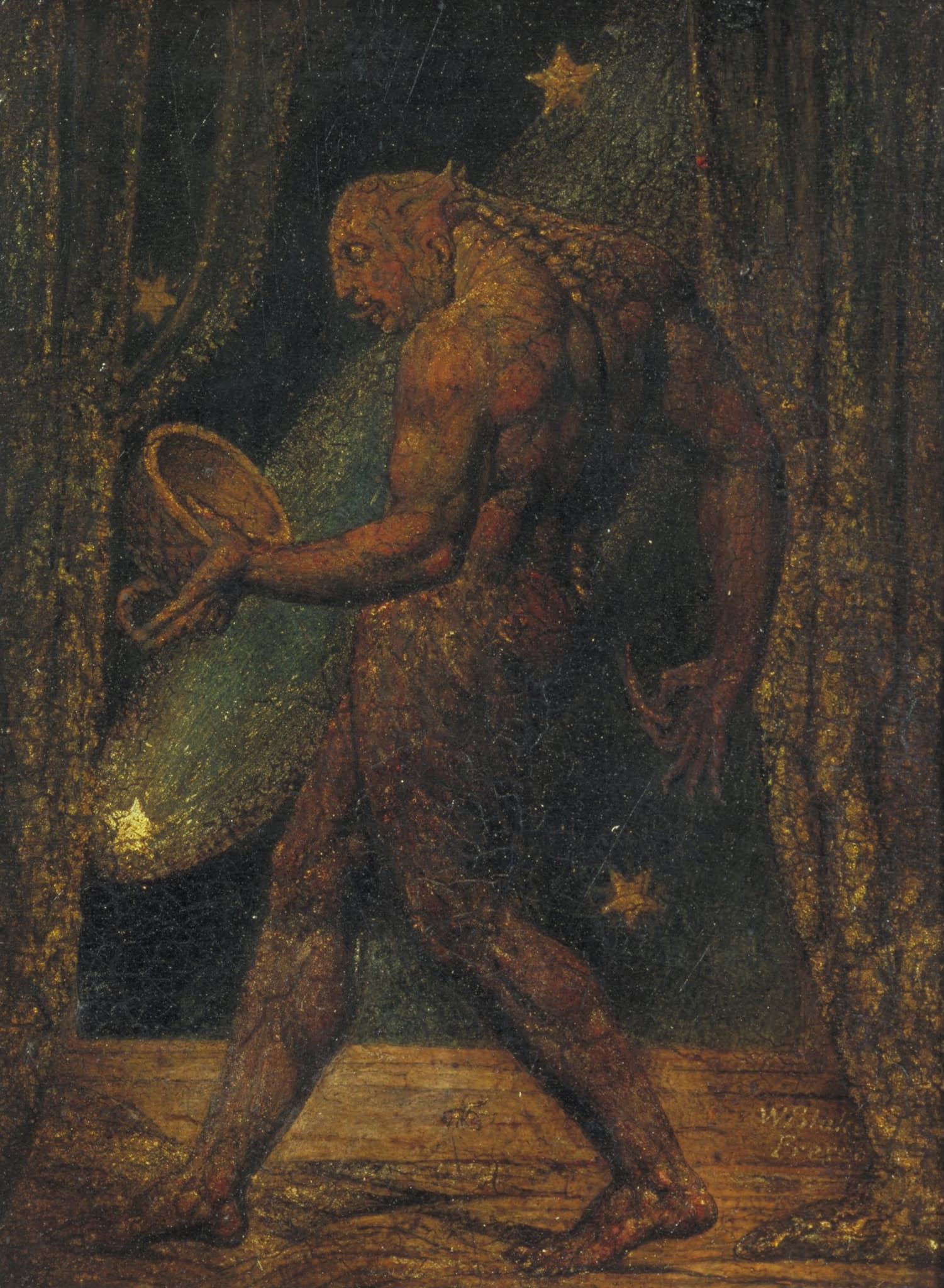
The Ghost of a Flea
William Blake • Tempera and gold on mahogany (small panel)
View more by William Blake →Valuation Analysis
Valuation conclusion: This conditional, private‑market valuation places William Blake’s tempera panel The Ghost of a Flea at approximately $500,000–$4,000,000. The figure assumes the work is accepted as autograph Blake, is in reasonably stable condition for a tempera on panel, and is offered in an open competitive sale or private placement aimed at institutional and specialist collectors. The painting is currently in Tate’s collection (Bequeathed by W. Graham Robertson 1949) and therefore not normally available for sale; the estimate is hypothetical and intended to reflect contemporary market dynamics [1].
The panel’s physical and scholarly profile materially informs the range. The Ghost of a Flea is a small tempera heightened with gold on mahogany (c. 21.4 x 16.2 cm), a medium that is both technically distinctive and condition‑sensitive. Early provenance ties the picture into the Varley/visionary‑heads circle and the later ownership of W. Graham Robertson — a provenance that adds academic prestige and exhibition history but simultaneously removes the object from active private‑market circulation while in institutional hands [1]. Any sale valuation must be conditioned on a current, detailed conservation report documenting paint stability, ground condition, and any historic restorations.
Comparable evidence sets the anchors for the band. Recent high‑visibility sales of Blake material show a broad dispersion: complete, hand‑coloured illuminated books have set the contemporary ceiling (one headline result reported near $4.3M) and important copies have achieved mid‑six to low‑seven figures, while single plates and prints often trade in the low five‑figures to low six‑figures depending on rarity and provenance [2][3]. Unique tempera panels such as this typically fall between single‑sheet print results and the top illuminated‑book realizations, their final price driven by condition, accompanying documentation, and whether they appear in a heavily marketed institutional sale or a specialist Old Master/British drawings auction.
The lower bound (~$500k) represents a pragmatic market floor for an authenticated, small Blake tempera offered without extraordinary exhibition or competitive bidding. The upper bound (~$4M) is an achievable but optimistic outcome in the event of ideal conditions: pristine condition, fresh scholarship/publicity, a high‑profile sale, and competing institutional/private bidders. Because Tate holds the work, an actual market realization would depend on the exceptional circumstance of deaccessioning or a discreet institutional/private transfer — events which themselves materially influence price discovery and competitive dynamics [1][2][3].
Next steps to firm a formal valuation: obtain a full catalogue‑raisonné citation (Butlin/Bentley), a written curatorial/technical report (X‑ray/infrared, pigment analysis), and a targeted auction‑house appraisal from Old Master/British drawings specialists. Those actions will move this band into a defensible reserve recommendation or an insurance valuation.
Key Valuation Factors
Art Historical Significance
High ImpactThe Ghost of a Flea occupies a particular place in Blake scholarship as part of his circle of small visionary heads and tempera experiments. While not one of Blake’s canonical, widely reproduced 'blockbuster' images, it is important to specialists for what it reveals about his working practice, small‑scale tempera technique, and iconographic experimentation. That scholarly interest increases desirability among institutions and serious private collectors and confers a premium above ordinary prints, yet the work’s niche status limits mass‑market recognition and broad popular demand. Its scholarly pedigree therefore supports a meaningful but measured market valuation.
Rarity & Medium
High ImpactUnique tempera panels by Blake are uncommon in private hands; most of his tempera and oil works are concentrated in institutional collections. The medium (tempera heightened with gold on mahogany) is distinctive and technically demanding, which enhances collectibility. Scarcity of comparable lots at auction elevates the price sensitivity: when such panels do appear they can attract concentrated bidding from specialists and institutions, but their rarity also makes direct comparative pricing less precise. The panel’s scarce medium therefore supports an upper‑market uplift relative to single plates or common prints.
Condition & Conservation
Medium ImpactTempera on panel is vulnerable to craquelure, flaking, panel movement and loss of ground; condition issues materially depress values for works on panel. Historic cleaning, consolidation or retouching — and any evidence of unstable ground or structural instability in the mahogany support — would reduce market value, while documented, professional conservation and stable condition increase buyer confidence and price. A formal conservation/technical report (X‑ray, IR, pigment analysis) is therefore essential; absence of such documentation increases transaction risk and typically lowers auction estimates.
Provenance & Exhibition History
High ImpactThe panel’s early provenance (John Varley/Varley circle), documented 19th‑century sale into W. Graham Robertson’s collection, and bequest to Tate in 1949 provide a strong, well‑documented chain of custody and a published exhibition history. That provenance and institutional exhibition record increase academic value and market prestige, which tends to lift price expectations for comparable material. Conversely, institutional ownership reduces market availability and makes any hypothetical sale exceptional, a factor that both elevates perceived scarcity and complicates price discovery.
Market Comparables & Demand
Medium ImpactRecent market activity for Blake shows large dispersion: complete hand‑coloured illuminated books have set the upper market (multi‑million results), important single works have realized mid six‑figures to low millions, while single plates often sell for far less. Demand is driven by institutions, specialist collectors and dealers; a museum‑quality tempera that appears in a marquee sale can approach the higher end of the range, but absent exceptional circumstances it is likely to sit in the mid‑six‑figure band. The panel’s final price would therefore be sensitive to sale context and marketing.
Sale History
Sotheby's (London)
Tate (bequest)
William Blake's Market
William Blake’s market is specialist and institutionally oriented. The strongest prices are reserved for rare, complete hand‑coloured illuminated books and a small number of distinguished drawings; those items have set recent headline results in the low‑to‑mid millions. Individual plates and common prints trade at much lower levels. Institutional holdings are extensive, which increases scarcity on the private market but also results in uneven liquidity: very desirable items attract intense bidding, while many sheets attract modest interest. Overall, Blake is collectible and can achieve seven‑figure prices for the rarest items, but most material trades in the mid‑to‑high five‑figure band [2].
Comparable Sales
Songs of Innocence and of Experience (complete, hand-coloured copy)
William Blake
Top‑market Blake sale (complete hand‑coloured illuminated book) establishing the contemporary market ceiling for the artist's most desirable, unique works.
$4.3M
2024, Sotheby's New York
~$4.4M adjusted
Songs of Experience (hand-coloured copy)
William Blake
Important illuminated Blake book sold in 2025—strong evidence of collector demand for unique, hand‑worked Blake material that trades at multi‑hundred‑thousand to multi‑million levels.
$1.9M
2025, Christie's New York (Maurice Sendak sale)
Songs of Innocence (hand-coloured copy)
William Blake
Another recent illuminated‑book sale (2025) showing mid‑six‑figure to low‑seven‑figure realizations for important Blake book copies—useful as an upper/mid‑market anchor.
$1.3M
2025, Christie's New York (Maurice Sendak sale)
Plate from The First Book of Urizen (colour-printed relief etching)
William Blake
Single plate/print by Blake—represents market for individual printed sheets (significantly lower than complete books; useful low‑end comparable for Blake material).
$176K
2025, Christie's New York (Maurice Sendak sale)
Current Market Trends
The works‑on‑paper market for British Romantic and visionary material is currently resilient: recent major exhibitions (notably the 2023–24 Getty exhibition), anniversary programming, and high‑profile sales have increased visibility and buyer interest. Demand concentrates on unique, well‑provenanced items; supply is limited by institutional collections, creating upward pressure for museum‑quality lots. Results remain uneven, with headline auctions driving spikes and most lots continuing to show variable liquidity [4].
Sources
- Tate — The Ghost of a Flea (collection entry)
- MutualArt — William Blake auction results (market snapshots)
- Christie's press release — Maurice Sendak sale (10 June 2025) results
- Sotheby's — Blake market context / talks and sale promotion (June 2024 coverage)
- Bentley/Bibliographic sale record — 1892 Sotheby's lot catalogue (archival listing)