How Much Is The Great Red Dragon and the Beast from the Sea Worth?
Last updated: May 20, 2026
Quick Facts
- Methodology
- comparable analysis
This sheet ("The Great Red Dragon and the Beast from the Sea", c.1805) is an authenticated William Blake watercolour held by the National Gallery of Art and is effectively off‑market. If a comparable, authenticated, well‑conditioned Blake Red Dragon sheet were to be offered publicly, a realistic auction range is approximately $2,000,000–$7,000,000 based on recent Blake sale evidence and scarcity-adjusted comparables.
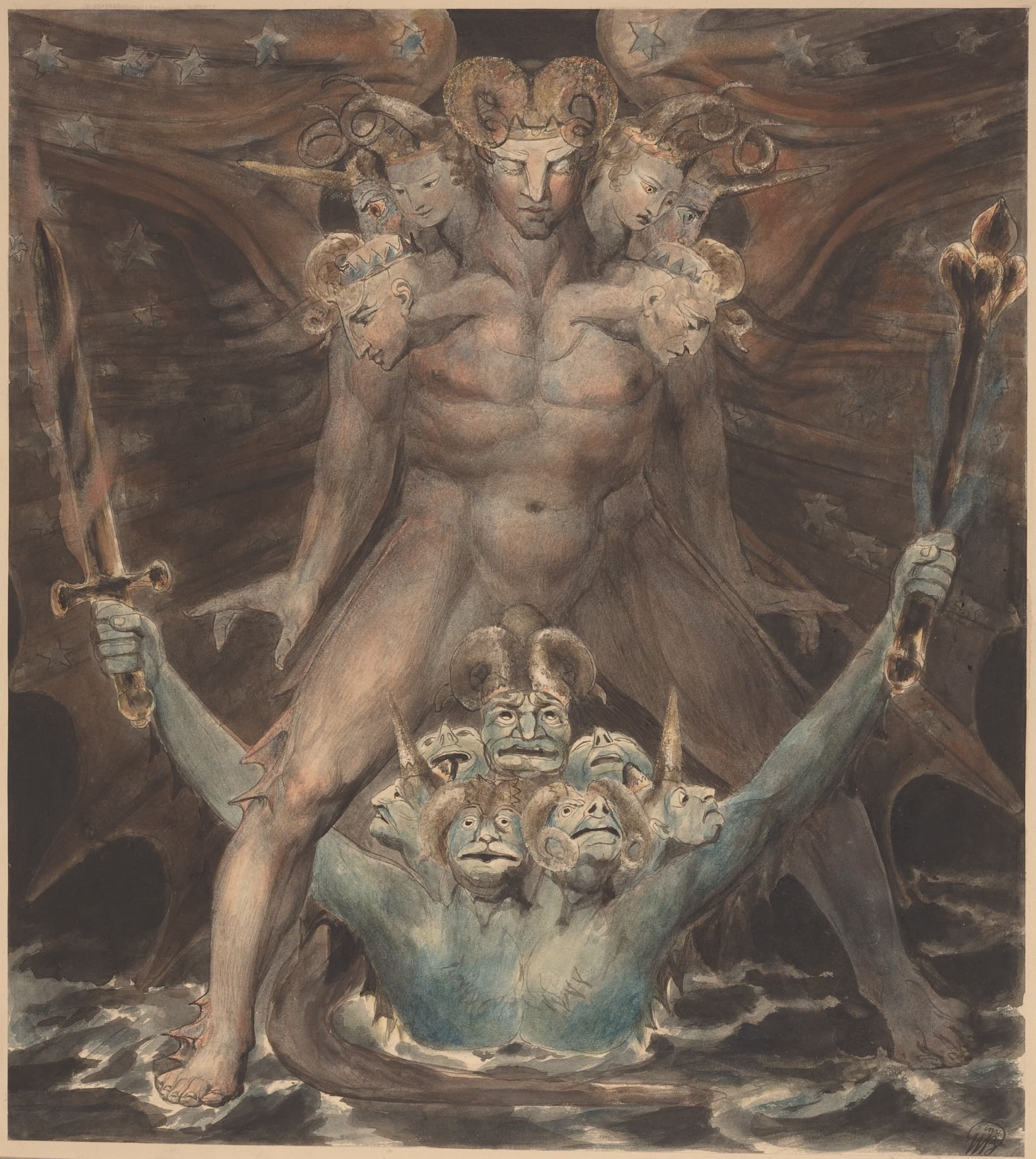
The Great Red Dragon and the Beast from the Sea
William Blake • Watercolour and ink on paper
View more by William Blake →Valuation Analysis
Object and market status. The sheet "The Great Red Dragon and the Beast from the Sea" (c.1805) is catalogued in the Rosenwald Collection of the National Gallery of Art; institutional ownership and acceptance in major scholarship mean the NGA example is effectively not market‑saleable under ordinary circumstances [1]. Any transactional value therefore is hypothetical unless the work were deaccessioned or an equivalent major Red Dragon sheet in private hands were offered.
Hypothetical market range and basis. For a comparable, authenticated, well‑provenanced and good‑condition Blake Great Red Dragon single sheet, a realistic public auction range is approximately $2,000,000–$7,000,000. That estimate is grounded in three interlocking data points: (1) the rarity and museum desirability of the Red Dragon designs; (2) recent high‑end Blake price discovery — including multi‑million results for exceptional Blake material (notably a top‑tier hand‑coloured copy of Songs of Innocence & of Experience in 2024) and single‑sheet results in the mid six‑figures to low millions; and (3) privately reported multi‑sheet packages that demonstrate institutional/private appetite for major Blake groups. These comparables indicate single‑sheet ceiling/benchmarks and a plausible market band for an individually offered major Red Dragon sheet [2].
Price drivers and sensitivity. The estimate is sensitive to five decisive variables: secure authorship (firm Blake attribution), paper and pigment condition (presence or absence of foxing, staining, or invasive restoration), the continuity and quality of provenance/exhibition history, the sale venue (major international auction house vs private treaty), and the competitive intensity of bidding (museum vs deep private collector interest). A pristine, well‑published sheet with continuous top‑tier provenance sold via a major house would approach the high end; any doubts about attribution, aggressive restoration, or incomplete provenance could reduce value into the low six‑figures or into the lower comparative band (roughly $200,000–$1,500,000).
Practical next steps to refine value. To firm this figure into an actionable valuation: secure a conservator’s condition report; assemble full provenance, exhibition and bibliography (Butlin references, Rosenwald/Marsden Perry entries); request a formal written estimate from a specialist in Old Master & British Drawings at a major house; and, if necessary, commission targeted technical analysis (paper/watermark, pigments). Because the NGA is the documented owner of this particular sheet, any market realization would require institutional deaccession and legal/ethical review prior to sale.
Key Valuation Factors
Art Historical Significance
High ImpactThe Great Red Dragon series represents some of William Blake’s most iconic visionary compositions and occupies a central place in his late‑career Revelation drawings. These sheets carry outsized cultural recognition relative to many other Blake works, are frequently reproduced and cited in scholarship, and are actively sought by museums and leading private collectors. That elevated art‑historical status translates directly into monetary value: works that are both compositionally important and visually emblematic of an artist’s oeuvre typically command premiums at sale. For this Red Dragon subject, significance is a primary driver of demand and supports pricing toward the upper end of the estimated range.
Attribution & Rarity
High ImpactAttribution certainty and the rarity of major single‑sheet Blake watercolours are paramount. Blake produced relatively few large-scale, fully worked watercolour compositions; the Red Dragon designs exist in only a small number of variations and are concentrated in museum holdings. An unquestioned, catalogue‑raisonné attribution (Butlin and other Blake scholars) elevates market confidence substantially. Conversely, any suggestion that the sheet is a later copy, workshop variant, or of uncertain authorship will materially compress value. Given supply constraints for genuine Red Dragon sheets, confirmed attribution has a high positive impact on valuation.
Condition & Conservation
High ImpactPaper quality, original pigment stability, presence of foxing, water staining, losses, fold lines, and the history and extent of any conservation treatments critically affect price. A well‑preserved, minimally restored sheet retains natural patina and visual integrity and will approach the upper valuation band; conversely, heavy restoration, tone discrepancies, or structural paper damage can reduce bidder confidence and auction interest, often by multiples. A professional conservator report is necessary to translate visual observations into market impact—this single factor can swing value by hundreds of thousands of dollars on a work at this price tier.
Provenance & Exhibition History
High ImpactContinuous, reputable provenance (early ownership by known collectors, inclusion in the Rosenwald collection, catalogue‑raisonné citations, and public exhibition history) materially increases buyer confidence and market price. Museum provenance and prior exhibition/publication history reduce attribution risk and support institutional valuation benchmarks. The NGA’s documented provenance (including Marsden J. Perry and Lessing J. Rosenwald entries and Butlin catalogue reference) is a strong positive factor for authenticity and marketability, but because museum ownership constrains sale prospects, provenance strengthens value in a hypothetical sale while simultaneously restricting real‑world liquidity.
Market & Sale Venue
Medium ImpactThe venue—major international auction house with a strong drawings department versus private treaty sale—shapes final price through competitive bidding dynamics, visibility, and buyer pool. Public sales at Sotheby’s/Christie’s typically produce transparent hammer results and can maximize value when multiple institutions or deep‑pocketed collectors compete. Private treaty can produce high results for discreet sales but with less transparent price discovery. The broader market for Blake is specialized and episodic; timing, the presence of comparable works on the market, and macroeconomic liquidity conditions moderate achievable prices.
Sale History
The Great Red Dragon and the Beast from the Sea has never been sold at public auction.
William Blake's Market
William Blake occupies a secure canonical position in British Romantic and visionary art markets. Market demand is strong for major works—particularly complete hand‑colored books and rare single‑sheet watercolours—but supply of museum‑quality items is extremely limited. High‑profile Blake material has sold in the low‑to‑mid millions (notably rare books and exceptional groups), while individual single‑sheet drawings more commonly appear in the mid six‑figures to low millions when they surface at major houses. Collectors are specialized; institutions remain the primary buyers for top examples, keeping public sale opportunities infrequent.
Comparable Sales
Songs of Innocence & of Experience (hand-coloured copy)
William Blake
Top-tier Blake material (complete hand-coloured book) demonstrating strong collector demand and an upper-market benchmark for exceptional Blake material; not a single-sheet but useful for ceiling estimation.
$4.3M
2024, Sotheby's New York
~$4.4M adjusted
The Grave (single-sheet drawing/watercolour offered in sale)
William Blake
Recent single-sheet Blake watercolour/drawing sold at a major auction — a direct, conservatively comparable market datapoint for individual Blake sheets (shows realized values in the mid six-figures to low seven-figures).
$750K
2026, Christie's New York (Old Master & British Drawings)
~$728K adjusted
Private sale: group of 19 Blake watercolours (reported)
William Blake
Private-treaty sale realising in excess of £5,000,000 for 19 watercolours (converted to USD) — indicates that exceptional Blake material (especially as groups or multiple sheets) can produce multi-million totals; helps establish a market ceiling though not a single-sheet hammer price.
$6.7M
2026, Private sale (reported by Dominic Winter Auctioneers)
~$6.5M adjusted
Current Market Trends
Current market conditions show continued interest in scarce, museum‑quality works on paper and a preference for strong provenance and conservation documentation. Price discovery for Blake is intermittent: private sales can aggregate multi‑million totals, while individual drawings see sporadic competitive bidding. Supply constraints (most major Red Dragon sheets are in public collections) and high collector concentration tend to sustain firm pricing, though outcomes remain sensitive to venue, condition and macroeconomic liquidity.
Sources
- National Gallery of Art — The Great Red Dragon and the Beast from the Sea (object page)
- Sotheby’s — sale listing and coverage (Songs of Innocence & of Experience sale referenced as recent high‑end Blake benchmark)
- Christie’s — example single‑sheet Blake sale (Old Master & British Drawings)
- Dominic Winter Auctioneers — reported private sale of Blake watercolours (context for private‑treaty ceiling)