How Much Is The Spiritual Form of Nelson Guiding Leviathan Worth?
Last updated: May 20, 2026
Quick Facts
- Methodology
- comparable analysis
Tate Britain holds William Blake’s tempera on canvas The Spiritual Form of Nelson Guiding Leviathan (c.1805–09; accession N03006), and it has not been offered on the market. Based on recent high‑end Blake comparables, medium (tempera), scale and museum provenance, a reasonable hypothetical market range is $1.5M–$6.0M USD.
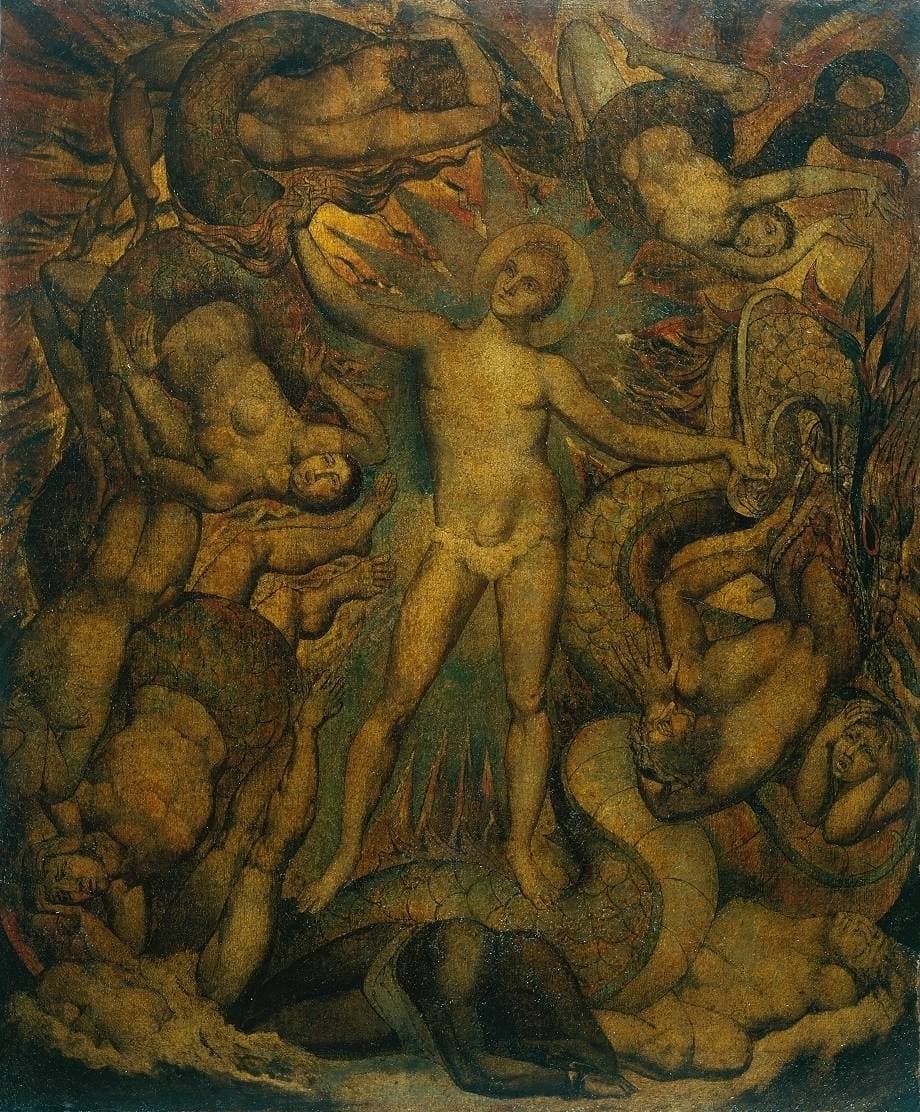
The Spiritual Form of Nelson Guiding Leviathan
William Blake • Tempera and gold on canvas / watercolour (portable fresco experiments)
View more by William Blake →Valuation Analysis
Object and provenance: The subject work, catalogued in a public collection since its acquisition in 1914, is a tempera on canvas by William Blake (c.1805–09). Because the painting is held by Tate (accession N03006) and has not been traded on the open market in the modern auction era, any monetary estimate is necessarily hypothetical and must be built from closely related sale comparables and an analysis of the work’s intrinsic attributes [1].
Method and comparables: This valuation uses a comparable‑analysis approach: recent auction results for unique Blake items (hand‑coloured illuminated books, unique drawings and rare single‑sheet works) provide the market anchors. Headline sales in 2024–2026 — notably a rare hand‑coloured copy of Songs of Innocence & of Experience at Sotheby’s in June 2024 — show institutional and private willingness to pay low‑to‑mid millions for top‑tier Blake material [2]. Single‑sheet drawings and important impressions have realised in the high five‑ to low seven‑figure bands, while printed plates and more common impressions trade lower.
Price range rationale: Weighting the medium (tempera on canvas), scale (76.2 × 62.5 cm as catalogued), museum provenance and the constrained pool of comparables yields a defensible hypothetical range of $1,500,000–$6,000,000 USD. The lower bound assumes moderate buyer competition, potential conservation needs or a sale scenario without auction guarantees. The upper bound assumes excellent condition, active institutional interest (or cross‑institutional sale) and aggressive bidding possibly supported by guarantees or private‑sale interest.
Risks and drivers: Key variables that could move the estimate materially include the painting’s conserved condition (tempera can be fragile), any undisclosed restoration history, and legal/administrative constraints on sale (UK deaccession policy and export licensing). Tate provenance reduces attribution risk and adds scholarly value but also makes a market sale unlikely in practice; in the event of a deaccession the sale pathway (museum‑to‑museum transfer vs open auction) will strongly influence price realization.
Conclusion and next steps: Given scarcity of comparable Blake tempera canvases and strong prices for the best unique Blake material, the comparable‑analysis range of $1.5–6.0M USD is a responsible working valuation for a hypothetical market offering. For a firm, sale‑ready valuation obtain high‑resolution photography, a full conservation report, complete exhibition and publication history, and consult a leading Blake specialist or the major auction‑house departments to model sale‑venue scenarios and reserve/guarantee strategies.
Key Valuation Factors
Art Historical Significance
High ImpactWilliam Blake occupies a central place in British Romantic and visionary art; this painting’s subject—Nelson guiding Leviathan—connects Blake’s prophetic iconography to a prominent national figure, enhancing scholarly interest. While not as broadly reproduced as Blake’s most iconic single images, the work represents a rare, large tempera exercise in his prophetic oeuvre. Museum ownership since 1914 further cements its cultural importance and ensures the work’s visibility to curators and scholars. That recognised significance supports stronger institutional bids in any hypothetical market offering and raises the painting above typical single‑sheet market lots.
Attribution & Authenticity
High ImpactAccepted attribution to Blake — as implied by long‑term Tate ownership and cataloguing — substantially reduces buyer uncertainty and enhances value. Autograph, securely attributed Blake works command premium pricing; conversely, any unresolved attribution questions or contested authorship would sharply depress market value. Because this painting is part of a major public collection the attribution is effectively validated for market purposes, which means potential buyers will treat authenticity risk as low and price accordingly.
Provenance & Exhibition History
High ImpactContinuous and public provenance (Tate acquisition 1914) and any associated exhibition/publication history materially increase market desirability. Museum provenance typically reassures buyers about authenticity and condition, and published exhibition records raise scholarly prominence — both of which support premium pricing. However, public‑collection ownership also introduces practical constraints (deaccession policy, possible restrictions), which can limit sale options and concentrate potential buyers to institutions or major private collectors prepared to navigate export and legal hurdles.
Medium & Condition
Medium ImpactThe work’s tempera on canvas medium is relatively rare in Blake’s output and is often considered a higher‑value category than routine watercolours or prints. Tempera can be fragile and sensitive to past restorations; condition will therefore be a major determinant of final price. If the painting is in excellent conserved condition, its medium and scale support the upper end of the estimate. Conversely, evidence of significant flaking, overpainting or structural instability would reduce marketability and lower realizations.
Market Demand & Comparables
Medium ImpactRecent auction evidence shows strong demand for unique Blake material: headline illuminated books and select drawings have traded in the mid‑six to low‑seven figures while notable single sheets and plates achieve high five‑figure to low‑six‑figure results. Because major Blake paintings rarely appear on the market, comparable sales are imperfect; however, institutional appetite and scarcity support outcomes in the low‑to‑mid‑millions for a high‑quality tempera canvas. The small, specialist buyer base adds volatility—concentrated interest can push prices up, limited liquidity can cap them.
Sale History
The Spiritual Form of Nelson Guiding Leviathan has never been sold at public auction.
William Blake's Market
William Blake is a canonical and highly collectible figure whose market is specialised and scarcity‑driven. The top tier (rare lifetime‑printed illuminated books and unique signed drawings) has produced headline auction results in the low millions; mid‑tier drawings and high‑quality prints trade in the mid‑to‑high five figures. Institutional collectors and bibliophiles dominate the upper end, and provenance/exhibition histories materially influence outcomes. Because supply of museum‑quality Blakes is low, individual unique works can outperform broader market softness when they surface with strong documentation.
Comparable Sales
Songs of Innocence & of Experience (hand‑coloured illuminated copy)
William Blake
Headline Sotheby's sale of a rare lifetime‑printed, hand‑coloured illuminated Blake book — a market benchmark for top‑tier, unique Blake material and institutional/bibliophilic demand; while a book (not a painting), it signals the ceiling for museum‑quality Blake works.
$4.3M
2024, Sotheby's New York
~$4.4M adjusted
Songs of Experience (hand‑coloured illuminated copy)
William Blake
Recent high‑value sale of a hand‑coloured illuminated Blake book (June 2025) from a major auction — indicates strong institutional/collector demand for unique Blake items in the mid‑seven to low‑six‑figure band; useful as a nearer‑term market benchmark.
$1.9M
2025, Christie's New York
Songs of Innocence (hand‑coloured illuminated copy)
William Blake
Companion lot to the June 2025 sales — another example of a lifetime‑printed, hand‑coloured Blake volume achieving seven‑figure results; shows a tiered market within rare Blake printed/hand‑coloured works.
$1.3M
2025, Christie's New York
The Tyger (first‑issue illuminated plate)
William Blake
Record auction result for a Blake print/plate (first‑issue coloured impression) — demonstrates demand and pricing for single‑leaf printed/hand‑coloured Blake material at the mid‑to‑upper five‑figure to low‑six‑figure level; less directly comparable in medium but useful for lower‑end benchmarks.
$305K
2025, Christie's London
Current Market Trends
From 2024–mid‑2026 the ultra‑top art market showed some cooling, but scarcity and institutional demand have kept prices resilient for rare Blake items. Headline sales of unique books and major drawings sustained market interest, while smaller, less‑provenanced pieces showed greater price sensitivity. Museum exhibitions and provenance stories continue to amplify demand for select lots, but the buyer pool remains narrow and results hinge on condition, venue and guarantee strategies.
Sources
- Smarthistory — William Blake: The Spiritual Form of Nelson Guiding Leviathan (object and museum context)
- Sotheby’s / market coverage — Recent headline sale of a rare hand‑coloured Blake copy (market benchmark for top‑tier Blake material, June 2024)
- Christie’s — The Tyger (first‑issue plate) sale coverage and market context (Dec 3, 2025)