How Much Is The Spiritual Form of Pitt Guiding Behemoth Worth?
Last updated: May 20, 2026
Quick Facts
- Methodology
- comparable analysis
The Spiritual Form of Pitt Guiding Behemoth (c.1805) by William Blake — currently in the Tate (accession N01110) and not market‑available — is hypothetically valued at $500,000–$3,000,000 USD. This band is grounded in comparables for museum‑quality Blake compositions and illuminated books, tempered by the painting’s long institutional ownership and the lack of a modern public sale record.
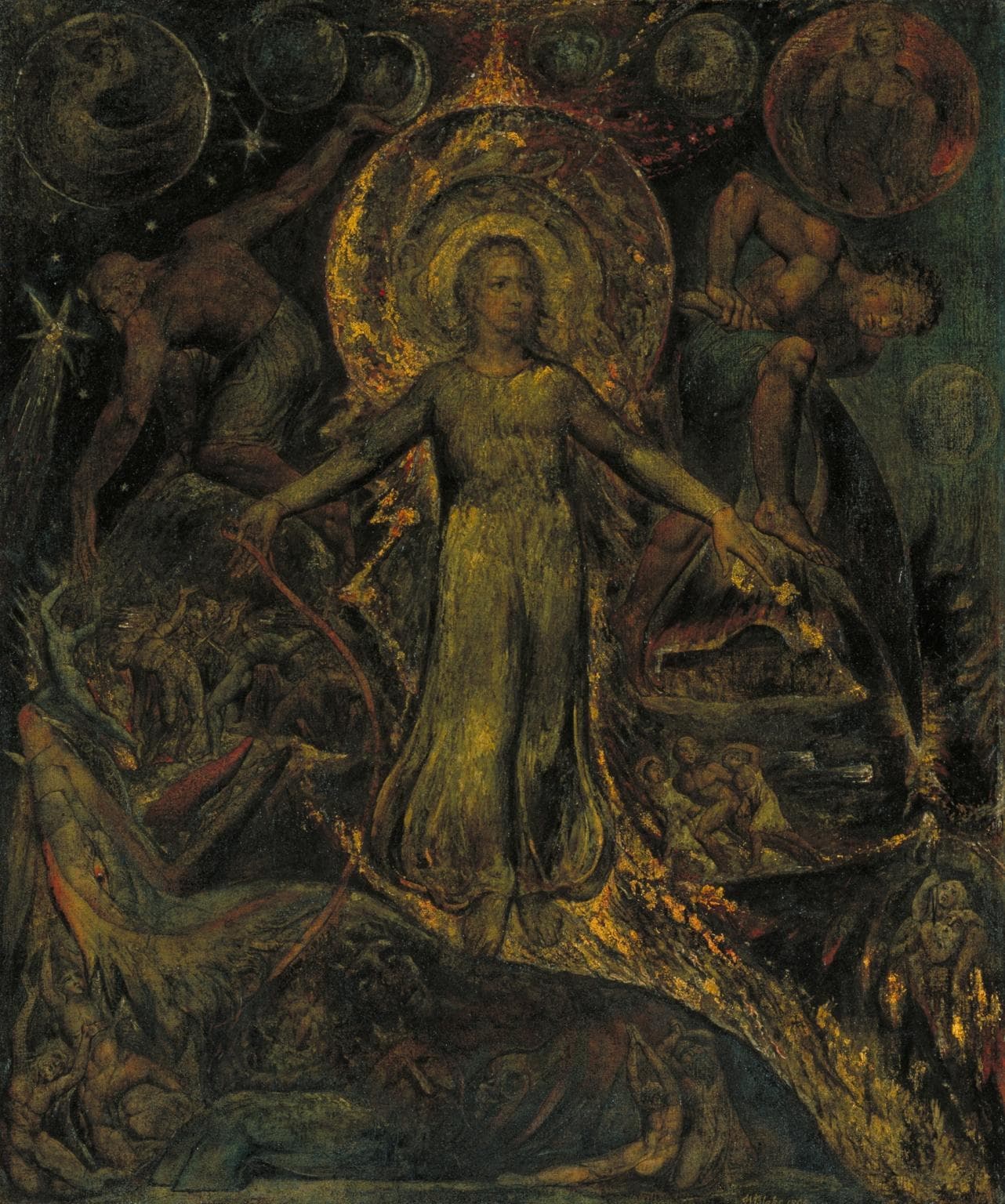
The Spiritual Form of Pitt Guiding Behemoth
William Blake • Tempera and gold on canvas (portable fresco experiment)
View more by William Blake →Valuation Analysis
Work and ownership: The Spiritual Form of Pitt Guiding Behemoth (c.1805), tempera and gold on canvas (c.74 x 62.7 cm), is in the Tate collection (accession N01110) and recorded as purchased in 1882. Because the picture has been museum‑held for well over a century, no modern public auction sale provides direct price discovery for this specific canvas [1].
Conclusion and working band: On a hypothetical open‑market offering, a prudent fair‑market range for an equivalent, securely attributed Blake tempera of this scale and significance is approximately $500,000–$3,000,000 USD. That band is derived by calibrating the documented high‑end results for rare Blake material (for example Sotheby’s 2024 rare complete Songs of Innocence & of Experience at c. $4.32M and the Sotheby’s 2004 sale of The Good and Evil Angels at c. $3.9M) against the more frequent mid‑six‑figure outcomes for single impressions and smaller works on paper. These headline lots demonstrate depth of institutional/collector demand but differ in medium and rarity profile from a tempera canvas, so the mid‑six‑figure to low‑seven‑figure window is the appropriate market anchor here [2][3].
Upward drivers: Blake’s painted oeuvre is scarce and highly sought by institutions and specialist collectors; tempera/gold canvases are technically interesting to curators and conservators and can command premium attention if in excellent condition and accompanied by strong exhibition/publication history. If pre‑1882 provenance or high‑profile loans/publications were documented, the top of the band could move materially upward. Major museum interest and competitive bidding for a deaccessioned masterpiece could push price toward the high end.
Downside drivers and market friction: The principal limitations here are the work’s long public ownership (no modern auction benchmark), potential condition or conservation complexity (tempera layers and gilding can be vulnerable), and the relatively narrow buyer universe for large Blake canvases compared with the rare‑book/illuminated‑copy market. Deaccession constraints, export licensing and public‑collection pre‑emption rights in the UK also limit practical saleability and typically lengthen marketing timelines, which buyers internalize in bids [1][4].
Practical confidence & next steps: Confidence in a precise figure is low–moderate because there is no recent market transaction for this object. To firm valuation, obtain Tate’s accession/provenance file, commission a current condition and technical report (pigment/medium analysis; conservation history), and request formal market appraisals from major houses (Sotheby’s/Christie’s) that can evaluate sale strategy (rare‑books vs. works‑on‑paper sale rooms, house guarantees, etc.). With those inputs the band can be narrowed and a defensible insurance or reserve value prepared.
Key Valuation Factors
Art Historical Significance
High ImpactBlake’s Pitt/Behemoth composition is an explicit political prophetic allegory from c.1805 and sits within a small subset of his large tempera canvases. As a named, exhibited and published image in Blake scholarship it carries substantial curatorial and academic importance. Institutional ownership (Tate) increases its cultural profile and ensures exposure in museum catalogues and exhibitions, which supports institutional interest and uplifts perceived value. The political content and its relationship to Blake’s prophetic cycle make it of high interest to museums assembling narratives about Romantic political iconography and British art of the Napoleonic era.
Provenance & Ownership
High ImpactThe work’s long‑standing presence in the Tate collection (acquired 1882) provides secure custodial provenance but removes direct market comparables. Institutional ownership reduces immediate market availability and invokes deaccession protocols, pre‑emption rights and export-control considerations that materially affect saleability and buyer pools. Conversely, museum provenance generally assures scholarly vetting and curatorial documentation—factors that increase institutional demand and perceived cultural value. Lack of detailed pre‑1882 provenance introduces some uncertainty that, if resolved positively, could raise the top end of the valuation band.
Condition & Technical Issues
Medium ImpactTempera and gold on canvas is a technically distinct medium; its conservation profile differs from oils and works on paper. Condition—paint layer stability, ground integrity, evidence of overpainting or past restoration—directly influences market value. A clean technical report confirming original materials, stable tempera films and minimal intrusive restoration increases buyer confidence and can support prices toward the high end. Significant structural or pigment degradation will depress realizations and increase buyer risk premiums. Technical authentication (pigment analysis, microscopic imaging) is therefore essential prior to final valuation.
Market Scarcity & Comparables
High ImpactBlake’s original painted works are rare in the market; supply is largely absorbed by institutions. High headline results in the rare‑books and monotype category set upper anchors (e.g., Sotheby’s 2024 Songs sale and the 2004 monotype sale), but these differ in medium. Comparable museum‑quality single compositions have achieved low‑to‑mid seven figures in exceptional cases; more typical outcomes for single works fall in the mid‑six‑figure range. Scarcity therefore supports potentially strong realizations but also produces episodic price discovery driven by single‑lot competition.
Saleability & Legal Constraints
Medium ImpactPractical saleability is constrained by public‑collection deaccession rules, UK export licensing, and institutional pre‑emption possibilities, which can deter some private buyers and lengthen transaction timelines. The buyer universe is concentrated (museums, foundations, specialist collectors), which can both intensify competitive bids for desirable lots and limit liquidity. Auction strategy (placement in works‑on‑paper vs. rare‑books rooms, house guarantees) and legal clearances materially affect realized price and should be assessed early in any disposition plan.
Sale History
Tate Gallery (London)
William Blake's Market
William Blake occupies a specialised, high‑value niche: original paintings, unique monotypes and complete illuminated books are scarce and most often reside in institutions. Recent headline sales (notably Sotheby’s 2024 rare complete Songs sale and the prominent monotype sale in 2004) demonstrate that top‑tier Blake material can reach low‑to‑mid seven figures, driven primarily by institutional buyers and specialist collectors. The market is episodic and illiquid — price discovery typically hinges on individual marquee lots and auction house strategies (guarantees, targeted sale rooms). Overall, demand is strong for museum‑quality examples but frequency of supply is the limiting factor.
Comparable Sales
Songs of Innocence and of Experience (complete illuminated copy)
William Blake
Same artist; highest recent public auction result for Blake material (rare complete illuminated book). Demonstrates top‑end collector demand for museum‑quality, rare Blake items though medium (book) differs from tempera painting.
$4.3M
2024, Sotheby's New York
~$4.5M adjusted
The Good and Evil Angels Struggling for Possession of a Child
William Blake
Same artist; a museum‑quality, unique Blake monotype/hand‑coloured work on paper that functionally occupies the top tier of Blake's market for single compositions — closest in market significance to a large, exhibition‑worthy Blake painting despite different medium.
$3.9M
2004, Sotheby's New York
~$6.1M adjusted
Songs of Experience (important impression — Maurice Sendak sale)
William Blake
Same artist; high‑profile sale of an important single illuminated impression shows strong demand for individual Blake works on paper, though scale/medium are smaller and less directly comparable to a tempera on canvas.
$1.9M
2025, Christie's New York
The Tyger (first‑issue colour impression)
William Blake
Same artist; record recent auction result for a single Blake print (first‑issue coloured impression). Useful to show the lower end of market pricing for important single prints, but materially less comparable in medium, scale and significance to a large tempera painting.
$305K
2025, Christie's London
Current Market Trends
From 2024–2026 institutional exhibitions and rare‑book/works‑on‑paper sales increased visibility for Blake, supporting stronger headline performances for very rare items. The market remains episodic — few paintings come up for sale — and houses increasingly use guarantees for marquee Blake lots. Institutional loans and anniversary programming (leading into Blake’s 2027 bicentenary) are likely to sustain demand for exhibition‑grade works, but liquidity will remain limited and lot‑by‑lot volatility high.
Sources
- Tate: object record for The Spiritual Form of Pitt Guiding Behemoth (accession N01110)
- Sotheby’s — Songs of Innocence and of Experience (complete illuminated copy), sale page (26 Jun 2024)
- Sotheby’s — The Good and Evil Angels Struggling for Possession of a Child (monotype), auction catalogue (May 2004)
- Fitzwilliam Museum — William Blake’s Universe exhibition (2024) / broader exhibition programming raising Blake’s profile