Public light vs private looking
Two American realists turn ordinary rooms, windows, and fields into instruments of psychology. Hopper designs the experience of public seeing—across glass and engineered light. Wyeth builds an ethics of private attention—into grain, air, and memory. Their shared ground is realism as thought; their split is where and how looking takes place.
Comparison frame: How do Hopper’s panes of public light and Wyeth’s weathered windows teach us to see differently?
Quick Comparison
| Topic | Andrew Wyeth | Edward Hopper |
|---|---|---|
| Where looking happens | Across plate glass and urban signage; the viewer stands outside | Through weathered windows and air; the viewer looks inward or alone |
| Light and material | Electric, fluorescent, planar light; crisp tonal edges | Egg tempera and drybrush; matte grain that slows vision |
| Space as device | Composite architecture; long counters, concealed doors | Recurrent sites; thresholds and stretched fields carry feeling |
| Figures | Present but absorbed; staged like actors under light | Often absent; rooms and objects function as portraits |
| Sense of time | Cinematic present—moments held mid‑pause | Durational—weather, wear, and memory accumulate |
| Emptiness | Phenomenology of light and volume (Sun in an Empty Room) | Portrait by objects and outlook (Groundhog Day) |
| Ethic of seeing | Public spectatorship—clarity without access | Private attention—contact by touch, grain, and air |
Shared Ground
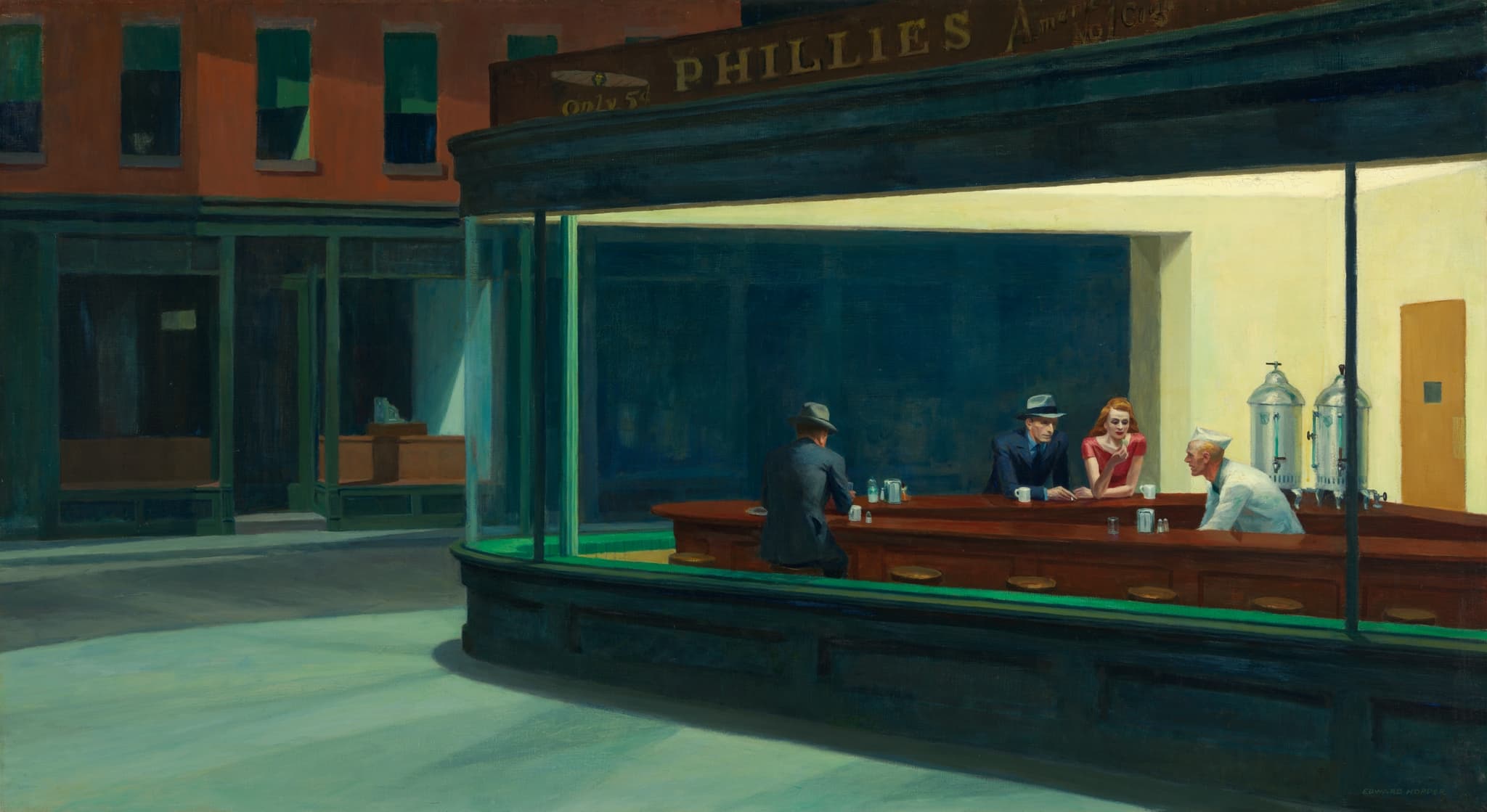
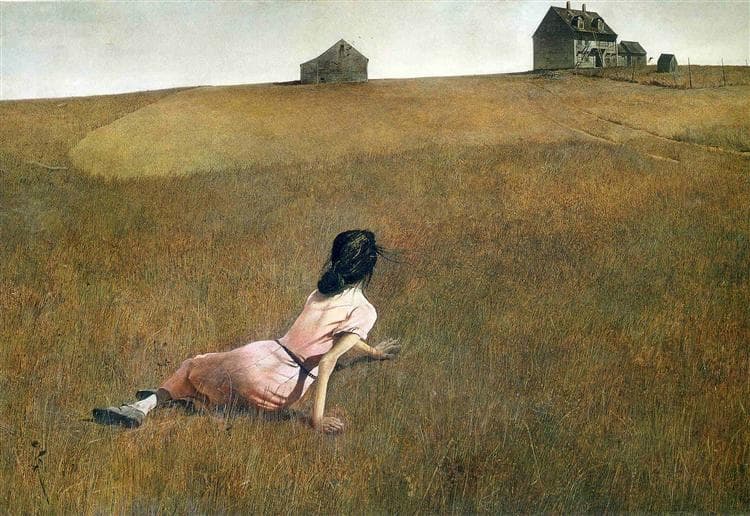
Hopper and Wyeth treat realism as a tool for inner life, not reportage. Each builds scenes from observation but edits hard for meaning. In Nighthawks, Hopper enlarges the diner, fuses architectural sources, and removes a visible door; the picture becomes a lucid machine for distance rather than a transcript of one corner. Wyeth’s Christina’s World similarly composites person and place; the figure’s form, the stretched field, and the calibrated pink dress are chosen to turn space itself into resolve. Both artists prove that fact can be arranged without losing truth—realism as construction in the service of psychology.
Architecture, light, and thresholds carry the drama. Hopper’s windows and panes stage spectatorship: from New York Movie to Nighthawks, glass and engineered light choreograph how we watch. Wyeth makes thresholds his central metaphor; Wind from the Sea removes the figure and lets a moving curtain and salt air render attention visible. Absence and distance act as protagonists for both—Hopper’s emptied streets and long counters, Wyeth’s pared interiors and long approaches across fields. The result is a slow spectatorship: viewers infer backstory from exact but withholding images. Whether it is Hopper’s Sun in an Empty Room or Wyeth’s Groundhog Day, the spaces feel legible yet reserved, as if the rooms were thinking. That shared commitment—exactness plus reserve—gives their realism its quietly modern charge.
Decisive Difference
Their decisive split lies in how they stage seeing itself: public versus private. Hopper makes modern, public vision his subject—looking across plate glass under electric light. In Nighthawks, the diner’s continuous wedge of glass seals four figures in view while denying entry; fluorescent light exposes and estranges at once. Even when he shows daylight, it behaves like a planar instrument that clarifies surfaces as if on a set. His cinematic framings and simplified, composite architectures instruct us to stand outside and watch, caught in the ethics of urban spectatorship: visible clarity, withheld access.
Wyeth turns inward, modeling a private attention attuned to material and air. Egg tempera’s matte grain, drybrush watercolor, and weathered wood slow the eye until touch feels possible. Wind from the Sea is less a view than a breathing threshold; a torn curtain, a moving draft, and a scuffed sill become the picture’s actors. In Christina’s World and Groundhog Day, time is durational—wear, memory, and season accumulate; even absence is thick with use. Where Hopper’s light flattens space into lucid planes, Wyeth’s textures thicken it into lived matter. Put simply: Hopper tests how we see in public—through panes, signage, and engineered light—while Wyeth tests how we attend in private—through grain, air, and the patient reading of rooms. That divergence reveals two philosophies of modern realism: exposure versus intimacy.
Paired Works
Locked out vs drawn in
Focus question: What changes when a painting positions us outside glass versus down in the grass?
Nighthawks vs Christina's World
Windows as instruments of attention
Focus question: Is the window a stage for a figure or a threshold that pictures air itself?
Morning Sun vs Wind from the Sea
Two philosophies of emptiness
Focus question: When a room is ‘empty,’ what remains to be seen?
Sun in an Empty Room vs Groundhog Day
Why This Comparison Matters
This pairing clarifies how realism can think. Hopper shows that modern visibility—glass, signage, engineered light—has an ethics: we see more and share less. Wyeth shows that attention—grain, draft, wear—has a tempo: looking slows until rooms and fields answer back. Learning to read their spaces changes how we read our own. Are we standing outside a pane with perfect clarity but no access, or are we close enough to feel the air move? The answer shifts how we meet ordinary places, from a storefront at night to a winter kitchen. Hopper and Wyeth teach that the stakes of painting are not only what is pictured but how looking is organized—public exposure versus private intimacy. That choice still structures daily vision, from city glass to domestic thresholds.
Related Links
Sources
- Art Institute of Chicago, Edward Hopper: Nighthawks (object page)
- Art Institute of Chicago, Nighthawks (feature)
- Whitney Museum, Hopper Drawing (exhibition)
- Whitney Museum, Edward Hopper’s New York (essay)
- MoMA, Christina’s World (object page)
- National Gallery of Art, Andrew Wyeth: Looking Out, Looking In
- Tucson Museum of Art, Experimenting with Egg Tempera
- Columbus Museum of Art, Pocketguide to CMA: Edward Hopper’s Morning Sun
- Smithsonian Magazine, Wyeth’s World
- EurekAlert, New study points to Charcot–Marie–Tooth disease in Christina Olson
- MoMA, New York Movie (object page)