Order and Duration in American Realism
Two exacting realists turned unremarkable houses and fields into American emblems. Grant Wood engineers public images of order—frontal, type‑like, and polished. Andrew Wyeth builds private, time‑saturated seeing—oblique, granular, and felt through thresholds.
Comparison frame: How do Wood’s frontal emblems and Wyeth’s time‑soaked distances ask us to see ordinary places as different kinds of truth?
Quick Comparison
| Topic | Andrew Wyeth | Grant Wood |
|---|---|---|
| Core aim | Codify an ethic; public emblems | Register lived time; private seeing |
| Usual vantage | Frontal, centered, close | Oblique, distant or through windows |
| Surface and medium | Oil with enamel‑like smoothness; crisp contours | Egg tempera on panel; matte, granular detail |
| Architecture’s role | Moral device and emblematic geometry | Repository of weathering, memory, and time |
| Space as meaning | Compressed, patterned clarity | Stretched diagonals; distance as feeling |
| Tone | Declarative, sometimes satirical | Intimate, elegiac |
| Iconic site | Eldon, Iowa Carpenter‑Gothic cottage | Olson House, Cushing, Maine |
| Viewer’s task | Read types and symbols; decode order | Sense duration and atmosphere; inhabit looking |

Shared Ground
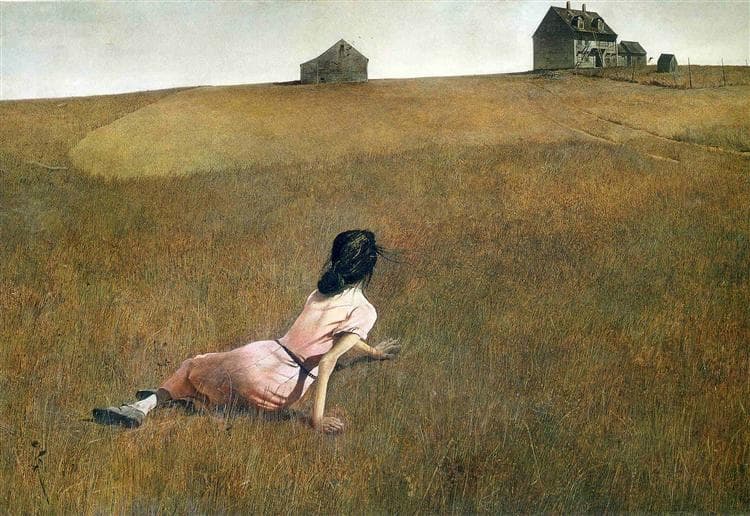
Grant Wood and Andrew Wyeth share a discipline that looks backward to pre‑modern craft and turns ordinary rural places into lasting images. Wood hardens Northern Renaissance clarity into a polished, emblem‑ready finish; Wyeth revives egg tempera to build a dry, factual surface where texture carries feeling. Each anchors meaning in a single, recognizable structure—the Eldon, Iowa Carpenter‑Gothic cottage behind the figures of American Gothic, and the Olson House on a Maine rise in Christina’s World and scores of other works. These houses are not backdrops; they act as centers of gravity where character, labor, and belief condense.
Their realism is selective and stern. Both strip away anecdote to let composition shoulder ambiguity. American Gothic reads as both tribute and scrutiny of Midwestern probity; Christina’s World operates as a psychological landscape rather than a portrait. Working largely outside New York’s avant‑garde orbit, both produced canonical images now housed in major museums. And both convert endurance into form: Wood through frontal symmetry, echoing verticals, and isolated implements that become signs; Wyeth through long diagonals, thinned horizons, and windows that stage looking itself. The shared ground is a precise, local realism that seeks durable meaning in vernacular sites—houses, fields, and the weathering of material life.
Decisive Difference
The decisive split is how each artist makes painting see. Wood imposes order. He engineers frontal, public emblems with hard‑edged finish and carefully chosen props that legislate an ethic of work and restraint. American Gothic compresses meaning into a near‑symmetrical face‑off of bodies and gable, the pitchfork rhyming every vertical seam into a metronome of discipline. In landscape, such as Fall Plowing, he turns rolling ground into banded design and isolates a plow as a sign. Even his irony (as in Daughters of Revolution) is architectural—types posed for inspection. Wood’s clarity is declarative, forged by his close study of Northern Renaissance precision and the sober exactness of Germany’s Neue Sachlichkeit, then redeployed on Midwestern matter.
Wyeth, by contrast, discovers duration. He composes obliquely and at a remove; thresholds and windows become instruments for seeing time. Wind from the Sea makes air visible as net curtains billow inward, turning a momentary breeze into subject. Christina’s World stretches a diagonal from figure to farmhouse so that distance itself becomes feeling—longing, stamina, return. Egg tempera’s matte, granular touch keeps attention on weathered surfaces and slow accumulation. The Olson House recurs not as emblem but as a repository of lived time and memory. Where Wood codifies a social ideal into fixed signs, Wyeth slows looking into experience—private, phenomenological, and elegiac. Both are exacting; they simply harness exactitude to different truths.
Paired Works
A house as worldview
Focus question: What kind of truth does the farmhouse carry—codified order or measured experience?
American Gothic vs Christina's World
Air and earth made visible
Focus question: How does each artist use a single near object to define how the whole scene is seen?
Study for Fall Plowing vs Wind from the Sea
Pattern and pause
Focus question: When detail is exact, does it declare an ideal or mark an interval?
Why This Comparison Matters
Putting Wood beside Wyeth clarifies what “realism” can do. It is not one style but two different commitments. In Wood, exactness becomes civic: forms are tightened until they function as emblems a culture can read—work, reserve, endurance. In Wyeth, exactness becomes experiential: details are tuned so that time, weather, and memory register in the smallest surfaces and distances. The comparison equips viewers to parse American images of place—when a house asserts an ethic and when it stores a life’s duration.
This lens also helps situate both artists in the twentieth century without clichés about nostalgia or anti‑modernity. Wood’s engineered clarity answers European precision with local subjects; Wyeth’s thresholds edge toward abstraction’s concerns with perception. Understanding their shared craft and core difference makes familiar icons newly legible, and teaches a practical habit: look for where realism points—toward public order or toward lived time.
Related Links
Sources
- Art Institute of Chicago: American Gothic overview and reception
- American Gothic House Center: Eldon Carpenter‑Gothic cottage
- Whitney Museum: Grant Wood biography and technique
- National Gallery of Art: Andrew Wyeth—Looking Out, Looking In (windows/thresholds)
- MoMA Collection: Christina’s World
- MoMA Magazine: Wyeth’s tempera process and surface
- Figge Art Museum: Study for Fall Plowing
- Cedar Rapids Museum of Art: Grant Wood overview (incl. Young Corn)
- Philadelphia Museum of Art: Andrew Wyeth, Groundhog Day
- National Gallery of Art: Wind from the Sea
- Cincinnati Art Museum: Grant Wood, Daughters of Revolution
- Farnsworth Art Museum: The Olson House and Wyeth