Two ways to make seeing the subject
Monet and Seurat both turn painting into a test of perception. One designs vision into a stable order; the other stages vision as a changing event. Set them side by side to see how light, water, and method pull the eye in opposite directions yet rest on shared ground.
Comparison frame: How do Seurat’s engineered harmonies and Monet’s atmospheric envelopes ask us to see differently: as ordered systems versus experiences in time?
Quick Comparison
| Topic | Claude Monet | Georges Seurat |
|---|---|---|
| What a painting promises | A calibrated, stable fusion of color and line at a chosen distance | A time-stamped encounter where light keeps remaking forms |
| Organizing principle | Harmony of tone, color, line; axial spacing; classicizing profiles | Atmospheric enveloppe; fixed vantages in series; dissolving contour |
| Light behaves as | Measured illumination, often motionless and ordered | Weather—variable, environmental, and temporal |
| Role of line | Contour governs; profiles and clear edges carry order | Line erodes; color-intervals and reflections carry structure |
| Working method | On-site studies; studio-built compositions; divisionist microstructure | Multiple canvases in rotation; ensemble display; studio distillation |
| Water’s job | A planar mirror to test controlled color relations | A volatile membrane where sky and ground trade places |
| Modern leisure and scale | Monumental friezes of crowds and stages (Bathers; La Grande Jatte) | Everyday motifs claimed by changing light (Argenteuil, Thames, Giverny) |
| Viewer’s position | Optimal, centered distance to trigger optical fusion | Comparative and serial; meaning accrues across time |
Shared Ground
Monet and Seurat both redefine painting as a calibrated way of seeing, not a vehicle for anecdote. Each builds the picture around conditions of light and perception. Seurat channels color theory into divisionist touches and a governing grammar of tone, color, and line; Monet organizes canvases by the enveloppe, the pervasive atmosphere that tints everything equally. In both cases, what matters is how the eye fuses small differences into a legible whole.
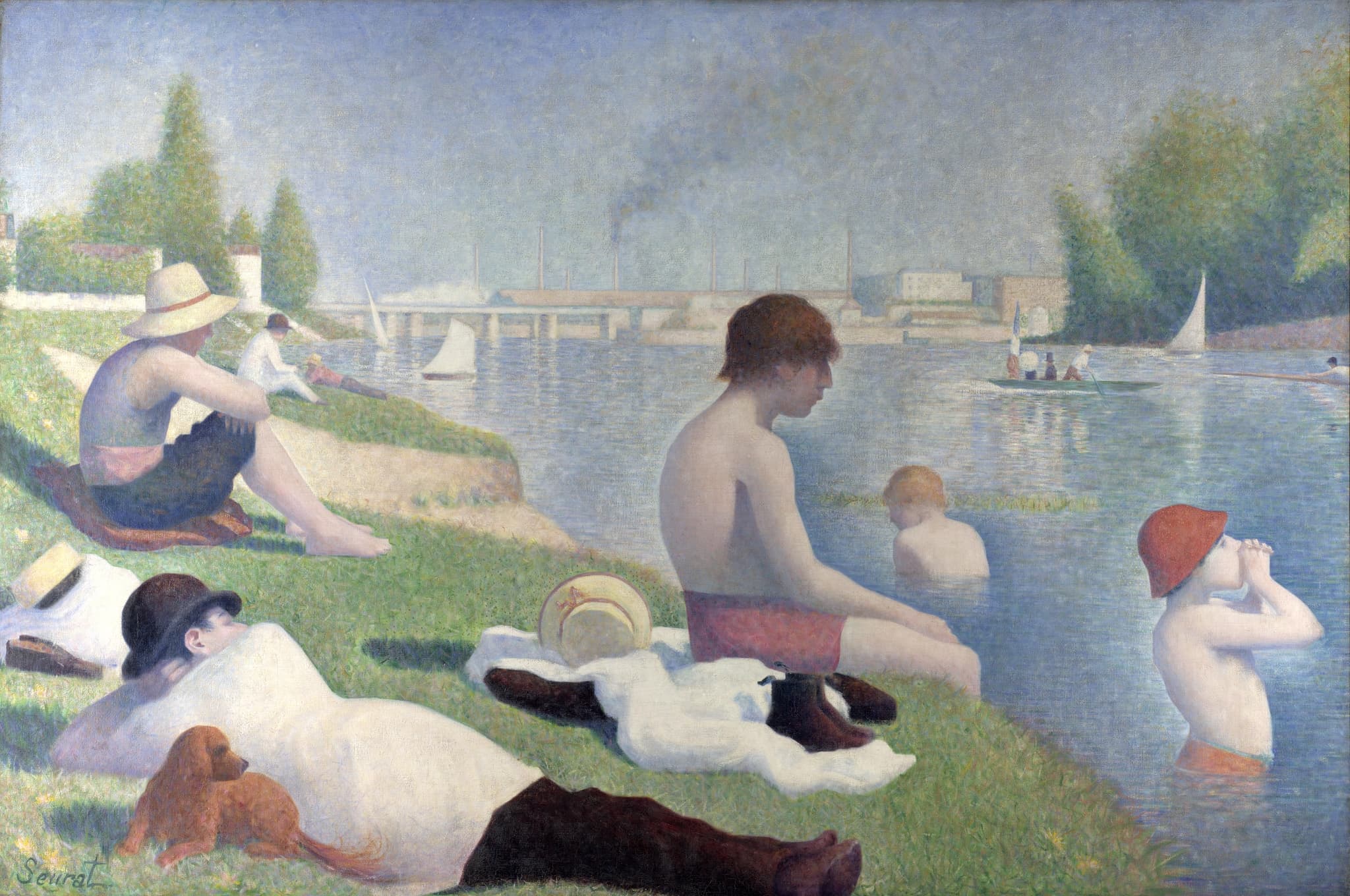
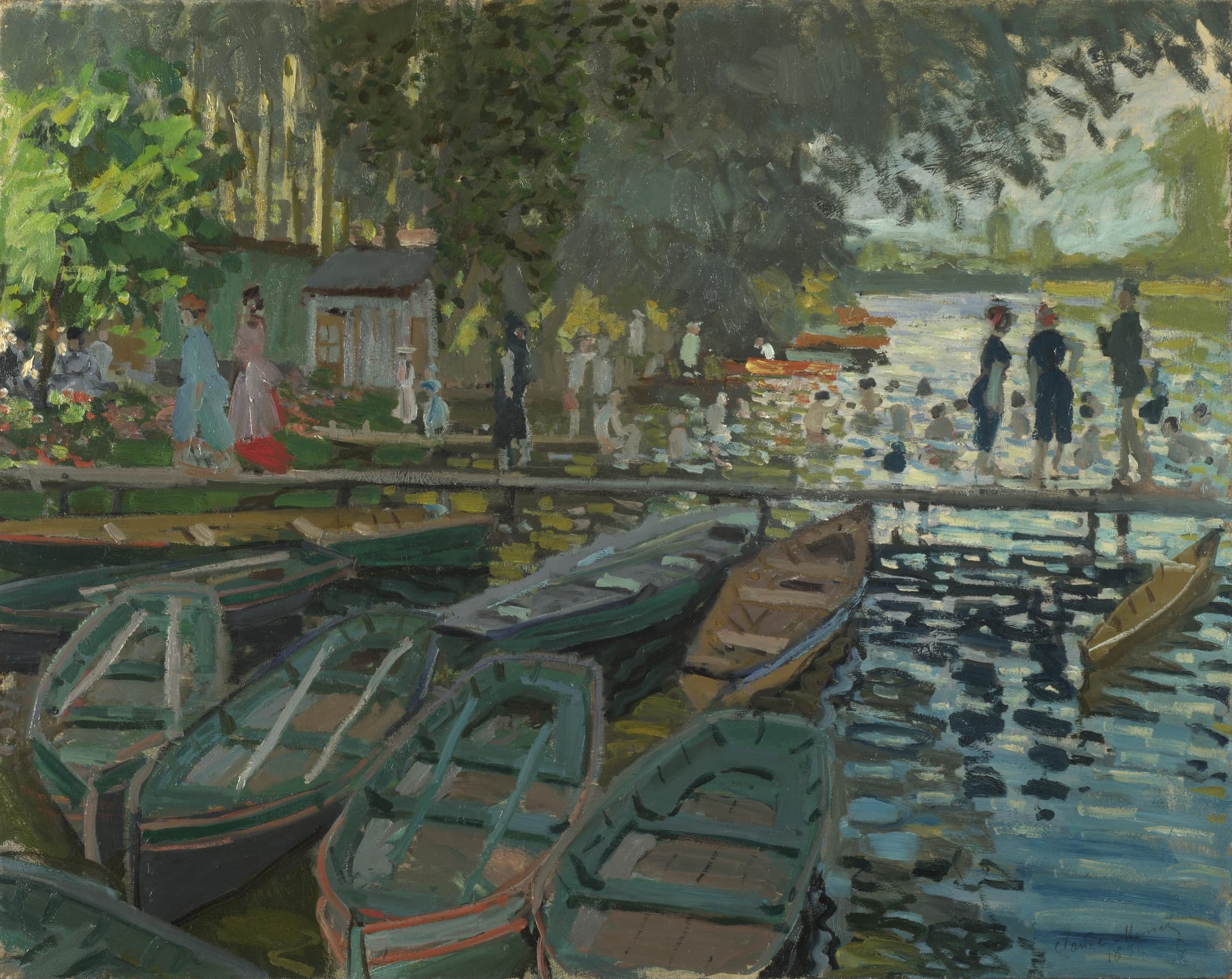
They also upgrade modern leisure to the scale of high art. Seurat’s Bathers at Asnières and A Sunday on La Grande Jatte—1884 marshal the Seine’s banks and crowds with monumental poise; Monet’s La Grenouillère and Argenteuil regattas claim riverside pleasure as a worthy subject through flicker and flux. Water becomes a laboratory for both: a surface that reflects, distorts, and serially tests color relations—whether under gasworks haze, suburban sunshine, or garden shade. Finally, each relies on a system. Seurat’s studio constructions grow from many measured oil and conté studies; Monet returns to fixed vantages across hours and seasons, then often synthesizes multiple sittings back in the studio. In short, they share a modern program: paint not stories, but seeing itself—how light, distance, and attention organize the world.
Decisive Difference
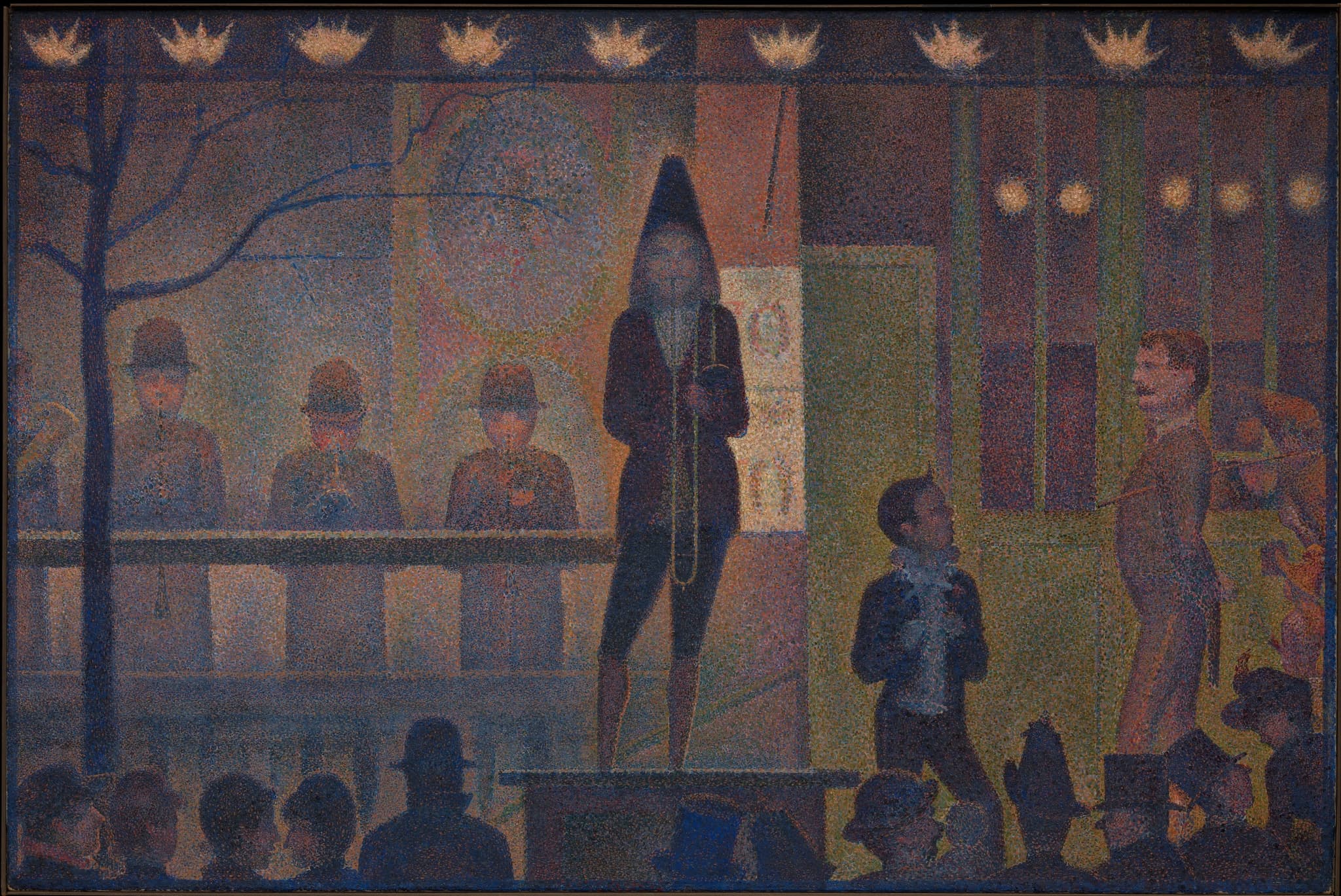
What they ask painting to do with perception diverges. Seurat engineers a stable order of seeing. His large canvases function like optical machines: divisionist touches calibrated to fuse at a viewing distance; clear profiles that read at once; macro-structures—horizontals, verticals, axial balances—that hold crowds and stages in equilibrium. Even the painted dot-border on La Grande Jatte regulates the transition from picture to frame. Night scenes such as Circus Sideshow count and diagram artificial light into a ritual rhythm, turning spectacle into measured harmony. The result is an art that designs vision—harmonizing tone, color, and line so the eye arrives at a controlled, timeless clarity.
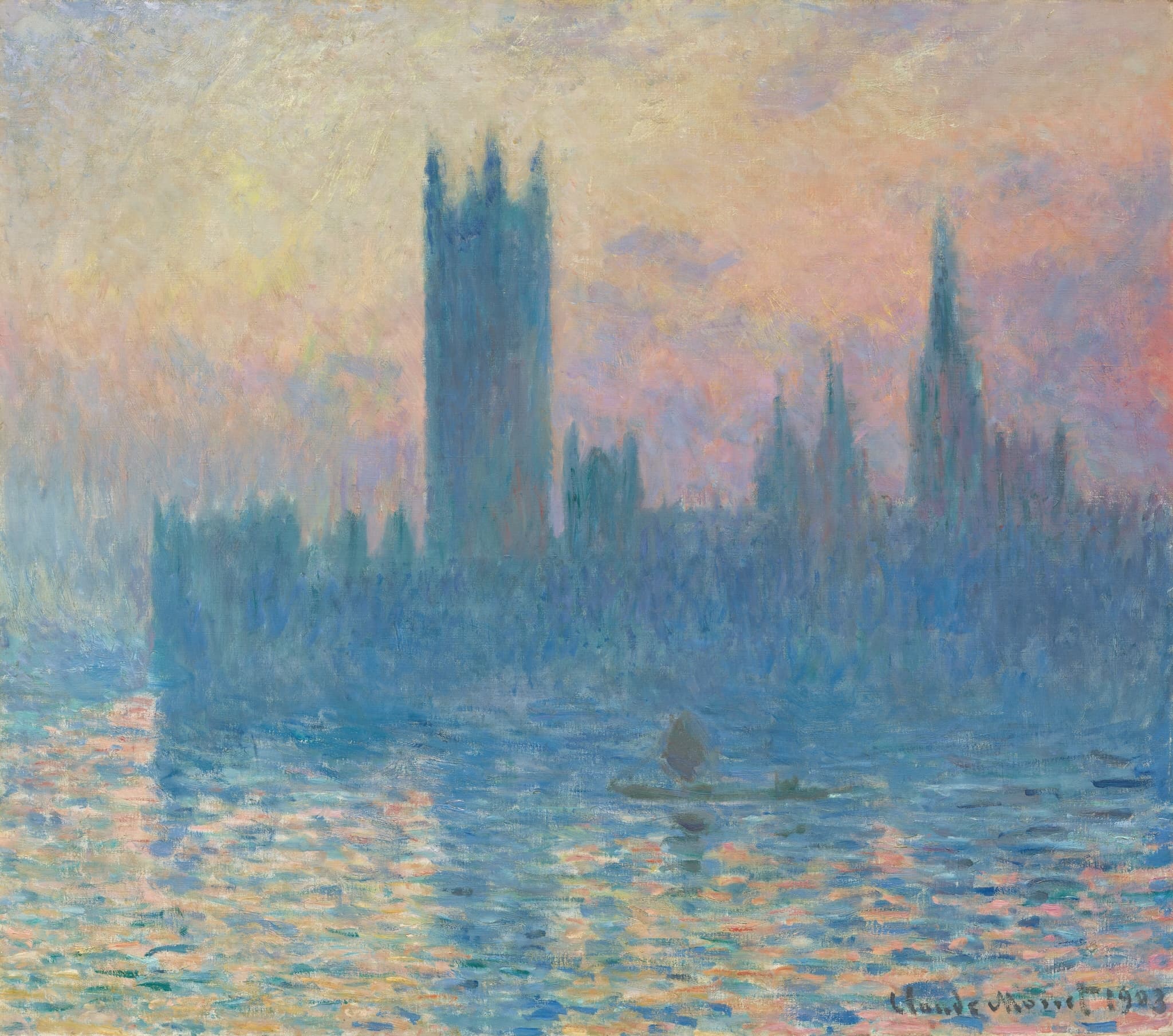
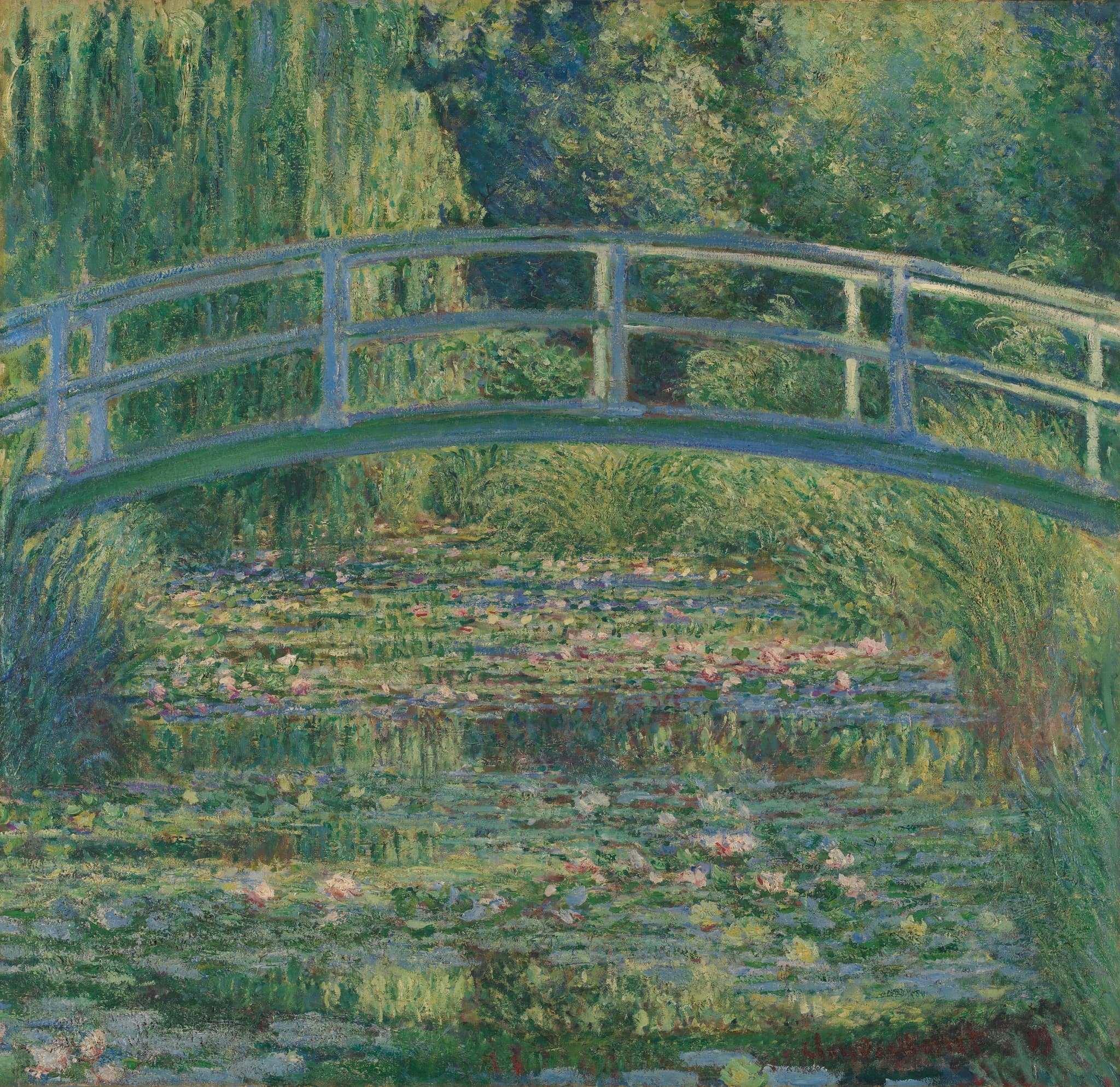
Monet, by contrast, stages a time-bound encounter. His “envelopes” make viewers register hour, weather, and season; meaning unfolds through serial comparison and the felt instability of contour. In the Thames and Venice canvases, architecture becomes an armature for atmosphere; in the garden at Giverny, sky and water swap roles so reflection structures the scene. Many works were completed in the studio to distill multiple sittings into a single time-sensation. Where Seurat secures forms and lets color vibrate within them, Monet lets color and light erode form so the world appears as duration. Put simply: Seurat stabilizes seeing; Monet temporalizes it. That difference—designed harmony versus experiential weather—reveals two fundamental answers to what painting should make our eyes do.
Paired Works
River leisure, two optics
Focus question: What happens to the Seine when stillness meets flux?
Bathers at Asnières vs La Grenouillère
Public leisure as optical program
Focus question: How do crowd and color become order versus weather?
A Sunday on La Grande Jatte—1884 vs Regattas at Argenteuil
Urban light systems
Focus question: What does light do to power and spectacle?
Circus Sideshow (Parade de cirque) vs Houses of Parliament
Water as a thinking surface
Focus question: How do surfaces structure perception?
The Channel of Gravelines, Grand Fort-Philippe vs The Water Lily Pond
Why This Comparison Matters
This pairing clarifies two durable models for modern vision. Seurat shows how a painting can be designed as a stable system—micro-touches, clear profiles, and balanced axes cohere into a legible, timeless order. Monet shows how a painting can stage experience in time—vantage, weather, and reflection fold the motif into an atmospheric event that can only be grasped comparatively, across moments and canvases.
Seeing these logics side by side helps decode a century of art that follows. Abstraction inherits Seurat’s belief in constructed harmony; photography, film, and environmental art inherit Monet’s insistence that conditions—light, air, pollution—are content. The same river, bridge, or façade can either be engineered into clarity or allowed to become weather. Learning to recognize which claim a picture is making—stability or duration—sharpens how we read not just paintings, but images everywhere that ask our eyes to complete the work.
Related Links
Sources
- National Gallery, London — Georges Seurat, Bathers at Asnières
- Art Institute of Chicago — Seurat and the Making of La Grande Jatte
- The Metropolitan Museum of Art — Seurat: Circus Sideshow exhibition materials
- National Gallery, London — Claude Monet, The Water-Lily Pond
- National Gallery, London — Seurat, The Channel of Gravelines, Grand Fort-Philippe
- National Gallery of Art, Washington — Monet, Rouen Cathedral: West Façade
- The Met Heilbrunn Timeline — Neo‑Impressionism (Fénéon’s coinage; Seurat’s program)
- The Met — Monet’s Houses of Parliament (Effect of Fog)
- Royal Society (2006) — Solar geometry and Monet’s London series
- PNAS (2023) — Atmospheric pollution and the optics of Impressionist skies
- National Gallery, London — Claude Monet, Bathers at La Grenouillère
- Musée d’Orsay — Regattas at Argenteuil