Emblem vs stage of looking
Both painters build American scenes that feel factual yet are engineered to govern how we look. Storefronts, windows, and calibrated light become rules for access and knowledge. Wood turns clarity into a civic emblem; Hopper turns clarity into a viewing predicament.
Comparison frame: From Gothic window to plate glass, how do Wood’s emblems of order and Hopper’s stages of looking organize what we can see—and what we can share?
Quick Comparison
| Topic | Edward Hopper | Grant Wood |
|---|---|---|
| Core aim of painting | Public emblem and visual code | Situation for perception; a staged watch |
| Spatial design | Axial frontality; tight symmetry; icon-like | Composite spaces; simplified forms; withheld entry |
| Light’s job | Even daylight that asserts moral clarity | Theatrical/fluorescent pools that separate and delay |
| Architecture’s role | Ethical armature (gable, porch, trim) that codifies conduct | Threshold machine (glass, counters, tracks) that estranges |
| Signage and text | Historical or emblematic references; minimal signage | Commercial signs dominate or are pared to vagueness |
| Human relations | Type-like figures; satire within orthodoxy | Solitary interiority; narrative withheld |
| Viewer’s position | Frontal witness before an icon | Outside the glass; no door in |
| Touchstone works | American Gothic; Daughters of Revolution | Nighthawks; Early Sunday Morning |
Shared Ground
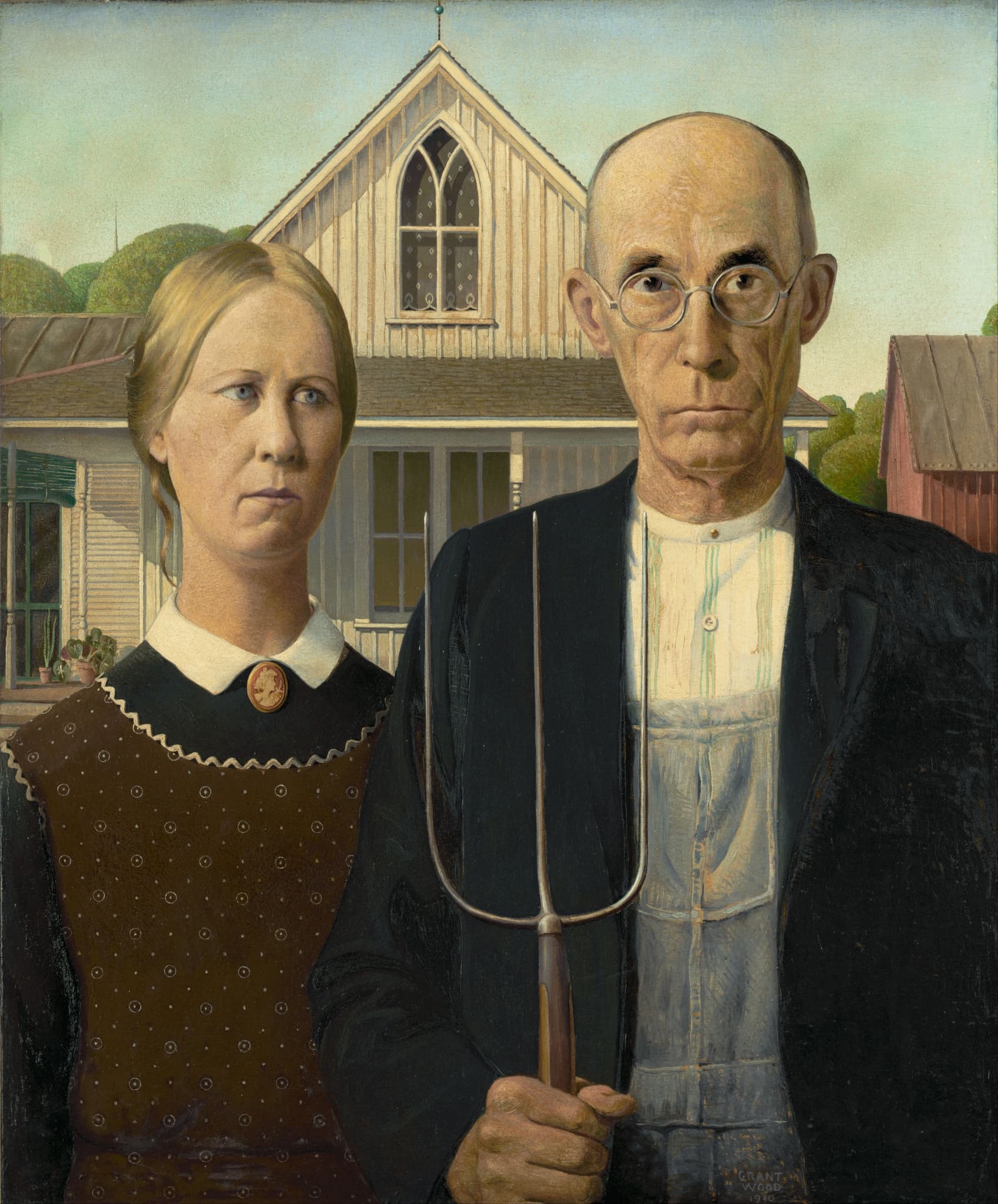
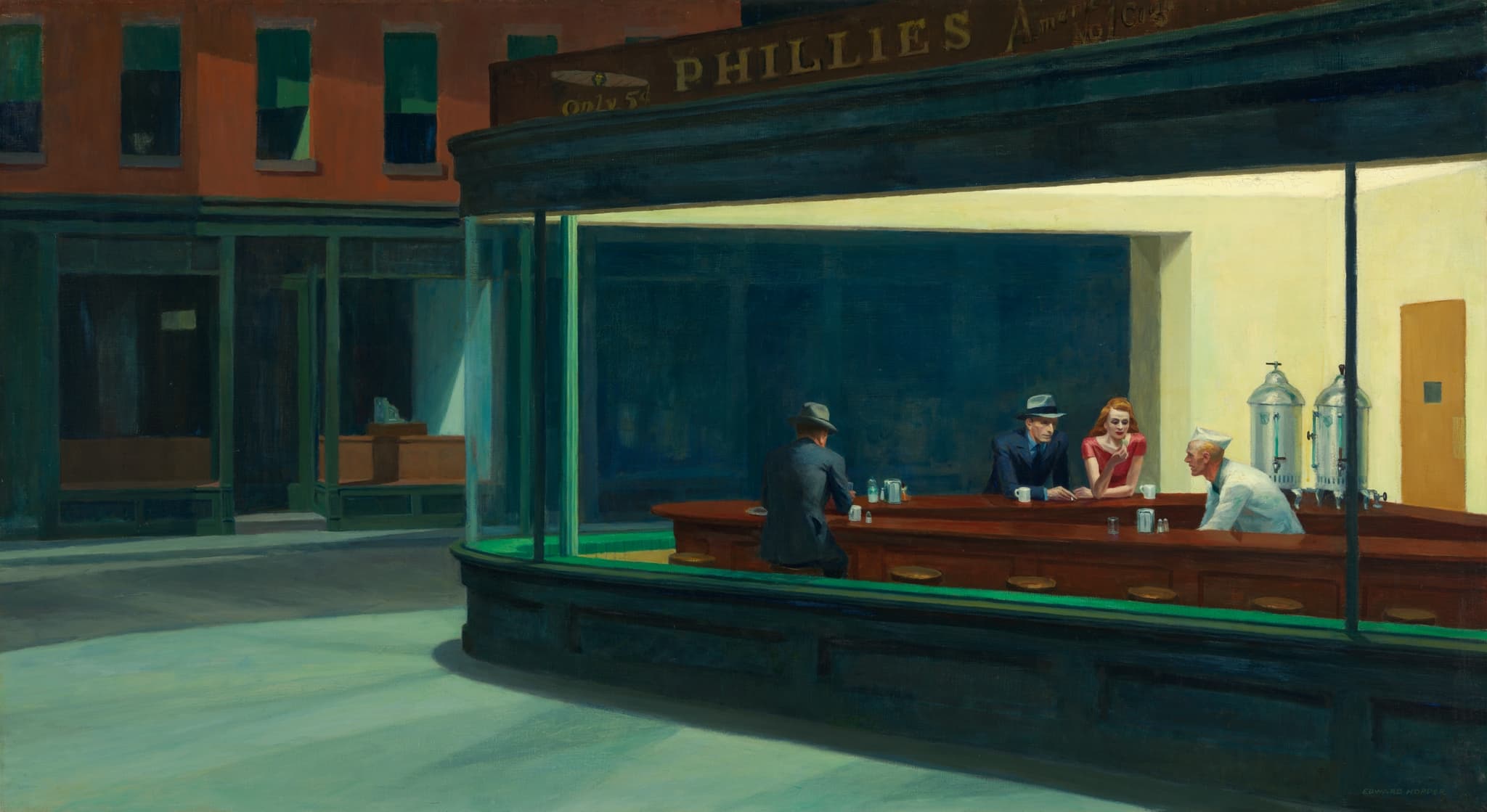
Hopper and Wood practice constructed realism: scenes that feel observed yet are deliberately built to control vantage and knowledge. Hopper wrote that he simplified Nighthawks and enlarged the diner, even removing a visible entrance, so the viewer becomes a late passerby pressed to the glass. In Early Sunday Morning he reduced a Seventh Avenue block to bare essentials—trimmed signage, distilled shadows—to model a universal street. Wood’s American Gothic is likewise engineered rather than casual: its axial frontality, rhyming verticals, and signature Gothic window make rectitude a compositional law rather than a personality trait.
Architecture is not backdrop but a meaning engine for both painters. Hopper’s House by the Railroad sets a Victorian façade behind railroad tracks that read as a visual barrier, turning a home into an isolated relic. Wood crowns his farmer and daughter with a Carpenter Gothic arch, elevating their pose into a creed. Their clarity produces ambiguity: Hopper’s lucid light still withholds what the figures feel; Wood’s immaculate surfaces leave us unsure whether we witness tribute or satire. Place, in each case, becomes a grammar of panes, eaves, rails, and counters that choreographs attention and social codes. The result is American realism that is less about recording incidents than about designing how the ordinary should be seen.
Decisive Difference
What painting is for divides them. Wood treats the image as a civic emblem and code. Trained on Northern Renaissance precision and sharpened by encounters with Neue Sachlichkeit, he compresses people and buildings into cool, frontal icons that ask to be measured. In American Gothic, the pitchfork, window muntins, and gable align like commandments; order is the subject. When he pushes toward critique—as in Daughters of Revolution, where elderly patriots pose before a reproduction of a Revolutionary myth painted in Germany—the satiric bite arrives through the same polished exactitude. Wood’s clarity legislates: it turns regional detail into a public ideal, sometimes honoured, sometimes punctured.
Hopper treats the image as a situation for perception. He builds composite spaces from studies, subtracting entries, sanding text to near-generic signs, and using modern light as a separator. In Nighthawks the fluorescent wash and curved glass stage spectatorship itself—you can look, not enter. New York Movie divides the theater into illuminated and dim compartments so the usherette’s inwardness becomes the drama, while Early Sunday Morning pares a street to bands of color and illegible signage to make a universal city of waiting. In short: Wood engineers icon-like order (the picture as public emblem); Hopper engineers viewing predicaments (the picture as private, cinematic watch). The split is not rural versus urban, but emblem versus mise-en-scène.
Paired Works
Glass vs gable: rules for looking
Focus question: What changes when clarity becomes a creed versus a viewing trap?
Civic piety vs private thought
Focus question: How do staged interiors produce public virtue in one picture and private thought in the other?
Daughters of Revolution vs New York Movie
Making truth by showing the artifice
Focus question: How do both artists literalize fabrication to recalibrate belief?
Parson Weems' Fable vs Early Sunday Morning
Façade as character
Focus question: When architecture stands in for people, does it bind or estrange?
American Gothic vs House by the Railroad
Why This Comparison Matters
This pairing clarifies two powerful uses of realist clarity. Wood shows how precision can become public iconography—rules, virtues, and myths compressed into frontal design. Hopper shows how the same precision can become a psychological architecture—glass, counters, and light arranging our distance from one another. Seeing the difference trains the eye for more than style. It teaches how pictures script our role as viewers: sometimes as citizens weighing a code, sometimes as watchers held outside the glass.
Once you recognize that architecture, light, and signage are not neutral details but instruments that regulate access, you start reading American images differently—from farmhouses and town halls to diners and street corners. The question shifts from “What happened here?” to “What conditions of looking does this image build?” In that shift, Wood and Hopper become guides to how modern America sees itself: as emblem and as mise-en-scène.
Related Links
Sources
- Art Institute of Chicago — Hopper, Nighthawks (research site)
- Art Institute of Chicago — Edward Hopper, Nighthawks (object entry, artist remarks)
- Art Institute of Chicago — Grant Wood, American Gothic (object entry)
- Whitney Museum of American Art — Edward Hopper, Early Sunday Morning (label)
- The Museum of Modern Art — Edward Hopper, House by the Railroad (label)
- The Museum of Modern Art — Edward Hopper, Gas (label on composite method and lighting)
- Cincinnati Art Museum — Grant Wood, Daughters of Revolution (object record)
- Amon Carter Museum of American Art — Grant Wood, Parson Weems' Fable (collection page)
- National Gallery of Art — Grant Wood (artist biography and European influences)
- Whitney Museum of American Art — Hopper Drawing (on constructed spaces and studies)