Order and Orchestration
Both artists built painting around optical mixture: separate colors on canvas so the eye completes them in view. From that shared premise, Seurat constructs a calm, classical architecture of sight, while Signac turns color into decorative, musical energy. Together they show two lucid answers to how modern painting can teach us to see.
Comparison frame: Both engineer the eye—why does Seurat’s system produce stillness while Signac’s yields radiating energy?
Quick Comparison
| Topic | Georges Seurat | Paul Signac |
|---|---|---|
| Central aim | Orchestrate chromatic energy into decorative harmony; color as music. | Stabilize vision into a classicizing order; art as harmony by line, tone, and tint. |
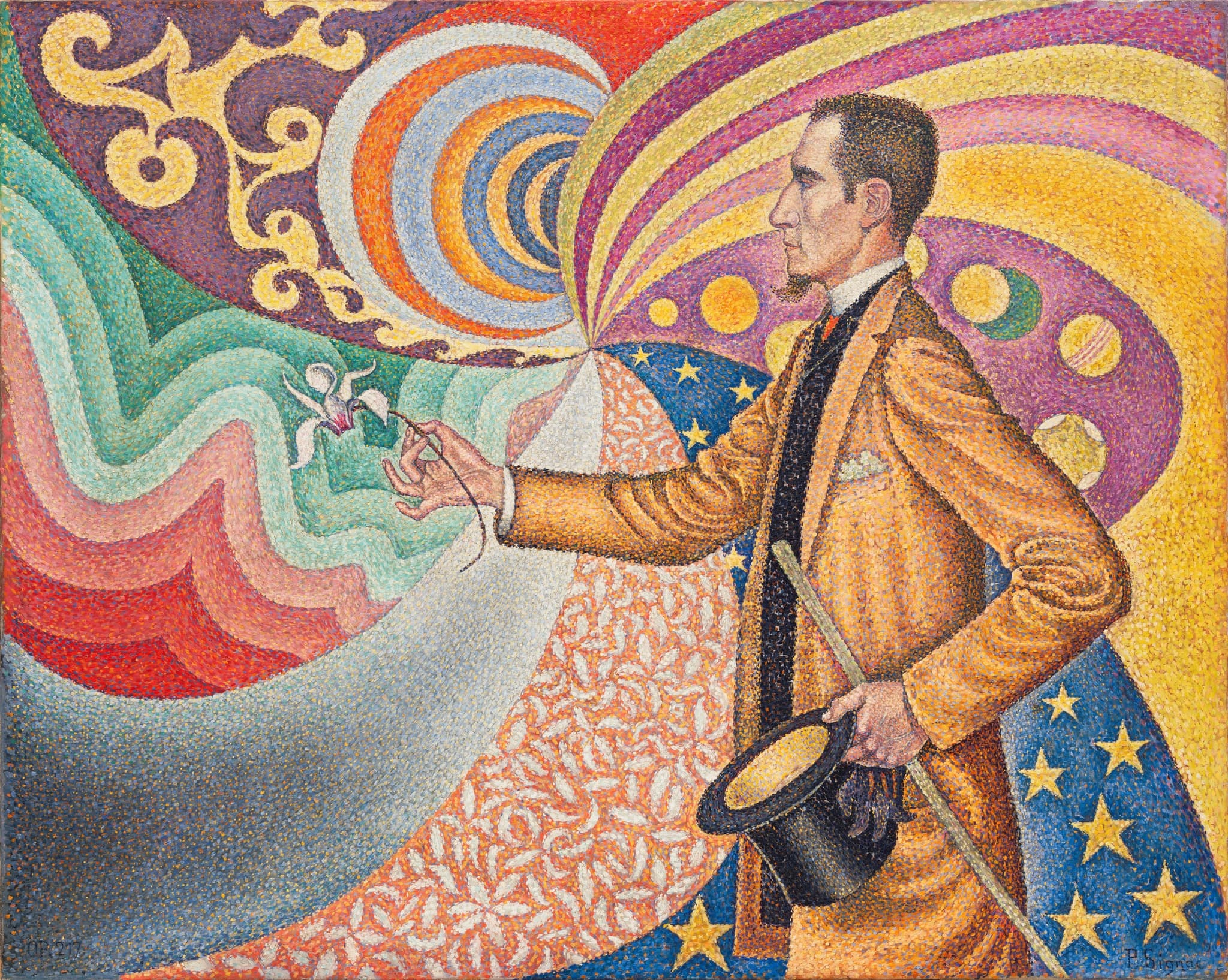
| Signature proof | Portrait of Félix Fénéon (Opus 217): theory staged as spectacle around a single profile. | A Sunday on La Grande Jatte — 1884: a crowd fused into a measured, architectonic whole. |
| Treatment of edges/frame | Patterned fields and, after mid‑1890s, larger mosaic‑like touches. | Disciplined “haloing”; in La Grande Jatte, a painted pointillist border unifies image and frame. |
| Mark/brushwork | From dots to broader tiles; ornamental rhythms and arabesques. | Even, fine touches that maintain planar clarity and tonal control. |
| Typical subjects | Ports, Mediterranean light, decorative allegories, portraits of allies. | Suburban leisure, gaslit nocturnes, circus and café‑concert thresholds. |
| Relation to theory | Public advocate; adopts Charles Henry’s expressive diagrams; 1899 treatise codifies the method. | Systematizes harmony internally; line, value, and color set a rule‑bound structure. |
| Emotional register | Calibrated radiance with utopian overtones. | Controlled stillness and ritualized mood. |
| Social note | Anarchist sympathies filtered through communal, decorative harmony. | Social contrasts observed but absorbed into formal balance. |
Shared Ground
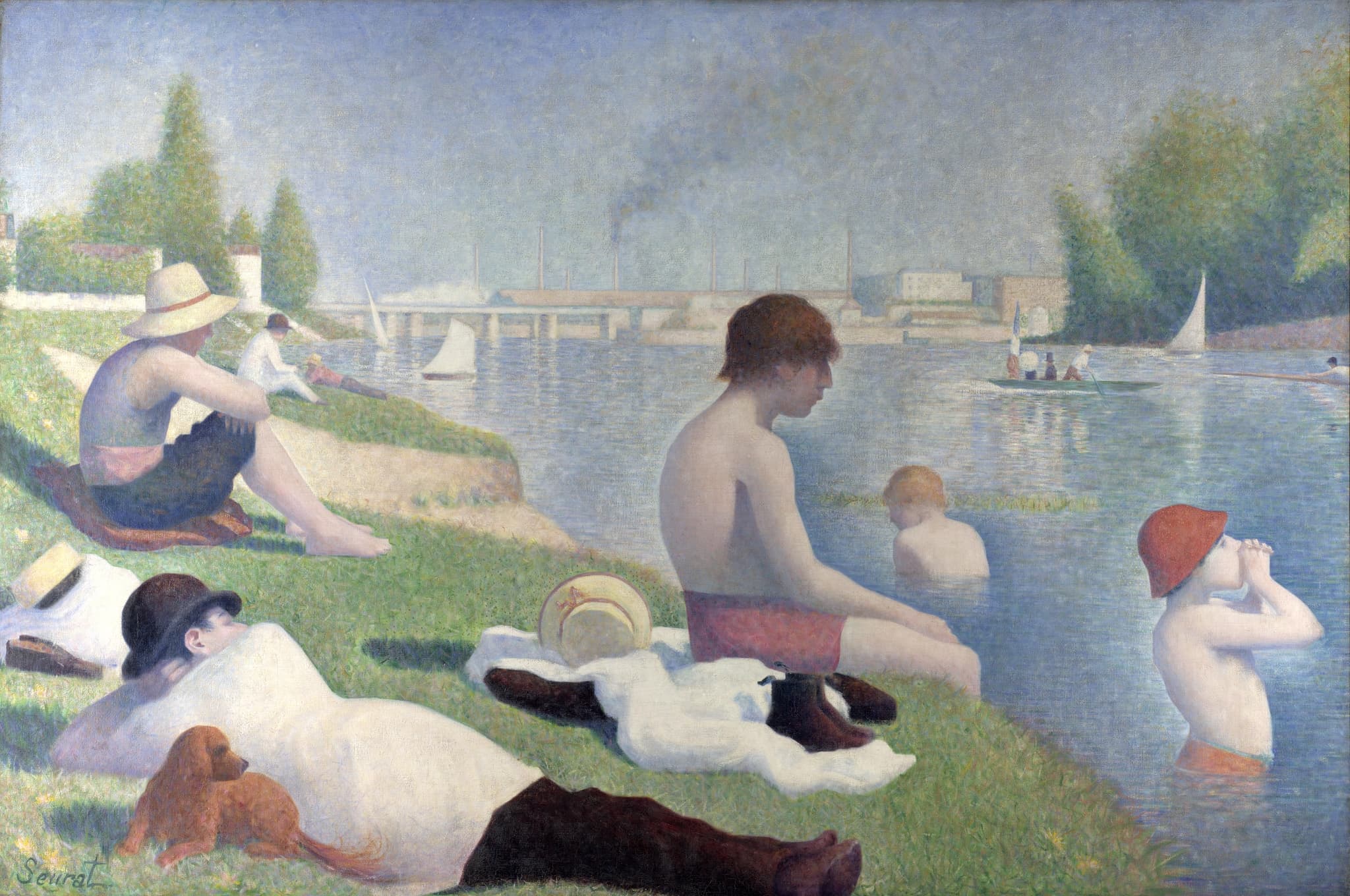
Seurat and Signac meet on the ground of optical construction. Instead of mixing pigments on the palette, they laid separate touches of pure color so that complements could blend in the viewer’s eye (Divisionism). This was not a mannerism of dots but a program drawn from contemporary color science. In practice it yielded surfaces that hum with calibrated interactions—orange beside blue, red keyed against green—so the picture’s light is built, not copied. You can see early and mature stages of this approach across emblematic works: Seurat’s Bathers at Asnières develops a unified, silvery envelope from measured strokes, while his La Grande Jatte goes so far as to ring the image with a pointillist border that fuses frame and field. Signac’s Cassis canvases divide the sea into prismatic chords, and his Portrait of Félix Fénéon turns optical theory into a visual engine of disks, spirals, and complementary contrasts.
They also share a conviction that modern life can bear classical weight when ordered by a system. Seurat treats suburban leisure and public spectacle with a frieze‑like, sculptural calm; Signac casts ports and communal allegories as decorative harmonies. Both worked through the Société des Artistes Indépendants and were championed under the name “Neo‑Impressionism,” with Signac later becoming its principal advocate in print and practice. Behind their differences lies a common ambition: to give modern subjects a legible structure and to make color itself a principle of order.
Decisive Difference
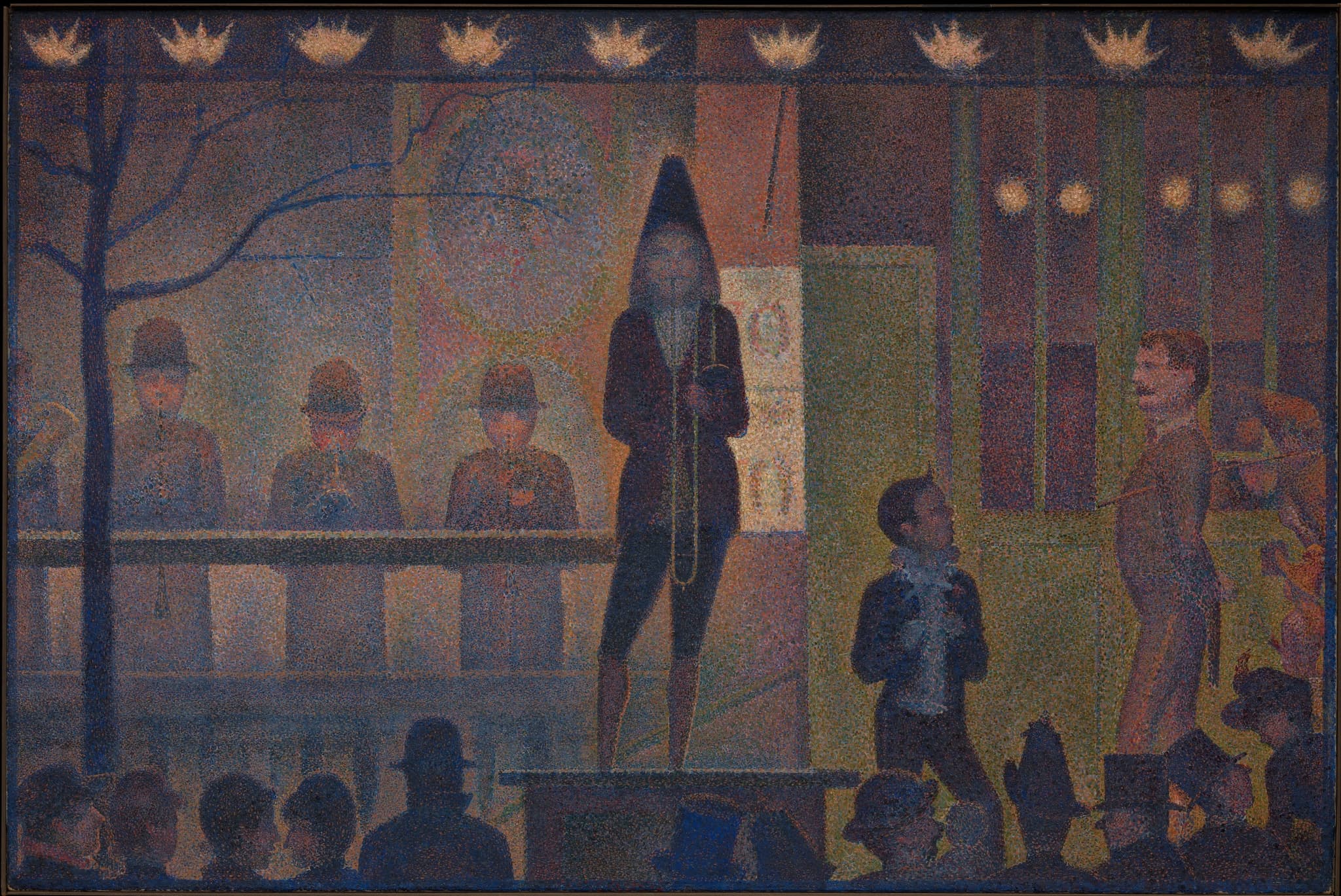
The split is not over science but over what the system is for. Seurat uses Divisionism to make seeing stable. He builds architectonic calm from line, tone, and tint: frieze‑like profiles, rigorously spaced silhouettes, and edges disciplined by subtle haloing. In A Sunday on La Grande Jatte — 1884, the crowd settles into a measured procession and even the painted dot border locks the scene into a self‑contained harmony. In Parade de cirque, nine gas jets mark time like a metronome; publicity is purified into ritual geometry. Even when he absorbs Charles Henry’s ideas on expressive line (as in Le Cirque), they serve a classicizing calculus: upward diagonals code gaiety within a larger, balanced scaffold.
Signac takes the same optical premises and makes color act. He literalizes harmony as orchestration—musical opus titles, whiplash arabesques, concentric disks—turning theory into a decorative and affective spectacle. Portrait of Félix Fénéon crowns a single profile with a vortex of complementary contrasts that becomes the actual subject. On the coast at Cassis, larger, mosaic‑like touches assemble the sea as a radiant field rather than a stable plane. In Au temps d’harmonie (retitled from Au temps d’anarchie after 1894), communal life is staged as a sunlit, patterned concord. If Seurat engineers a cool equilibrium, Signac seeks calibrated energy with social overtones. Put simply: Seurat stabilizes perception into form; Signac mobilizes color into force.
Paired Works
System or Spectacle: Two Manifestos
Focus question: What does each artist make the true subject of Neo‑Impressionism: a stabilized social tableau or color harmony itself?
Portrait of Félix Fénéon vs A Sunday on La Grande Jatte—1884
Mass Culture: Ritual vs Utopia
Focus question: How do their systems reshape public entertainment and communal life?
Au temps d’harmonie vs Circus Sideshow (Parade de cirque)
Water Organized
Focus question: What do their river and sea scenes reveal about how the method builds space and light?
Cassis, Cap Lombard, Opus 196 vs Bathers at Asnières
Why This Comparison Matters
This pairing clarifies two modern options for what a painting can do with perception. Seurat shows how a disciplined grammar of line, tone, and color can stabilize the flux of city life into an image of lasting order—an approach that seeded later interests in structure, from formalist design to geometric abstraction. Signac demonstrates how the same optics can orchestrate sensation and social hope, rendering harmony as calibrated radiance and opening a route toward color‑driven modernisms (his writings and example mattered for painters like Matisse). For viewers, the lesson is practical: Divisionism is not a “dot style” but a way of constructing light and mood, and small technical choices at the edge—spacing, touch, complements—change the moral temperature of a scene. Seeing how these two methods diverge helps decode countless modern pictures that balance structure against energy.
Related Links
Sources
- The Met, “Georges Seurat (1859–1891) and Neo‑Impressionism.”
- Art Institute of Chicago, “A Sunday on La Grande Jatte — 1884.”
- National Gallery, London, “Bathers at Asnières.”
- The Met, “Seurat’s Circus Sideshow (Parade de cirque).”
- MoMA, “Portrait of Félix Fénéon (Opus 217).”
- Kunstmuseum Den Haag, “Cassis, Cap Lombard, Opus 196.”
- BnF Catalogue, “Au temps d’harmonie / d’anarchie” (title history).
- Musée d’Orsay, “Le Cirque.”