Patterned Force vs Dissolving Atmosphere
Both artists make landscape a test site for energy. Hokusai builds legible patterns that let you read waves and weather; Turner immerses you in rain, steam, glare, and speed until outlines give way to sensation. Their diagonals do the work: a breaker about to fall; a locomotive bursting through rain.
Comparison frame: How do Hokusai and Turner turn landscape into a way to see forces—one by clarifying pattern, the other by dissolving form?
Quick Comparison
| Topic | Hokusai | J. M. W. Turner |
|---|---|---|
| Deep shared aim | Landscape as a lab for forces—currents, wind, weather | Landscape as a lab for forces—rain, steam, glare, speed |
| How the image is built | Line, silhouette, modular repetition; bokashi gradation | Glaze and scumble; vortex/diagonal recession; edges yielded |
| Anchor of stability | Fuji’s geometry and print clarity | Continuity of light and atmosphere, not outline |
| Signature diagonal | Cresting wave/boat arcs that frame Fuji | Onrushing rails and Brunel’s viaduct driving at the viewer |
| Materials/tech as vision | Prussian blue; uki‑e one‑point depth; planned tonal steps | Railway/steam as motif; RA perspective; industrial haze |
| Human work in frame | Identifiable oshiokuri‑bune crews under pressure | Boatmen, ploughman, and a hare set ethical scale for speed |
| Medium & audience | Reproducible color woodblock for a broad public | Singular oils that court ambiguity and immersion |
| What you feel first | Patterned, graspable structure of power | Perceptual overwhelm: weather overruns form |
Shared Ground
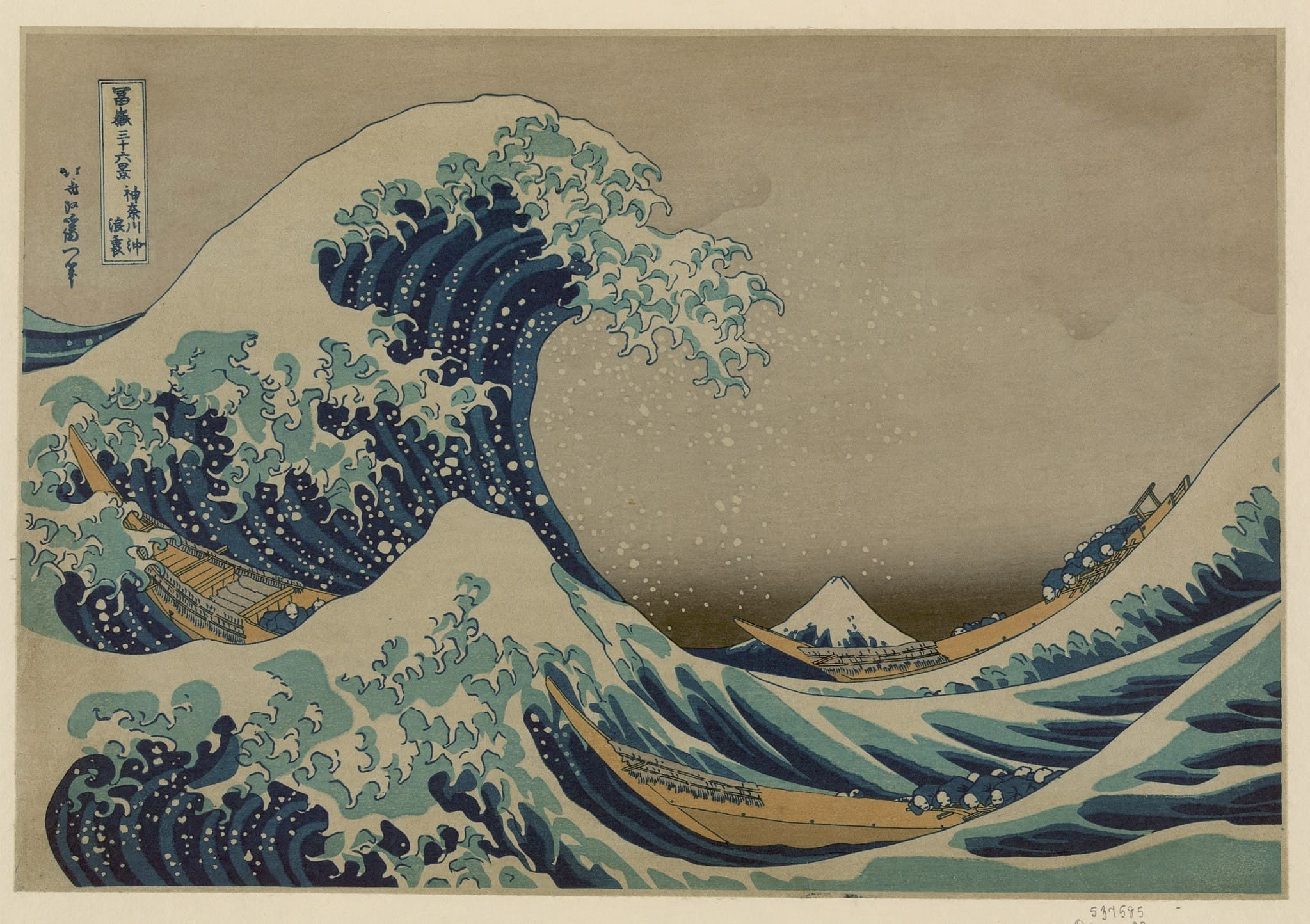
Hokusai and Turner both convert landscape into a way to picture forces, not merely places. In Hokusai’s The Great Wave off Kanagawa, a steep left‑leaning breaker, articulated by clawed foam and parallel boat arcs, compresses an instant when water’s power becomes legible. In Turner’s Rain, Steam and Speed, a dark locomotive thrusts along Brunel’s Maidenhead Viaduct, its diagonal rails and narrowing span manufacturing onrush as rain and light blur the world. In each, composition is an engine: a decisive thrust that makes energy visible and measurable to the eye.
New means unlock new seeing. Hokusai exploits Prussian blue (bero‑ai) and Western one‑point perspective to stack cool depth and telescope the viewer into the trough, an imported optics folded into ukiyo‑e craft by precise registration and bokashi tonal steps. Turner fuses the latest infrastructure—the Great Western Railway, a Firefly‑class engine, Brunel’s radical bridge—with the atmospheric techniques he taught as Royal Academy Professor of Perspective, so that weather and glare become active pictorial agents. Both also stage human work within larger systems: Hokusai’s oshiokuri‑bune crews shoulder commerce through swells; Turner counterposes a rower, a ploughman, and even a hare against a train’s velocity to gauge what speed displaces. Their icons are anchored, not abstract: Hokusai’s Fuji converses with Fuji‑kō devotion; Turner’s railway is a real line over the Thames. The result is a shared project—turning force into form—delivered with different optics.
Decisive Difference
Hokusai organizes force; Turner dissolves it. Hokusai’s prints clarify structure through line, silhouette, and modular repetition—wave teeth, boat ribs, Fuji’s triangle—so that energy reads as a patterned grammar. Prussian blue is stepped across planned impressions; bokashi gradations model depth without sacrificing contour. The result is legible power: a breaker’s cadence, a gust’s path, a mountain’s constancy—cycles that communal labor can anticipate and endure. His adoption of uki‑e perspective telescopes space cleanly, while the reproducible woodblock medium rewards precision and public readability.
Turner, by contrast, lets weather erode edges until objects verge on atmosphere. Glazes, scumble, and reflected light dissolve hulls, fields, and even masonry into veils of rain, steam, and glare. Perspective remains crucial, but as propulsion: diagonal recession and vortex structures project motion at the viewer, turning perception itself—dazzle, blur, veiling spray—into the subject. The singular oil supports risk and ambiguity; it asks you to feel how phenomena overrun form and how modern speed becomes a new sublime. Where Hokusai locates stability in Fuji’s geometry and the discipline of craft, Turner locates it in the continuity of light across change. Read side by side, they reveal two coherent answers to the same problem: make forces visible—either by binding them into pattern or by letting them flood the image.
Paired Works
Breaker vs Locomotive: when force becomes legible
Focus question: How does a diagonal turn raw power into something the eye can measure?
The Great Wave off Kanagawa vs Rain, Steam and Speed
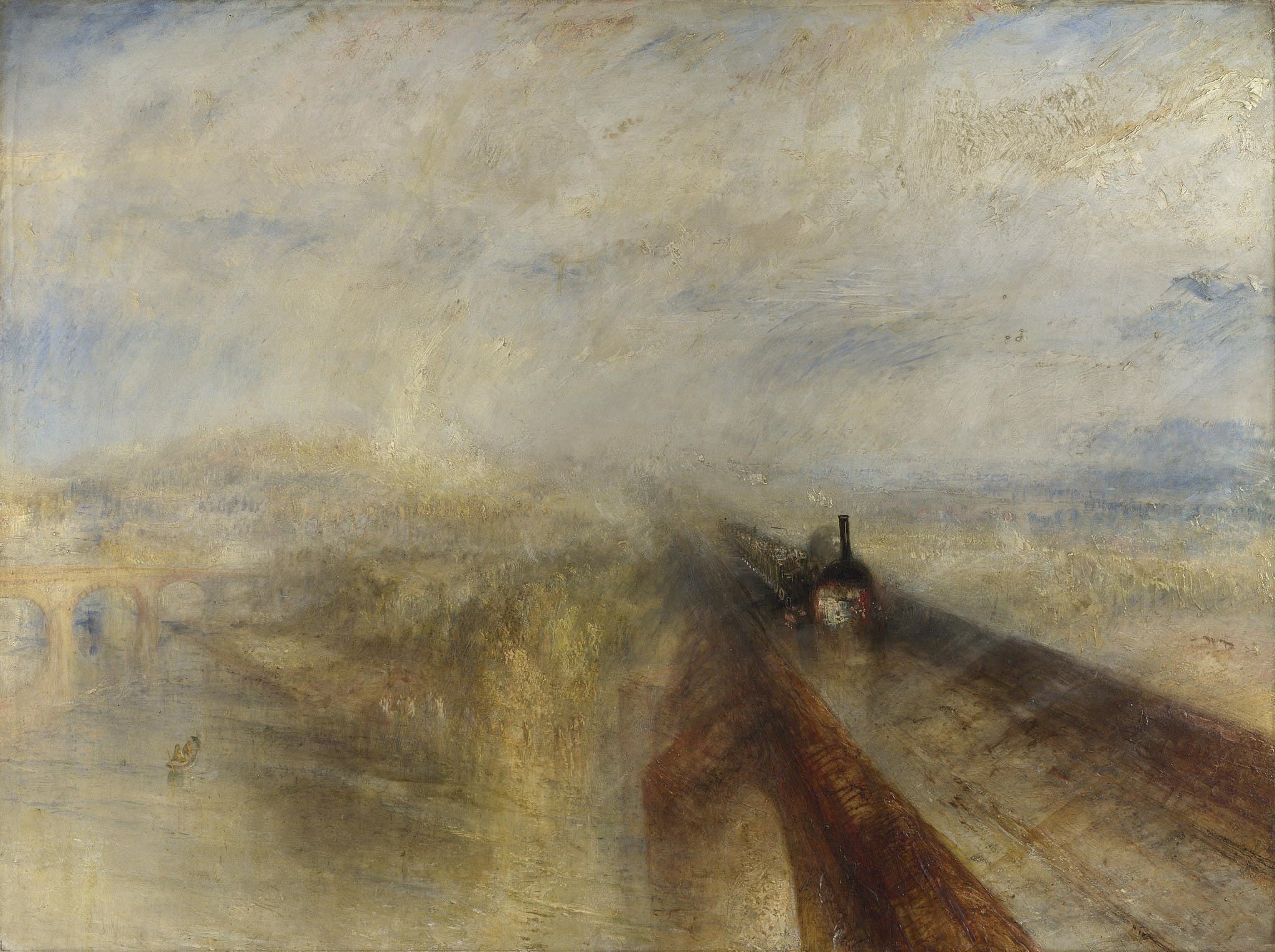
Both images manufacture impact with a commanding diagonal. Hokusai’s left‑leaning breaker lifts like a hinged door while oshiokuri‑bune stitch forward in parallel troughs; Fuji, miniaturized and centered, calibrates scale and calm. Prussian blue—new, deep, lightfast—builds cool volume in the sea, and Western one‑point perspective seats the viewer inside the trough so the crest’s fall is thinkable, not just theatrical. The scene reads as timed skill under pressure, not apocalypse.
Turner’s rails shrink to a single dark lance across Brunel’s Maidenhead Viaduct, projecting a Firefly‑class engine through rain that liquefies river and field. The diagonal does not describe motion; it produces it, as the world dissolves into tawny glare and wet scumble. Peripheral motifs—a small boat under pale arches, a ploughman, the near‑invisible hare ahead of the train—measure what industrial speed displaces. The decisive split appears in the handling: Hokusai’s line turns force into a repeatable pattern; Turner’s atmosphere turns it into a felt event. Both solve for energy; one clarifies its grammar, the other floods the eye.
Red permanence vs towed memory
Focus question: Where does each artist ‘put’ stability—and how does color carry that choice?
Fine Wind, Clear Morning (Red Fuji) vs The Fighting Temeraire
Hokusai condenses stability into a single, crystalline form: Fuji as a red‑wedge triangle under a pale, evenly stepped sky. Bokashi lifts dawn from deep blue to light aqua; the mountain’s faceted planes and snowcap remain crisp. The clarity is ethical as well as optical—Fuji’s permanence offers an anchor for daily flux across the series.
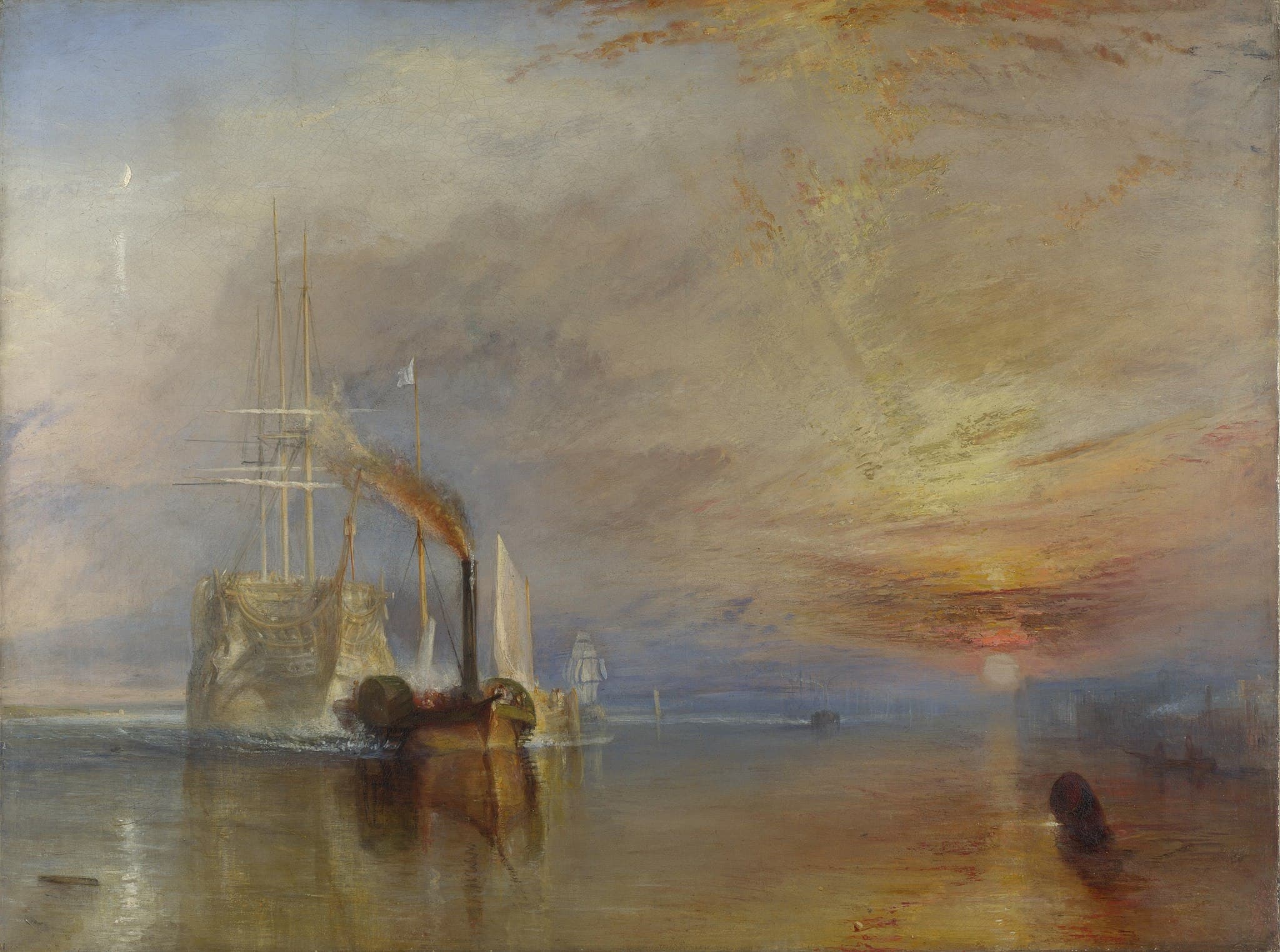
Turner, instead, stages an ending. The Temeraire’s pallid bulk—historic livery suppressed—reads like a memory towed by a squat, sooty tug whose smoke occupies the place where flags once flew. A molten, invented sunset and a small new moon bind nature’s cycle to technological handover; glazes make light the real subject. Turner takes poetic license (full masts restored; two tugs compressed to one) to clarify meaning: workhorse steam ushers grandeur offstage. Color does the thinking—Hokusai’s cool, stable chroma makes solidity; Turner’s radiant dusk makes transience. Stability for Hokusai is geometry that endures; for Turner it is the continuity of light across loss.
Drawing a gust, painting a vortex
Focus question: How do you picture an invisible force without turning it into a prop?
Ejiri in Suruga Province (Sudden Gust of Wind) vs Snow Storm—Steam-Boat off a Harbour's Mouth
Hokusai plots a gust with line and repetition. Sheets of paper, garments, reeds, and even hat ties snap along a crisp diagonal; figures bend and reach, their gestures echoing one another so the breath of air acquires a readable path. Contour remains firm, bokashi is sparing, and ground features—Fuji distant, horizon low—stay stable. The force is clear because the picture is grammatical.
Turner pictures a storm not by tracing paths but by dissolving them. Sea, sky, smoke, and snow whirl into a vortex around a threatened core; edges fray, tonal contrasts soften, and the vessel’s identity nearly yields to atmosphere. The composition substitutes a field of energy for classical stability, asking the viewer to feel vision straining in spray and glare. Compared directly, Hokusai’s gust is a pattern you can learn to read; Turner’s storm is a sensorium you must endure. Both succeed because each commits to a different contract with perception—articulation versus immersion.
Why This Comparison Matters
This pairing clarifies two durable strategies for making the world intelligible. Hokusai builds a grammar—line, repetition, and planned color—that turns forces into patterns a community can navigate. Turner tests what happens when phenomena outrun outline and seeing itself becomes the subject. Together they show how materials and media are not neutral: Prussian blue and woodblock registration make clarity public and repeatable; oil, glaze, and scumble make ambiguity experiential and singular.
Understanding this split helps you read far more than nineteenth‑century art. From weather maps to high‑speed video, images still toggle between organizing data into legible structure and immersing us in raw sensation. Hokusai and Turner offer models for both: the ethics of pattern (how to work within cycles) and the truth of atmosphere (how change feels as it happens). Learning to switch lenses—patterned clarity or dissolving form—is a practical skill for looking now.
Related Links
Sources
- British Museum Blog: Technique—making a good impression (ukiyo‑e printing, Prussian blue, bokashi)
- British Museum collection: Hokusai, The Great Wave off Kanagawa (with oshiokuri‑bune details)
- National Gallery, London: Turner, Rain, Steam and Speed—The Great Western Railway
- Fluid‑dynamics analysis of Hokusai’s wave (rogue/plunging breaker, not tsunami)
- UNESCO World Heritage: Fujisan, sacred place and source of artistic inspiration
- The Met: Fine Wind, Clear Morning (Red Fuji)
- Khan Academy/Smarthistory: Turner’s Snow Storm—Steam‑Boat off a Harbour’s Mouth
- Art UK: Turner’s training and the Royal Academy—perspective and experiment