Zero of Form vs Dynamic Equilibrium
Both artists abandon depiction to build a truer painting from relations alone. Malevich drives to a zero point—autonomous planes floating before an infinite white—while Mondrian builds a rule‑bound armature where verticals, horizontals, and primaries achieve balance. Read together, they clarify two modern kinds of attention: still contemplation and rhythmic scanning.
Comparison frame: How do Malevich’s “zero of form” and Mondrian’s “dynamic equilibrium” retrain our seeing—one toward still, infinite non‑objectivity, the other toward rhythmic, rule‑bound scanning?
Quick Comparison
| Topic | Kazimir Malevich | Piet Mondrian |
|---|---|---|
| Program | Suprematism (1915–18 core): “supremacy of pure feeling.” | Neo‑Plasticism / De Stijl (1917–44): universal order via vertical/horizontal, primaries, neutrals. |
| Structure of form | Autonomous planes, often diagonal, suspended in an infinite field. | Orthogonal armature binds all parts; the grid is law. |
| White field | Metaphysical “free white sea,” an ideal, limitless space. | Active interval equal to color, crucial to balance and rhythm. |
| Viewer’s task | Still contemplation of a non‑image; feel weight and suspension. | Stepwise scanning across equivalent parts; sense dynamic equilibrium. |
| Relation to the world | Transcendent non‑objectivity over mimesis; modern “icon.” | Universality immanent to worldly systems (city grid, music), abstracted. |
| Display and writing | 0,10 icon‑corner hanging for Black Square; manifestos defining a zero. | De Stijl’s linkage to architecture/design; sustained theoretical essays. |
| Iteration method | Serial planes from Black Square to White on White; visibly hand‑worked edges. | Serial recalibration of line weight, plane size, and line stoppages. |
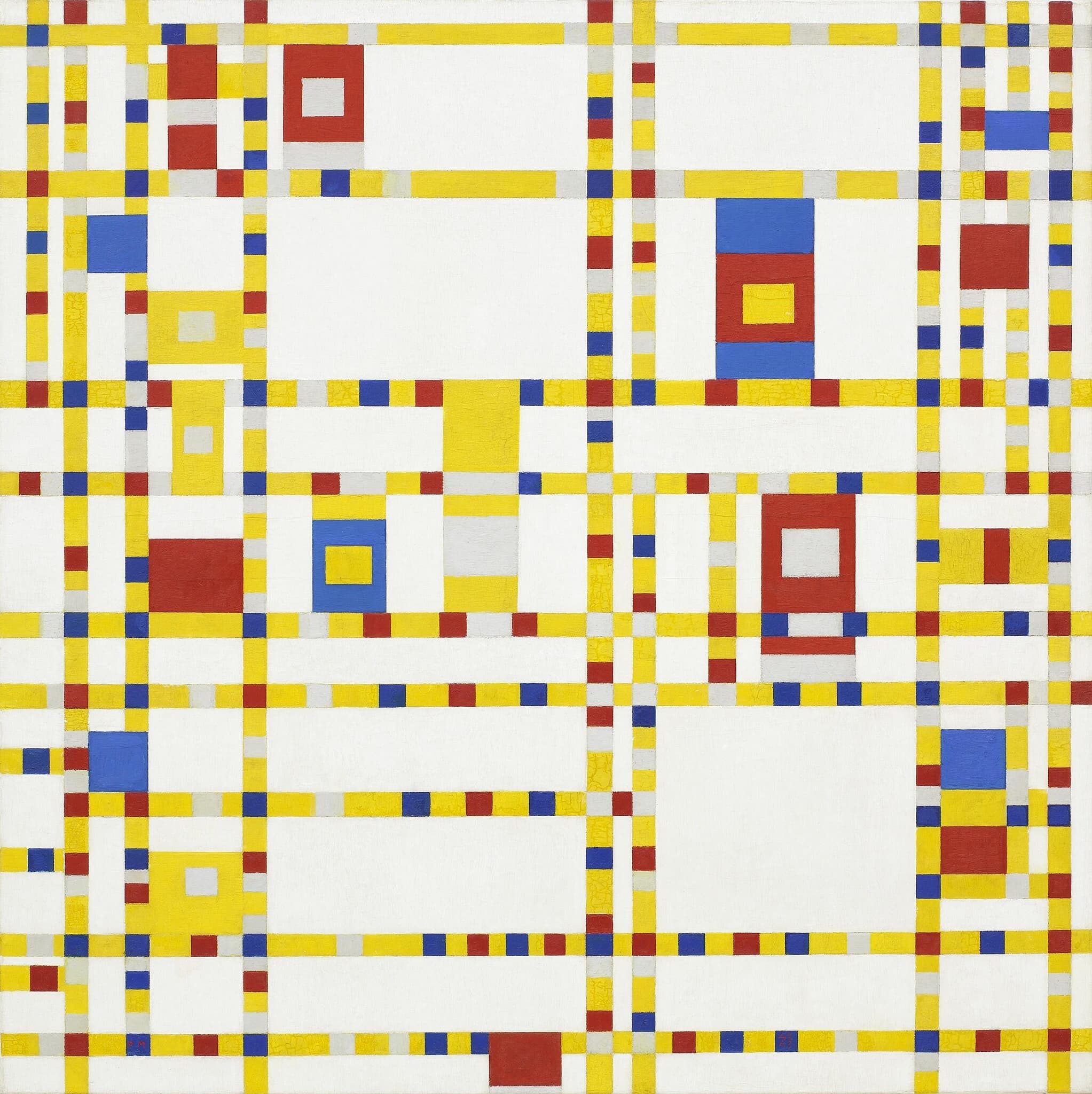
| Late development | Ascetic white‑on‑white; maximum stillness. | Color carries structure (e.g., Broadway Boogie Woogie); black largely dropped. |
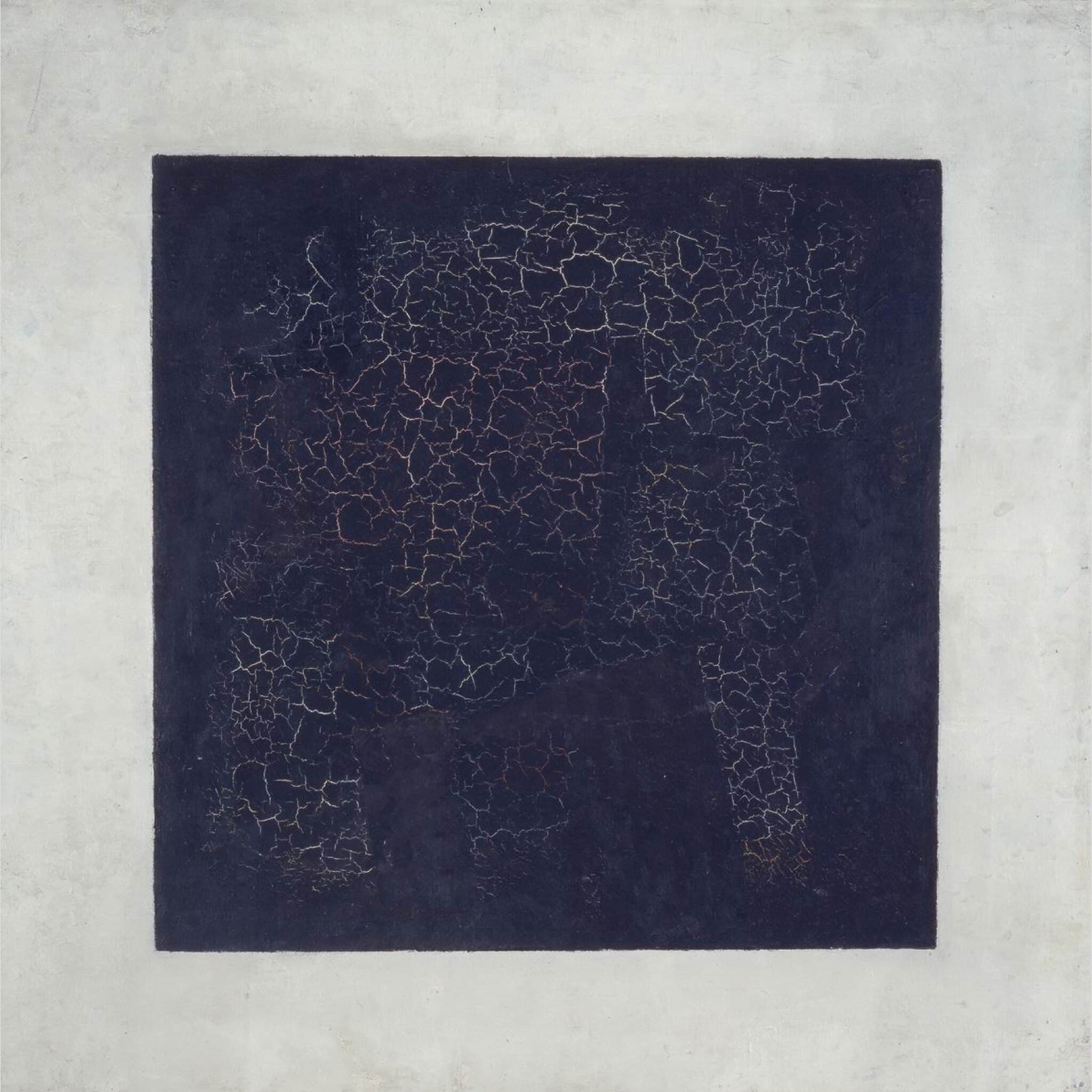
Shared Ground
Malevich and Mondrian meet on the ground of non‑objectivity: painting freed from depiction to present relations as reality. Malevich names this Suprematism—the supremacy of pure feeling or perception—debuted publicly in 1915. Mondrian formulates Neo‑Plasticism within De Stijl a few years later as a universal grammar of verticals and horizontals, primaries and neutrals. Both argue that content arises not from recognizable things but from calibrated differences of direction, interval, and tone set on a flat surface.
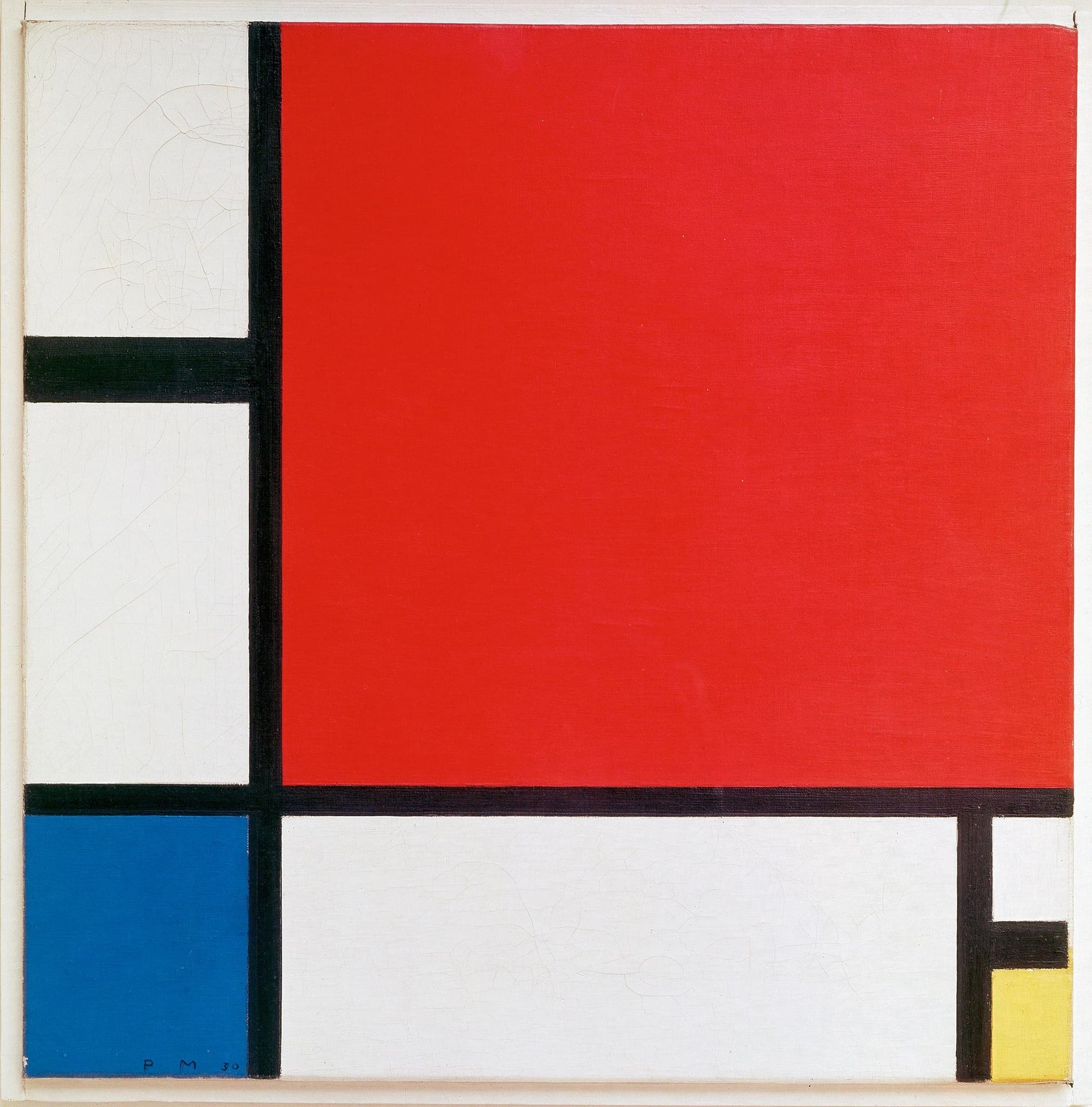
Each makes the white field active. In Malevich, white is an ideal, infinite expanse that carries forms—the “free white sea” in which planes float and tilt. In Mondrian, whites are equal partners in the composition, audible pauses that hold color and black in balance. Black Square and White on White for Malevich, and Composition with Red, Blue and Yellow and Broadway Boogie Woogie for Mondrian, all demonstrate that what seems like background is in fact the work’s breathing space, its logic made visible.
Both are system‑builders who publicize method. Malevich stages doctrine through the 0,10 exhibition, hanging Black Square in the room’s icon corner. Mondrian extends painting into architecture and design through De Stijl, aligning studio practice with a proposed order for modern life. And both iterate relentlessly: Malevich varies the number, scale, and tilt of planes; Mondrian tunes line weight, line termination, and the size of white intervals. In both cases, meaning is inseparable from methodical testing.
Decisive Difference
The decisive difference lies in what each painting asks the eye to do. Malevich constructs a zero point that quiets the gaze before an “infinite” white. From Black Square to White on White, his planes—often diagonal, visibly hand‑worked—hover in a boundless field that reads like a modern icon. The slight wobble of edges and the lived surface pull the claim of transcendence back through matter, inviting an attentive stillness: to feel weight, suspension, and the hush of a non‑image without narrative props.
Mondrian, by contrast, builds a calibrated armature that makes you move. The orthogonal law—verticals and horizontals only—binds every part into one system, and the eye is compelled to scan stepwise across equivalent units. In the 1930 Composition with Red, Blue and Yellow, the balance depends on unequal intervals held taut; in Broadway Boogie Woogie, black drops out and color carries structure, turning the grid into syncopated rhythm keyed to the city. Where Malevich privileges autonomous planes in an ideal expanse, Mondrian dissolves any privileged center in favor of a democratic circulation. The first proposes transcendence through emptying; the second proposes universality immanent to worldly systems—the grid of streets, the beat of music—refined into pure relations. Stillness versus rhythm; icon versus instrument: that divergence governs how each artist thinks painting, perception, and the world.
Paired Works
Zero vs equilibrium, stated plainly
Focus question: How does each canvas state its first principle of painting?
Black Square vs Composition with Red, Blue and Yellow
Stillness vs rhythm at full stretch
Focus question: Which kind of attention—contemplation or rhythmic tracking—does the surface enforce?
Suprematist Composition: White on White vs Broadway Boogie Woogie
1915: two origins from nature toward non‑objectivity
Focus question: When both artists leave nature behind, what do they keep?
Suprematist Composition: Airplane Flying vs Pier and Ocean 5
Why This Comparison Matters
The pairing clarifies that abstraction is not one thing. Malevich and Mondrian propose different ethics of attention that still shape how we read images and systems today. Malevich models a modern icon: content arises from the encounter with limits—silence, suspension, the felt presence of an ideal white that refuses depiction. Mondrian models a civic rhythm: content arises from rules equitably applied, where balance is achieved through many small, interdependent choices across the field.
This difference scales. It informs how we experience architecture, interfaces, and urban space: either as charged stillness before a clearing, or as distributed focus within a grid of relations. Seeing the split helps a viewer tell whether a non‑objective work is asking for contemplation or for scanning—and why both modes can feel precise, ethical, and alive.
Related Links
Sources
- MoMA: Suprematism (collection terms)
- State Russian Museum VRM: Malevich, Black Square (0,10 icon corner documentation)
- MoMA: Malevich, Suprematist Composition: Airplane Flying
- MoMA: Malevich, Suprematist Composition: White on White
- MoMA: Mondrian, Broadway Boogie Woogie
- MoMA: Piet Mondrian (artist overview)
- The Guardian: Imaging and inscription debate on Malevich’s Black Square (2015)
- Malevich, From Cubism and Futurism to Suprematism (1915/16) – English trans.
- Mondrian, The New Plastic / Plastic Art and Pure Plastic Art (overview)
- MoMA: Conservation notes on Broadway/Victory Boogie Woogie
- MoMA Press: Mondrian Boogie Woogie (2026 survey announcement)