Two ways painting makes ideas visible
Under Pope Julius II, both artists turned fresco into a medium for thinking. Michelangelo makes ideas strike through a charged, sculptural body; Raphael makes them unfold through legible relations in space. Seen together, they map painting’s twin powers: presence and clarity.
Comparison frame: Two ways of making ideas visible: body-as-revelation (Michelangelo) versus architecture-of-reason (Raphael)—what do we learn by looking at them side by side?
Quick Comparison
| Topic | Michelangelo | Raphael |
|---|---|---|
| Core proposition | Truth felt as embodied revelation | Truth grasped as intelligible order |
| Primary engine of meaning | A single, monumental figure at a charged threshold | Many figures choreographed into readable groups |
| Architecture’s role | Fictive stone frames that yield to bodily force | One-point perspective and coffered halls that organize argument |
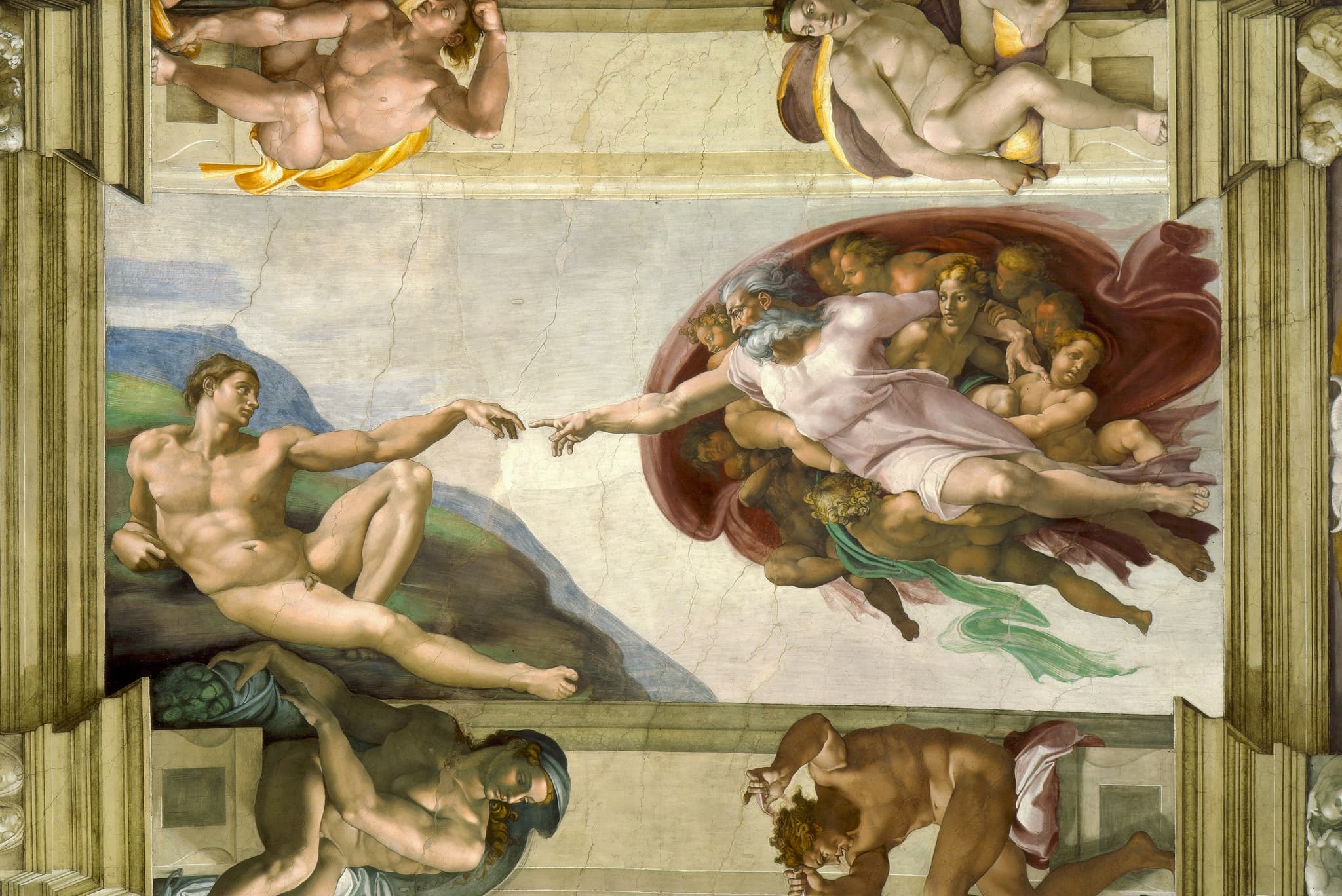
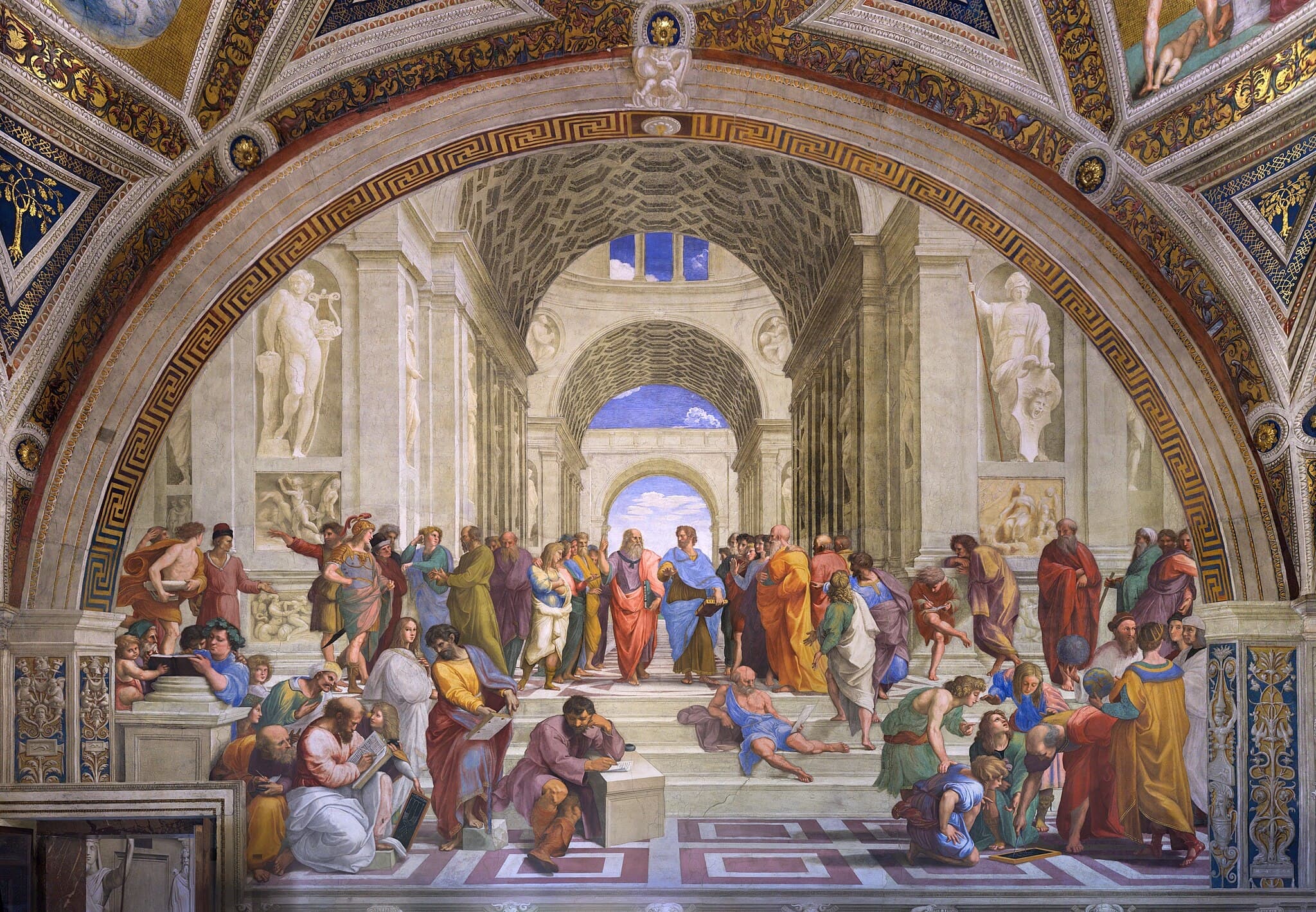
| Signature Vatican work | The Creation of Adam (Sistine Ceiling) | The School of Athens (Stanza della Segnatura) |
| Gestural keynote | The near‑touch between God and Adam | Plato points up; Aristotle levels his hand |
| How authority is staged | Solitary prophets and sibyls as seers | Disciplines gathered in civic debate |
| Viewer experience | Confronted by presence, torque, and tension | Invited to parse a lucid map of ideas |
| Later culmination | The Last Judgment’s vortex around Christ | The Transfiguration’s ordered two-register design |
Shared Ground
In Julius II’s Rome, Michelangelo and Raphael worked within the same papal complex, turning fresco into a vehicle for thought. The Sistine Ceiling (1508–1512) and the Stanza della Segnatura (c. 1508–1511) treat walls and vaults as arguments about origin, knowledge, and order. Both artists make abstract truths legible through the human figure and rigorous architecture. Specific gestures carry doctrine: Michelangelo condenses the gift of life into the near‑touch of God and Adam; Raphael stages philosophy through opposed hands—Plato’s upward, Aristotle’s level—so that a debate on forms and empiricism becomes visible. In each, painting claims parity with the learned disciplines: the Segnatura’s walls align Theology and Philosophy across the room, while the Sistine program moves from Genesis toward redemption in a didactic sequence.
Classical Rome is their shared resource. Raphael houses thinkers in a basilica inspired by Bramante’s new St. Peter’s; Michelangelo enthrones prophets and sibyls with antique gravity and the heroic nude. The 1506 discovery of the Laocoön, with its writhing classicism, sharpened their sense of bodily power and expressive form. Yet their classicism is not quotation for its own sake: it is a framework for clarifying ideas. In both rooms, architecture, inscription, and figure coordinate to teach. The result is a High Renaissance consensus about what painting can do in the highest places of Church and state: turn space into knowledge and bodies into arguments.
Decisive Difference
The decisive difference is how each artist asks painting to persuade. Michelangelo makes truth arrive as presence. He isolates a heightened body—Adam’s ideal torso, a coiled prophet, Christ in judgment—and charges it with sculptural force. Meaning concentrates in threshold moments: the instant before fingers meet in The Creation of Adam; the poised turns of the ceiling’s sibyls and prophets; the suspended verdict of The Last Judgment. Architecture frames but never outruns the figure; fictive stone exists to intensify the body’s voltage. The viewer is compelled physically first, intellectually through that impact.
Raphael makes truth arrive as order. He distributes significance across many figures and a perfectly legible space. In The School of Athens, one-point perspective, measured color harmonies, and rhetorical groupings allow the eye to read arguments in sequence—Euclid’s demonstration, Pythagoras’s ratios, Diogenes’s isolation—culminating at Plato and Aristotle. Even when drama is high, as in The Transfiguration, he clarifies it through a two-register design that links miracle above to urgent need below. The viewer infers meaning by tracking relationships. Compressed contrast: Michelangelo persuades by intensifying the body-as-revelation; Raphael persuades by clarifying the architecture-of-reason.
Paired Works
Creation vs. School: a hand’s interval vs. a room’s order
Focus question: What carries an idea more powerfully—the split-second interval between two fingers, or a whole architecture converging on a debate?
The Creation of Adam vs The School of Athens
Two Sibyls: torsion vs. rhythm
Focus question: How does each painter make prophecy feel authoritative?
Libyan Sibyl (Sistine Ceiling) vs Sibyls with Angels (Santa Maria della Pace)
Two Isaiahs: translating a model
Focus question: What changes when Michelangelo’s coiled prophet becomes Raphael’s lucid authority?
Prophet Isaiah (Sistine Ceiling) vs Prophet Isaiah (Sant’Agostino)
Judgment vs. Transfiguration: total summons vs. ordered revelation
Focus question: Is truth a single, encompassing summons or a hierarchy of scenes?
The Last Judgment vs The Transfiguration
Why This Comparison Matters
This pairing clarifies two durable models for how images persuade. Michelangelo shows what happens when painting borrows the immediacy of sculpture: a single body, perfectly formed and tensely posed, makes metaphysical claims tangible. Raphael shows what happens when painting borrows the logic of architecture: space, sequence, and grouping allow complex ideas to be read and tested. Both strategies shaped art for centuries—from Baroque bodies of conviction to academies built on perspective and rhetoric.
For viewers today, the distinction becomes a tool. When a picture moves you through presence, ask where the pressure sits in the body and why; when it convinces you through order, follow how the parts are arranged to be learned. Michelangelo and Raphael, working steps apart in the Vatican, demonstrate that beauty is not decoration but evidence—either concentrated in a figure or distributed through a system.
Related Links
Sources
- Vatican Museums: The Creation of Adam (Sistine Ceiling)
- Vatican Museums: The School of Athens (Stanza della Segnatura)
- Smarthistory: Raphael, School of Athens
- Britannica: High Renaissance in Italy
- Vatican Museums: Sibyls and Prophets (Sistine Ceiling)
- Oxford Art Journal: Raphael’s Roman Sibyls and Michelangelo
- Vatican Museums: The Last Judgment (Sistine Chapel)
- Vatican News: The discovery of the Laocoön
- Britannica: Raphael—Last years in Rome