Two High Renaissance ways to make truth visible
Raphael and Titian both turn painting into a guide for how to look. Raphael builds clarity through architectural design and measured groupings; Titian makes conviction happen through light, color, and motion. The School of Athens and the Assumption of the Virgin show the split at monumental scale, each tailored to its room and its public.
Comparison frame: How do Raphael’s architecture of reason and Titian’s column of light teach the eye to know and believe?
Quick Comparison
| Topic | Raphael | Titian |
|---|---|---|
| Core aim | Turn seeing into understanding | Turn seeing into believing |
| How truth is made visible | Argument clarified by structure and plan | Event enacted by light, color, and motion |
| Primary tools | Disegno: one‑point perspective, calibrated groups, legible contours | Colorito: layered glazes, tonal modeling, breathing edges |
| Compositional tendency | Central axes, symmetries, closed form | Diagonals, tiered stages, open form |
| Edge behavior | Firm, drawing-led contours | Lost-and-found edges; forms dissolve into atmosphere |
| Color’s job | Serves clarity and hierarchy | Carries structure and unifies movement |
| Viewer path | Read stepwise through groups to a central hinge | Ride chromatic currents; feel ascent or sweep |
| Typical site/use | Programmed rooms that debate across walls (Stanza della Segnatura) | Altarpieces designed for nave distance and backlight (Frari) |
Shared Ground
Raphael and Titian share a core ambition: use painting to organize how a community looks, learns, and believes. Each designs for a specific institutional space and choreographs the viewer’s path so that a complex idea can be grasped as an ordered experience. Their most public works—Raphael’s The School of Athens in a papal library and Titian’s The Assumption of the Virgin in a Franciscan church—translate doctrine into a staged way of seeing.
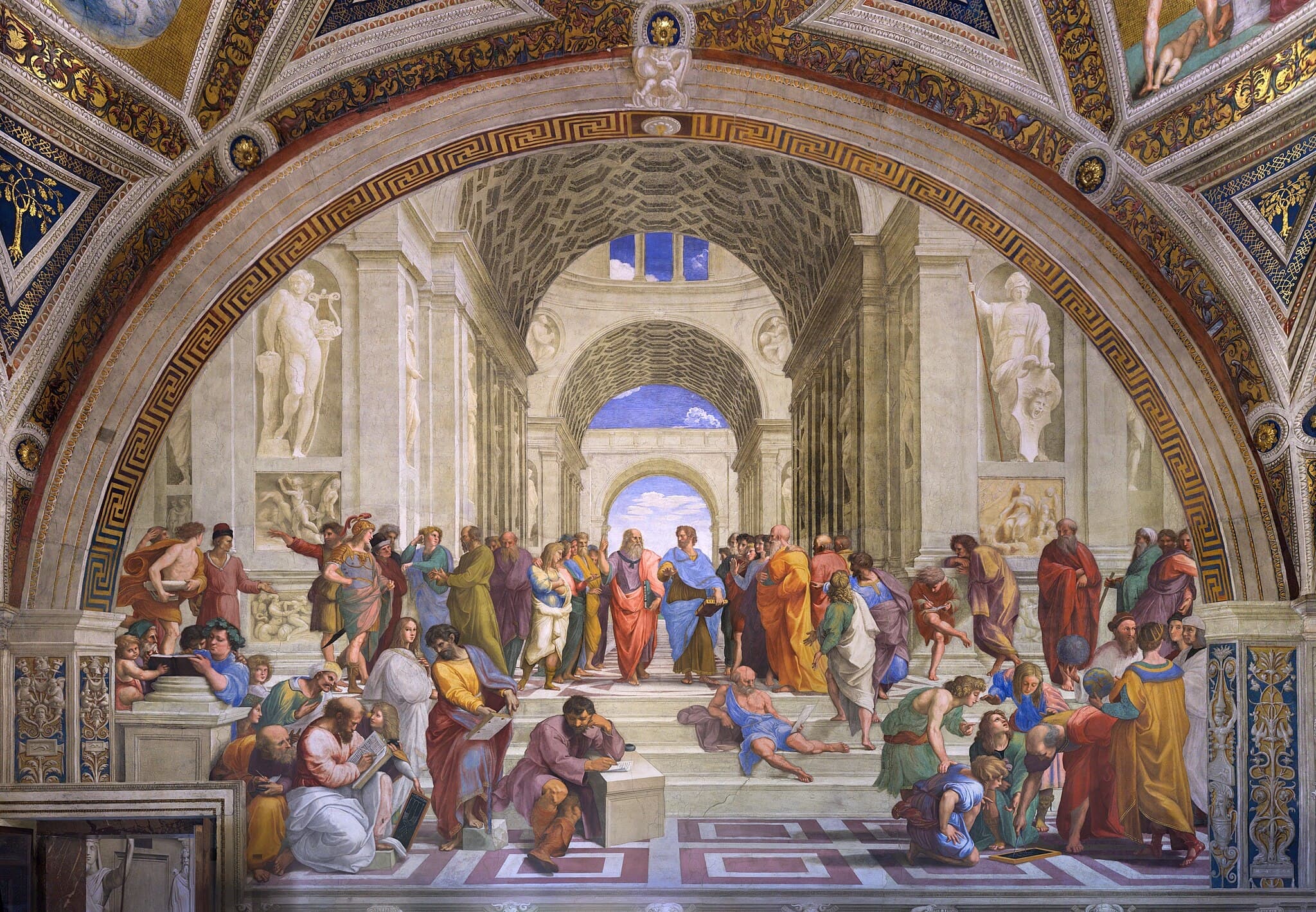
In the Stanza della Segnatura, Raphael turns the room itself into a program of knowledge. Philosophy (The School of Athens) faces Theology across the chamber, with Poetry and Justice completing the set. The imagery is not ornamental; it is an architecture of ideas that the viewer navigates. The central pair of Plato and Aristotle establishes an intelligible axis, while named clusters (Euclid, Ptolemy/Zoroaster, Diogenes) model how disciplines interrelate inside a unified civic-humanist order.
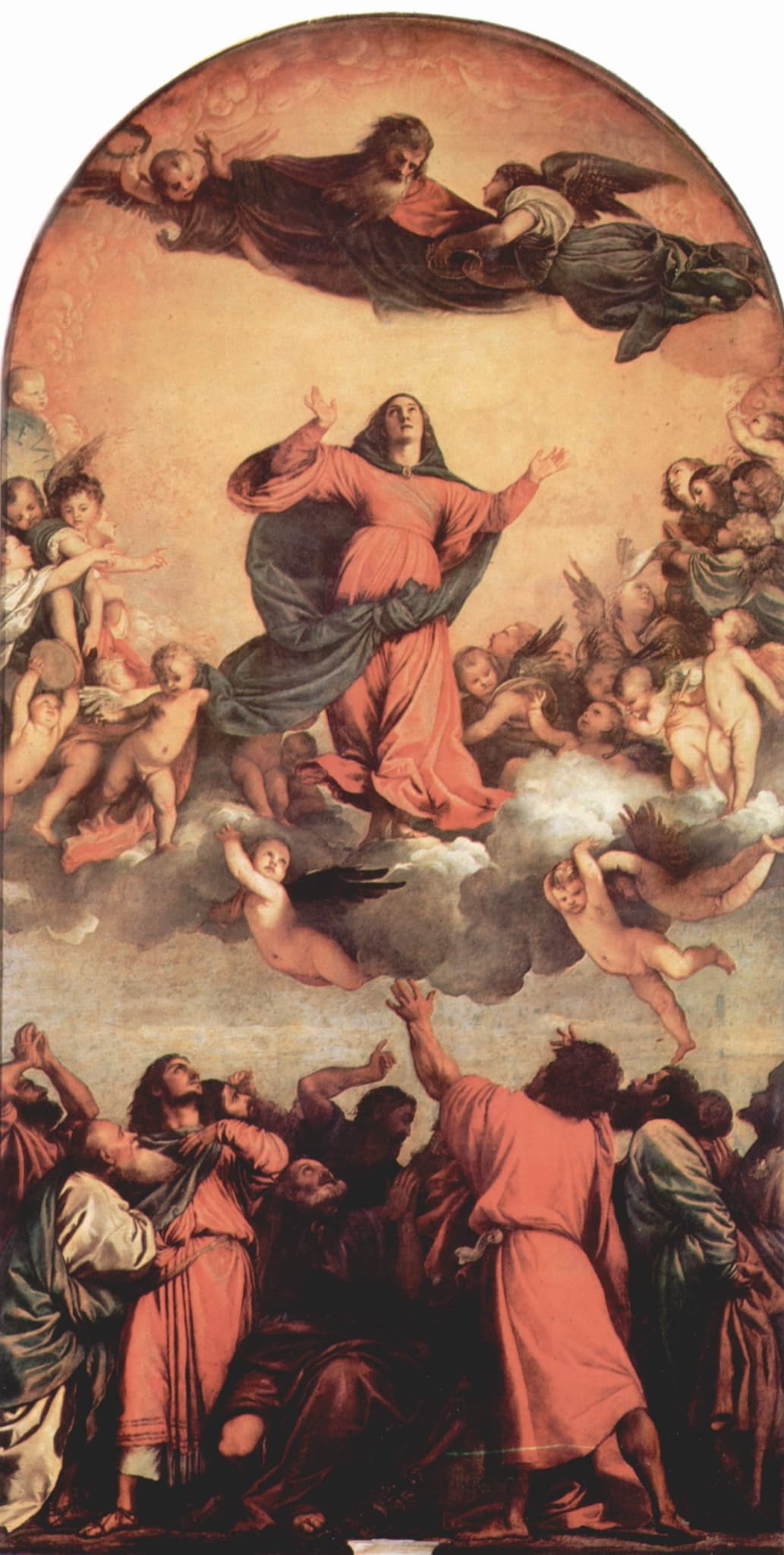
At the Frari, Titian’s Assumption addresses a congregation approaching from the nave. Its three-register ascent—apostles, Mary, God the Father—reads at distance, with color keyed to backlight and scale chosen for the apse. The painting fuses doctrine with optics: light and motion make the mystery legible as a single, upward flow. In both artists, then, persuasion is spatial and communal. Whether through a lucid plan or a radiant theophany, painting becomes a tool for forming shared understanding in the very rooms that house authority and worship.
Decisive Difference
The decisive difference lies in how each painter makes truth convincing. Raphael clarifies truth by structure. He builds sense through disegno: one‑point perspective, stable axes, measured color harmonies, and groupings that behave like propositions. In The School of Athens, a perfectly ordered hall funnels attention to Plato and Aristotle, whose opposed gestures become the picture’s hinge. Around them, episodes such as Euclid’s demonstration or the paired globes of Ptolemy and Zoroaster read as modules in an argument, stitched to the architecture so the eye learns by following an intelligible plan.
Titian enacts truth by sensation. He lets color, light, and softening contours carry form and meaning so that the image behaves like an event. In the Assumption, a vertical column of gold atmosphere fuses three zones into one surge; Mary’s red and blue anchor the chromatic system, and diagonals torque the cloud-ring into motion. The viewer does not parse steps so much as feel ascent unfold in real time, an effect intensified by distance and backlight from the apse.
Put schematically: Raphael tends toward linear, closed clarity; Titian toward painterly, open effects where edges breathe and time is palpable. The first proves by plan; the second persuades by presence. Both are rigorous, but they model two fundamental answers to how a painting can be true.
Paired Works
Argument in Stone vs Event in Light
Focus question: How does each altar‑scale image guide a body moving through space?
The School of Athens vs The Assumption of the Virgin
Two ideals of presence
Focus question: What kind of “now” does each portrait construct?
Portrait of Baldassare Castiglione vs Portrait of Pope Paul III
Myth designed vs myth in motion
Focus question: How do line and color set myth’s tempo?
The Triumph of Galatea vs Bacchus and Ariadne
Why This Comparison Matters
This comparison isolates two infrastructures of persuasion that still shape how images work. Raphael models the power of plan: a picture can guide the eye through a reasoned architecture and make complexity legible without noise. Titian models the power of event: a picture can unfold as light and color in time, convincing because it behaves like lived experience. Together they define complementary lineages that later artists recalibrate—Poussin and Le Brun on one side; Rubens, Velázquez, and Tiepolo on the other.
For viewers today, the question “Is this painting teaching me or happening to me?” is a practical tool. In a museum or church, notice whether edges lock down or breathe, whether the eye advances by steps or is swept along by chromatic currents, whether argument or atmosphere leads you. Raphael and Titian do not cancel each other; they map two durable ways painting can tell the truth.
Related Links
Sources
- Musei Vaticani — Stanza della Segnatura (program overview)
- Musei Vaticani — The School of Athens (identifications, context)
- Save Venice — Titian’s Assumption of the Virgin (site, scale, viewing)
- The Met — Venetian Color and Florentine Design (disegno vs colorito)
- National Gallery Technical Bulletin 34 — Titian’s early techniques
- Louvre — Raphael, Portrait of Baldassare Castiglione
- National Gallery, London — Titian, Bacchus and Ariadne
- Accademia dei Lincei — Villa Farnesina (Raphael’s Galatea)
- Heinrich Wölfflin — Principles of Art History (linear vs painterly)