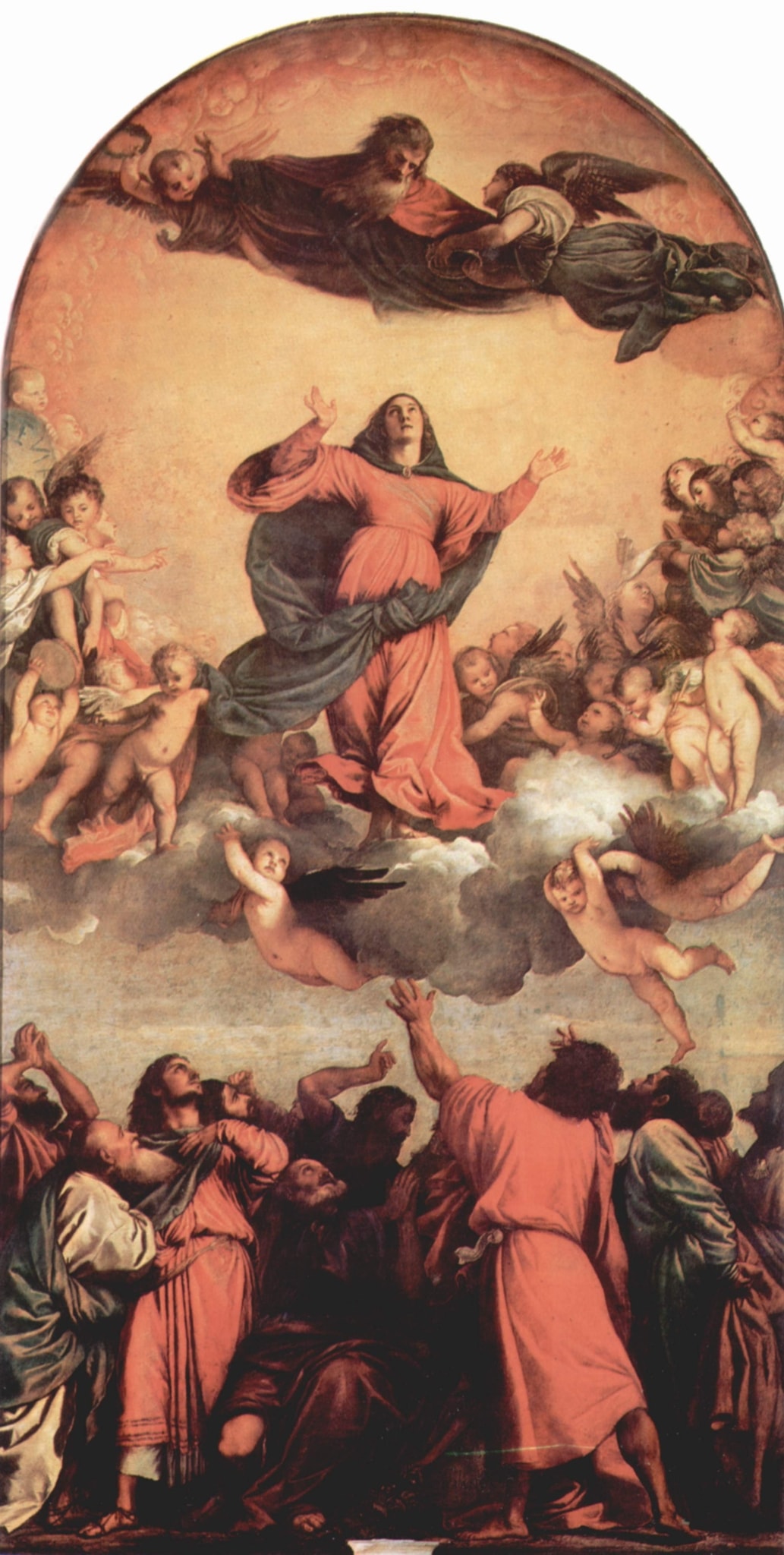
The Assumption of the Virgin
by Titian
Titian’s The Assumption of the Virgin stages a three-tier ascent—apostles below, Mary rising on clouds, and God the Father above—fused by radiant light and Venetian colorito. Mary’s red and blue drapery, open orant hands, and the vortex of putti visualize grace lifting humanity toward the divine. The painting’s scale and kinetic design turned a doctrinal mystery into a public, liturgical drama for Venice. [1][2]
Study Print Studio
Create a personal study print
Build a companion study sheet around the part of this painting that speaks to you most. Choose a detail, shape an interpretation, and walk away with something personal and display-worthy.
Fast Facts
- Year
- 1516–1518
- Medium
- Oil on wood panel
- Dimensions
- c. 690 × 360 cm (published figures vary slightly)
- Location
- Basilica di Santa Maria Gloriosa dei Frari, Venice
Click on any numbered symbol to learn more about its meaning
Meaning & Symbolism
Titian makes doctrine legible as movement. At the base, a dark, earthy register crowds the apostles into a frieze of twisting bodies and flung arms; their gestural turbulence channels the viewer’s sight upward, transforming astonishment into faith. Their bare feet on stone and contrasting garments of olive, rose, and teal root the miracle in human time. Above them, the earth thins into pearly cloud where a carousel of putti heaves Mary aloft; their torsos torque and wings beat at diagonals, creating a visual vortex that converts cloud into a vehicle of grace. Mary’s billowing red robe (charity) cinched under a deep blue mantle (heavenly wisdom) declares who she is theologically while amplifying Venetian colorito—color and light as carriers of meaning. Her upturned face and widely opened hands form the ancient orant gesture, not merely accepting but interceding; in a Franciscan church whose high altar serves a city of petitioners, her posture links the congregation’s prayers to her ascent. 25
Light organizes the theophany into a three-stage ascent that remains one continuous act. The lower zone’s chiaroscuro yields to a warm, gold atmosphere in the middle register before brightening at the top, where God the Father leans forward across a windblown cumulus, arms extended to receive her. An attendant angel presents a crown, signaling the imminent Coronation and completing a theological arc from witness to welcome. The composition’s diagonals—Mary’s mantle swept left, the counter-swoop of the angelic ring right, the apostles’ thrusting arms—interlock like gears, making the scene read from the nave in a single glance yet rewarding prolonged devotion at the rail. Titian replaces landscape with a column of light; the world is not the setting but the thing being transcended. In a city saturated with Byzantine memory, Mary’s orant silhouette echoes San Marco’s mosaics while recasting them in oil’s atmospheric depth; the ancient posture becomes newly kinetic, spanning East-West visual traditions within a decisively Venetian idiom. 124
The painting’s importance lies equally in function and innovation. Built for the Frari’s monumental frame and distant sightlines, its over-lifesized figures and triadic structure turn liturgy into vision: processions advancing up the nave meet the Virgin rising above the altar, so that the church’s spatial ascent becomes sacramental metaphor. This is why The Assumption of the Virgin is important: it institutionalized a Venetian synthesis where color, light, and motion perform theology. Contemporary accounts note the work caused a sensation; its energy unsettled some but soon set the standard for Venetian altarpieces and confirmed Titian’s ascendancy after Bellini. Modern conservation has clarified the chromatic and structural daring on a colossal wood panel—described by Save Venice as the world’s largest—affirming that the painting’s technical audacity is inseparable from its spiritual charge. Grace here is not argued but enacted: a spiral of light that gathers earth, lifts Mary, and reaches its source in the Father’s outstretched welcome. 1367
Explore Deeper with AI
Ask questions about The Assumption of the Virgin
Popular questions:
Powered by AI • Get instant insights about this artwork
💬 Ask questions about this artwork!
Interpretations
Liturgical Choreography (Site-Specific Viewing)
Designed for the Frari’s vast Gothic nave, the Assunta is not merely seen; it is approached. Titian scales figures and stacks registers so the image reads from the church’s threshold yet intensifies at the altar rail. The composition’s triadic ascent meets the faithful’s bodily advance, converting procession into theology made visible. The high altar’s monumental frame and the Feast of the Assumption dedication amplify this choreography: apostles witness (earth), angels translate (middle), and the Father receives (heaven). In this setting, Mary’s intercessory orant binds petitions uttered below to the visual climb above, so the civic-liturgical traffic of Venice becomes part of the painting’s meaning—devotion as movement, not merely contemplation 16.
Source: Encyclopaedia Britannica; Basilica dei Frari (official site)
Colorito as Doctrine
Venetian theory prized colorito—color and handling as vehicles of thought—over Florentine disegno. In the Assunta, chroma is catechesis: the red of charity and the blue of heavenly wisdom do not label Mary so much as radiate her vocation. The warm gold-violet atmosphere stages a graduated sanctity from shadowed earth to blazing divinity, making light itself the medium of grace. Titian’s wet-in-wet fusions and saturated complements translate metaphysics into optics: faith becomes a way of seeing. This is not decorous tint but argument by luminosity, a Venetian rejoinder to Florentine line in which color organizes belief and motion carries doctrine to the eye 145.
Source: Encyclopaedia Britannica; National Gallery, London; The Met (Heilbrunn Timeline)
Byzantine Memory, Venetian Modernity
Mary’s open-handed orant silhouette echoes icons and mosaics familiar from San Marco, yet Titian reanimates the archaic type with atmospheric oil and centrifugal motion. The result is a hybrid image that spans East–West visual languages: a Byzantine intercessor rendered in Renaissance space, drenched in Venetian light. This negotiation is not antiquarian; it’s strategic. By retaining the legibility of the orant while injecting diagonals, torqued putti, and graduated radiance, Titian fuses timeless theology with up-to-date illusionism, claiming Venice as a crossroads where memory becomes innovation and tradition accelerates into vision 2.
Source: Smarthistory (Dr. Letha Ch’ien)
Material Bravura and the Engine of Ascent
The painting’s spiritual torque rides on technical audacity: an immense oil on wood—described by conservators as the world’s largest panel painting—engineered to withstand the Frari’s climate and vibrations from the organ behind it. Recent conservation removed clouded varnishes, stabilized joins, and revealed the frame’s original gilding, restoring the orchestrated dialogue between image and architecture. Macro-imaging shows confident layering and adjustments that fine-tune the upward pull of drapery and cloud. Material facts—panel joins, pigment bodies, gilded architecture—work as the hidden mechanics of grace: a miracle of ascent built, quite literally, on carpentry, glue, and light-responsive color 37.
Source: Save Venice; Finestre sull’Arte
Reception and the Aesthetics of Motion
From its unveiling, the Assunta “caused a sensation” for unprecedented dynamism; later, Ruskin’s ambivalence—praising nobility while decrying “showy masses”—registered a Victorian unease with spectacle in sacred art. Between early acclaim and nineteenth‑century scruple lies the painting’s wager: that velocity, not stasis, communicates sanctity. The geared diagonals, flung arms, and vortexing cloud propose a theology of motion—truth apprehended in transit. Modern scholarship now reads this energy as the Venetian altarpiece’s new standard, consolidating Titian’s leadership after Bellini and articulating how movement can be not distraction but devotion intensified 148.
Source: Encyclopaedia Britannica; National Gallery, London; Lancaster University (Ruskin resources)
Seen in Comparisons
Related Themes
About Titian
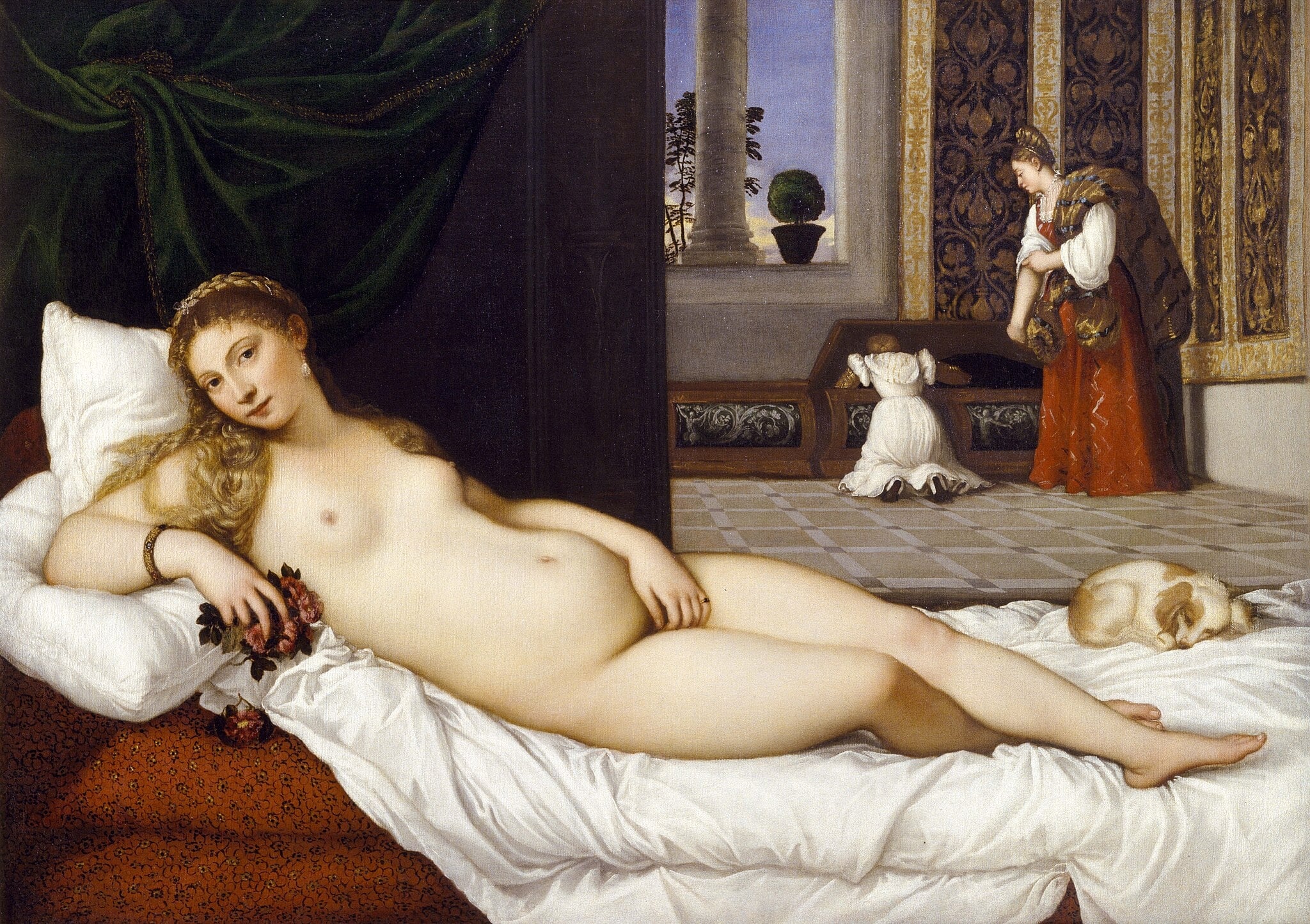
Titian (c. 1488/90–1576), the leading painter of 16th‑century Venice, transformed European painting through color‑driven modeling and poetic invention, serving elite patrons across Italy and Habsburg courts. His collaborations with the della Rovere of Urbino provided a key context for this canvas [5].
View all works by Titian →