The Crushed Ship in The Sea of Ice
A closer look at this element in Caspar David Friedrich's 1823–1824 masterpiece
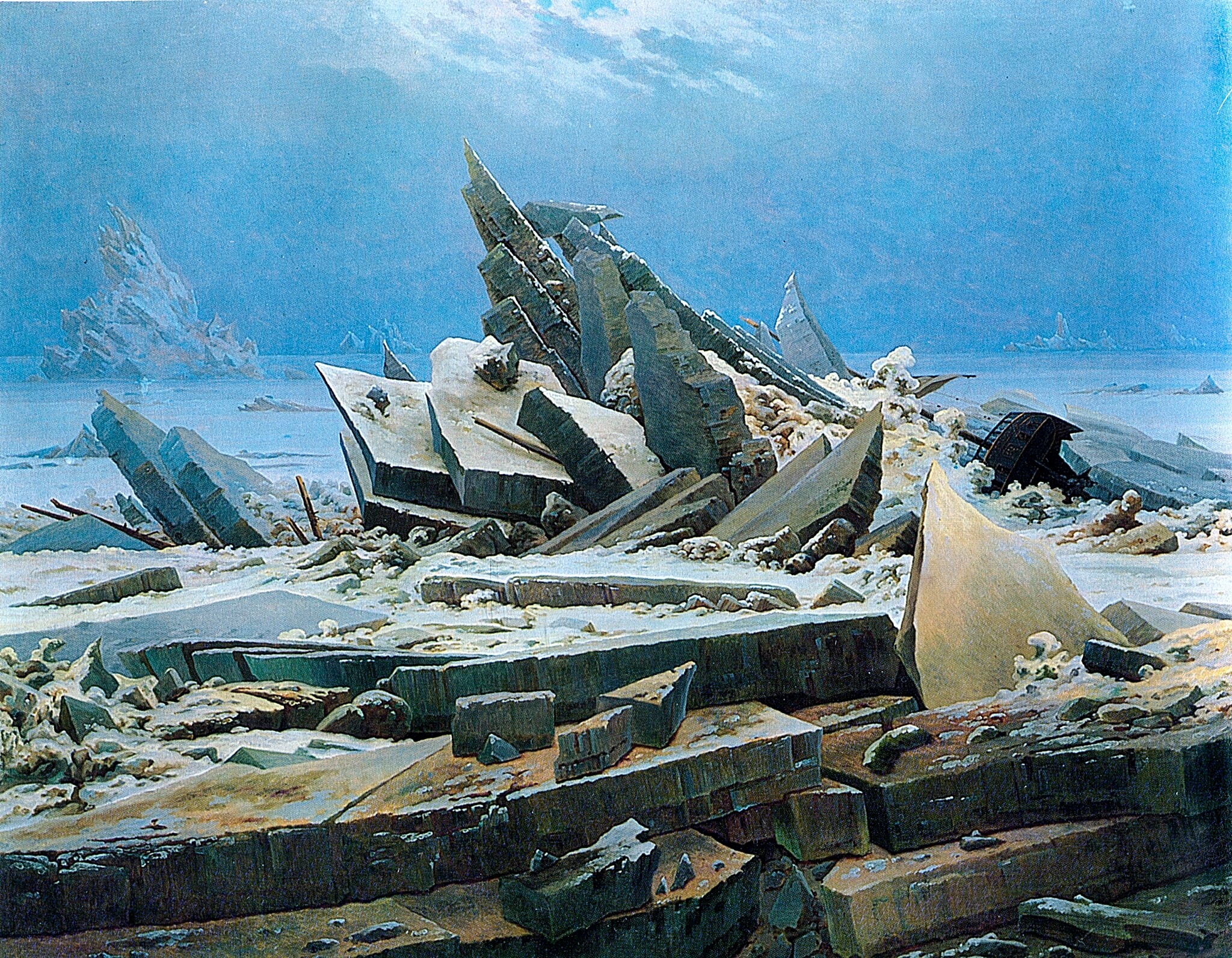
Friedrich’s “crushed ship” splinters out of pressure‑ridged pack ice, its stern and broken mast being swallowed by floes—a stark emblem of catastrophe. Rather than record a specific voyage, the wreck crystallizes a Romantic meditation on human ambition overwhelmed by indifferent polar forces, yet a clearing sky hints that despair is not absolute.
Historical Context
Caspar David Friedrich painted The Sea of Ice in 1823–1824 after observing the Elbe River’s extraordinary freeze of 1820–21 in Dresden. He made oil studies on site and later monumentalized their jagged geometries into an Arctic scene, placing a wrecked sailing ship where the floes converge and grind together 1. The picture emerged amid a Europe captivated by recent Northwest Passage attempts—above all William Parry’s 1819–20 voyage—which made polar perils a topical subject without tying the canvas to any single expedition 12.
First exhibited under the title The Polar Sea, the work was quickly read as an emblem of a generic disaster in the ice. In the 19th and 20th centuries it was repeatedly confused with the title The Wreck of Hope, a misattribution later corrected by scholars; the persistence of that label nonetheless confirms how viewers associated the image with dashed aspirations and catastrophe 21.
Symbolic Meaning
The splintered hull and snapped mast stage a confrontation between human endeavor and the overwhelming agency of nature. In Friedrich’s program, the ship embodies hubris—ambition pressed into the polar realm—while the ice represents impersonal, crushing forces that erase intention and mastery 1. The absent crew intensifies a vanitas meditation: the wreck’s timbers, like bones, signal the certainty of mortality and the futility of pride in the face of geologic time 2.
Contemporaries and later scholars have also read the motif politically. Within Vormärz discourse the ship becomes a ship of state, its hopes for reform trapped and broken by the reactionary “freeze” after the Congress of Vienna—a metaphor supported by studies of Friedrich’s recurring ship imagery as a vehicle for political meaning across his oeuvre 25. Yet the symbolism is not univocal. The Hamburger Kunsthalle notes a brightening blue sky and a small star—details that imply hope is not entirely extinguished, even as the wreck succumbs to the floes. The element thus holds despair and a faint, metaphysical promise in tense equilibrium 31.
Artistic Technique
Friedrich constructed the motif from close observation, translating small Elbe studies into a polar catastrophe. He miniaturizes the ship against pyramidal slabs of upthrust ice, sharpening annihilating scale. The timbers’ warm browns and ochres cut against cold blues and greys, separating artifact from environment while visually binding them through parallel diagonals 1.
His finish is exacting at near‑microscopic scale: crushed logs reflected along ice edges, stained wood grain, and pinched seams where floes abut record the wreck’s entrapment with forensic clarity. Such precise incident—documented in gigapixel analysis—anchors the allegory in a world of tactile facts 6.
Connection to the Whole
The wreck is the painting’s narrative and scalar fulcrum. By wedging a small, broken hull beneath a tomb‑like cairn of ice, Friedrich subordinates human striving to a vast, indifferent order; the motif transforms an ice study into an existential image of defeat and reckoning 21.
Compositional vectors—spars echoing floe diagonals that drive from lower right to upper left toward a jagged “peak”—bind the man‑made to natural force and visually prove the crushing action. The staging delays recognition: only after reading the central collision does the eye register the ship’s fate. Against this desolation, the distant, cleared sky with a star threads a contrary note, aligning the whole with Romantic tension between time, finitude, and the possibility of transcendence 43.
Explore More from This Painting
This detail is one part of The Sea of Ice. Use the links below to return to the full interpretation, browse the full set of details, or view the painting's valuation if available.
Sources
- Hamburger Kunsthalle / 250 Jahre Caspar David Friedrich portal – Das Eismeer (chronicle entry)
- Vanishing Ice: Alpine and Polar Landscapes in Art 1775–2012 (Whatcom Museum exhibition catalog)
- Hamburger Kunsthalle Online Collection – Das Eismeer (object HK‑1051)
- Wikipedia (DE) – Das Eismeer
- Deutsches Schiffahrtsarchiv – The Ship as a Political Metaphor in the Work of Caspar David Friedrich
- Hamburger Kunsthalle / 250 Jahre Caspar David Friedrich portal – Gigapixel notes