The Jagged Ice Sheets in The Sea of Ice
A closer look at this element in Caspar David Friedrich's 1823–1824 masterpiece
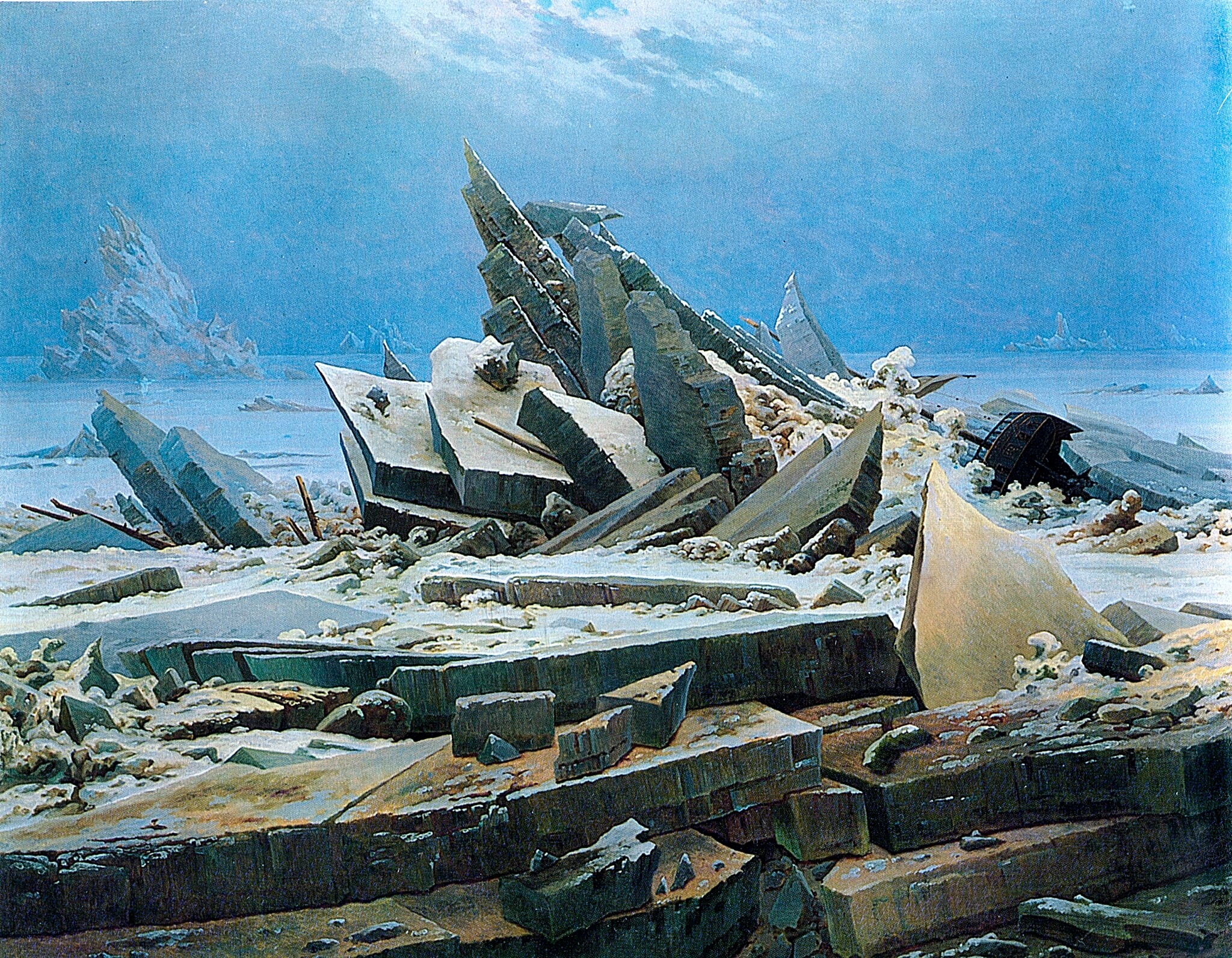
At the painting’s core, a pyramidal cairn of jagged ice sheets rears up and crushes the remains of a ship. Drawn from Friedrich’s close studies of real river ice and enlarged to monumental scale, this up‑thrust mass turns an Arctic scene into a stark drama of nature’s supremacy and human fragility.
Historical Context
Friedrich painted The Sea of Ice in 1823–1824, when Europe avidly followed polar voyages and shipwreck news. The work debuted under the telling title “An Idealized Scene of an Arctic Sea, with a Wrecked Ship on the Heaped Masses of Ice,” and it circulated with variants such as The Polar Sea—framing the central heap of ice as both subject and agent of catastrophe 2.
Rather than travel north, Friedrich grounded the image in observation at home. During the severe winter of 1820/21 he made outdoor oil studies on the Elbe near Dresden, noting the fractured geometry of floes and their greenish‑blue to yellowed tones. He later magnified those motifs into the painting’s towering, slab‑like sheets that bury the vessel beneath them. Technical study also records his careful staging of color and light across the ice and sky, underscoring the deliberate, study‑to‑studio construction of the scene 1. The result met a public primed for Arctic spectacle while asserting a distinctly Romantic vision in which the ice itself becomes the protagonist.
Symbolic Meaning
The jagged ice sheets embody the Romantic sublime—a spectacle of overwhelming, impersonal force that inspires awe and dread. Rising to a sharp apex, the heap dwarfs and crushes human technology, rendering the ship’s ribs and spars into minor, almost incidental debris. Viewers in the nineteenth century readily associated such imagery with polar peril and the limits of mastery in an age of exploration; the painting’s title history, including popular formulations like the “wreck” or “failed hope,” reinforces the reading of the ice as an emblem of human aspiration undone 2.
At the same time, Friedrich’s treatment resists a single, nihilistic message. The central mass functions as a memento of mortality and pride, yet the wider field—its pale light, open horizon, and subtle atmospheric gradations—introduces a counter‑current of endurance and moral testing. Curatorial analysis points to nuanced color transitions and a faint clearing in the sky that temper annihilation with the possibility of persistence or grace 1. In this balance, the jagged sheets serve as both literal Arctic geology and a distilled allegory of human limits before creation.
Artistic Technique
Friedrich builds the ice into a pyramidal pile set on a strong diagonal, its slabs beveled, tilted, and cross‑braced to read as fractured planes. Color is keenly observed and orchestrated: translucent greenish‑blues, chalky whites, and yellowed highlights differentiate ice, snow, and slush. Paint handling alternates between crisp edges and dry‑brushed veils to suggest granular frost versus glassy fracture faces. Conservation imaging notes a pinkish ground showing through thin passages in the sky and the use of smalt, whose coarse particles modulate the cold atmosphere. These study‑based observations, scaled up and tightened into a severe geometry, make the heap a constructed monument of ice—convincing in detail, commanding in form 1.
Connection to the Whole
The jagged heap is both structural hub and semantic engine. Compositional vectors—the tilted slabs, littered spars, and raking shadows—converge on its apex, while the buried hull fragments confirm the ice as the scene’s active force. By subordinating every human trace to this mass, Friedrich literalizes the picture’s subject: an Arctic sea where “mighty sheets of ice” dominate all else 1. Across the canvas, the low horizon and wide, wintry sky amplify that dominance, aligning the whole with the Romantic sublime and with contemporary fascination for polar exploration and wreck narratives 2. The element does not merely occupy the center; it defines the painting’s meaning.
Explore More from This Painting
This detail is one part of The Sea of Ice. Use the links below to return to the full interpretation, browse the full set of details, or view the painting's valuation if available.