How Much Is Agapanthus Worth?
Last updated: March 15, 2026
Quick Facts
- Methodology
- comparable analysis
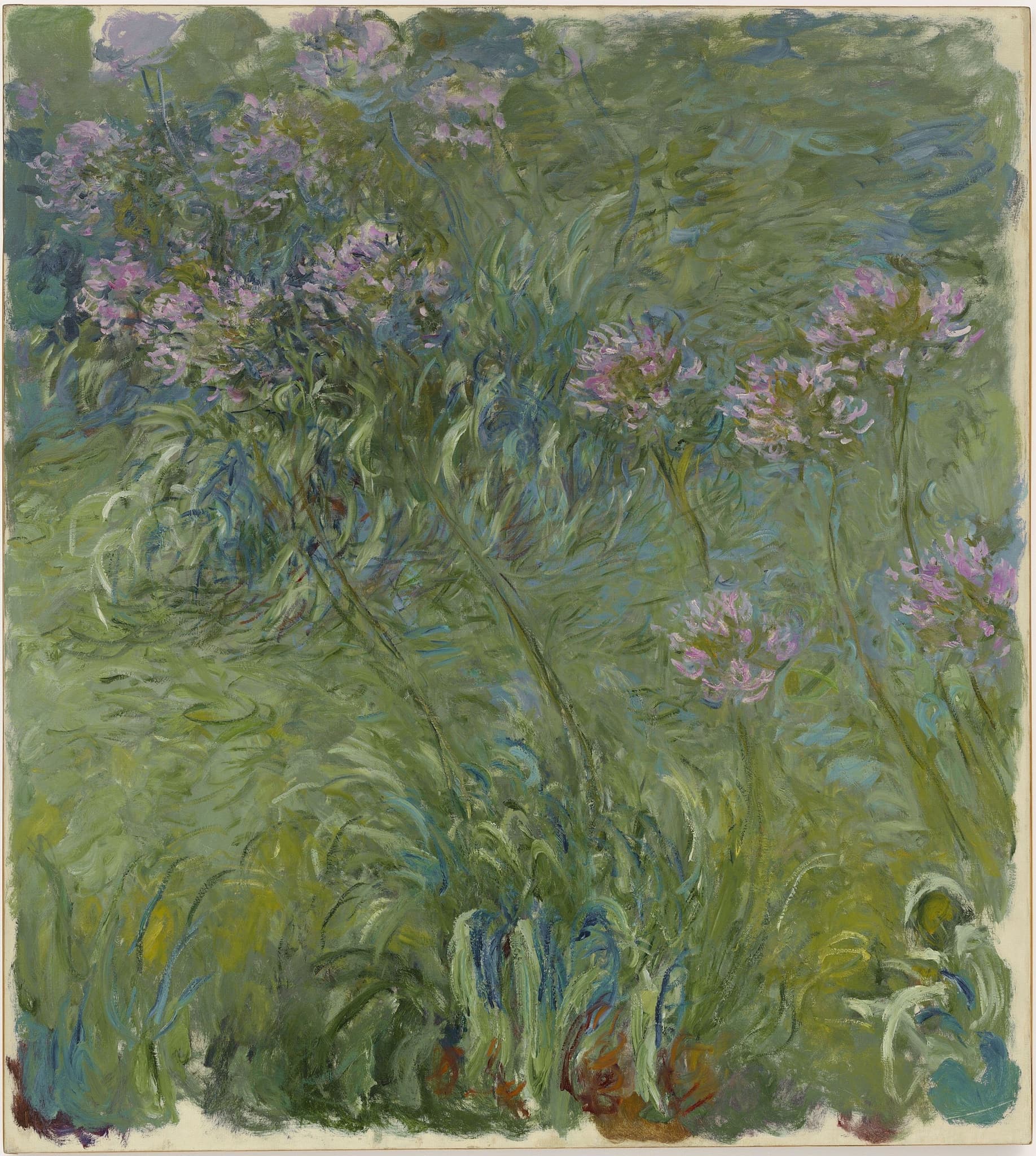
We estimate Claude Monet’s Agapanthus (the reunited three-panel Water Lilies triptych, c. 1915–1926) at $260–360 million. The range is anchored to recent prices for prime late single-panel Nymphéas canvases ($65.5–$84.7 million) and applies an ensemble premium for a conceived panorama of exceptional rarity and art-historical importance. Individual panels would command roughly $75–120 million each, depending on color, condition, and context.
Valuation Analysis
Valuation conclusion: $260–360 million (hypothetical fair-market value, as of early 2026) for Claude Monet’s Agapanthus as a reunited triptych. This estimate is built from recent marquee results for top late single-panel Water Lilies and an ensemble premium reflecting the rarity and art-historical primacy of a conceived, multi-panel panorama.
Market anchors: Prime late Nymphéas canvases have traded in the $65–85 million band over the last several years, including Nymphéas en fleur at $84.7m (2018, Rockefeller) [1], Le bassin aux nymphéas at $74.0m (Nov 2023) [2], and Nymphéas at $65.5m (Nov 2024) [3]. Sotheby’s also placed a late Le Bassin aux nymphéas at $70.35m in 2021 [4]. Monet’s overall auction record remains $110.7m for Meules (2019) [5]. On a per‑panel basis, Agapanthus aligns with the top tier of these late lilies; the sum-of-parts points to roughly $225–255m before any ensemble consideration.
Ensemble premium: Unlike standalone lilies, Agapanthus was conceived as a continuous three-panel panorama. Such late multi-panel decorations are far rarer and more institutionally coveted, warranting a substantial premium above three like-for-like single panels. A 20–40% ensemble premium is appropriate given the triptych’s prominence, repeated museum reunifications (2011–12; 2015–16) [7], and its stature within Monet’s late project at Giverny. Applying that premium to the per-panel baseline supports the $260–360m range.
Provenance, stature, and scarcity: The triptych’s panels passed from Michel Monet through Galerie Katia Granoff and M. Knoedler & Co. into three U.S. museums—Cleveland Museum of Art, Saint Louis Art Museum, and the Nelson‑Atkins Museum of Art—by 1956–60 [6][8][9]. None of the panels has appeared at public auction, underscoring absolute scarcity. Their periodic reunification and prominent display cement art-historical significance and visibility, factors that amplify demand and pricing power for any hypothetical disposition [7].
Positioning within Monet’s oeuvre: Monumental late lilies are among Monet’s most desired subjects, rivaling Haystacks and select Venice/London series. As a conceived panorama, Agapanthus stands closer to the grand decorations in ambition and scale, placing it at the apex of late Monet collecting. That status justifies a value materially above even exemplary single-panel lily benchmarks.
Market context: Blue‑chip Impressionism has acted as a relative safe haven versus ultra‑contemporary volatility; while 2024 public auction volumes softened, the segment rebounded on museum‑quality, correctly estimated consignments in 2025, with strong private‑sale absorption in parallel [10]. Against this backdrop, trophy late Monets continue to attract deep global demand, validating the upper-tier framework applied here.
Key Valuation Factors
Art Historical Significance
High ImpactAgapanthus is a landmark of Monet’s late Giverny project: a conceived, panoramic Water Lilies composition that extends the ambition and immersive viewing experience of the Grandes Décorations. Within Monet’s oeuvre, few works convey the same scale, continuity, and meditative surface as a fully realized multi-panel lily panorama. The triptych’s critical reception, frequent scholarly citation, and repeated reunifications in major museum exhibitions elevate it well above the already desirable late single-panel lilies. This depth of art-historical significance translates directly to pricing power, positioning Agapanthus at the apex of Monet’s late work and as a canonical Impressionist masterpiece.
Rarity and Ensemble Integrity
High ImpactLate Monet multi-panel lily panoramas are exceptionally scarce. While strong single-panel lilies appear periodically at auction, conceived triptychs almost never come to market—many reside in institutions. Agapanthus’s rarity is compounded by its ‘ensemble integrity’: the three panels were designed to read as a continuous field. Works that are both series-defining and complete command premiums well above the sum of parts. In practice, such ensembles can realize 20–40% more than comparable standalone components due to their uniqueness, curatorial priority, and the elevated pool of institutional and trophy-focused private buyers prepared to compete for “one-of-one” opportunities.
Market Benchmarks and Liquidity
High ImpactRecent marquee sales confirm a robust, liquid market for late Water Lilies: $84.7m (Rockefeller, 2018), $74.0m (2023), $70.35m (2021), and $65.5m (2024). These results establish a durable price band for prime single-panel late lilies and provide a defensible base for per-panel valuation of Agapanthus. Monet’s $110.7m artist record further illustrates headroom for iconic subjects with outstanding quality and visibility. Depth of global bidding across the U.S., Europe, and Asia for A‑tier late Monets supports a confident extrapolation to triptych scale, with competitive conditions likely to yield an ensemble premium in line with best‑in‑class trophies.
Provenance, Exhibition, and Museum Status
Medium ImpactEach panel moved from Michel Monet via Katia Granoff and Knoedler into leading U.S. museums in the 1950s–60s, with no public auction appearances. This “clean,” well-documented provenance and decades of institutional stewardship are significant value drivers, alongside extensive exhibition history including periodic reunifications. While current museum ownership makes a sale hypothetical, it simultaneously underscores the work’s institutional caliber and the difficulty of replacement—considerations that inform both fair-market logic and potential insurance/indemnity frameworks. In market settings, museum-level provenance and visibility regularly translate into stronger demand and tighter bidding spreads for blue‑chip masterpieces.
Sale History
Agapanthus has never been sold at public auction.
Claude Monet's Market
Claude Monet is a foundational blue-chip artist with a deep, global collector base across the U.S., Europe, and Asia. His most coveted subjects—late Water Lilies, Haystacks, and iconic London/Venice views—regularly lead marquee sales. Monet’s auction record stands at $110.7 million for Meules (Sotheby’s, 2019). In recent years, prime late Water Lilies have clustered in the $65–85 million range at auction, with multiple results confirming consistent liquidity at the top end. Works with fresh-to-market provenance, strong color, and major exhibition history command premiums and often attract third‑party guarantees. This enduring demand profile underpins robust pricing for best‑in‑class late Monets.
Comparable Sales
Nymphéas en fleur
Claude Monet
Prime late Water Lilies (c. 1914–17), large single-panel lily from the same late Giverny cycle as Agapanthus; widely considered a trophy example and a key anchor for late Nymphéas pricing.
$84.7M
2018, Christie's New York
~$108.4M adjusted
Le Bassin aux nymphéas
Claude Monet
Large late Water Lilies (1917–19), near in date, subject, and scale to Agapanthus; recent marquee result illustrating demand for blue‑chip, late lilies.
$70.4M
2021, Sotheby's New York
~$83.0M adjusted
Coin du bassin aux nymphéas
Claude Monet
Late lily (1918) in an elongated, semi‑panoramic format related to the grand decorations; helpful for bracketing value on wide-format late lilies.
$50.8M
2021, Sotheby's New York
~$59.9M adjusted
Le bassin aux nymphéas
Claude Monet
Top 2023 Monet result; late, large Water Lilies (c. 1917–19). Confirms current price band for prime single‑panel late lilies in strong condition.
$74.0M
2023, Christie's New York
~$77.7M adjusted
Nymphéas
Claude Monet
Late lily (c. 1914–17) from a prominent collection; very close in period and subject to Agapanthus and a fresh benchmark just before the centenary year.
$65.5M
2024, Sotheby's New York
~$67.5M adjusted
Nymphéas (1907)
Claude Monet
Earlier lily from Monet’s pre‑War cycle; still subject‑relevant and market‑probative for lily demand, though earlier and typically smaller than the c.1914–26 grand decorations.
$45.5M
2025, Christie's New York
Current Market Trends
Impressionist and early Modern masterworks have acted as relative safe havens amid broader market rebalancing. Public auction volumes at the very high end softened in 2024, but 2025 marquee sales rebounded on museum‑quality, correctly priced consignments, with private sales absorbing additional demand. Within this context, late Monet lilies continue to perform strongly, benefiting from deep cross‑regional demand and institutional interest. As the 2026 centenary focuses renewed attention on Monet, supply-driven opportunities are meeting committed buyers, and correctly estimated, guaranteed trophies remain highly competitive. This environment supports elevated valuations for canonical, multi‑panel late lilies.
Study print
Study this painting as a print
Pair the full artwork with a museum-style study sheet focused on one meaningful detail.
Sources
- Christie’s press release — Rockefeller Sale (2018): Nymphéas en fleur $84.7m
- Christie’s — Marquee Week, New York (Nov 2023): Le bassin aux nymphéas $74,010,000
- Sotheby’s — Fall 2024 New York results: Nymphéas $65,500,000
- Sotheby’s — May 2021 Evening Sale: Le Bassin aux nymphéas $70,353,000
- Sotheby’s — Monet’s Meules sets $110.7m artist record (2019)
- Royal Academy — Painting the Modern Garden (Immunity from Seizure object list): provenance and ownership
- Nelson‑Atkins Museum of Art — Water Lilies (object page) with triptych reunification notes
- Cleveland Museum of Art — Water Lilies (Agapanthus), object page
- Saint Louis Art Museum — Water Lilies, object page
- Art Basel & UBS — The Art Market Report 2025 (market trends and 2024–2025 dynamics)