How Much Is Grainstack (Sunset: winter) Worth?
Last updated: May 14, 2026
Quick Facts
- Methodology
- comparable analysis
Anchored by the two marquee Meules benchmarks—$110.7m at Sotheby’s in 2019 and $81.45m at Christie’s in 2016—and the trophy subject (sunset/winter snow), Monet’s Grainstack (Sunset: winter) supports a current fair‑market value of $100–140 million. Identified with the Wildenstein catalogue (W1282) and on loan to the National Gallery, London, it is a full‑scale, prime 1890–91 Haystack with museum‑level stature and extreme scarcity in private hands.
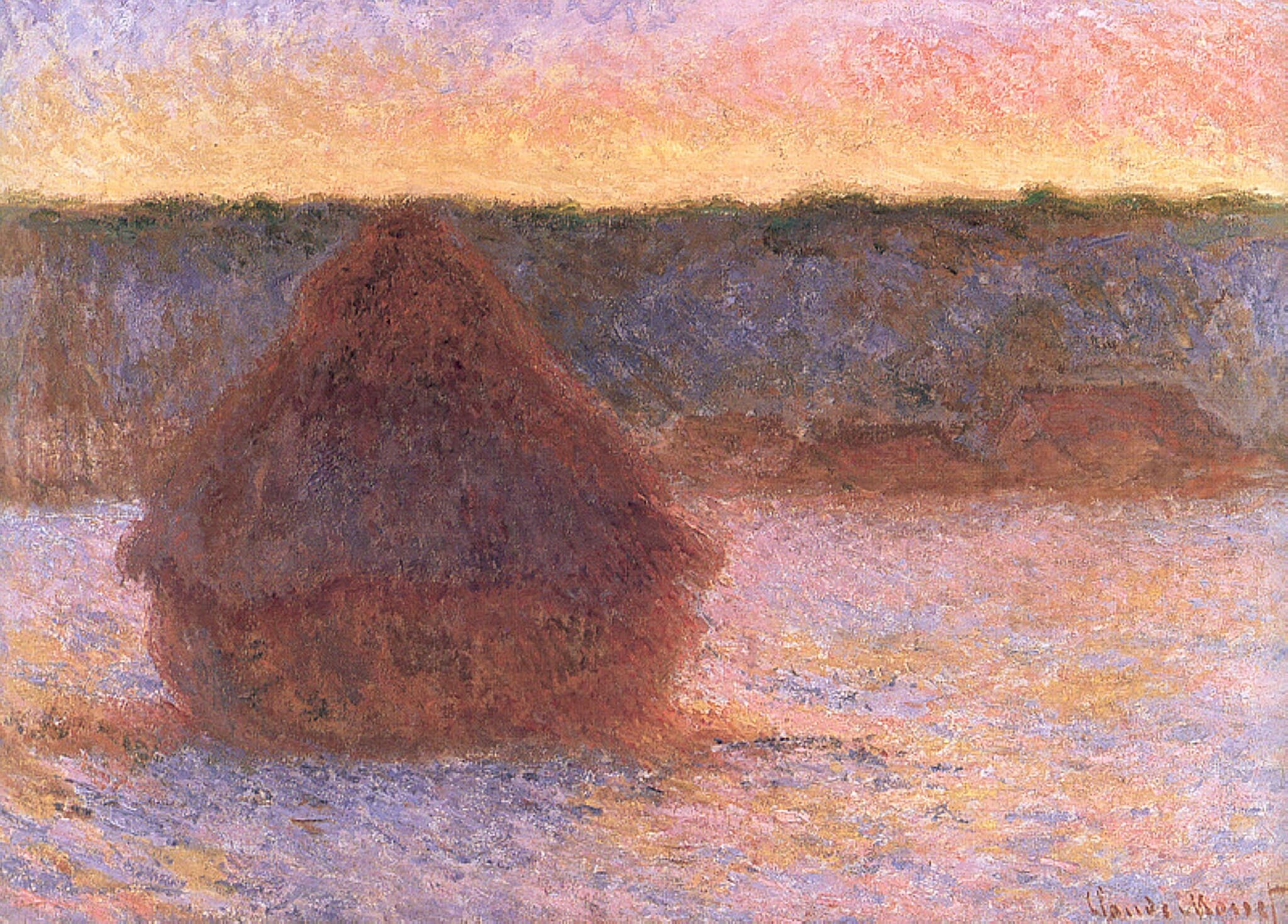
Grainstack (Sunset: winter)
Claude Monet, 1890–1891 • Oil on canvas
Read full analysis of Grainstack (Sunset: winter) →Valuation Analysis
Conclusion: We estimate Claude Monet’s Grainstack (Sunset: winter), 1890–91 (Wildenstein W1282), at $100–140 million fair‑market value today. The work is a full‑size, canonical Haystack of sunset/winter effect—among the rarest, most coveted variants in Monet’s seminal 1890–91 Meules campaign—currently on loan to the National Gallery, London, underscoring its museum‑caliber quality and scholarly standing [1][5].
Comparable benchmarks: The most probative comparables are within the same Meules series. Sotheby’s New York sold Meules for $110.7 million in May 2019, Monet’s auction record and the high‑water mark for any Impressionist work [2]. Christie’s New York sold Meule for $81.45 million in November 2016, the prior artist record [3]. Robust recent demand for top‑tier Monets is further evidenced by Christie's sale of a major Water‑Lilies at $74.01 million in November 2023 [4]. Together these establish a durable pricing corridor for prime, dramatic Haystacks; a sunset/winter (snow) effect like this canvas typically sits toward the upper end of that corridor.
Subject quality and rarity: The Meules series is foundational to Monet’s exploration of seriality, light, and atmospheric change—core to Impressionism’s legacy. Sunset and winter/snow variants are especially scarce, immediately legible to collectors, and historically aligned with peak prices. At approximately 64.8 × 92.1 cm, the painting matches the full, exhibition scale preferred by top buyers. The work’s visibility on the National Gallery’s walls reinforces its stature, and the AIC’s scholarly catalogue links the private‑collection canvas in Great Britain directly to W1282, confirming its identity within the series corpus [1][5].
Market positioning and liquidity: At the very top of the pre‑war market, supply scarcity and global trophy demand drive pricing. While 2024 saw selectivity at the ultra‑high end across categories, blue‑chip, museum‑caliber Impressionist masterpieces continued to secure deep bidding and guarantees; 2025 results reaffirmed buyer appetite for first‑rate examples. In this context, an A‑level, full‑scale Haystack with dramatic chroma and winter light sits among the most liquid and globally recognized works available by Monet.
Valuation takeaways: The indicated $100–140 million range is derived from direct Meules comparables (2016 and 2019) and recent marquee Monet results, adjusted for subject superiority (sunset/winter), scale, institutional endorsement, and extreme scarcity. This estimate presumes excellent condition, clear provenance from the Durand‑Ruel period onward, and strong literature/exhibition history—expectations consistent with a long‑term National Gallery loan. With pristine condition and distinguished provenance, competitive auction dynamics or a guaranteed private treaty could credibly press the upper band or beyond; conversely, material condition or provenance issues would skew value lower within the series’ established corridor [2][3][4].
Key Valuation Factors
Art Historical Significance
High ImpactMonet’s 1890–91 Haystacks (Meules) are a cornerstone of Impressionism and of modern art’s embrace of serial observation. The series crystallizes Monet’s study of transitory light, color, and seasonality—concepts that seeded later developments in modernism. Sunset/winter canvases are particularly resonant: their heightened chroma, low sun angles, and snow‑cover effects exemplify the poetic extremes of the cycle. Within Monet’s oeuvre, only Water‑Lilies and Rouen Cathedral rival Haystacks for canonical status. A full‑scale, textbook example with a dramatic winter sunset occupies the very top of the artist’s hierarchy, making it instantly identifiable to global audiences and institutions. This exceptional art‑historical standing is a primary value driver and justifies pricing at the upper end of Monet’s market.
Subject Rarity and Quality
High ImpactAmong Meules, the winter/snow and sunset variants are scarce in private hands and command a structural premium. Collectors prize the saturated palette, raking light, and crisp, reflective snow passages that heighten perceptual drama. This canvas’s full, exhibition scale (c. 65 × 92 cm) aligns with the best‑performing examples at auction and in private treaty. Works with immediate, iconic imagery benefit from a broader base of trophy buyers, including cross‑category collectors. Because a limited number of A‑level sunset/winter Haystacks remain in private ownership, any fresh appearance can catalyze intense competition. In sum, the subject’s rarity, quality, and instant legibility meaningfully elevate value relative to other strong but less dramatic Meules or later Monet subjects.
Provenance, Exhibition, and Scholarly Standing
High ImpactThe painting’s identification within the Wildenstein catalogue (W1282) and its loan to the National Gallery, London, signal unimpeachable standing. Museum exhibition confers rigorous vetting, elevates public profile, and supports literature citations. Such visibility compounds over time, anchoring market confidence and broadening potential demand from institutions and leading private collections. A clear line back to Durand‑Ruel stock and early collectors would further strengthen value, as would inclusion in major catalogues and exhibitions. While individual conservation details should be reviewed in any transaction, the current museum‑loan context typically suggests a stable condition profile and strong curatorial support—both additive to value. In the absence of red flags, this combination helps place the work firmly in Monet’s top tier.
Market Benchmarks and Liquidity
High ImpactTwo direct Meules comparables establish the price framework: $110.7m (Sotheby’s, 2019) and $81.45m (Christie’s, 2016). Recent marquee Monet results, including a $74.01m Water‑Lilies (2023), confirm continued depth for prime, blue‑chip works. At the same time, supply is extremely thin: most great Haystacks reside in museums, and each A‑level example reaching the market attracts global bidding and financial guarantees. In today’s selective high end, liquidity remains strongest for instantly recognizable, museum‑caliber masterpieces with bulletproof provenance. Given these dynamics, a sunset/winter Haystack of full scale and strong condition rightly prices at the top of Monet’s range, with plausible competitive upside in a well‑timed auction or private treaty setting.
Sale History
Grainstack (Sunset: winter) has never been sold at public auction.
Claude Monet's Market
Claude Monet is a perennial blue‑chip artist with one of the broadest and deepest global buyer bases. His record stands at $110.7 million for a Haystacks (Meules) canvas sold at Sotheby’s in 2019, and multiple Water‑Lilies have realized $50–75+ million in the last decade. Demand is most intense for iconic series—Haystacks, Water‑Lilies, Rouen Cathedral, and Poplars—especially full‑scale works with dramatic effects and pristine provenance. While the market became more selective in 2024, top‑tier Monets continued to command strong bidding and guarantees, and 2025 results reaffirmed appetite for museum‑caliber examples. Scarcity is the key driver: many of the best works are in institutions, so when a great Monet emerges, competition from private collectors and, occasionally, institutions is immediate and global.
Comparable Sales
Meules (Haystacks)
Claude Monet
Directly comparable: same 1890–91 Meules series, full-size, luminous late-day effect; the key public benchmark for a top-tier Haystack.
$110.7M
2019, Sotheby's New York
~$135.1M adjusted
Meule (Grainstack)
Claude Monet
Direct series comp (1890–91), similar scale and importance; long used by the trade to price prime Haystacks.
$81.4M
2016, Christie's New York
~$105.9M adjusted
Peupliers au bord de l’Epte, crépuscule
Claude Monet
Same year (1891) and a marquee serial campaign (Peupliers) with a twilight effect; calibrates pricing for prime 1891 works beyond Meules.
$43.0M
2025, Christie's New York
Le bassin aux nymphéas (Water-Lily Pond)
Claude Monet
Trophy Monet in another core series; evidences depth of demand for blue‑chip Monets at the $70m+ level in current cycles.
$74.0M
2023, Christie's New York
~$77.7M adjusted
Coin du bassin aux nymphéas
Claude Monet
Major Water-Lilies variant; helps anchor broader top-tier Monet pricing across series circa $50–60m (2025 dollars).
$50.8M
2021, Sotheby's New York
~$58.9M adjusted
Peupliers au bord de l’Epte, temps couvert
Claude Monet
Same 1891 campaign (Peupliers), good but less dramatic effect; underscores the premium that Meules command over other 1891 series.
$30.7M
2023, Sotheby's New York
~$32.2M adjusted
Current Market Trends
Impressionist and Post‑Impressionist sales softened in 2024 at the very top end, but the segment rebounded in 2025 with disciplined pricing and a pronounced flight to quality. Trophy‑grade, blue‑chip works with iconic imagery, strong condition, and clean provenance drew deep bidding and guarantees, while mid‑tier or compromised examples faced resistance. Monet remains a market bellwether: recent $40–75m results show durable demand for prime works, with the Meules series retaining a distinct premium. Institutional exhibitions tied to the Impressionist anniversary and Monet’s 2026 centenary sustain visibility, and the scarcity of A‑level Haystacks in private hands concentrates competition when such works surface. Net: selective but robust conditions favor a top‑tier Meules at $100–140m.
Study print
Study this painting as a print
Pair the full artwork with a museum-style study sheet focused on one meaningful detail.
Sources
- National Gallery, London – Claude Monet, Grainstack (Sunset: winter)
- Sotheby’s – Monet’s Meules Sells for $110.7 Million, A New Artist Record
- The Art Newspaper – Monet’s Grainstack fetches $81.4m at Christie’s
- Christie’s – 20th Century Evening Sale Results (Nov 9, 2023)
- Art Institute of Chicago – Monet: Stacks of Wheat (Meules) entry