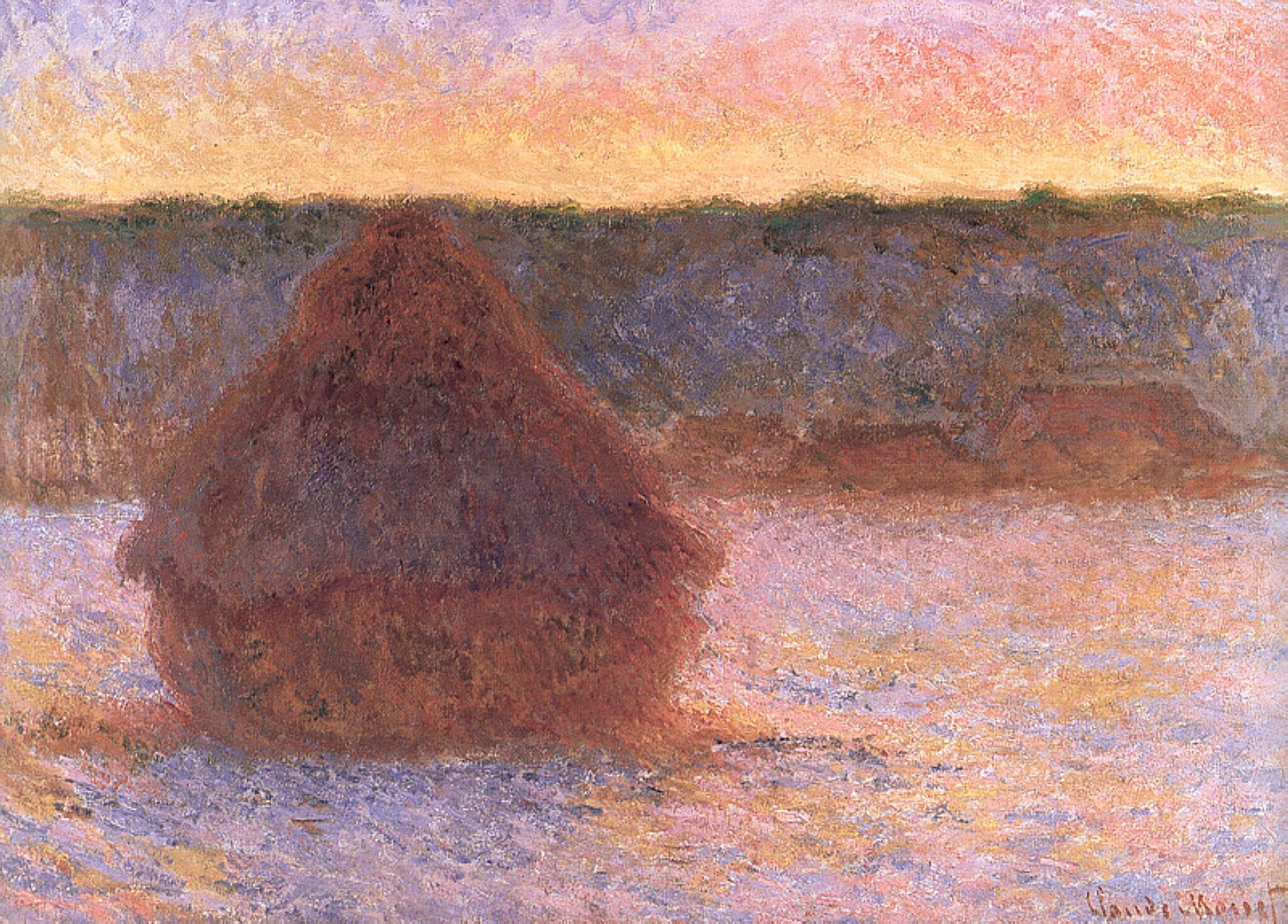
Grainstack (Sunset: winter)

by Claude Monet

Claude Monet’s Grainstack (Sunset: winter) turns a single rural grainstack into a condenser of light and time. A conical mound, rimmed with warm glow against violet-blue snow and a dusk band of trees, declares light as structure and winter’s cyclical pause.
💰

Market Value

$100–140 million

How much is Grainstack (Sunset: winter) worth?

Study Print Studio

Create a personal study print

Build a companion study sheet around the part of this painting that speaks to you most. Choose a detail, shape an interpretation, and walk away with something personal and display-worthy.

Fast Facts

Year
1890–1891
Medium
Oil on canvas
Dimensions
64.8 × 92.1 cm
Location
National Gallery, London (on loan from a Private Collection)
See all Claude Monet paintings in London
Grainstack (Sunset: winter) by Claude Monet (1890–1891) featuring Grainstack (conical mound), Rim light on the stack, Snowfield, Dusk sky gradient

Click on any numbered symbol to learn more about its meaning

Meaning & Symbolism

Monet centers a single, conical grainstack so it nearly touches the horizon, its apex deliberately aligned with the distant hill line—a compositional decision he reworked as the paint dried, imposing geometry within flux 1. The stack’s sunward edge kindles with orange and rose, while its body sinks to violets and umbers; the snowfield around it mottles into lavender, blue, and pale gold. These chromatic oppositions do not describe material facts so much as register the atmosphere’s temperature: warmth nestles inside winter’s chill. By letting broken strokes dissolve the contour, Monet makes the stack seem to breathe out into the air. The horizon, a dark treeline laced with low buildings, moors the scene without competing for attention, so that the sky’s gradient—from apricot at the band of light to lilac above—reads as the true engine of form. In this painting, light is not an accessory; it is the organizer of matter. That is why the stack’s shadow feels like pooled time—the day already sliding away—even as the rim still burns. Monet’s letter confessing that the sun “sets so fast I cannot follow it” clarifies the wager here: to trap vanishing light by distributing its stages across canvases, each a chapter in a single phenomenon 3. Within the broader series painted at Giverny from late 1890 to early 1891, Grainstack (Sunset: winter) occupies the dusk register, where perceptual strain is greatest and structure must be coaxed from near-silhouette 2. Monet’s serial logic converts sameness into a laboratory of change: snow or no snow, sunrise or sunset, clear or veiled air. When fifteen of these pictures were shown together in 1891, critics recognized that the ensemble communicated both the “ephemeral instant” and the earth’s larger course—daily and seasonal cycles fused in painted intervals 2. Curators have noted how, across the winter variants, flanking hills seem to wrap the stacks as if bedded down; here that sense is tightened by the apex-to-hill alignment, which stabilizes the motif even as the sky flickers 14. Technically, thickened impasto and visible revisions amplify the sensation of an envelope—light saturating surface and depth—so that meaning emerges from paint’s tactile weather as much as from its hues 2. Symbolically, the grainstack is not mere hay; it is stacked sheaves, a repository of sustenance that carries the harvest through scarcity 5. Read in this way, the warm rim against cold snow does not only report optics; it posits stored energy persisting through dormancy. Some scholars have pushed this further, arguing that Monet’s chosen serial motifs—grainstacks, poplars, Rouen Cathedral—tacitly evoke French fertility and civic endurance; while interpretive, this cultural resonance explains why a local field could bear national weight in the 1890s 2. Yet the canvas finally insists on a more radical claim: that seeing, temporally understood, is the landscape’s deepest content. Because the form’s solidity gives way to atmosphere, the picture instructs us to treat perception itself as durable—held, like grain in winter, by the painter’s calibrated chords of violet, rose, and gold. That is why Grainstack (Sunset: winter) is important: it demonstrates how a single motif, precisely placed and chromatically reimagined, can disclose time’s passage as the true subject of modern painting 123.

Explore Deeper with AI

Ask questions about Grainstack (Sunset: winter)

Popular questions:

Powered by AI • Get instant insights about this artwork

💬 Ask questions about this artwork!

Interpretations

Phenomenology of Perception

Monet’s wager is optical and temporal: to catch light that “sets so fast I cannot follow it.” The painting’s chromatic dialectic—apricot band, lilac dome, violet shadows—renders temperature as structure, so that seeing becomes the subject. The broken contour lets air absorb edges, making the stack appear to exhale into dusk; sky gradients read not as background but as the engine that organizes mass. In phenomenological terms, the motif arises from atmospheric conditions rather than underlying outline: substance is an effect of illumination distributed across the field, a lived duration made visible by calibrated color chords 23.

Source: The Metropolitan Museum of Art; Art Institute of Chicago

Technical/Conservation Lens

Look closely and the painting tells on itself: edges shifted, passages reloaded, the stack’s apex realigned to meet the distant hill—pentimenti that the National Gallery links to Monet’s on‑the‑spot starts and extended studio reworking. The crusted impasto and scumbled sky act like a time‑lapse on canvas, where drying intervals enabled structural edits while preserving the flicker of wet‑into‑wet color. These material traces convert changing light into a tactile record; the “envelope” of atmosphere is not only pictured but literally built up in layers. In this view, facture is the timekeeping device: paint thickness, overlap, and revisions are indices of duration, binding fleeting sunset to the slow labor of making 12.

Source: National Gallery, London; Art Institute of Chicago

Seriality & Exhibition Strategy

Monet’s 1891 Durand‑Ruel display—fifteen Grainstacks hung together—was not an afterthought but a structuring premise. Following John House, the series should be read as an ensemble where each canvas calibrates a different register of light, weather, and season, gaining meaning through adjacency. Geffroy praised this “victorious demonstration” for conveying the ephemeral instant while intimating the earth’s longer course, a dual temporality only legible when viewers compare canvases across the wall. Grainstack (Sunset: winter) functions as the dusk node within that system, intensifying contrasts and near‑silhouette so the set as a whole maps time’s arc—from thawing dawns to frozen twilights—onto a single rural motif 24.

Source: Art Institute of Chicago (scholarly catalogue); Gustave Geffroy (1891, via AIC)

Cultural-Historical Symbolism

Beyond optics, the grainstack is a reserve of life—bound sheaves protected to bridge scarcity. Paul Hayes Tucker argues Monet’s 1890s motifs formed a quiet lexicon of French resilience: grainstacks (fertility), poplars (Republican liberty), Rouen Cathedral (historic continuity). While interpretive, this lens clarifies why a field at Giverny could carry national resonance in the Third Republic, especially in the wake of war and rural modernization. Here, the warm rim against cold snow reads as stored energy persisting through dormancy, aligning agrarian abundance with civic endurance. Such cultural charge helps explain the series’ impact in 1891, when sameness turned symbolic through serial difference 25.

Source: Paul Hayes Tucker; Art Institute of Chicago

Geometry vs. Atmosphere (Formal Analysis)

This canvas sharpens a paradox at the heart of Impressionism: near‑dissolution under raking light countered by geometric poise. Monet realigns the stack’s apex to the hill line, producing a hinge that stabilizes the composition while the sky flickers. Critics like Mauclair saw in such moments an almost mathematical assurance—structure distilled within flux. The dark horizon band and low buildings act as a datum, allowing high‑key complements (rose/orange vs. violet/blue) to vibrate without losing legibility. The result is a negotiated image: atmosphere is sovereign, yet a few axial decisions—apex, horizon, shadow vector—anchor perception, keeping dusk’s ambiguity generative rather than amorphous 12.

Source: National Gallery, London; (Mauclair quoted in NG text)

Related Themes

About Claude Monet

Claude Monet (1840–1926) led Impressionism’s pursuit of open-air painting and optical immediacy, especially during his Argenteuil years focused on modern leisure and light. He later developed serial studies of changing conditions, culminating in the Water Lilies cycle [2].
View all works by Claude Monet

More by Claude Monet

Haystacks Series by Claude Monet | Light, Time & Atmosphere by Claude Monet

Haystacks Series by Claude Monet | Light, Time & Atmosphere

Claude Monet

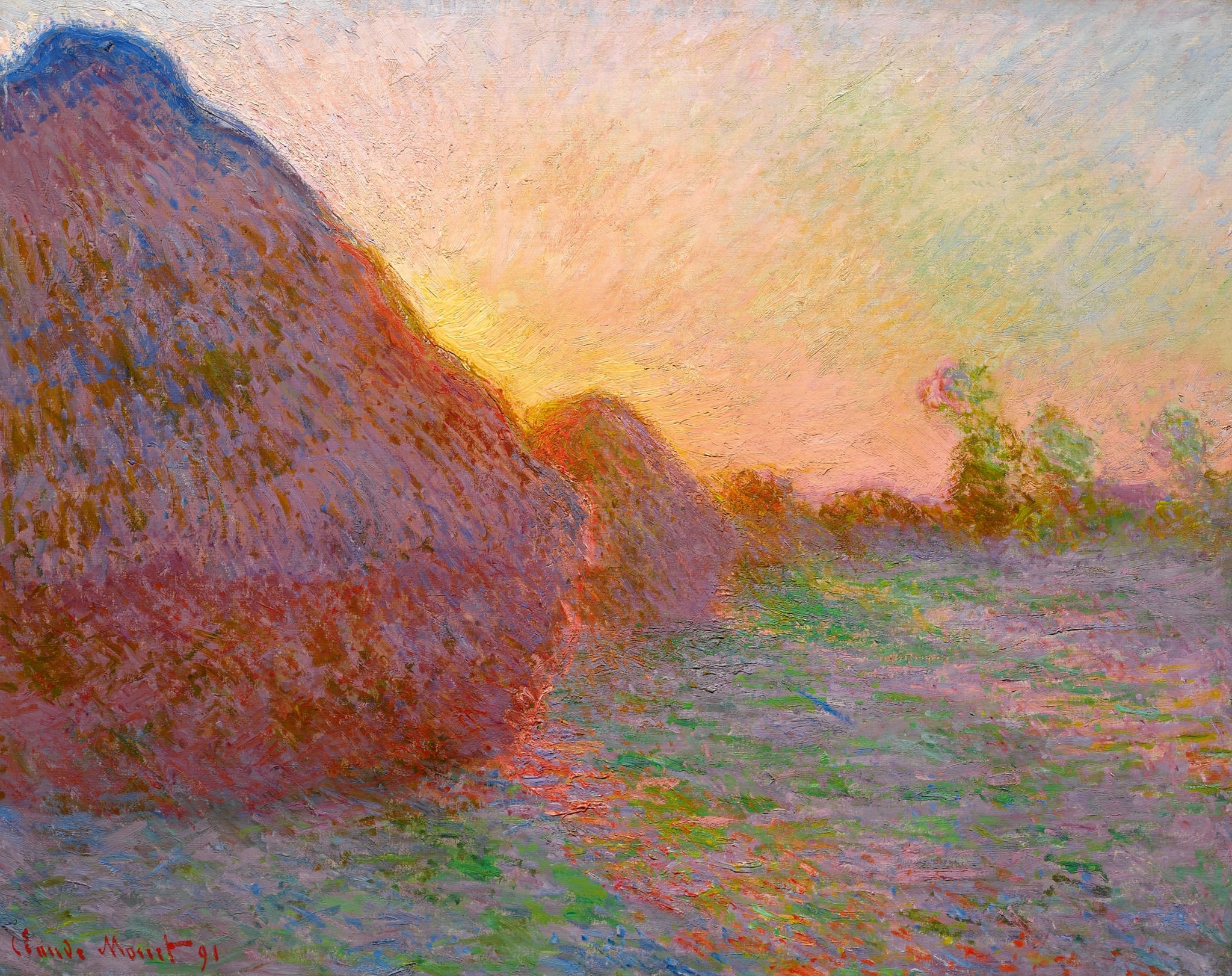
Claude Monet’s <strong>Haystacks Series</strong> transforms a routine rural subject into an inquiry into <strong>light, time, and perception</strong>. In this sunset view, the stacks swell at the left while the sun burns through the gap, making the field shimmer with <strong>apricot, lilac, and blue</strong> vibrations.
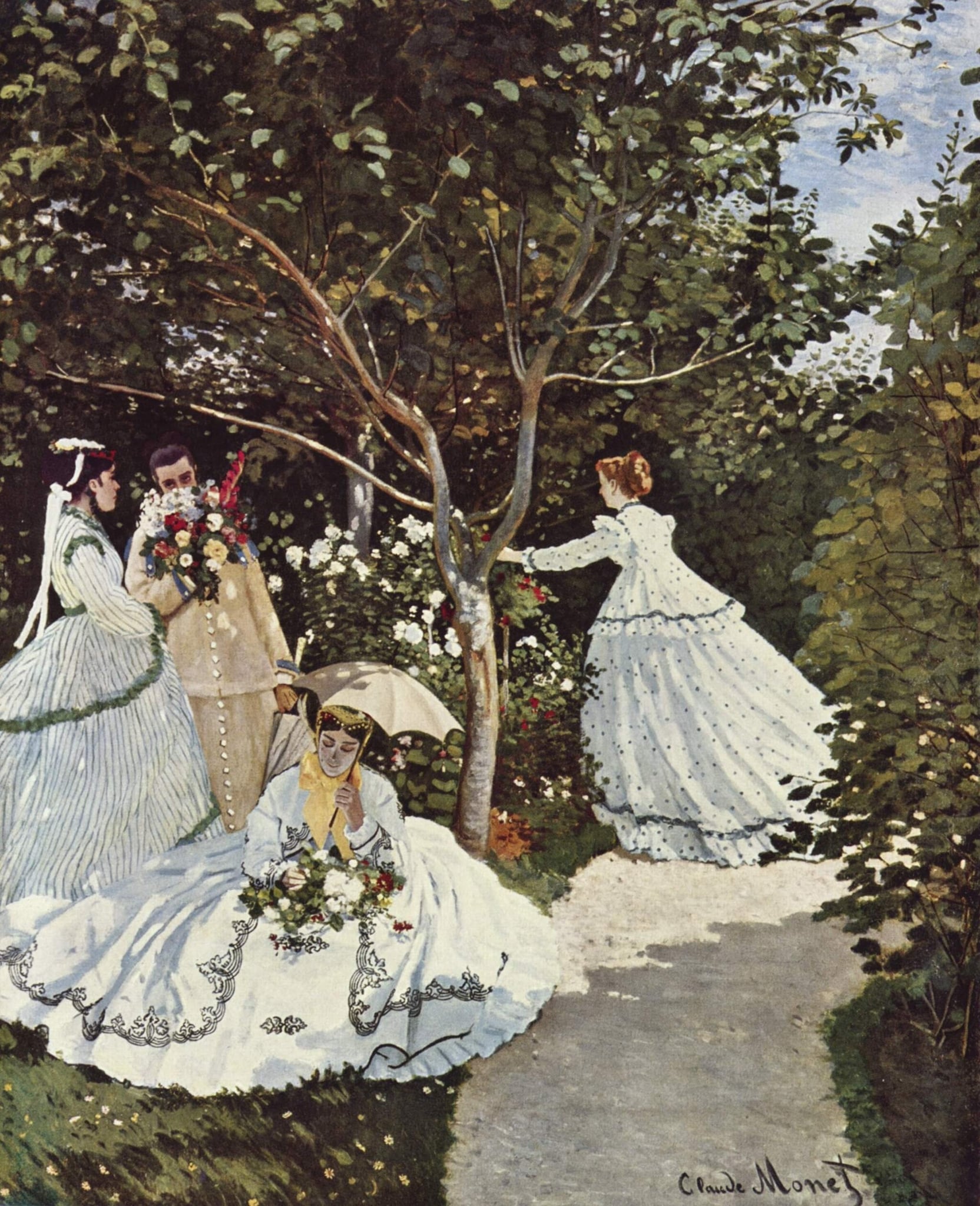
Women in the Garden by Claude Monet

Women in the Garden

Claude Monet (1866–1867)

Claude Monet’s Women in the Garden choreographs four figures in a sunlit bower to test how <strong>white dresses</strong> register <strong>dappled light</strong> and shadow. The path, parasol, and clipped flowers frame a modern ritual of leisure while turning fashion into an instrument of <strong>perception</strong>. The scene reads less as portraiture than as a manifesto for painting the <strong>momentary</strong> outdoors <sup>[1]</sup><sup>[3]</sup>.
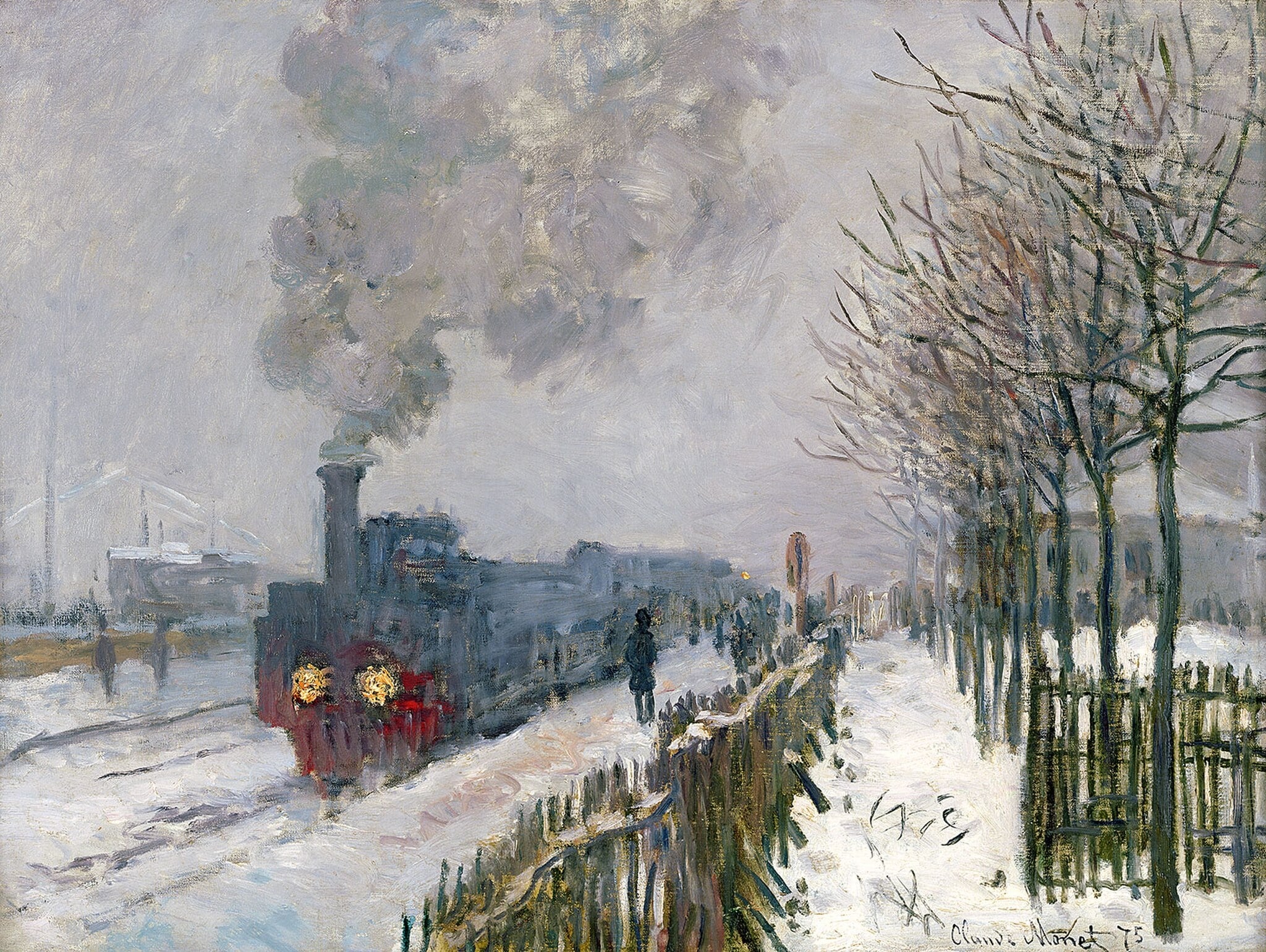
The Train in the Snow (The Locomotive) by Claude Monet

The Train in the Snow (The Locomotive)

Claude Monet (1875)

Claude Monet’s The Train in the Snow (The Locomotive) (1875) turns a suburban winter platform into a study of <strong>modernity absorbed by atmosphere</strong>. The engine’s twin yellow headlights and a smear of red push through a world of greys and violets as steam fuses with the low sky, while the right-hand fence and bare trees drill depth and cadence into the scene <sup>[1]</sup><sup>[4]</sup>. Monet fixes not an object but a <strong>moment of perception</strong>, where industry seems to dematerialize into weather <sup>[1]</sup><sup>[2]</sup>.
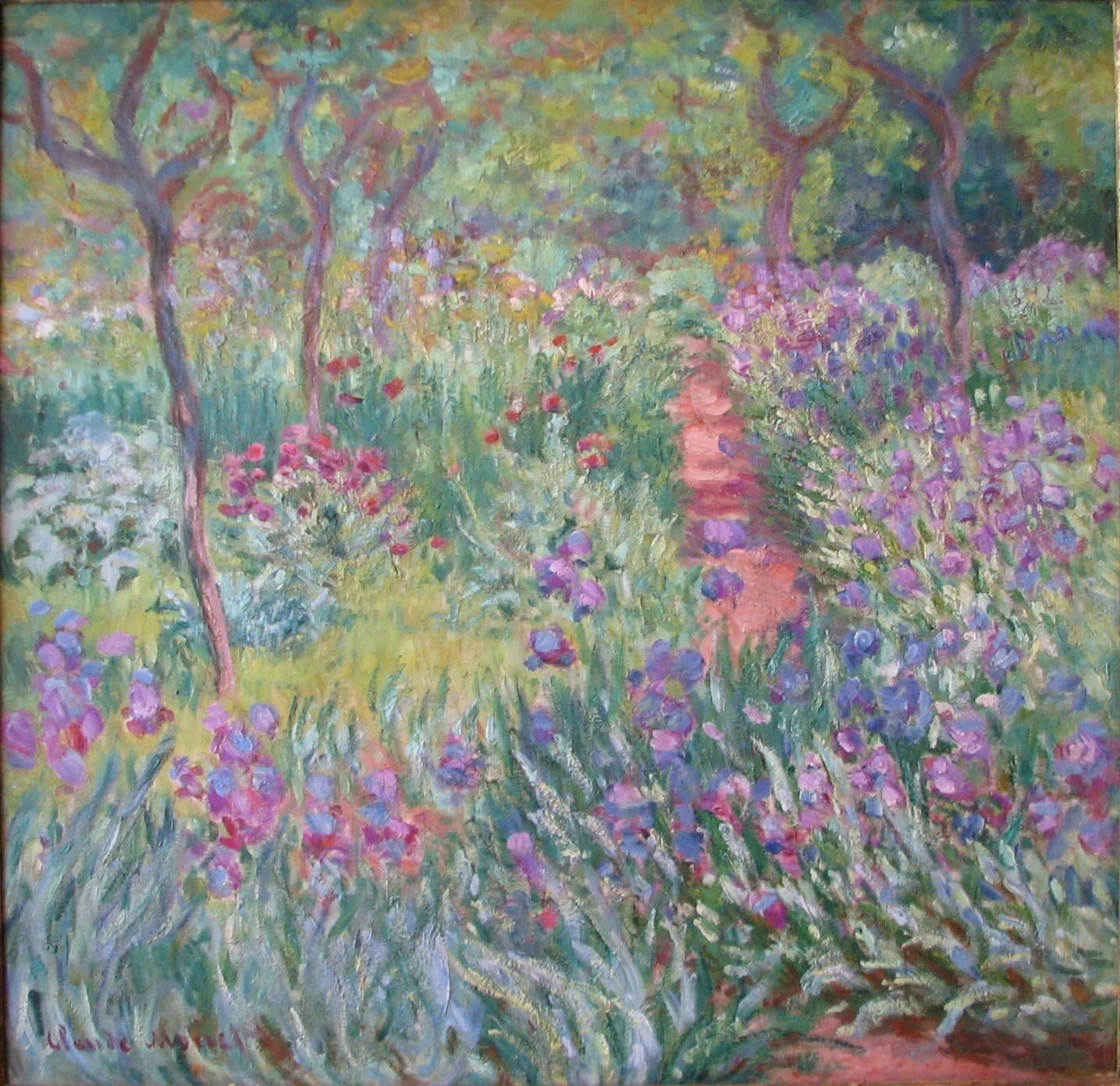
The Artist's Garden at Giverny by Claude Monet

The Artist's Garden at Giverny

Claude Monet (1900)

In The Artist's Garden at Giverny, Claude Monet turns his cultivated Clos Normand into a field of living color, where bands of violet <strong>irises</strong> surge toward a narrow, rose‑colored path. Broken, flickering strokes let greens, purples, and pinks mix optically so that light seems to tremble across the scene, while lilac‑toned tree trunks rhythmically guide the gaze inward <sup>[1]</sup><sup>[3]</sup>.
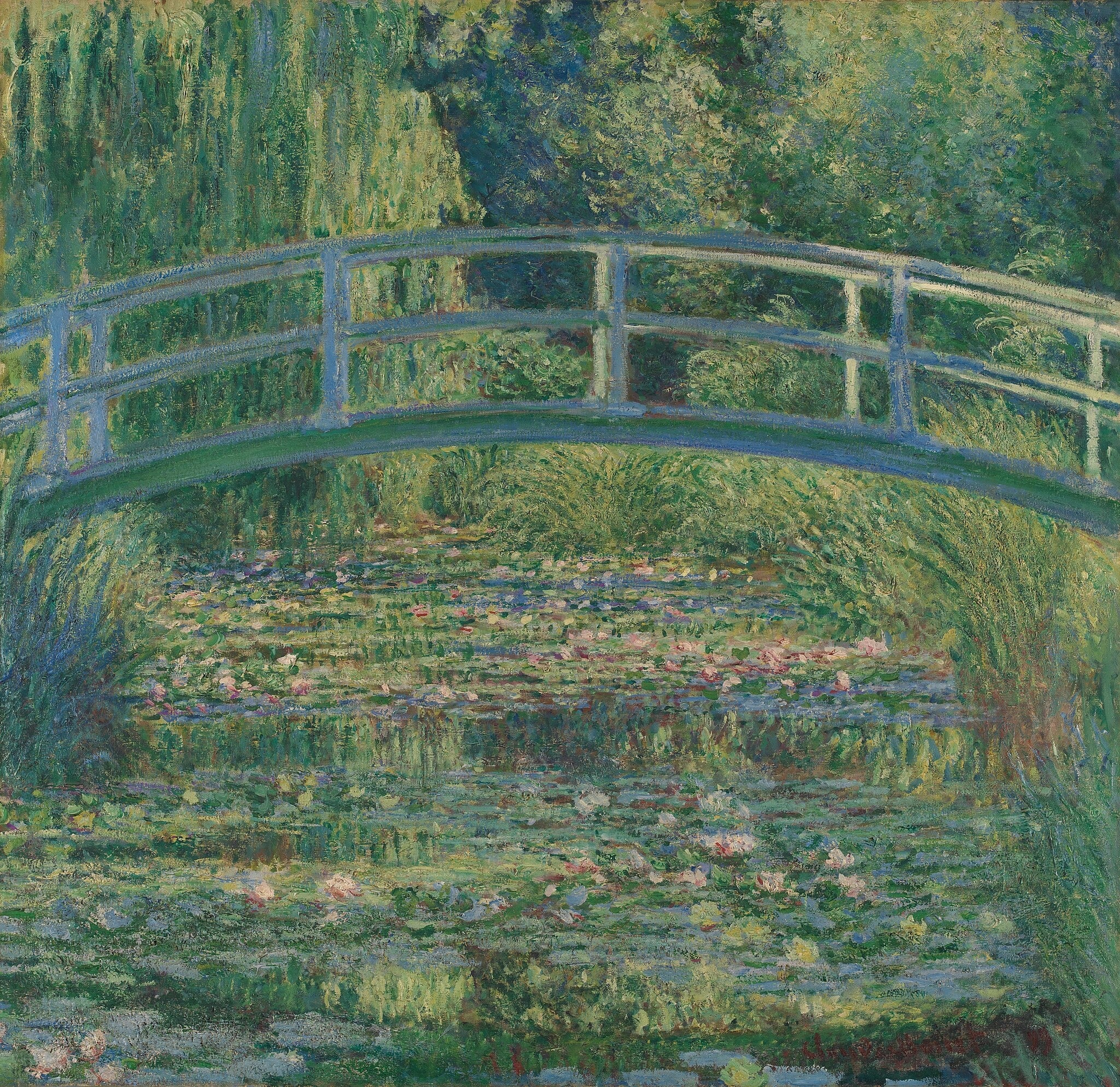
Water Lilies by Claude Monet

Water Lilies

Claude Monet (1899)

<strong>Water Lilies</strong> centers on an arched <strong>Japanese bridge</strong> suspended over a pond where lilies and rippling reflections fuse into a single, vibrating surface. Monet turns the scene into a study of <strong>perception-in-flux</strong>, letting water, foliage, and light dissolve hard edges into atmospheric continuity <sup>[1]</sup><sup>[3]</sup>.
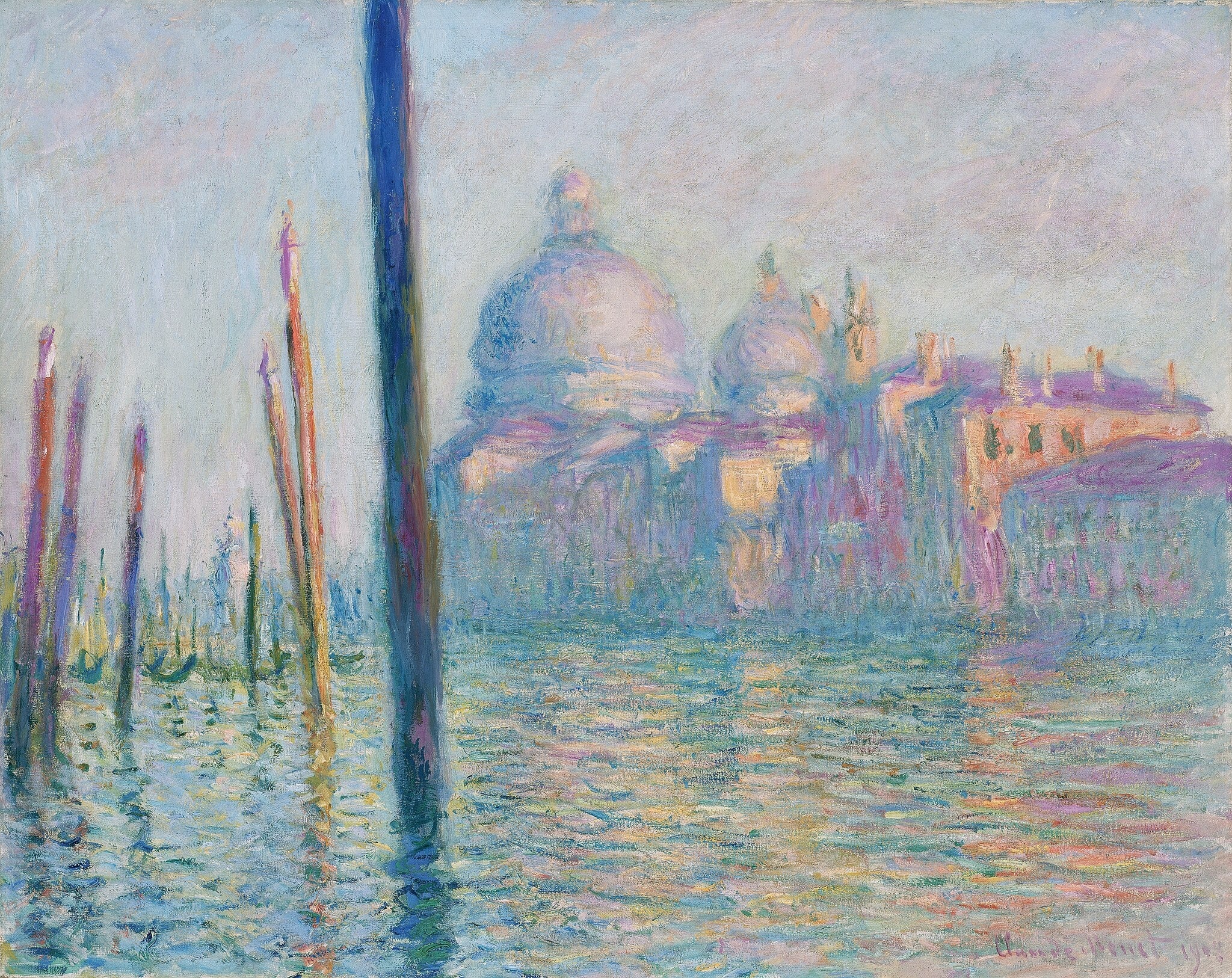
The Grand Canal by Claude Monet

The Grand Canal

Claude Monet (1908)

Claude Monet’s The Grand Canal turns Venice into <strong>pure atmosphere</strong>: the domes of Santa Maria della Salute waver at right while a regiment of <strong>pali</strong> stands at left, their verticals reverberating in the water. The scene asserts <strong>light over architecture</strong>, transforming stone into memory and time into color <sup>[2]</sup><sup>[3]</sup>.