How Much Is Regattas at Argenteuil Worth?
Last updated: May 7, 2026
Quick Facts
- Methodology
- comparable analysis
Assuming a prime, autograph oil from Monet’s 1872–74 Argenteuil regatta series comparable in quality and scale to the Musée d’Orsay canvas, we estimate fair‑market value at $30–70 million. The bracket is anchored by like‑for‑like Argenteuil results and calibrated to the current Monet market, where early Impressionist river scenes with vivid sails and reflections remain highly sought after.
Valuation Analysis
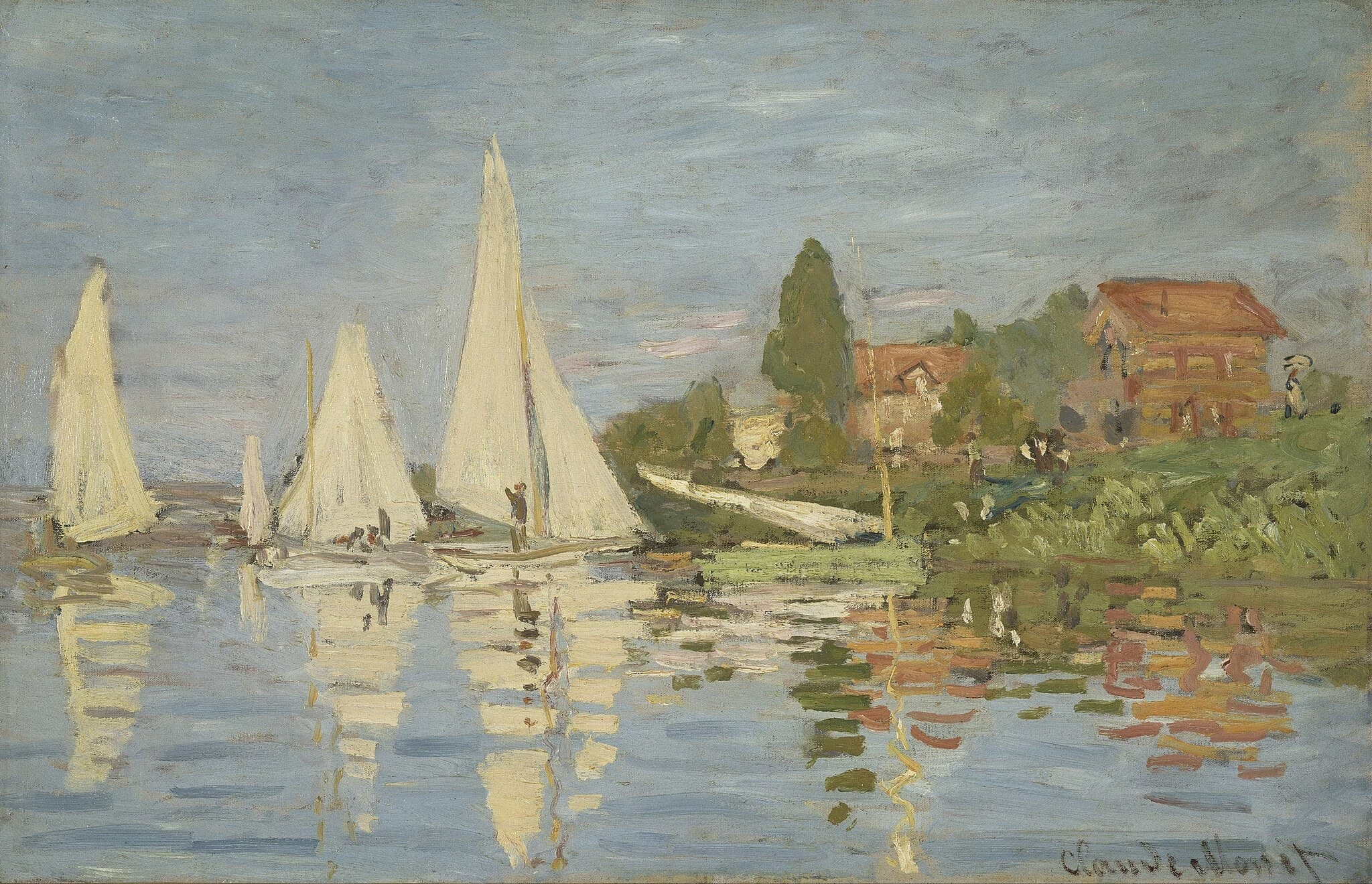
Scope and identification. “Regattas at Argenteuil” (Les Régates à Argenteuil) denotes Monet’s celebrated early‑Impressionist subject painted at Argenteuil circa 1872–74. The canonical version (Wildenstein W233; 48 × 75.3 cm) resides in the Musée d’Orsay, Paris, with provenance to Gustave Caillebotte and the French state, and is effectively off‑market [1]. Our valuation therefore addresses the fair‑market value a prime, autograph oil of this regatta motif—comparable in date, scale, and quality—would command if offered today.
Market anchor points. Within Monet’s oeuvre, Argenteuil river and boating views from 1872–74 are among the most commercially coveted outside the Water Lilies, Haystacks, and London series. Two sales tightly bracket today’s pricing for the subject: Christie’s New York sold Le bassin d’Argenteuil for $27.84m on November 11, 2021 (Cox Collection) [3], while the marquee Argenteuil canvas Le Pont du chemin de fer à Argenteuil brought $41.48m in May 2008 [4]. At the category level, Monet’s market remains exceptionally strong, with the artist’s record at $110.7m for Meules (2019) [2] and late masterpieces like Le bassin aux nymphéas achieving $74.01m in 2023 [5].
Derivation of estimate. Adjusting for quality, composition, and inflation since 2008 and 2021, a prime Argenteuil regatta oil (good scale; crisp sails/flags; luminous reflections; first‑rate condition; A‑level provenance and literature) would realistically clear the high‑eight to low‑nine figures today. We therefore place fair‑market value at $30–70 million. Works that are smaller, compositionally quieter, or less fully resolved would cluster toward the $10–30 million band; conversely, a truly exceptional, exhibition‑provenanced canvas with standout “wall power” and pristine condition could test or exceed the upper half of our range in strong sale settings.
Positioning and sensitivities. Key value drivers for this motif are: 1) early Argenteuil dating (c.1872–74); 2) dynamic sails, flags, and rippling reflections; 3) condition (surface preservation and color balance are critical); 4) blue‑chip provenance (e.g., Durand‑Ruel, Caillebotte/early exhibitions); and 5) comprehensive literature and institutional exposure. The estimate is conservative relative to Monet’s top series benchmarks but assertive for early Impressionist river scenes given sustained global demand and limited supply of first‑rate examples.
Bottom line. For a prime, autograph oil of “Regattas at Argenteuil” quality offered fresh to market with unimpeachable condition and pedigree, $30–70 million is the correct current bracket, supported by like‑for‑like Argenteuil sales and the prevailing Monet price architecture [3][4][2][5].
Key Valuation Factors
Art Historical Significance
High ImpactThe Argenteuil period (1871–1878) marks Monet’s early, definitive statement of Impressionism—open‑air color, light, and modern leisure on the Seine. Regatta scenes encapsulate this breakthrough with crisp sails, flags, and reflective water that became touchstones of the movement. The Musée d’Orsay’s canonical “Regattas at Argenteuil” (W233) anchors the motif’s importance in the literature and in public consciousness, reinforcing demand for top private examples. While not as globally iconic as Water Lilies or Haystacks, a prime Argenteuil regatta ranks as a major subject in Monet’s oeuvre, frequently illustrated in surveys and exhibitions. This art‑historical weight translates directly to liquidity and price resilience, particularly when coupled with early dating (c.1872–74) and strong exhibition history.
Subject and Composition
High ImpactMarket appetite for Monet’s early river views is highly composition‑sensitive. Pictures that marshal multiple bright sails, fluttering pennants, and shimmering reflections—especially against a sunlit sky—have superior “wall power” and performance histories. Balanced horizontals, crisp rigging lines, and animated figures along the quayside amplify visual dynamism and commercial appeal. Conversely, quieter reaches of the Seine or a single, small sailboat can trade at material discounts. Within Argenteuil, the regatta iconography is among the most sought‑after permutations of the boating theme, and it benefits from immediate recognizability to a wide collector base, including contemporary‑leaning buyers prioritizing color and impact.
Provenance, Exhibitions, and Literature
High ImpactBlue‑chip provenance and scholarship are decisive at the top of Monet’s market. Works handled by Durand‑Ruel, owned by connoisseur‑collectors, included in early Impressionist exhibitions, or tracked continuously in the Wildenstein catalogue perform at meaningful premia. Robust literature citations and high‑quality museum loans validate attribution, dating, and condition while broadening the buyer pool. Conversely, gaps in ownership history, contested attributions, or thin literature can compress bidding and widen the bid‑ask spread. For a regatta canvas to test the upper end of our range, a clear chain of title, early exhibition history, and full literature coverage are expected, alongside accessible conservation and technical reports.
Condition, Scale, and Finish
High ImpactSurface freshness (saturated color, intact impasto), minimal restoration, and an undisturbed paint film are critical price determinants. Clean, stable canvases with sympathetic past treatments and no significant overpaint command premium bidding. Scale and finish also matter: works around 48 × 75 cm (Orsay’s format) or larger that are fully resolved and exhibition‑ready outperform smaller or sketch‑like variants. A lining undertaken many decades ago may be acceptable if well executed; however, discoloration, blanching, or aggressive cleaning will dampen demand. Recent, reputable conservation documentation can meaningfully de‑risk a purchase and support pricing near the top of the estimate range.
Sale History
Regattas at Argenteuil has never been sold at public auction.
Claude Monet's Market
Claude Monet is a top‑tier, globally liquid blue‑chip artist whose best works routinely anchor evening sales. His auction record stands at $110.7 million for Meules (Haystacks) at Sotheby’s New York in 2019, with multiple Water Lilies and London/Parliament paintings realizing $50–75 million in recent years. Demand is deep across regions, led by U.S., European, and Asian buyers, and supported by strong museum narratives. Price dispersion is series‑driven: late Water Lilies, Haystacks, London/Waterloo Bridge, and Poplars dominate the ceiling, while early Argenteuil river scenes—especially dynamic boating and regatta subjects—occupy a robust, upper‑mid tier. Fresh‑to‑market examples with exemplary condition, provenance, and literature attract competition and, frequently, third‑party guarantees.
Comparable Sales
Le bassin d’Argenteuil
Claude Monet
Same artist and Argenteuil boating subject with vivid sails/reflections from the core 1872–74 period; closest like‑for‑like thematic comp.
$27.8M
2021, Christie's New York
~$33.2M adjusted
Le Pont du chemin de fer à Argenteuil
Claude Monet
Prime Argenteuil canvas (1873) with sailboats and landmark bridge; same place/time, similar scale and ambition—long a benchmark for top Argenteuil scenes.
$41.5M
2008, Christie's New York
~$62.2M adjusted
Argenteuil, fin d’après‑midi
Claude Monet
Monet Argenteuil river scene with sailboats in the 1870s; same subject/location family but a more modest, mid‑level example.
$6.1M
2013, Christie's New York
~$8.4M adjusted
Voilier sur le petit bras de la Seine, Argenteuil
Claude Monet
1872 Argenteuil‑area sailboat subject by Monet; same period and motif family, smaller and less compositionally complex.
$3.5M
2009, Sotheby's New York
~$5.3M adjusted
Waterloo Bridge, effet de brouillard
Claude Monet
Same artist; a marquee late series used to anchor Monet’s top pricing band today. Not subject‑identical, but a useful ceiling reference for blue‑chip Monets.
$48.5M
2021, Christie's New York
~$57.8M adjusted
Current Market Trends
The Impressionist market remains a relative safe harbor marked by high selectivity: buyers chase museum‑quality, fresh works and penalize secondary or condition‑compromised examples. For Monet specifically, price discovery in 2021–2023 reaffirmed strength across top series, while early, high‑impact Argenteuil canvases continued to perform in the high‑eight to low‑nine figures. Supply is the primary constraint; when compelling, well‑documented Monets appear, global bidding depth reasserts itself. Macroeconomic caution has encouraged prudent estimates and greater use of guarantees, but it has not diminished willingness to pay for the very best. Against this backdrop, a prime Regattas at Argenteuil sits in a confident $30–70 million band.
Sources
- Musée d’Orsay — Regattas at Argenteuil (RF 2778)
- Sotheby’s — Monet’s Meules Sells for $110.7 Million (Artist Record)
- Christie’s — The Cox Collection results (incl. Le bassin d’Argenteuil at $27.84m, Nov 11, 2021)
- CBS News — Monet painting sells for $41.4 million (Le Pont du chemin de fer à Argenteuil), May 6, 2008
- Christie’s — Le bassin aux nymphéas sells for $74,010,000 (Nov 9, 2023)