How Much Is The Bridge at Argenteuil Worth?
Last updated: July 4, 2026
Quick Facts
- Insurance Value
- $74.8M (Analyst estimate (retail replacement; 15% above high estimate))
- Methodology
- comparable analysis
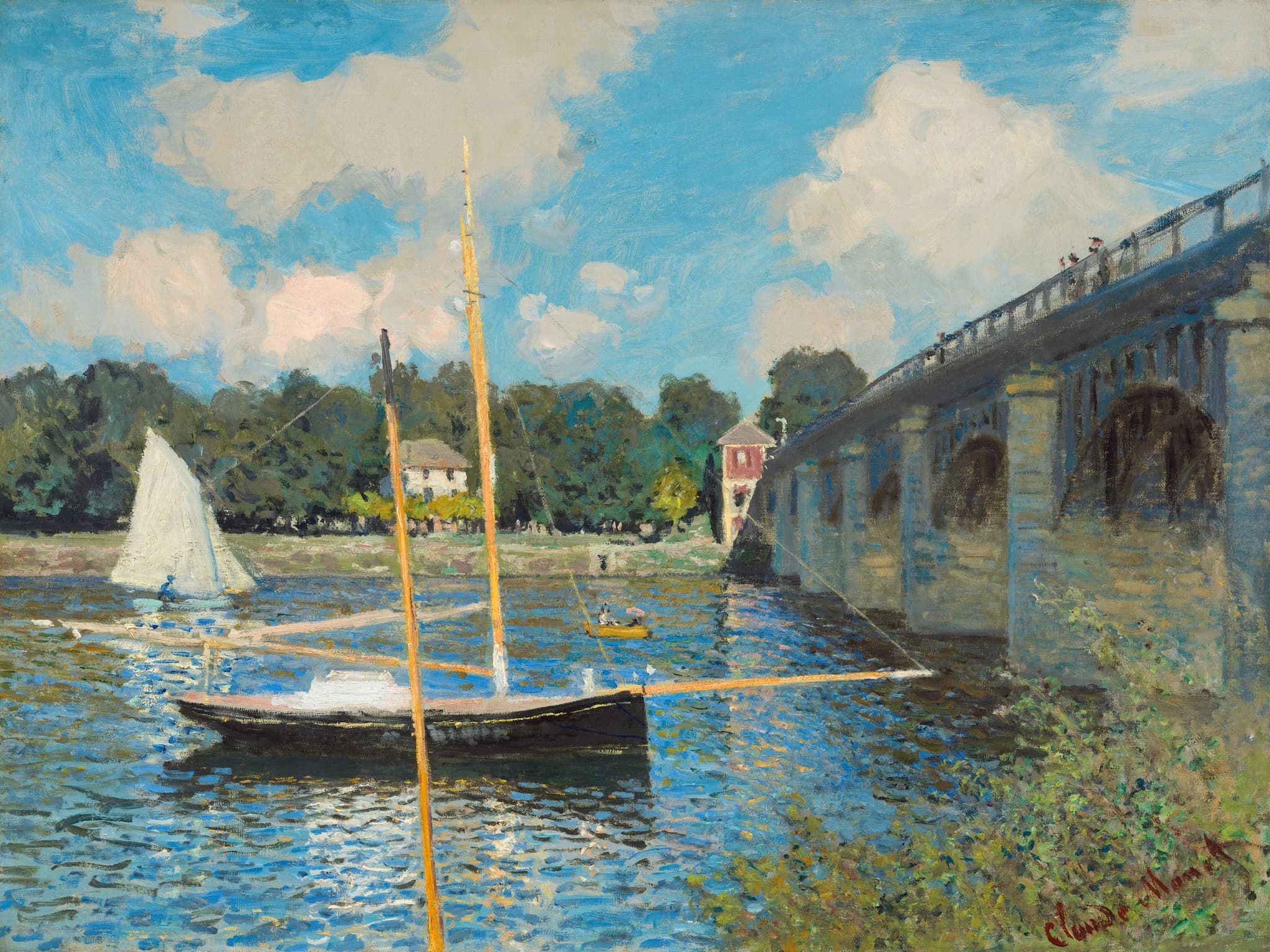
Based on direct and near-direct comparables, a prime 1873–1875 oil-on-canvas from Monet’s Argenteuil bridge series in excellent condition with strong provenance would likely achieve $35–65 million at auction today. The 2008 Christie’s sale of Monet’s Railroad Bridge at Argenteuil (inflation-adjusted ≈$61 million) anchors the upper band, while recent blue-chip Monet results bracket the broader range.
Valuation Analysis
Estimate: $35–65 million for a prime oil-on-canvas from Claude Monet’s Argenteuil bridge series (c. 1873–1875), assuming excellent condition, robust pre‑1945 provenance, and meaningful exhibition/literature. This range is derived from direct subject comparables, inflation-adjusted benchmarks, and recent top-tier Monet outcomes.
Key anchor comparable: Monet’s Le Pont du chemin de fer à Argenteuil sold at Christie’s New York on May 6, 2008 for $41.48 million; inflation-adjusted, this indicates roughly $61 million today and establishes a realistic upper anchor for a best-in-class Argenteuil bridge canvas entering the current market [1]. This subject sits at the heart of Monet’s early Impressionist period, with canonical variants held by the Musée d’Orsay and the National Gallery of Art—works that are not for sale, reinforcing scarcity and demand for comparable examples in private hands [2][3].
Recent blue‑chip Monet pricing: A late Nymphéas achieved $65.5 million at Sotheby’s in November 2024, reaffirming deep demand for the artist’s most coveted series [4]. In May 2022, the Houses of Parliament (sunset) realized $76 million at Christie’s, a reminder that iconic serial motifs with elite provenance can test the high‑$60m to $70m+ zone in strong rooms [5]. Against these yardsticks, a top Argenteuil bridge—iconic but generally a step below Water Lilies and the very top Thames canvases in global name recognition—sensibly prices into the mid‑eight figures with upside toward the low‑$60m band for an exceptional, museum‑level example.
Market conditions: The broader Impressionist/Modern segment contracted in 2024 due to a scarcity of trophy consignments, not a loss of appetite; when A‑quality material appears, bidding remains competitive. Spring 2026 evening sales signaled stabilizing demand for blue‑chip Modern, benefiting rare, high‑quality Monets [6][7]. In this context, a well‑catalogued, beautifully preserved Argenteuil bridge—particularly with distinguished provenance, scale in the ~60–80 cm or larger range, and strong publication/exhibition history—should command the $35–65 million window with credible potential to test the top end.
Determinants within the range: Upward drivers include large format, luminous palette, resolved surface, unlined/original canvas, absence of overpaint, and A‑level provenance (e.g., legendary collections, early gallery history) and literature. Downward adjustments apply for condition compromises, thin documentation, title/subject variants perceived as less definitive, or smaller, sketchier treatments. Placement with a top evening‑sale platform and judicious use of third‑party guarantees can further optimize execution.
Key Valuation Factors
Art Historical Significance
High ImpactArgenteuil (1873–1875) marks Monet’s definitive early Impressionist breakthrough. The bridge views synthesize modern infrastructure with shimmering river light and leisure craft—subjects central to the movement’s identity. Museums including the Musée d’Orsay and the National Gallery of Art hold canonical Argenteuil bridge variants; their inalienability concentrates demand onto the few high‑quality examples remaining in private hands. Works from this cluster are widely exhibited and published, making them cornerstone acquisitions for blue‑chip collectors. This centrality within Monet’s oeuvre and the broader Impressionist narrative elevates the motif above most Normandy coast or village views, though it typically sits a notch below the late Water Lilies and the very top London Thames canvases in global recognition.
Subject and Period Appeal
High ImpactCollectors prize the Argenteuil years for their luminous palette, crisp atmospherics, and proto‑serial exploration of a modern subject. The bridge motif—with sailboats, barges, and sunlit surfaces—offers immediate visual appeal and strong name recognition, often outperforming less iconic Monet subjects from the same decade. Within the Argenteuil bridge group, compositions that combine a commanding bridge profile, animated river traffic, and balanced sky/water registers tend to lead. The 1873–1875 dating places such works at the core of early Impressionism, coinciding with the 1874 exhibition. As a result, this subject maintains cross‑category appeal: classic Impressionist buyers, Modern generalists, and private museums seeking foundational ‘movement touchstones’ all compete for top examples.
Condition and Provenance
High ImpactSurface integrity (original canvas, minimal abrasion, stable impasto), absence of overpaint, and sympathetic cleaning strongly influence pricing, often swinging outcomes by millions. Relined or heavily restored works trail pristine examples. Provenance is equally pivotal: continuous ownership histories predating 1945, early dealer ties (Durand‑Ruel/Bernheim‑Jeune), and publication/exhibition depth can add meaningful premiums. Conversely, gaps in the 1933–1945 period or open restitution questions chill bidding. For a prime Argenteuil bridge, museum‑level provenance and literature can push value into the top decile of the range; notable compromises, even with strong subject matter, tend to compress results toward the lower or mid bands.
Market Comparables and Liquidity
High ImpactThe most probative comparable is Monet’s Railroad Bridge at Argenteuil, sold for $41.48m (2008), approximately $61m today when inflation‑adjusted, effectively bracketing the upper band for a top Argenteuil bridge [1]. Recent blue‑chip Monet trophies—$65.5m for late Nymphéas (2024) and $76m for Houses of Parliament (2022)—define the current ceiling for the artist’s most iconic serial works [4][5]. Liquidity is robust for A‑tier Monets; scarcity of trophy consignments, rather than demand, has constrained category totals. In a stabilizing 2026 market, a well‑documented Argenteuil bridge placed in a New York evening sale with appropriate financial structuring should clear in the mid‑eight figures, with credible potential to test the low‑$60m zone for an exceptional example [6][7].
Sale History
Christie's New York
Le Pont du chemin de fer à Argenteuil (1873–74); closest direct comparable to the Argenteuil-bridge motif; not the exact work.
Christie's New York
Le Parlement, soleil couchant (1903); iconic series benchmark that helps bracket the upper ceiling for prime Monets (different subject).
Sotheby's New York
Nymphéas (c. 1914–17); late Water Lilies result demonstrating current demand for blue‑chip Monet trophies (different subject).
Christie's New York
Peupliers au bord de l’Epte, crépuscule (1891); record for the Poplars series; a mid‑to‑upper anchor for prime but non‑trophy Monets.
Claude Monet's Market
Claude Monet is a cornerstone of the blue‑chip Impressionist and Modern market, with deep global demand from top private collectors and private museums. His auction record stands at $110.7 million for Meules (2019), and recent seasons have reaffirmed strength at the top end: $65.5 million for a late Nymphéas in 2024 and $76 million for Houses of Parliament in 2022. Category data show that pricing concentrates around his emblematic serial subjects—Water Lilies, Haystacks, London Thames, and, to a somewhat lesser but still significant degree, Argenteuil. Supply scarcity governs peaks; when A‑quality Monets appear, bidding is vigorous and international. Well‑documented works with strong provenance, scale, and exhibition histories remain highly liquid and can outperform estimate bands.
Comparable Sales
Le Pont du chemin de fer à Argenteuil (The Railroad Bridge at Argenteuil), 1873–1874
Claude Monet
Best like-for-like: same artist and Argenteuil-bridge motif from 1873–74; museum-caliber quality and provenance; anchors direct subject comparability.
$41.5M
2008, Christie's New York
~$61.0M adjusted
Le Parlement, soleil couchant (Houses of Parliament, Sunset), 1903
Claude Monet
Prime, iconic serial subject with deep market depth; large-scale, blue-chip Monet benchmark to bracket upside for a top Argenteuil-bridge canvas.
$76.0M
2022, Christie's New York
~$85.1M adjusted
Waterloo Bridge, soleil voilé (Waterloo Bridge, Veiled Sun), 1899–1903
Claude Monet
Top-tier London series work and another ‘bridge’ motif; demonstrates current pricing for canonical Monet serial subjects with elite provenance.
$64.5M
2022, Christie's New York
~$72.3M adjusted
Nymphéas (Water Lilies), c. 1914–1917
Claude Monet
Late Water Lilies—Monet’s most in-demand series; indicates current demand/ceiling for blue-chip Monet masterpieces in recent seasons.
$65.5M
2024, Sotheby's New York
~$67.5M adjusted
Peupliers au bord de l’Epte, crépuscule (Poplars at the Edge of the Epte, Dusk), 1891
Claude Monet
Record-setting Poplars series painting; prime serial Monet with strong literature/exhibition—useful benchmark near the upper mid-range for canonical motifs.
$43.0M
2025, Christie's New York
Current Market Trends
Impressionist/Modern totals contracted in 2024 due to limited trophy supply, but demand for blue‑chip classics like Monet remained resilient. By spring 2026, New York evening sales indicated stabilizing confidence, with strong bidding for quality Modern consignments. Within Monet’s market, a clear hierarchy persists: late Water Lilies and iconic serial motifs anchor the upper tier, while prime Argenteuil works occupy a robust mid‑to‑upper band. Scarcity of museum‑level examples amplifies competition when they surface. Strategic sale placement (New York evening sale), compelling cataloging, and third‑party financial support can enhance execution. Net: conditions are constructive for a prime Argenteuil bridge to achieve mid‑eight figures, testing the low‑$60m range if quality and provenance are exceptional.
Sources
- Christie's press release: Monet's Railroad Bridge at Argenteuil sells for $41.48m (May 6, 2008)
- Musée d'Orsay collection: Le Pont d’Argenteuil (1874)
- National Gallery of Art: The Bridge at Argenteuil (1874)
- Sotheby’s: Nymphéas sells for $65.5m (Nov 18, 2024)
- Seydoux Associates: Market Perspective (May 2022) — Monet’s Houses of Parliament $76m
- The Art Newspaper: Evidence of stabilising auction market (May 20, 2026)
- Artnet Intelligence: 2024 category contraction and supply dynamics