How Much Is Häuser mit bunter Wäsche (Houses with Laundry / Suburb II) Worth?
Last updated: July 8, 2026
Quick Facts
- Last Sale
- $39.6M (2011, Sotheby's London, Impressionist & Modern Art Evening Sale)
- Insurance Value
- $108.0M (Conventional replacement-factor (120% of high estimate) used for insurance/replacement coverage)
- Methodology
- recent sale
This is the identical painting that realised GBP 24,681,250 (≈ USD $39.6M) at Sotheby’s London on 22 June 2011. Adjusting that concrete market result for inflation, scarcity of comparable large 1914 Schiele oils, and current market dynamics yields a present-market estimate of approximately USD $50–90M, assuming the work is authentic, in comparable good condition, and marketable.
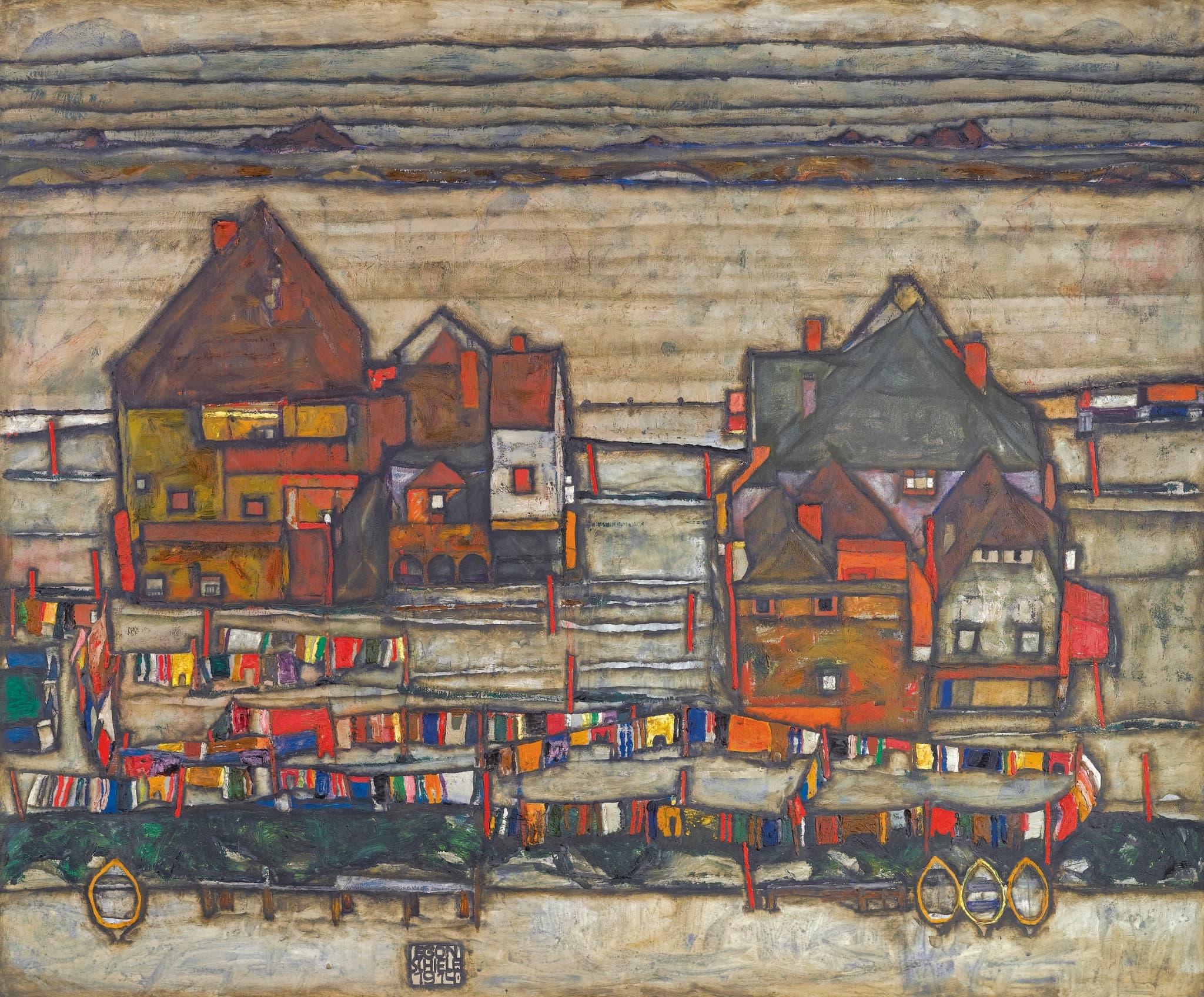
Häuser mit bunter Wäsche (Houses with Laundry / Suburb II)
Egon Schiele, 1914 • Oil on canvas
View more by Egon Schiele →Valuation Analysis
Anchor and approach: This valuation is anchored to the painting’s documented auction result at Sotheby’s London on 22 June 2011 (price realised GBP 24,681,250; ≈ USD $39.6M) and then adjusted for inflation, proven market movement for top Schiele works, and qualitative premiums/discounts related to provenance, condition and marketability [1]. Because the lot sold from the Leopold Museum with a well‑documented chain of ownership, the 2011 sale functions as a direct and highly reliable market datum for the identical object.
Inflation and market adjustment: Converting the 2011 realised figure into mid‑2020s purchasing power (CPI uplift and modest market appreciation for trophy Old Master/Modern lots) produces a baseline equivalent in the mid‑tens of millions (roughly USD $55–65M). From that baseline I apply a market premium range to reflect scarcity of large, museum‑quality 1914 Schiele oils, continued institutional interest, and periodic spikes in demand for Viennese‑Secession material; this results in a practical trading range of approximately USD $50–90M for an on‑market offering in similar condition and documentation.
Upside and downside drivers: Upside to the top of the range would require exceptionally clean, published provenance, an unambiguous catalogue raisonné entry / major exhibition history, strong competition among deep‑pocket international collectors or institutions, and favourable macro conditions (guarantees, third‑party backing). Downside adjustments would follow from condition problems, gaps in provenance (or newly disclosed restitution claims), lack of literature/exhibition citation, or diminished market interest at the time of sale. The painting’s past institutional ownership and published entry reduce many provenance risks, but due diligence and technical examination remain essential [2].
Practical positioning: If you plan to consign, leading international houses would market this as a marquee lot and could achieve a result toward the upper part of the stated range; private‑sale/guarantee structures could compress risk and affect final price. For insurance or estate purposes a mid‑range number (roughly USD $65–70M) is defensible, with replacement/insurance values typically set higher (see insurance field). Key next steps are obtaining full condition and technical reports, securing letters from recognized Schiele specialists, and confirming catalogue/exhibition citations to maximize market value.
Conclusion: The 2011 Sotheby’s sale is the controlling market fact. Given that, reasonable current market expectation for this identical painting — assuming unchanged condition and unchanged documented provenance — is USD $50–90M, with the midpoint reflecting inflation adjustment plus a premium for rarity and institutional desirability. All estimates assume clean title and confirmatory expert opinion prior to sale.
Key Valuation Factors
Art Historical Significance
High ImpactPainted in 1914, this work belongs to Schiele’s mature late period and exemplifies his urban/topographical output at a moment of formal refinement. While Schiele’s market is often driven by portraits and erotic nudes, large, finished oils from 1914 are critical for scholarship and institutional collections. This subject—suburban houses with laundry—demonstrates characteristic compositional compression, colour modulation and brushwork from his late development; such qualities make the painting highly desirable to curators and collectors seeking pivotal examples of his late oeuvre. Its art‑historical weight elevates market interest beyond routine landscape lots.
Provenance, Literature & Exhibition
High ImpactThe painting’s direct provenance from Heinrich Böhler to Rudolf Leopold and its prior display/ownership by the Leopold Museum materially increase marketability. A secure ownership chain back to the artist, presence in exhibition histories, and citation in standard Schiele reference material (catalogue raisonné entries) reduce buyer risk and support higher bids. Works with this level of documentation attract institutional buyers and high‑net‑worth collectors prepared to pay premiums; conversely, any newly disclosed provenance gaps or restitution claims would be value‑detracting and materially increase buyer caution.
Rarity, Size and Medium
High ImpactLarge oil paintings by Schiele from 1914 are comparatively scarce in the market; most surviving material is on paper or smaller canvases. The painting’s near‑meter dimensions and oil technique place it in the small subset of trophy paintings that define Schiele’s top market tier. Rarity at that scale concentrates demand among institutions and established collectors, increasing the probability of a multi‑tens‑of‑millions result when fully marketable. Size and medium therefore act as multiplicative value drivers relative to common sheet‑level material.
Condition & Technical State
Medium ImpactI lack a current technical/condition report for the object. Condition markedly affects final price: original, stable paint surfaces and minimal intrusive restoration preserve value; conversely, relining, heavy inpainting, or structural problems reduce buyer confidence and can generate discounts. Prior institutional conservation and transparent technical documentation would mitigate concerns and preserve market value; absent those documents a prudent underwriter or bidder will apply a conservative discount until technical clearance is provided.
Market Liquidity & Buyer Demand
High ImpactThe Schiele market is selective and trophy‑driven: a small number of high‑quality paintings or colour drawings generate headline prices, while the broader market remains thin. When a genuine museum‑quality oil appears, competition among institutions and well‑financed private collectors can be intense, supporting multi‑million outcomes. Recent years have also heightened provenance scrutiny (restitutions), which increases due diligence costs and can temper speculative bids, but does not eliminate demand for securely‑provenanced masterpieces.
Sale History
Sotheby's London, Impressionist & Modern Art Evening Sale
Egon Schiele's Market
Egon Schiele (1890–1918) is one of the central figures of Austrian Expressionism; his strongest market results derive from large oils and mature‑period colour drawings. The artist’s auction record (the 2011 sale of Houses with Laundry) anchors the top of the market. Works with museum‑quality provenance and catalogue/exhibition history consistently outperform sheets and smaller works. Recent high results for drawings have reinforced collector interest, but aggregate turnover is low and headline figures are driven by a small set of trophy lots. Buyers expect rigorous provenance and technical verification.
Comparable Sales
Häuser mit bunter Wäsche (Vorstadt II) / Houses with Laundry (Suburb II)
Egon Schiele
Direct prior auction record for the exact painting — identical object, large 1914 oil with top provenance and exhibition/catalogue documentation; serves as the primary anchor for valuation.
$39.6M
2011, Sotheby's London, Impressionist & Modern Art Evening Sale
~$57.4M adjusted
Drawing (from the Fritz Grünbaum group) — top Schiele lot
Egon Schiele
High-profile sale of a museum-quality Schiele drawing (provenance: Grünbaum). Shows active demand and strong realized prices for top Schiele works on paper in the low‑millions; useful for market depth though different medium/scale than the 1914 oil.
$2.2M
2023, Christie's New York — Works from the Fritz Grünbaum Collection
~$2.4M adjusted
Crouching Nude, Back View (1917)
Egon Schiele
Recent high-result for a late-period Schiele drawing (reported €3.23M ≈ $3.7M). Confirms continued strong collector interest and auction market strength for top Schiele sheets; less directly comparable by medium but important for current-market tone.
$3.7M
2025, Dorotheum, Vienna
Current Market Trends
The market for Schiele remains selective: institutional exhibitions and scholarship in 2024–2025 have reinforced interest in his late period, while restitution activity since 2020 has increased provenance scrutiny. Supply of top‑tier oils is limited, so single consignments can meaningfully shift headline pricing. Overall demand for museum‑quality Schieles is robust but episodic and sensitive to legal and macroeconomic conditions.