How Much Is Self-Portrait with Physalis Worth?
Last updated: July 7, 2026
Quick Facts
- Methodology
- extrapolation
Hypothetical open‑market value: $50–80 million. This prime 1912 self‑portrait is one of Schiele’s most iconic images; its fame and rarity justify an estimate above the artist’s $39.6m auction record. Actual sale is improbable due to museum ownership and Austrian export controls.
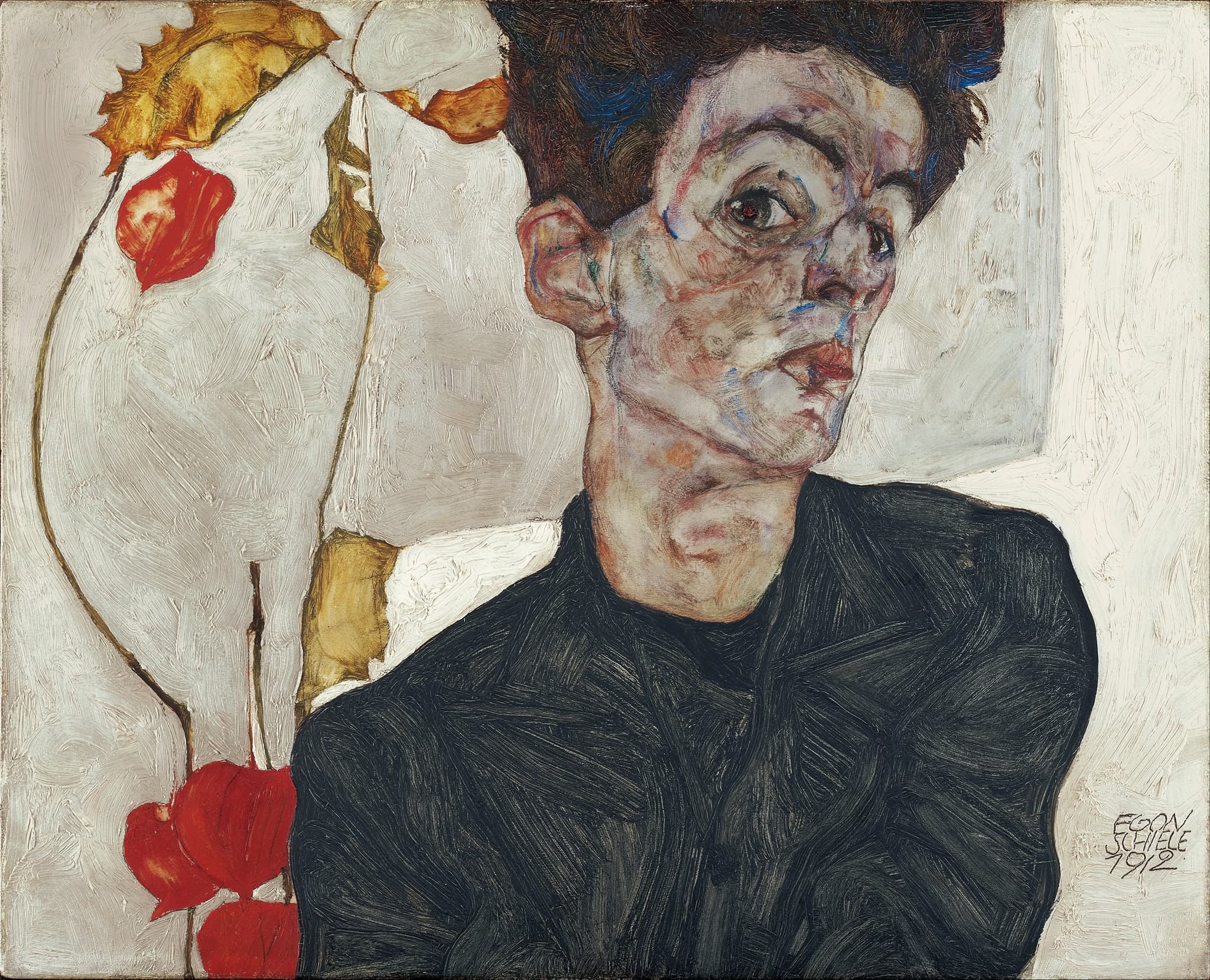
Self-Portrait with Physalis
Egon Schiele, 1912 • Oil, opaque color on wood
Read full analysis of Self-Portrait with Physalis →Valuation Analysis
Estimated value (if tradable today): $50–80 million. Self‑Portrait with Physalis (1912) is a canonical image within Egon Schiele’s oeuvre—oil and opaque color on wood, 32.2 × 39.8 cm—long held by the Leopold Museum, which identifies it as one of the artist’s best‑known works [1]. As a prime‑year, psychologically charged self‑portrait, it occupies the narrow apex of Schiele’s market where subject, date, and renown converge, warranting an estimate above the artist’s historical auction record.
Position in the oeuvre and rarity premium. Works from 1910–1915 define Schiele’s mature voice; self‑portraits from this period in oil are exceptionally scarce. This composition—cropped, electric, and instantly recognizable—has been widely reproduced and exhibited, effectively functioning as a brand image for the artist and the Leopold Museum [1]. Iconic self‑portraits, across categories, routinely command premiums over comparably scaled works due to their cultural resonance and scarcity.
Comparable pricing and extrapolation. Public benchmarks for top Schiele oils include the record, Houses with Laundry (Suburb II) at about $39.6m (Sotheby’s London, 2011) [2], City in Twilight (The Small City II) at $24.5m (Sotheby’s New York, 2018) [3], and the important early oil Danaë at approximately $23.6m (Sotheby’s London, 2026) [4]. On paper, psychological self‑portraiture can test eight figures: Ich liebe Gegensätze (1912) achieved $10.99m in 2023 [5]. Against these signals, Self‑Portrait with Physalis is both more iconic and rarer than the available oil comparables. We therefore extrapolate above the $39.6m oil record to a tight, trophy‑level band of $50–80m, reflecting an “iconicity” premium supported by cross‑category behavior for blue‑chip masterworks.
Category tailwinds. Demand for Vienna 1900 remains exceptionally deep at the top end, evidenced by Gustav Klimt’s $108.4m Lady with a Fan (2023) and the $236.4m Portrait of Elisabeth Lederer (2025), records that have amplified global focus on this milieu [7][8]. While recent Schiele oil results show selectivity, they also confirm durable eight‑figure appetite; when a truly emblematic, museum‑grade image appears, bidding tends to concentrate and stretch to premium territory.
Practical considerations. The work is museum‑held (Leopold Museum) and would be subject to Austria’s cultural‑property export controls, meaning any hypothetical transaction would likely occur via private treaty and potentially with location/permission constraints [1][6]. Those mechanics influence venue and buyer logistics, but do not diminish the underlying market value indicated here. In a global, guarantee‑supported setting, we would expect multiple institutional‑caliber buyers and private collectors across the U.S., Europe, and Asia to compete at this level.
Key Valuation Factors
Art Historical Significance
High ImpactPainted in 1912—within Schiele’s universally acknowledged peak—Self‑Portrait with Physalis synthesizes the traits that define his legacy: radical cropping, linear tension, and unflinching psychological candor. It is among the artist’s most reproduced images and a signature of the Leopold Museum’s identity, keeping it continuously in the public eye and scholarship. As a best‑known self‑portrait, it carries symbolic weight far beyond a typical work from the period. This caliber of art historical importance translates into persistent, global demand among top collectors and institutions, warranting a valuation premium over even strong, non‑self‑portrait oils from the same years.
Rarity and Subject
High ImpactPrime‑year Schiele self‑portraits in oil are exceptionally scarce; many of his self‑scrutinizing images are on paper. The combination of medium (oil/opaque color on wood), date (1912), and iconic subject (the intense, angular visage framed by physalis) is uniquely potent. Scarcity is a central driver of top pricing in Modern art: collectors can find strong Schiele figures, nudes, and townscapes, but they cannot easily replace a canonical self‑portrait of this renown. That supply constraint, together with the widely recognized image, supports a price materially above typical prime oils, consistent with the $50–80 million range.
Market Comparables and Pricing Power
High ImpactThe $39.6m record for a Schiele oil (2011) establishes a clear ceiling for non‑iconic works, while other prime oils have traded at $23–25m in the last decade. A psychologically charged 1912 self‑portrait on paper reached $10.99m, proving buyers stretch for emblematic imagery even without the oil premium. Against this backdrop, Self‑Portrait with Physalis justifies an extrapolation above the $39.6m benchmark. We position $50–80m to capture the iconicity premium for a museum‑defining self‑portrait, allowing for competitive escalation in a guarantee‑backed, globally marketed sale and acknowledging that the very best Schieles are vanishingly scarce.
Legal/Export and Provenance Context
Medium ImpactThe painting is in the Leopold Museum-Privatstiftung and would be subject to Austrian cultural‑property export review, implying any disposal is unlikely and, if contemplated, could be constrained to private treaty or local venues. While such mechanics can limit bidder participation, they also confer institutional prestige and a perception of unimpeachable status. The provenance—early private ownership, acquisition by Rudolf Leopold in 1956, foundation transfer in 1994—reads as straightforward for Schiele, supporting buyer confidence. These factors shape sale logistics rather than intrinsic value; our estimate assumes a scenario in which the work is fully tradable and exportable.
Sale History
Self-Portrait with Physalis has never been sold at public auction.
Egon Schiele's Market
Egon Schiele is a cornerstone of Austrian Expressionism and a perennial focus of major Modern evening sales. His all‑time auction record stands at approximately $39.6 million for Houses with Laundry (Suburb II) (Sotheby’s London, 2011). Prime oils from 1910–1915 have realized strong eight‑figure prices, while exceptional works on paper can achieve seven to eight figures, demonstrating broad, tiered demand. Supply of museum‑quality oils is extremely thin, magnifying competition when first‑rate works surface. Collectors value psychological intensity and iconic imagery, with self‑portraiture and signature motifs commanding premiums. Demand is global, with recurring participation from U.S., European, and Asian buyers.
Comparable Sales
Houses with Laundry (Suburb II)
Egon Schiele
Artist’s all-time auction record; prime-year oil; establishes the upper bound of public market appetite for museum-quality Schiele oils even though the subject is a townscape rather than a self-portrait.
$39.6M
2011, Sotheby's London
~$55.5M adjusted
Dämmernde Stadt (Die Kleine Stadt II) [City in Twilight (The Small City II)]
Egon Schiele
Major 1913 oil from Schiele’s prime; blue-chip evening-sale result that benchmarks eight-figure demand for top-quality oils, close in date and quality even if not a self-portrait.
$24.5M
2018, Sotheby's New York
~$30.4M adjusted
Triestiner Fischerboot (Trieste Fishing Boat)
Egon Schiele
1912 oil—the same year as Self-Portrait with Physalis—demonstrating pricing for strong but less-iconic prime-year oils; useful year-and-medium control comp.
$14.2M
2019, Sotheby's London
~$17.3M adjusted
Ich liebe Gegensätze (I Love Antitheses)
Egon Schiele
1912 self-portrait on paper; direct subject-matter proximity to the painting’s psychological intensity and year; shows premium for iconic self-portrait imagery despite medium difference.
$11.0M
2023, Christie's New York
~$11.7M adjusted
Danaë
Egon Schiele
Seminal early oil (1909), widely published; a recent marquee London result that indicates current eight-figure pricing for celebrated Schiele oils, providing fresh context for top-tier market depth.
$23.6M
2026, Sotheby's London
~$23.1M adjusted
Current Market Trends
The Vienna 1900 segment is buoyed by landmark Klimt results—$108.4m in 2023 and $236.4m in 2025—which have amplified global attention and trophy‑seeking behavior in the category. Within Schiele’s market, recent oil results show selective depth in the low‑ to mid‑eight figures, while emblematic works on paper have tested eight figures. Guarantees and private‑treaty frameworks remain important in converting top consignments. Overall, the segment prizes canonical, well‑published images and strong provenance; when those converge, prices stretch decisively, even amid broader market caution. This context supports an upward extrapolation for a best‑known, prime‑year Schiele self‑portrait in oil.
Study print
Study this painting as a print
Pair the full artwork with a museum-style study sheet focused on one meaningful detail.
Sources
- Leopold Museum – Self‑Portrait with Chinese Lantern Plant (object entry)
- HENI – Schiele record: Houses with Laundry (Suburb II), Sotheby’s London, 2011
- The Art Newspaper – Sotheby’s NY 2018: City in Twilight (The Small City II) at $24.5m
- Observer – Sotheby’s London 2026: Schiele’s Danaë around $23.6m
- Christie’s – Marquee Week Results Nov 2023 (Ich liebe Gegensätze at $10.99m)
- Bundesdenkmalamt (Austria) – Export of Cultural Property (Ausfuhr)
- The Art Newspaper – Klimt sets European auction record with $108.4m ‘Lady with a Fan’ (2023)
- Axios – Klimt’s Portrait of Elisabeth Lederer sells for $236.4m (2025)