Self-Portrait with Physalis

by Egon Schiele

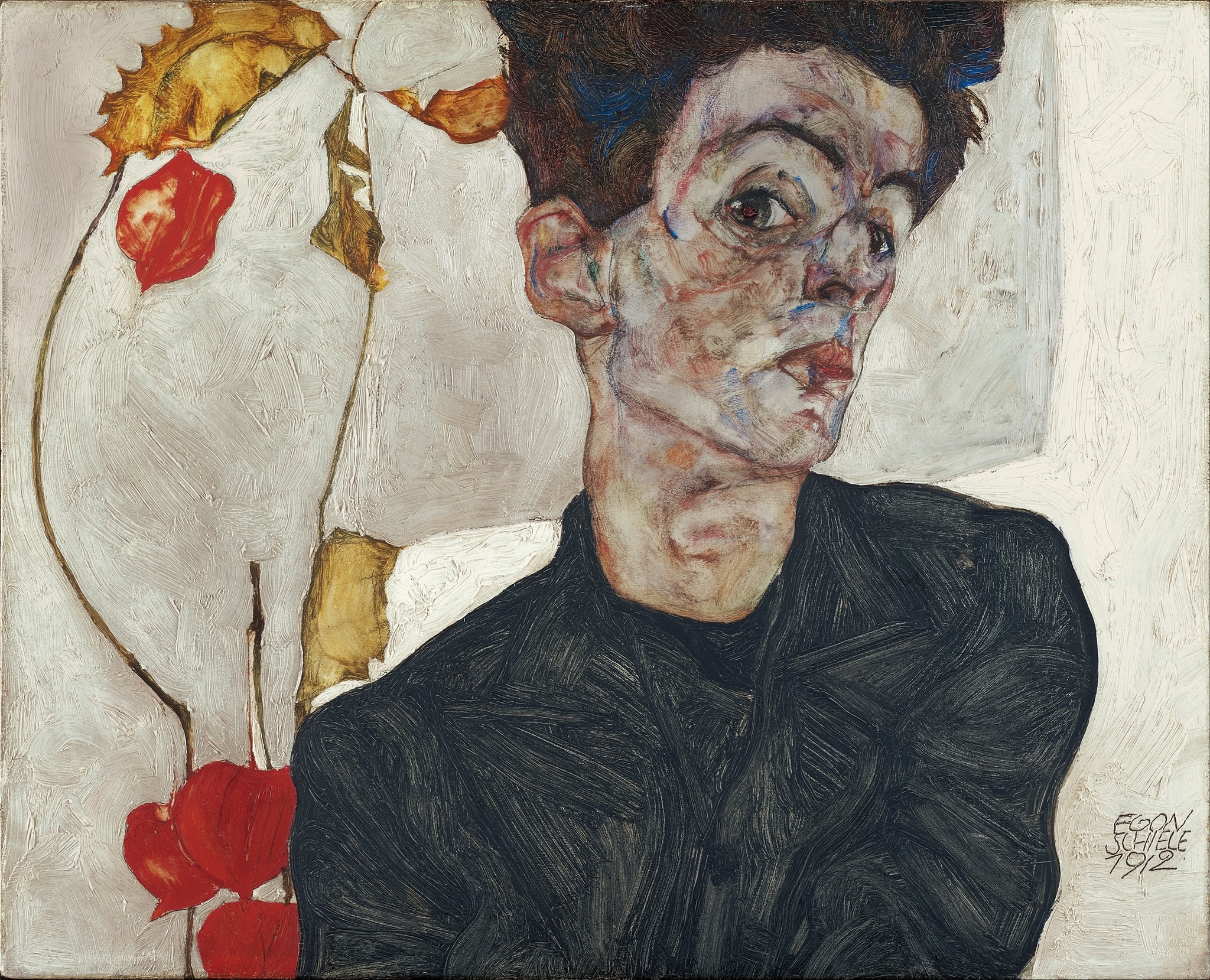
In Self-Portrait with Physalis, Egon Schiele twists his gaunt body toward us, the face flayed by violet and blue accents and set against a scraped, chalky ground. The red-orange lantern pods flare beside his black, sharply linear jacket, a counterweight that charges the image with tension between vitality and decay [1][2]. Signed and dated 1912 at lower right, it crystallizes Schiele’s Expressionist self-scrutiny.

Study Print Studio

Create a personal study print

Build a companion study sheet around the part of this painting that speaks to you most. Choose a detail, shape an interpretation, and walk away with something personal and display-worthy.

Fast Facts

Year
1912
Medium
Oil, opaque color on wood
Dimensions
32.2 × 39.8 cm
Location
Leopold Museum, Vienna
Self-Portrait with Physalis by Egon Schiele (1912) featuring Physalis (Chinese lantern) pods, Black angular jacket, Confronting eye/gaze, Twisted head and cropped body

Click on any numbered symbol to learn more about its meaning

Meaning & Symbolism

Schiele builds the picture as a tense machine of oppositions. The body is cropped by horizontal edges that slice the torso and compress space; the jacket is carved into the wood in wiry, graphic grooves, its black mass a slab of willpower. Against that rigidity, the face looks unarmored: sallow, fibrous, and streaked with bruised purples and cobalt along the eye socket and cheek. The head tilts left, but the eye confronts us directly, creating a double motion—withdrawal and address—that reads as self-accusation and defiance at once 2. The ground is scumbled and scraped, its off-whites thick with drag marks, so that emptiness feels worked, not vacant. Into this austerity Schiele plants the physalis stem, its papery leaves yellowing and its lanterns glowing red-orange; these small fires answer the painting’s dark wedge of jacket and stabilize the asymmetrical layout, a deliberate balancing act the Leopold Museum calls out as central to the work’s construction 2. The plant is not a mere prop. In physalis, the inflated, lantern-like calyx encloses and protects a hidden berry; even as the husk skeletonizes, the fruit can remain—an organic image of life encased in fragility 5. Placed beside a pallid, nervy visage, the pods read as an emblem of protected intensity and latent desire, but they also hint at danger: parts of the plant are toxic when unripe, an undertone that shadows the portrait’s eros with thanatos 5. Chromatically, the lanterns are the painting’s warm heart, lighting the left edge like embers and throwing the figure’s cadaverous tonality into higher relief. Structurally, they serve as counterweights, pinning the left side so the twisted head and black jacket on the right do not topple the composition—an equilibrium that heightens psychological pitch 2. The signature “EGON SCHIELE 1912” in the lower right asserts authorship as if carved into the surface, sealing the work’s confession in time 1. Context intensifies the reading. 1912 is Schiele’s hinge year—arrest, confinement, and a surge of portraits and allegories sharpened his art’s moral and erotic edge 34. Self-Portrait with Physalis is conceived as the pendant to Portrait of Wally Neuzil, a purposeful pairing that stages a dialogue between self and intimate other; the lanterns act as the bridge, a visual rhyme tying the two panels into a single argument about attachment, exposure, and identity 23. Within Expressionism, the work is exemplary not because it exaggerates features, but because it overloads every formal choice—cropping, contour, color, ground—with psychic consequence. The result is not likeness but self-diagnosis: an image of isolation and survival, where a brittle shell barely contains heat. That is why Self-Portrait with Physalis endures: it turns paint, plant, and posture into a compact drama of human precarity and persistence, a modern icon whose intensity is inseparable from its meticulous design 123.

Explore Deeper with AI

Ask questions about Self-Portrait with Physalis

Popular questions:

Powered by AI • Get instant insights about this artwork

💬 Ask questions about this artwork!

Interpretations

Material/Support Analysis

Painted in oil and opaque color on wood, the portrait exploits the panel’s resistance: contours feel incised, the ground is scumbled and scraped, and the jacket reads as a chiseled, planar mass. These are not neutral choices; the wood’s hardness invites carving gestures that double as psychic etching, making the body appear scored by experience. The horizontal truncations of head and torso collaborate with the stiff, wiry line to compress depth, so the figure seems pressed forward against a worked but airless field. The physalis’ saturated orange-red punctures this stony register, its translucence a chromatic and textural foil to the matte, abraded surroundings. In sum, medium and support co-author the image’s severity: surface labor becomes psychological labor, a hallmark of Schiele’s Expressionist facture 21.

Source: Leopold Museum (Highlights; Online Collection)

Pendant Logic and Gendered Address

As a deliberate pendant to Portrait of Wally Neuzil (1912), the self-portrait performs an address to an intimate other; the lantern fruits act as a visual rhyme that threads between the two panels. This pairing reconfigures the genre: self-portraiture becomes relational, staging a call-and-response between gazes, pigments, and poses. The asymmetry that might topple the self-image is stabilized by the left-edge lanterns, a balance echoed in Wally’s portrait, so that compositional equilibrium reads as a model for emotional negotiation. The dyad thus frames love not as idyll but as tense reciprocity, where exposure and defense play out across two canvases. Exhibitions and institutional texts have cemented this interdependence, making the pair a case study in how modern authorship can be co-constructed through relational display 23.

Source: Leopold Museum; MoMA (Leopold Collection brochure)

Carceral Year and Self-Surveillance

1912—Schiele’s year of arrest and confinement—haunts the portrait’s architecture. The horizontal slices that crop the figure and the compressed field read like formal analogues to restriction, while the head’s turn paired with a direct, confronting eye stages self-surveillance: the subject watches himself being watched. Rather than anecdotal illustration, the bio-history sharpens form into discipline: dark wedges, narrow depth, and a signature that feels carved into the panel’s skin, as if to notarize a testimony. Contemporary museum framings link the surge of portraits and allegories after Neulengbach to intensified moral and erotic stakes; here, confinement becomes a lens that clarifies Schiele’s method—overloading contour, crop, and ground with juridical pressure, so vision itself feels arraigned 342.

Source: MoMA (Leopold Collection brochure); Egon Schiele Museum; Leopold Museum

Botany as Modern Vanitas

The physalis’ anatomy—a papery calyx sheltering a berry that can persist as the husk skeletonizes—updates the vanitas code for 1912. Its glowing pods are the painting’s warm heart, but their biology also signals contingency: brilliant color secured by a fragile envelope, with toxicity in unripe parts adding a latent hazard. Set beside a gaunt face tinged with bruise-like hues, the plant figures life guarded at the brink, a compact emblem where eros flickers under the threat of thanatos. Schiele’s placement of the stem as a left-edge counterweight literalizes the metaphor: survival hinges on a delicate balance that might snap. The result is less still-life accessory than biomorphic thesis, fusing horticultural fact with Expressionist psychology 25.

Source: Leopold Museum; NC State Extension (Physalis botany)

Signature as Performance of Authorship

The lower-right inscription—“EGON SCHIELE 1912”—operates like an authorial seal, its blocky assertion mirroring the jacket’s mass. In Expressionist practice, the signature can act as a performative device, binding the body on panel to the legal body of the artist. Here it reads almost epigraphic, as if cut into wood, and thus temporalizes the confession: a situated statement dated to Schiele’s hinge year. Curatorial texts stress that “nothing is left to chance” in the structure; the maker’s name becomes another formal weight, pinning the right side against the lanterns’ leftward pull. This is not mere identification but an aesthetic of accountability—a self that signs what it shows, tethering psychic exposure to a precise historical moment 12.

Source: Leopold Museum (Online Collection; Highlights)

Expressionism as Self-Diagnosis

Rather than amplifying features for effect, Schiele routes Expressionism through structural overload: crop, contour, chroma, and ground each bear psychological consequence, yielding not likeness but self-diagnosis. The turned head with a directly addressing eye forges a paradox of withdrawal and address, while the jacket’s black slab and the scraped, worked ground externalize psychic strain as material drag. Contemporary framings place the painting at a summit of his creativity, inflected by 1912’s shocks; even medical-humanities readings emphasize how prop choice and gaze index interiority beyond face-value traits. The result is a compact diagnostic tool, where formal decisions test and register the sitter’s precarity and persistence, aligning the work with modernity’s will to scrutinize the self 236.

Source: Leopold Museum; MoMA; Emerging Infectious Diseases (art essay)

Related Themes

About Egon Schiele

Egon Schiele (1890–1918) was a leading Austrian Expressionist associated with Viennese modernism and mentored by Gustav Klimt. Known for taut line, planar color, and psychologically intense portraits, he pushed figuration toward raw self‑revelation before his death in the 1918 influenza pandemic [6][3].
View all works by Egon Schiele

More by Egon Schiele

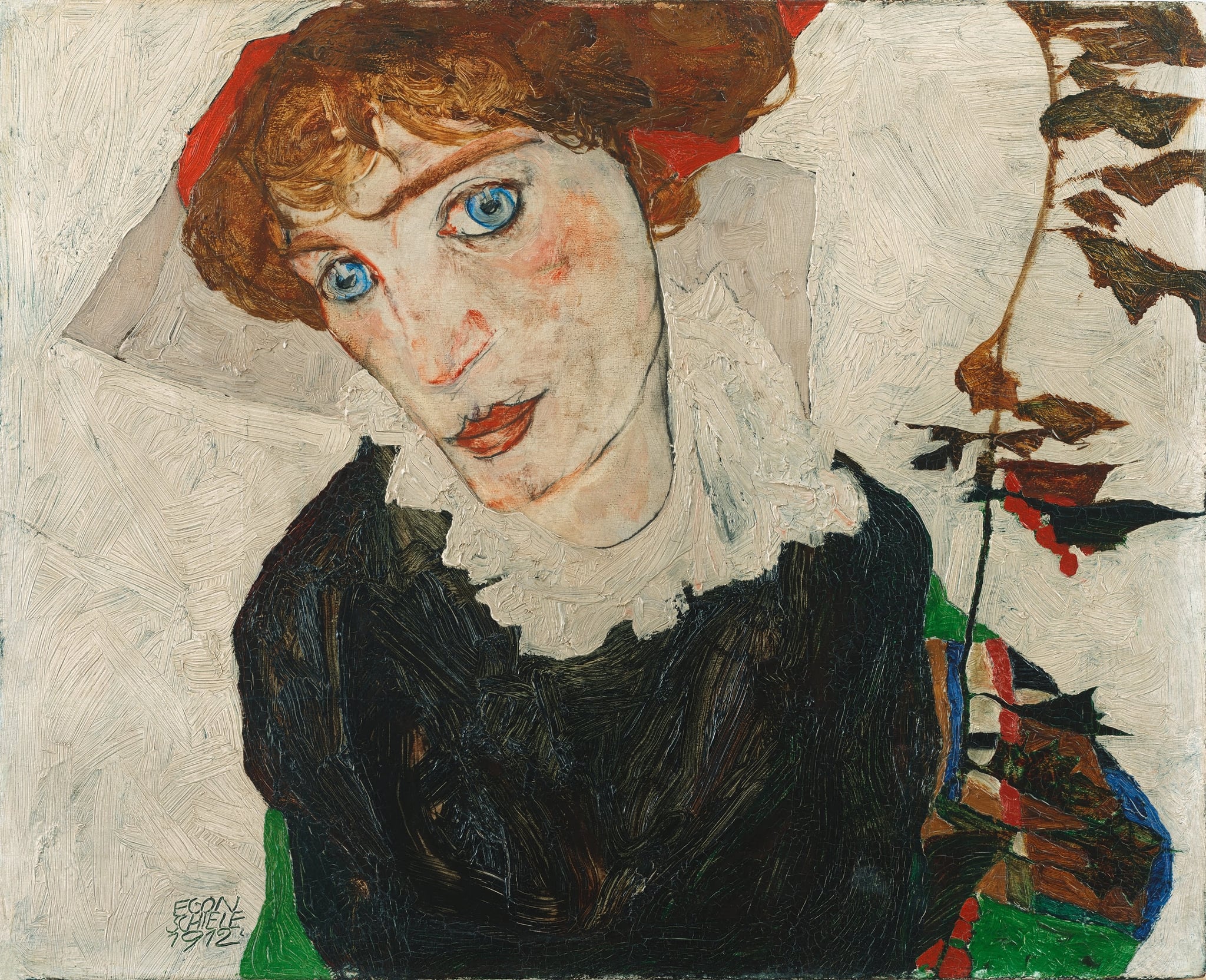
Portrait of Wally by Egon Schiele

Portrait of Wally

Egon Schiele (1912)

Egon Schiele’s Portrait of Wally (1912) turns likeness into <strong>emotional topography</strong>: an oblique head, ice‑blue eyes, and a ruffled white collar flare against an <strong>impasto, airless ground</strong>. The right‑edge twig with red berries acts as a terse sign of <strong>vitality under threat</strong>, while jagged contours and a dense black dress pull the figure toward us with unsettling intimacy <sup>[1]</sup><sup>[3]</sup>.
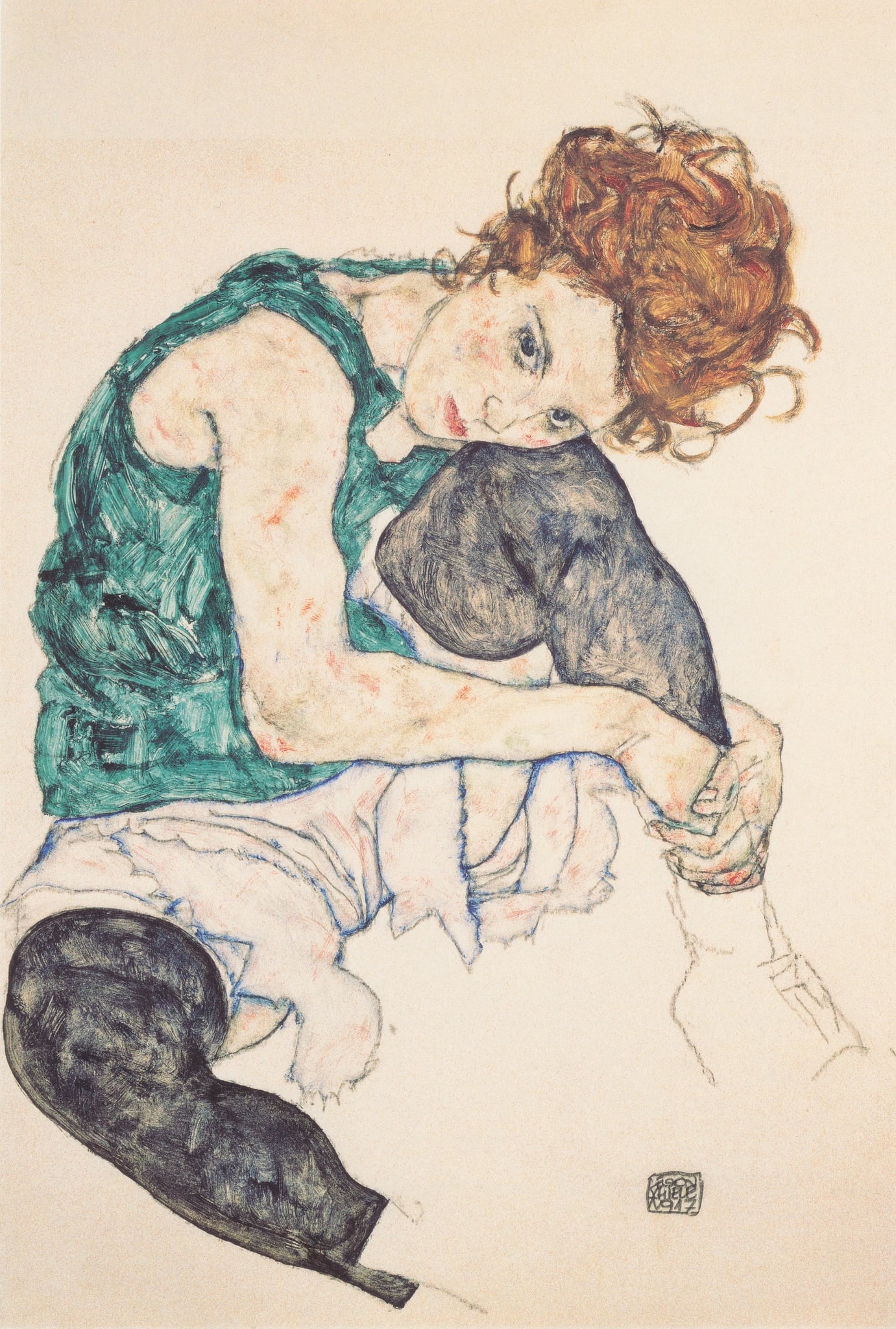
Seated Woman with Bent Knee by Egon Schiele

Seated Woman with Bent Knee

Egon Schiele (1917)

Egon Schiele’s Seated Woman with Bent Knee compresses the body into a tense, looping knot, fusing <strong>erotic charge</strong> with <strong>psychological vulnerability</strong>. The emerald bodice, inky stockings, and copper hair vibrate against a blank ground, while the sitter’s hands clamp her ankle, signaling <strong>self‑containment</strong> as much as display <sup>[1]</sup><sup>[3]</sup>.

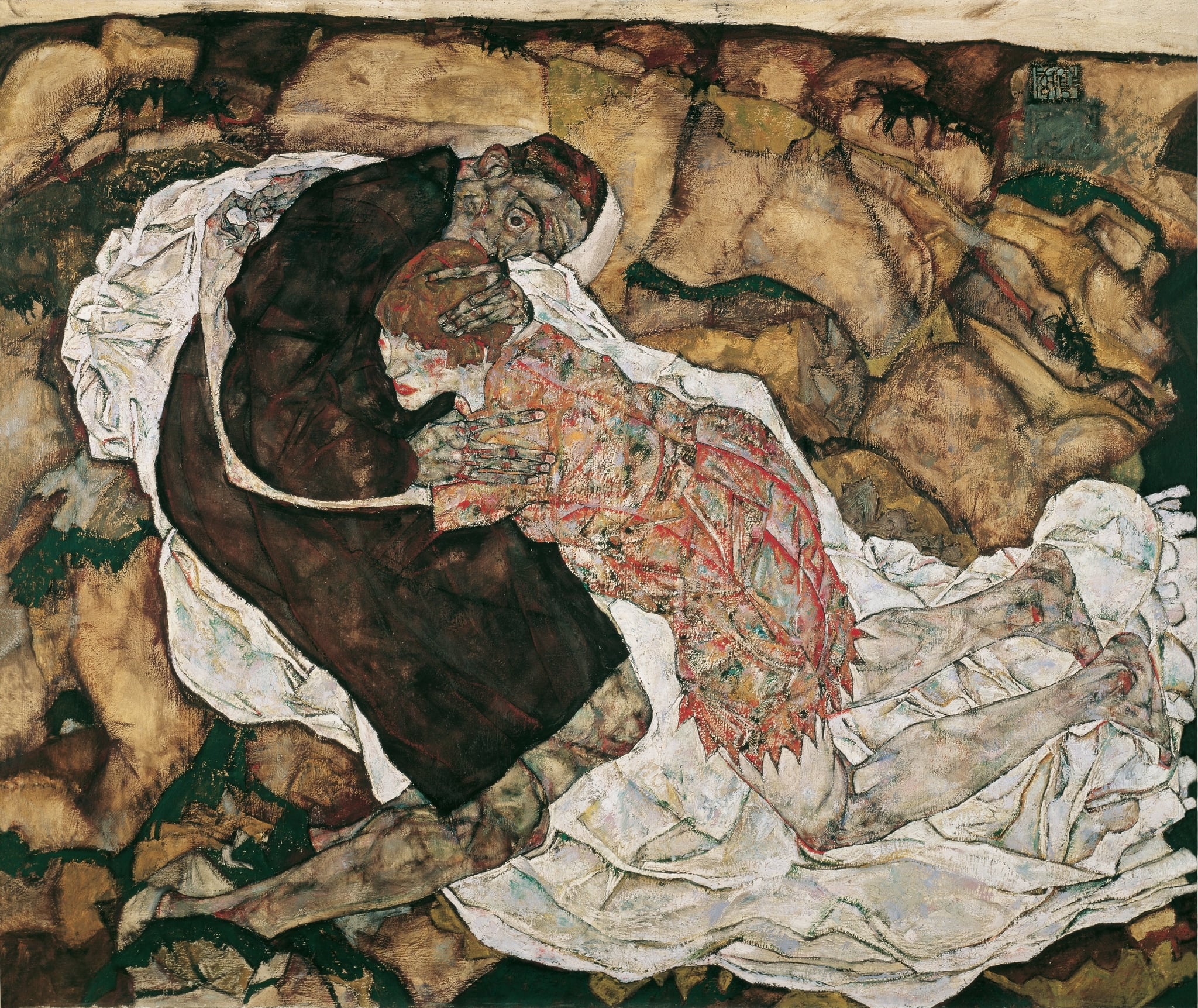
Death and the Maiden by Egon Schiele

Death and the Maiden

Egon Schiele (1915)

In Death and the Maiden, Egon Schiele fuses <strong>eros and thanatos</strong> into a single, uneasy embrace: a gaunt, hooded figure in dark robes wraps himself around a young woman whose patterned dress and red mouth still signal life. On a crumpled <strong>white cloth</strong>—at once bed and shroud—their angular, ashen bodies kneel against <strong>barren ocher earth</strong>, turning intimacy into a memento of parting. The scene asserts that tenderness and terror are inseparable, especially under the shadow of war.