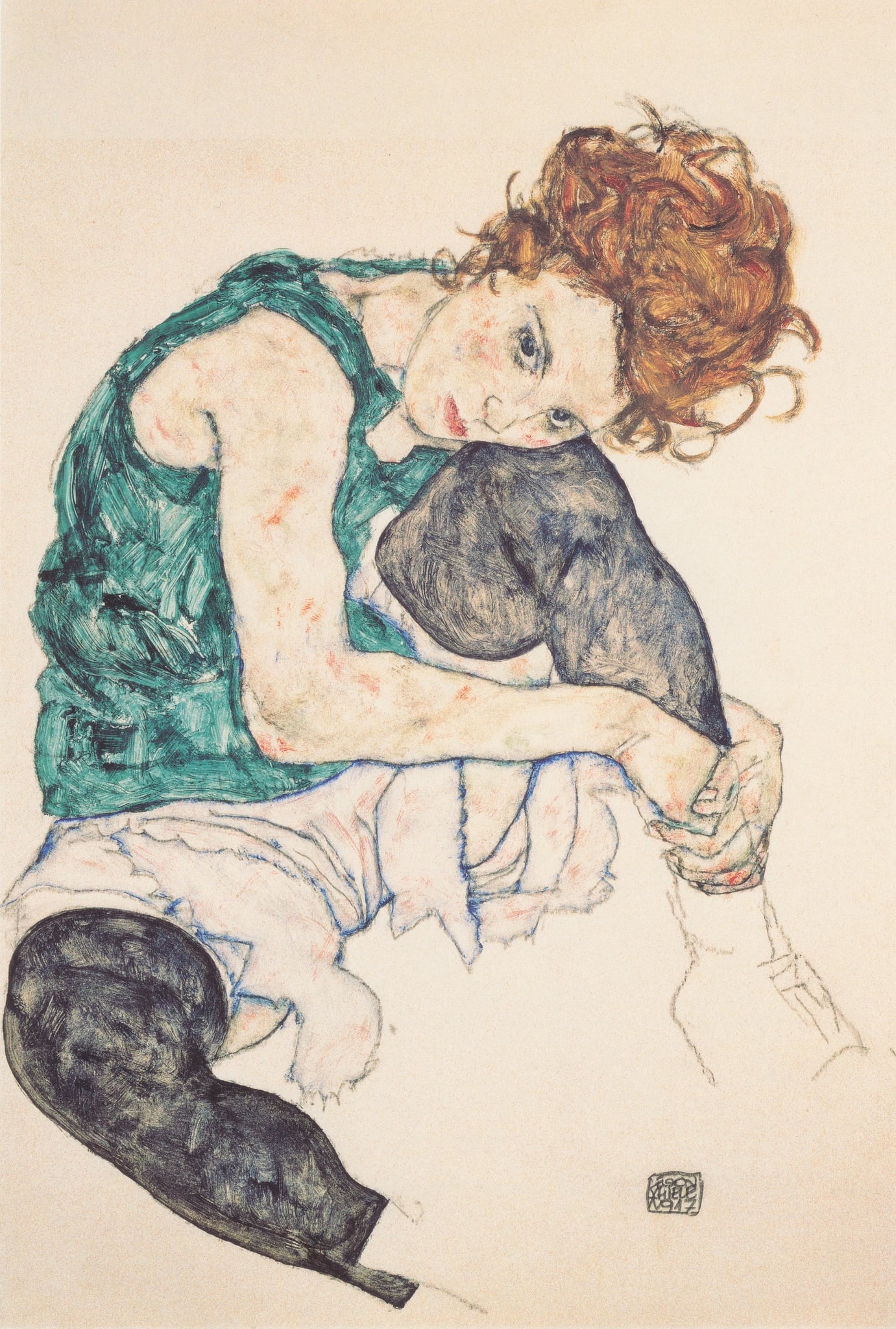
Death and the Maiden

by Egon Schiele

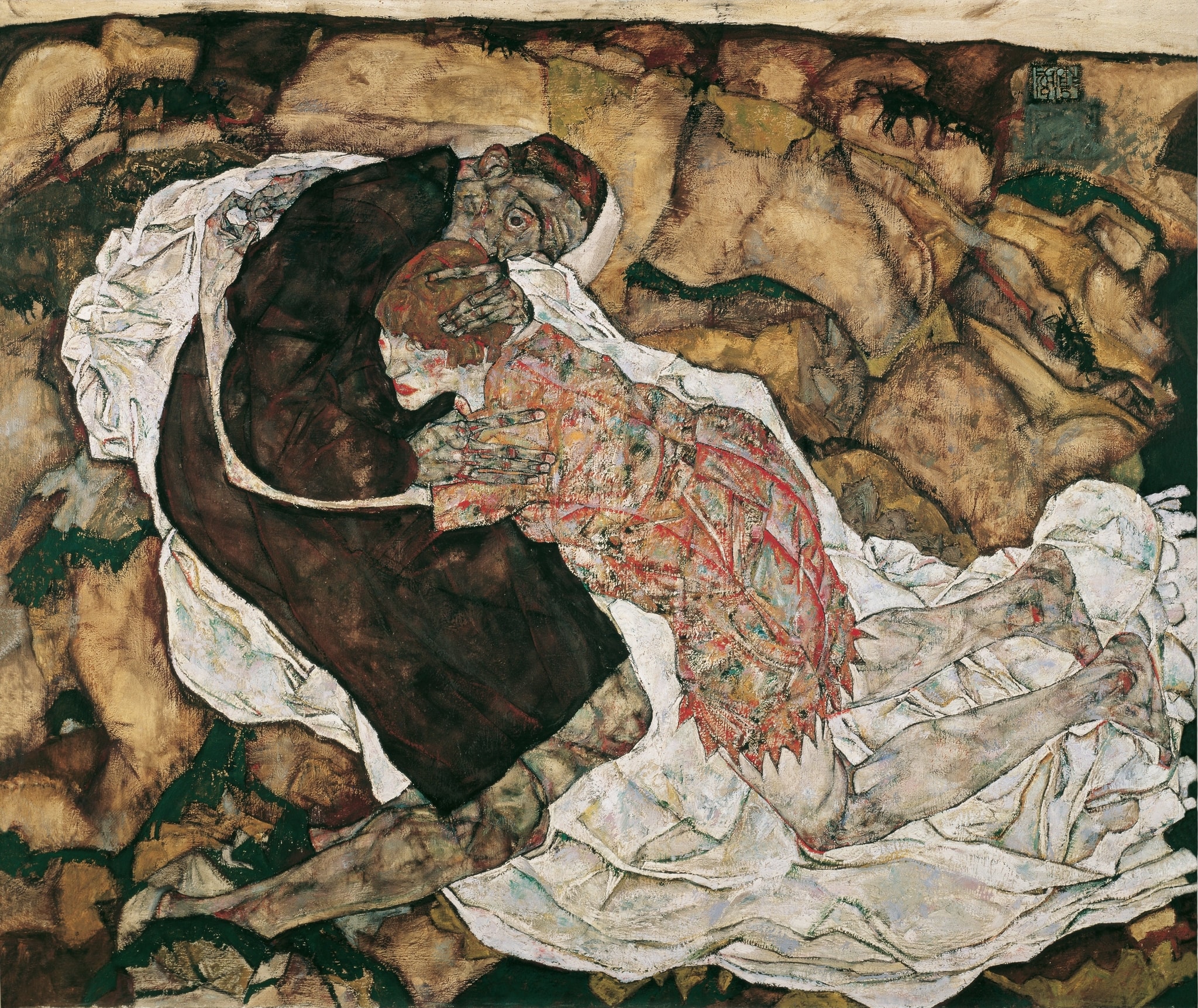
In Death and the Maiden, Egon Schiele fuses eros and thanatos into a single, uneasy embrace: a gaunt, hooded figure in dark robes wraps himself around a young woman whose patterned dress and red mouth still signal life. On a crumpled white cloth—at once bed and shroud—their angular, ashen bodies kneel against barren ocher earth, turning intimacy into a memento of parting. The scene asserts that tenderness and terror are inseparable, especially under the shadow of war.

Study Print Studio

Create a personal study print

Build a companion study sheet around the part of this painting that speaks to you most. Choose a detail, shape an interpretation, and walk away with something personal and display-worthy.

Fast Facts

Year
1915
Medium
Oil on canvas
Dimensions
150 × 180 cm
Location
Upper Belvedere, Vienna
Death and the Maiden by Egon Schiele (1915) featuring Dark monk-like robe (Death), White cloth (bed/shroud), Patterned dress of the maiden, Red lips

Click on any numbered symbol to learn more about its meaning

Meaning & Symbolism

Schiele engineers a collision of intimacy and annihilation. The monk-like figure in a dark, almost monastic robe is not a skeleton; he is a gaunt presence whose hollow, sidelong gaze looks past the woman and out of the scene, refusing consolation. His hands, bony and splayed, encircle her skull and shoulder with a grip that reads as both cradle and claim. The woman’s red lips and intricately patterned dress assert the last signals of vitality, yet her knees buckle into the white cloth that pools beneath them, a fabric that reads simultaneously as a marriage sheet and a funerary shroud. Their limbs are sharply contoured, the skin tinged with greenish ash; Schiele’s tense, electric line makes their bodies feel brittle, already succumbing to time. Around them spreads an unpeopled ocher ground, scraped and patchy like graveyard earth, closing the space so that the embrace becomes an island of contact in a field of loss 12. The painting’s dramaturgy is a farewell staged as an embrace. The woman’s arms hook around Death’s torso as though asking for protection, yet the turn of his face, the slackness of his upper body, and the enclosing robe signal inevitability rather than rescue. This ambivalence—clinging and yielding at once—turns the couple into an emblem of how desire persists precisely at the edge of disappearance. Schiele painted the canvas in 1915, the year of his marriage to Edith Harms and near-immediate conscription into the Austro‑Hungarian army; museums link the picture to his break with his long-time partner Wally Neuzil and to a climate of wartime uncertainty 35. Read through this lens, the cloth’s double valence as bed and shroud condenses biography into icon: union already shadowed by parting. The work becomes a wartime memento mori, not through allegorical props but through the body’s own attenuation and embrace, love compressed into a last hold before release 4. At the level of art-historical dialogue, Schiele pointedly negates the optimistic erotics of Viennese contemporaries. Where Klimt’s Kiss stages transcendence through gold and ornament, Schiele strips the ground to bare earth and corrugates flesh with contour, making expression—the line itself—the carrier of dread. The robe’s dark mass reads like a void that wraps the maiden, an abstract wedge of mortality entering the figure group; her patterned dress, by contrast, flickers with broken reds and greens, a fragile surface animation against the robe’s blunt finality. Even the composition’s low horizon and the figures’ kneeling posture bind them to the earth, refusing upward lift. In this sense, the meaning of Death and the Maiden is not the triumph of either love or death but the knowledge that they are coextensive: tenderness is the form that finitude takes when it meets the body. That is why Death and the Maiden is important—Schiele retools a Renaissance topos for modern catastrophe, compressing personal severance and collective fear into a single, unresolvable embrace that continues to define Austrian Expressionism’s psychology of the figure 124.

Explore Deeper with AI

Ask questions about Death and the Maiden

Popular questions:

Powered by AI • Get instant insights about this artwork

💬 Ask questions about this artwork!

Interpretations

Historical Context: Mobilized Intimacy

Painted in 1915, weeks after Schiele’s marriage and immediate conscription, the picture internalizes wartime logistics: bodies are registered, rerouted, and finally held in suspension. The embrace reads like a furlough that cannot outlast the order of departure. Crucially, there are no uniforms; instead, the white cloth and barren ground become the stage where civic crisis infiltrates the domestic sphere. Museums tie the work to Schiele’s rupture with Wally Neuzil, making the canvas a ledger where personal severance tallies with imperial mobilization. The result is not propaganda but a civilian time-lag, a pause before separation in which touch stores meaning against imminent loss—a private armistice that never arrives 534.

Source: Egon Schiele Museum (timeline); Belvedere Museum (story); MoMA catalogue

Iconography Recast: From Skeleton to Cowl

Schiele pointedly abandons the skeletal Death common to the traditional “Death and the Maiden” topos, opting for a gaunt, monastic figure whose cowl evokes penitence rather than horror. This shift exchanges allegorical terror for the slow abrasion of time: Death becomes a presence one can physically cling to, even as his averted gaze refuses reciprocity. The theological register is muted yet legible—an inverted pietà in which no redemption is offered, only contact. By humanizing Death, Schiele drags the Renaissance motif into modernity, making mortality intimate, tactile, and psychologically proximate rather than emblematic and distant 18.

Source: Belvedere Museum (collection entry); Wikipedia (motif overview, tertiary)

Formal Analysis: Line as Affect, Ground as Fate

Schiele’s signature, taut contour corrugates the bodies, producing a brittle, desiccated epidermis where color thins to greenish ash. The low horizon and kneeling posture pin the couple to an ocher ground that behaves less like space than like a pressure plate—figure and field coalesce into a single affective surface. Ornament survives only in the woman’s dress, a fragile counter-rhythm to the robe’s dark mass. In Expressionist terms, mimesis yields to psychic transcription: line carries dread; color withdraws toward austerity; composition refuses lift. The embrace becomes a closed circuit of energy anchored by earth rather than elevated by vision or gold 24.

Source: Belvedere Museum (gallery guide); MoMA catalogue

Comparative Modernism: Anti-Transcendence after Klimt

Against Klimt’s The Kiss—where gold leaf promises ecstatic transfiguration—Schiele stages a counter‑image of eros under duress. He strips away the decorative cosmos to reveal bare earth, substituting transcendence with immanence and attrition. The robe’s near‑abstract darkness acts as a negative volume, infiltrating the couple like a wedge of nullity; the woman’s patterned dress flickers as a last, unstable surface. Belvedere curators frame this as a Viennese dialogue in which Schiele negates the Secessionist ideal of beautified union, recoding the couple as an emblem of parting rather than consummation—modern love as an elegy, not an apotheosis 2.

Source: Belvedere Museum (gallery guide)

Gendered Asymmetry: Cling, Claim, and Refusal

Gender dynamics turn on an asymmetry of agency. The woman’s arms actively hook and pull; her red lips and patterned dress insist on residual vitality. Death’s grip can read as cradle or claim, yet his sidelong, hollow gaze refuses mutuality. The result is an erotic script in which female desire becomes a strategy of self-preservation, meeting a male figure who withholds the very promise she seeks. Read through the Wally separation, the picture stages care as negotiation under patriarchy and war: intimacy as work performed by the vulnerable partner to delay abandonment, even as the scene admits abandonment’s inevitability 31.

Source: Belvedere Museum (story; collection entry)

Identity and Substitution: The Doppelgänger Couple

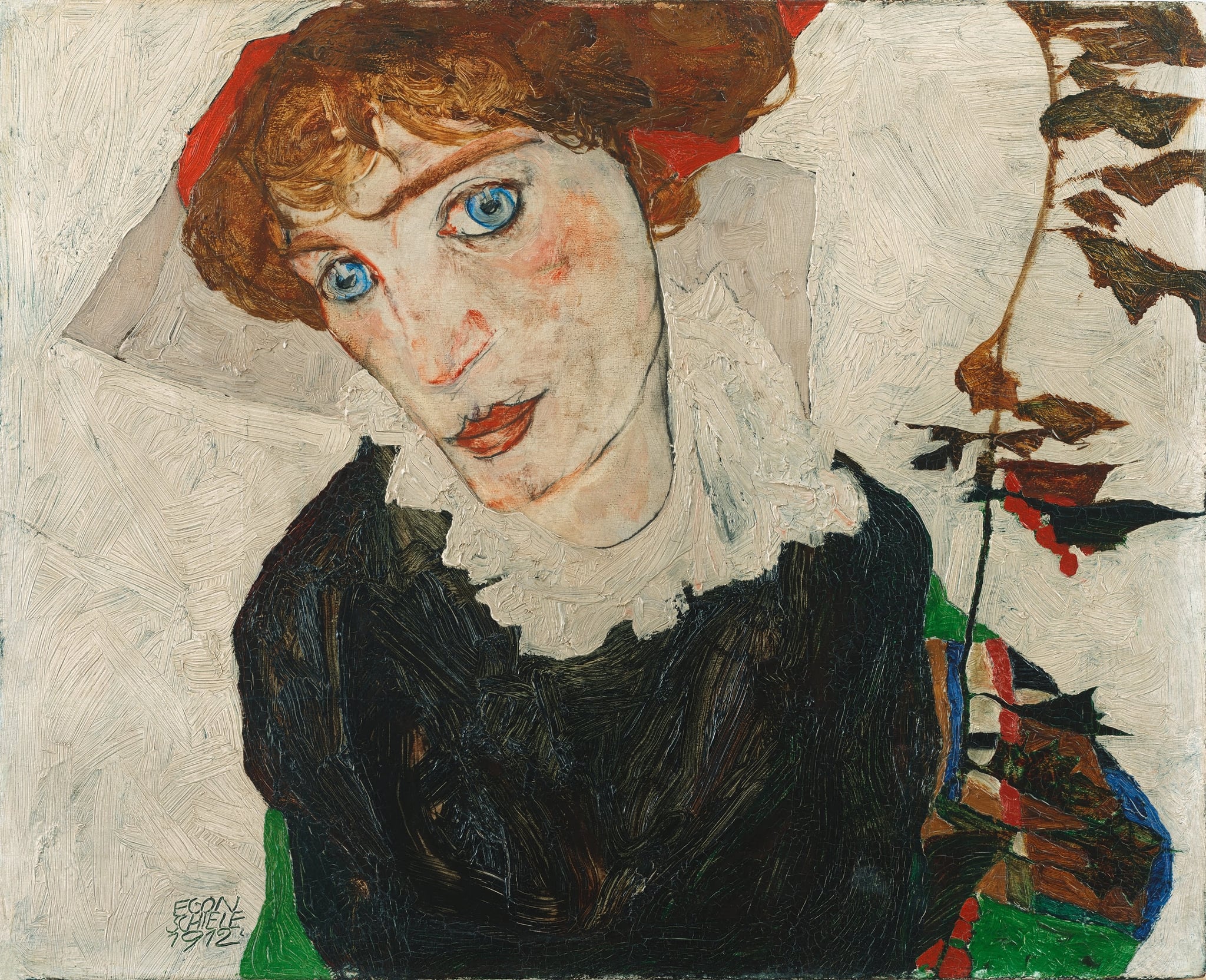
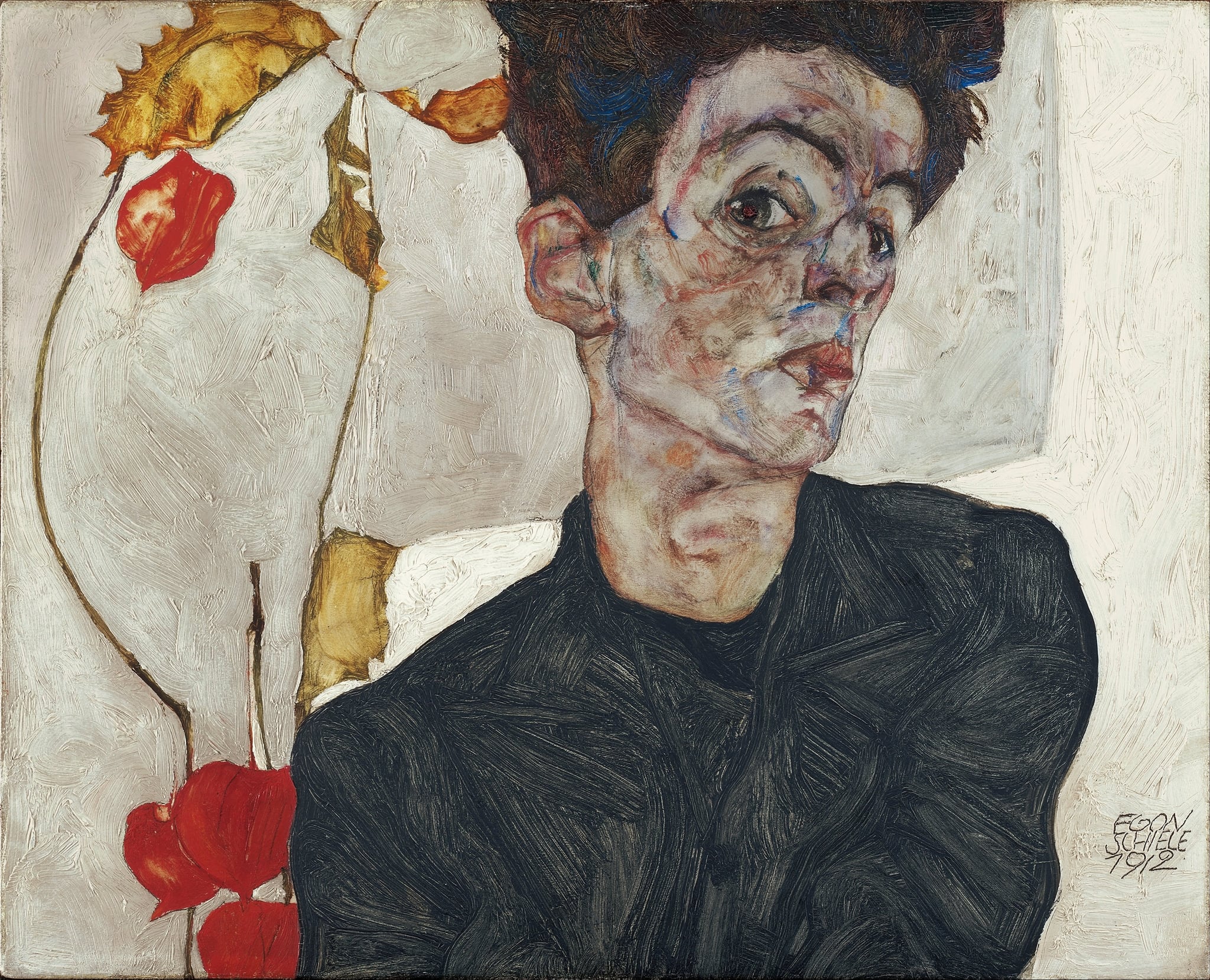
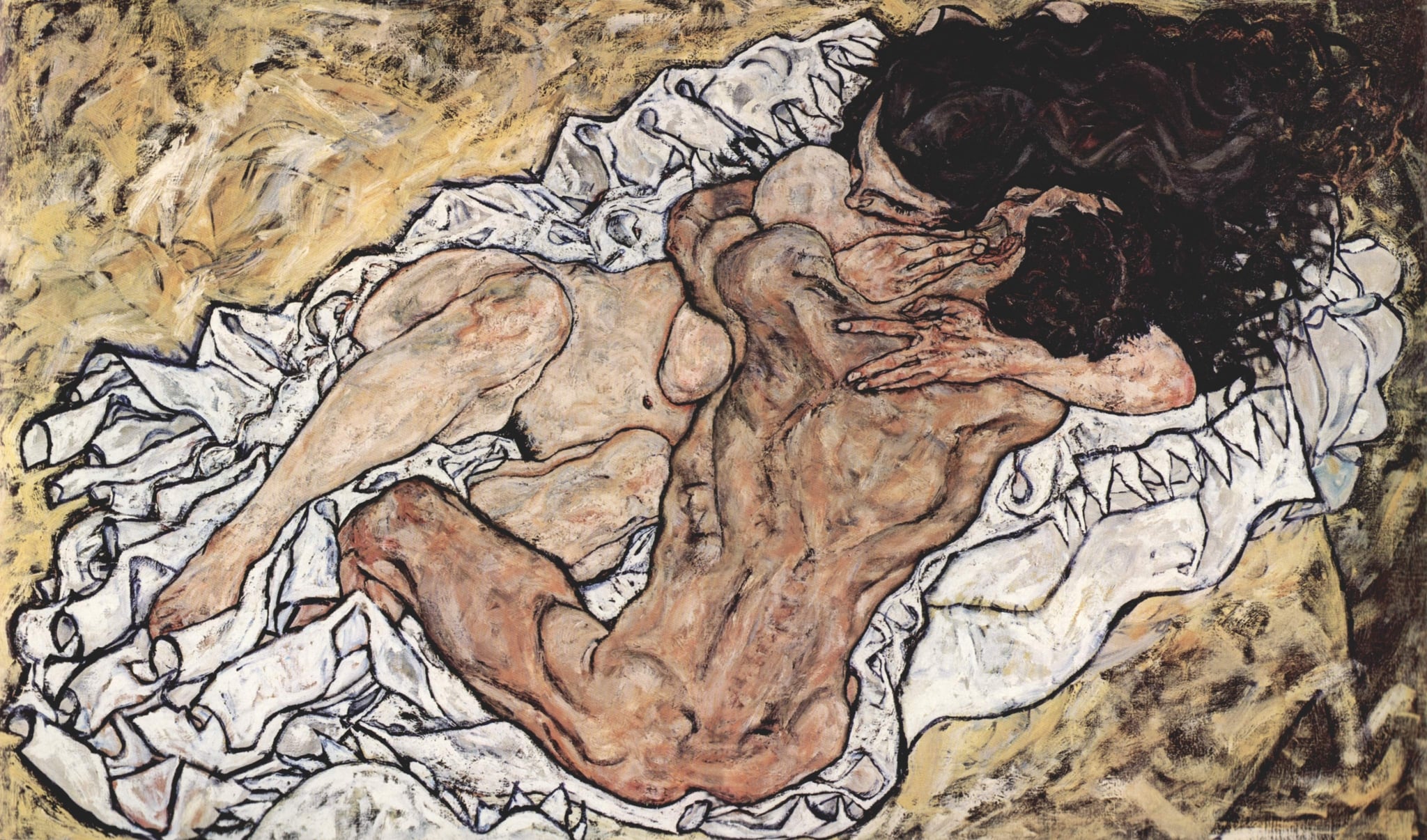
Early titles like “Man and Girl” and “Entwined People” hint at role fluidity rather than fixed portraiture. Many curators align the maiden with Wally Neuzil, yet the image resists singular identification, reading as a composite of Wally and Edith or as archetype. The dark‑robed figure doubles as Death and as a Schiele surrogate—a self split between lover and annihilator. This doppelgänger logic aligns with Expressionist self-fashioning: the artist inserts his psychic double into the embrace to picture desire crossed by self‑undoing. Identity here is less biographical likeness than performative mask, shifting with title, context, and viewer memory 39.

Source: Belvedere Museum (story); Wikipedia (early titles, tertiary)

Related Themes

About Egon Schiele

Egon Schiele (1890–1918) was a leading Austrian Expressionist associated with Viennese modernism and mentored by Gustav Klimt. Known for taut line, planar color, and psychologically intense portraits, he pushed figuration toward raw self‑revelation before his death in the 1918 influenza pandemic [6][3].
View all works by Egon Schiele

More by Egon Schiele