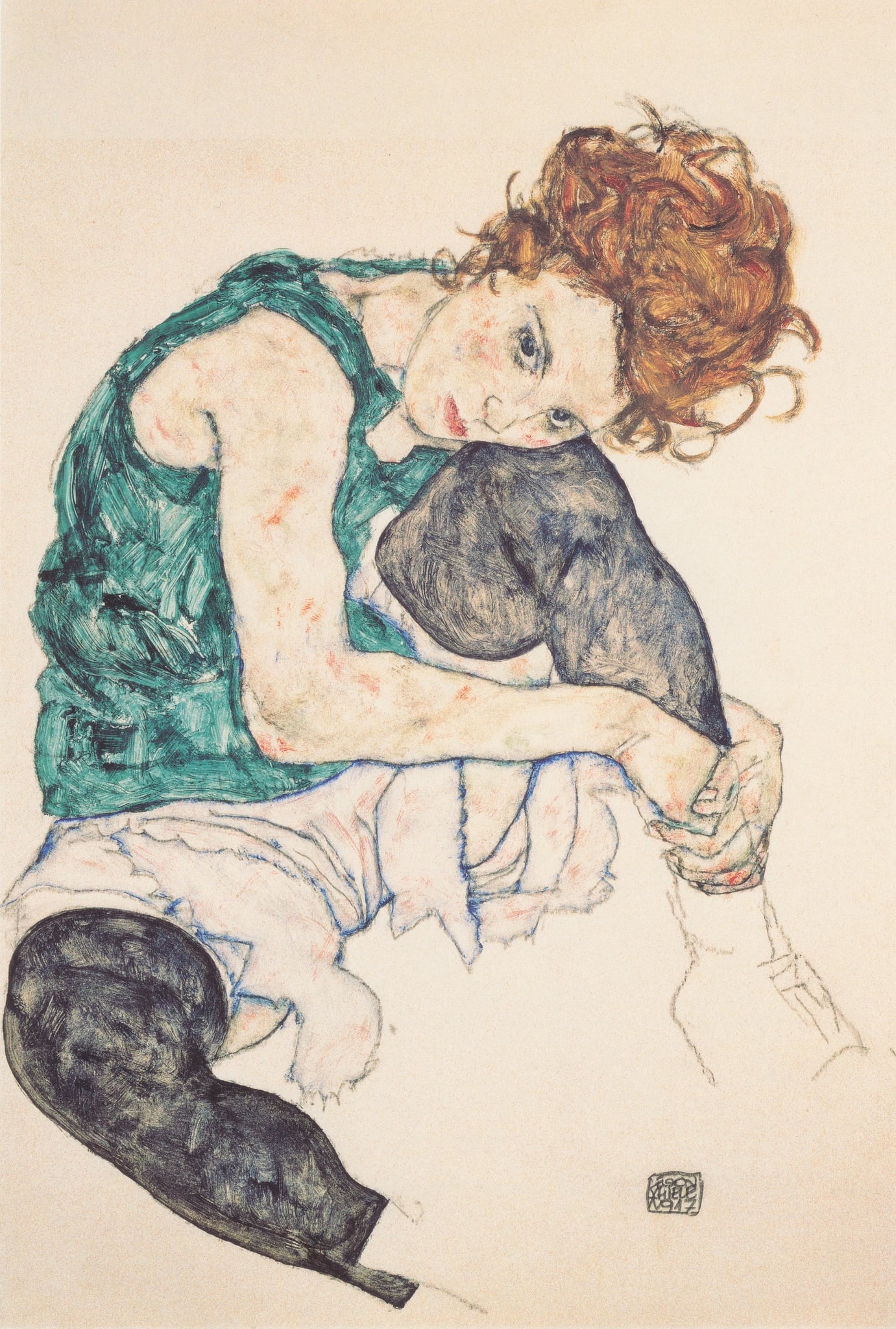
Portrait of Wally

by Egon Schiele

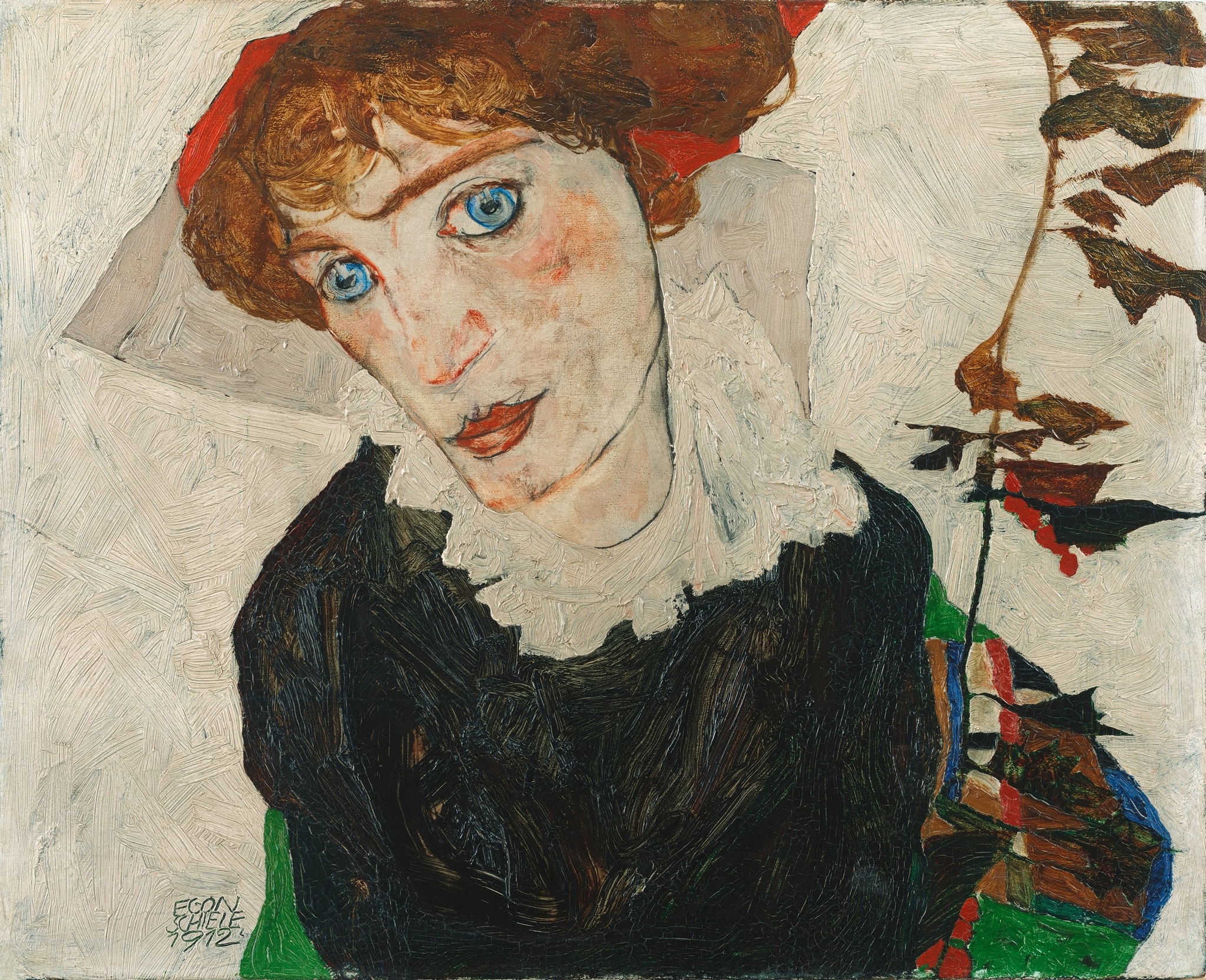
Egon Schiele’s Portrait of Wally (1912) turns likeness into emotional topography: an oblique head, ice‑blue eyes, and a ruffled white collar flare against an impasto, airless ground. The right‑edge twig with red berries acts as a terse sign of vitality under threat, while jagged contours and a dense black dress pull the figure toward us with unsettling intimacy [1][3].

Study Print Studio

Create a personal study print

Build a companion study sheet around the part of this painting that speaks to you most. Choose a detail, shape an interpretation, and walk away with something personal and display-worthy.

Fast Facts

Year
1912
Medium
Oil on wood (panel)
Dimensions
32 × 39.8 cm
Location
Leopold Museum, Vienna
Portrait of Wally by Egon Schiele (1912) featuring Twig with red berries, Ice‑blue eyes and unwavering gaze, Ruffled white collar, Dense black dress

Click on any numbered symbol to learn more about its meaning

Meaning & Symbolism

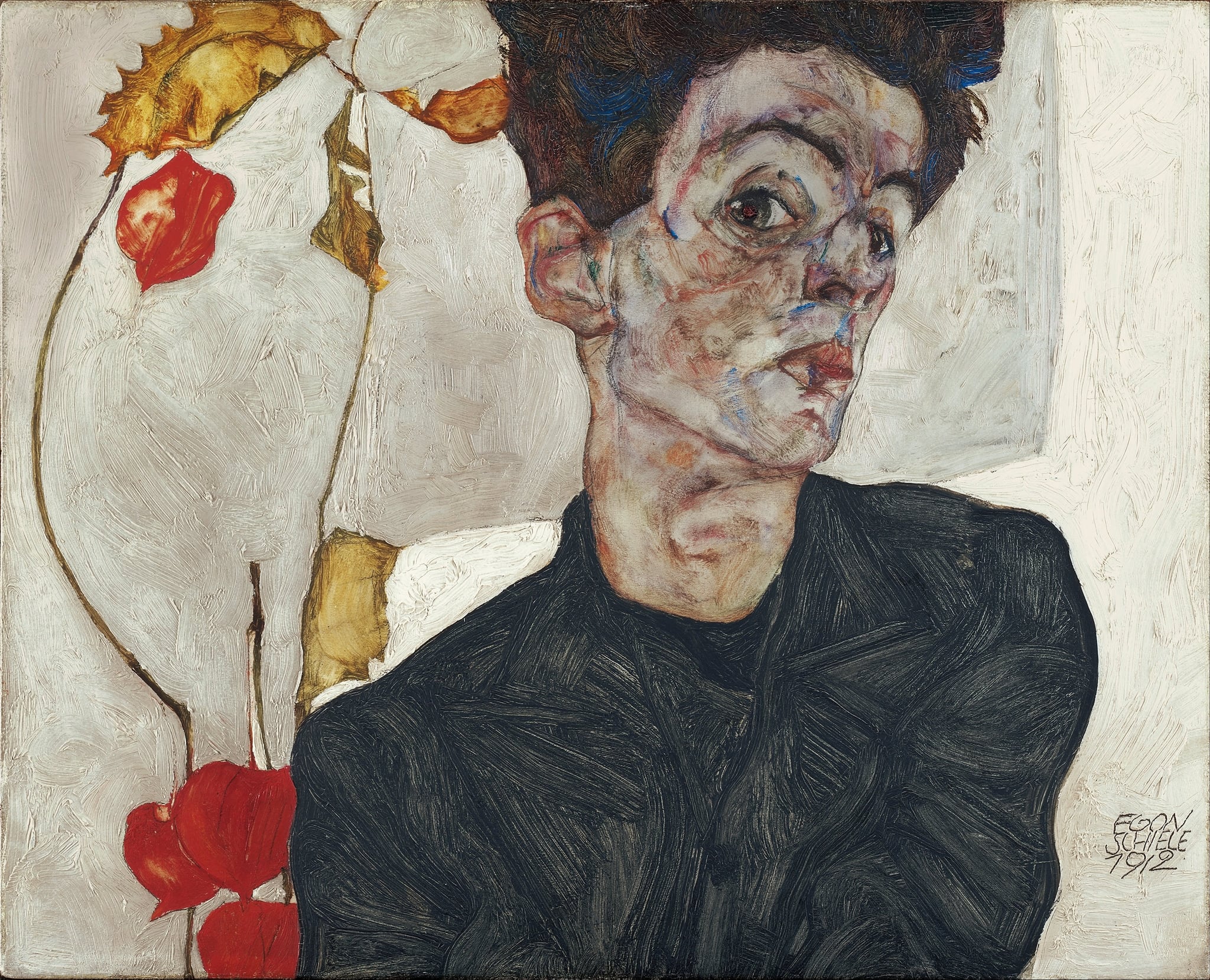
Schiele engineers psychological pressure through framing, angle, and surface. The figure leans diagonally into the picture plane, the neck taut and the head canted, so that the wide, ice‑blue eyes seem to fix on us from below the red cap. Contour lines articulate cheekbone, jaw, and lips with a nervous exactitude, but color is laid as patches rather than naturalistic modeling: blushes, pallor, and the dense black of the dress register as expressive fields, not polite finish. The ruffled white collar flares like a paper fan, catching the light and pushing the head forward, while the background is a chalky, scraped impasto whose directional strokes deny depth and force the subject into our space. This is portraiture as exposure. By withholding atmospheric relief and compressing the body against the edge, Schiele turns the likeness into a site where affection collides with appraisal—love sharpened by unease 13. The right margin holds a fragile, thorned twig with withered leaves and bright red berries, a vertical counterpoint to the sitter’s tilt. In the context of 1912, when Schiele conceived this work as the counterpart to Self‑Portrait with Chinese Lantern Plant, the motif reads as an intentionally staged echo: plant life as a spare emblem of vitality under pressure, time passing, and the body’s vulnerability 2. The severe palette—black, white, bitter reds, and a sharp green wedge at the lower edge—keeps the picture autumnal and unsentimental. Formally, Schiele balances geometric blocks (black torso, white ruff, pale field) with the zigzag of contour and twig; psychologically, the balance is between resolve (the frontal, unwavering eyes) and exposure (the thin skin of paint, the way bone and blush show through). As MoMA’s curatorial frame stresses, Schiele privileges structure over conventional modeling; here, line locks the form while color radiates feeling, so that the portrait functions less as a record of features than as a map of inward strain 3. This formal and emotional charge has been further intensified by the painting’s public life. Its now‑established provenance—pre‑war private ownership, Nazi seizure, post‑war misattribution, and a landmark U.S. settlement requiring permanent acknowledgment of the theft—has made the work a touchstone in debates about cultural memory and restitution 145. That history does not replace the image’s meanings, but it reframes them: the isolated ground reads more starkly; the thorny sprig, more brittle; the unwavering gaze, more ethically urgent. Why Portrait of Wally is important is thus twofold: as a consummate instance of Viennese Expressionism’s capacity to turn paint into psyche, and as a case where a modern masterpiece’s visibility is inseparable from the responsibility to remember the conditions under which artworks travel and endure 1345.

Explore Deeper with AI

Ask questions about Portrait of Wally

Popular questions:

Powered by AI • Get instant insights about this artwork

💬 Ask questions about this artwork!

Interpretations

Pendant Logic: The Intimate Double

Conceived as the “counterpart to Self‑Portrait with Chinese Lantern Plant,” Portrait of Wally participates in a diptych-like dialogue between self and beloved. Schiele sets up compositional rhymes—tight cropping, planar color blocks, a vertical plant attribute—that make Wally both mirror and foil to his own image. Rather than a passive muse, she becomes an intersubjective double through which the artist tests identity by proxy. The vegetal sign shifts from the self-portrait’s lantern fruit to Wally’s withered sprig, modulating the register from flamboyant self-inscription to austere memento. This pairing aligns with Schiele’s 1912 emphasis on structure and psychological charge: line locks the form while color radiates affect, so that the two panels operate as a relational system of forms and feelings rather than isolated likenesses 123.

Source: Leopold Museum; MoMA

Materiality and Support: Panel as Pressure Device

Executed in oil on wood, not canvas, the portrait’s panel support amplifies its compressed, airless design. The relatively hard, non-springy surface takes the chalky impasto and scraped passages cleanly, supporting Schiele’s emphasis on contour exactitude over atmospheric modeling. Planar, patchwork chroma reads as deliberate construction rather than blended flesh, consistent with curatorial accounts of Schiele’s priority on structure over modeling. The small scale (32 × 39.8 cm) intensifies proximity: edge trims and the forward-pitched head activate the panel’s perimeter as a pressurized boundary, making the sitter feel proximate and inescapable. In this reading, material choice is not incidental craft but a formal engine for psychological insistence—paint behaving like incision on a rigid ground to fix the viewer in Wally’s unwavering gaze 13.

Source: Leopold Museum; MoMA

Gendered Modernity: Wally’s Agency and the Gaze

Wally Neuzil, far from a generic model, was Schiele’s closest collaborator in these years, shaping a body of works whose intensity hinges on reciprocal looking. The painting complicates muse conventions: Wally’s wide, level eyes return the viewer’s scrutiny, disallowing objectification through a confrontational gaze. Schiele’s linear syntax (taut neck, nervy cheek contours) registers intimacy without softness; desire is filtered through appraisal, a negotiation typical of Viennese modernism’s ambivalence about the modern female subject. Rather than erotic reverie, we encounter a subject who occupies visual authority within a tightly structured frame. This reframes “the sitter” as a co-author of modern portraiture’s psychic contract, aligning with museum accounts that credit Wally’s pivotal role in Schiele’s 1911–12 innovations in figure and portrait 13.

Source: Leopold Museum; MoMA

Botanical Minimalism: A Memento Without Emblem

The thorned twig with withered leaves and red berries reads as botanical minimalism—a reduced life-cycle sign that resists precise iconography. Museum records refrain from species identification; instead, the plant carries meaning by formal placement and pendant echo to the self-portrait’s lantern fruit. This restraint strengthens the motif’s role as open-ended memento, suspending interpretation between vitality and decline. The autumnal palette (bitter reds, dense black, chalky ground) calibrates the plant’s punctuation to Wally’s exposed physiognomy, making mortality a formal counterpoint rather than a narrative program. Such spareness suits Schiele’s 1912 language of planar fields and exacted line: life and time are invoked not by allegorical burden but by attentive reduction, a modernist economy of means that lets context and pairing carry symbolic weight 123.

Source: Leopold Museum; MoMA

Carceral Atmospherics: 1912 and the Architecture of Confinement

Schiele’s April 1912 arrest and weeks in custody form a charged backdrop for the year’s portraits. In Wally, spatial compression—the figure thrust against a scraped, depth-denying ground—reads like an affective residue of confinement. The panel’s edges function as a carceral architecture, with the flared white ruff acting almost as a collaring device that projects the head forward yet holds it in place. The result is an ethnography of pressure: intimacy heightened by claustrophobia, tenderness parsed through control. While causation cannot be proved, the conjunction of date, format, and design supports a reading in which personal upheaval translates into formal austerity and constrained space, aligning with curatorial claims about 1912 as a crucible for Schiele’s psychologically exacting portraiture 12.

Source: Leopold Museum

Restitution Aesthetics: How Provenance Rewrites Reception

Wally’s modern fame is inseparable from its Nazi-era theft, misattribution, and the 2010 U.S. settlement mandating permanent wall text acknowledging Lea Bondi Jaray’s ownership and the painting’s seizure. This legal afterlife turns the picture into a memory device: the isolated, chalky ground seems starker; the thorny twig feels more brittle; the gaze, more ethically charged. The case helped popularize a public grammar of provenance and cultural responsibility, reminding viewers that modernist masterpieces circulate through coercive histories that adhere to them in display and discourse. In this frame, the portrait’s “exposure” extends beyond psyche to institutional self-disclosure—labels, archives, and settlements that co-author meaning whenever the work is seen, in Vienna or abroad 145.

Source: U.S. Department of Justice; Leopold Museum; Smarthistory

Related Themes

About Egon Schiele

Egon Schiele (1890–1918) was a leading Austrian Expressionist associated with Viennese modernism and mentored by Gustav Klimt. Known for taut line, planar color, and psychologically intense portraits, he pushed figuration toward raw self‑revelation before his death in the 1918 influenza pandemic [6][3].
View all works by Egon Schiele