Seated Woman with Bent Knee

by Egon Schiele

Egon Schiele’s Seated Woman with Bent Knee compresses the body into a tense, looping knot, fusing erotic charge with psychological vulnerability. The emerald bodice, inky stockings, and copper hair vibrate against a blank ground, while the sitter’s hands clamp her ankle, signaling self‑containment as much as display [1][3].

Study Print Studio

Create a personal study print

Build a companion study sheet around the part of this painting that speaks to you most. Choose a detail, shape an interpretation, and walk away with something personal and display-worthy.

Fast Facts

Year
1917
Medium
Gouache on paper
Dimensions
46 x 30.5 cm
Location
National Gallery Prague, Collection of Prints and Drawings
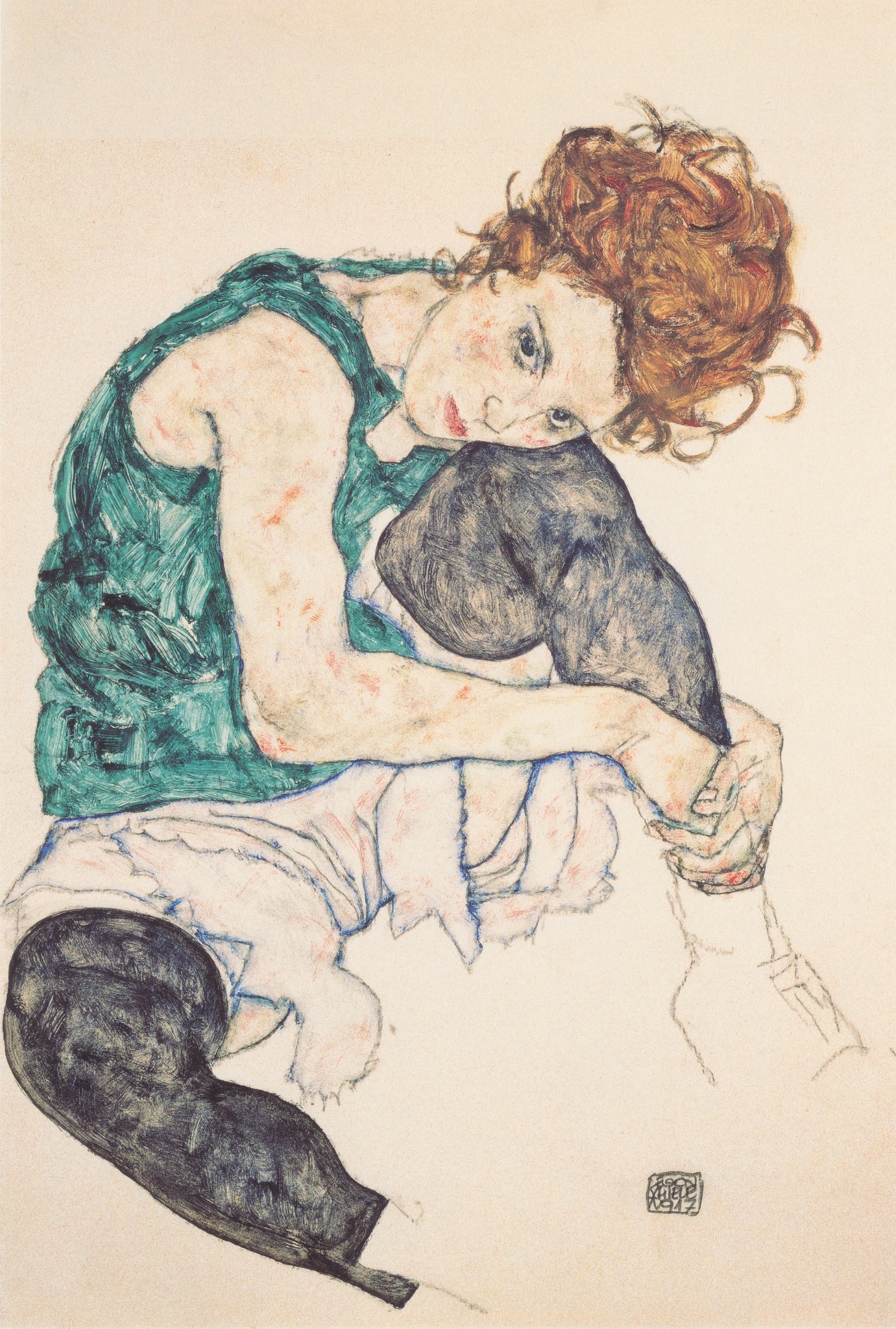
Seated Woman with Bent Knee by Egon Schiele (1917) featuring Raised, black‑stockinged thigh, Clasped hands gripping the ankle, Spiral/knot pose, Emerald bodice

Click on any numbered symbol to learn more about its meaning

Meaning & Symbolism

Schiele builds intensity by compressing anatomy into a charged spiral: the raised, stockinged thigh forms a dark fulcrum; the forearms hook around the shin; the head tilts and rests near the knee, bringing face and limb into an almost claustrophobic circuit. The hands—bony, articulated, and gripping—read as anchors rather than caresses, converting a potentially inviting pose into a defensive lock. Around this armature, wiry contour lines scissor the pale skin and leave abrasions of reddish wash, like heat rising to the surface. The emerald bodice, scumbled with opaque gouache, behaves as a stubborn color-block against the whitening paper; the black stockings sink into the sheet’s depth, fetishizing the legs while refusing softness 134. Schiele’s blank ground is not a neutral space but a deliberate isolation chamber. By denying furniture, interior, or landscape, he makes the sitter’s body the only site where meaning can happen; the void pushes the figure outward, so that every tilt of gaze and torque of elbow becomes amplified to a near-audible pitch 15. This staging enacts a modern paradox: exposure without relief. The rumpled skirt and half-dressed state generate an explicit erotic signal, yet the posture’s knotted geometry frustrates access. The sitter’s eyes, slanted upward beneath a tangle of copper hair, do not seduce; they assess, wary but unflinching. Schiele’s famous “deformation” is not cruelty but diagnosis: beauty here is edged with rawness, because the truth of desire includes fear, will, and self-possession. Critics have shown how his nudes overturn conventions that neutralized erotic power; instead of a reclining offering, he gives us a vertical, confrontational body that manages its own display 5. The stockings—so prominent in Schiele’s erotic modernity—operate as both magnet and barrier, heightening sexuality while insisting on the sitter’s constructedness, her right to modulate how she is seen 3. In this sense, the tight clasp around the ankle reads as an act of control: a grip that steadies the self against the centrifugal pull of the viewer’s gaze. Materially, the sheet belongs to Schiele’s late wartime language: quick, incisive contour; thin washes mottling skin; and assertive gouache passages. This hybrid facture intensifies the theme of unstable identity: parts of the body appear fully present; others fade, as if the figure were emerging from or dissolving into the paper. That dynamic echoes the cultural climate of 1917 Vienna, where the pressures of war and rapid social change drove artists to chart the psyche rather than idealize the form 24. Why Seated Woman with Bent Knee is important lies here: it distills the Expressionist conviction that to tell the truth about the body is to show its tensions—erotic, emotional, and existential—without smoothing them away. The drawing offers intimacy without comfort, insisting that modern seeing must confront not only what the body is, but what it feels like to inhabit one 125.

Explore Deeper with AI

Ask questions about Seated Woman with Bent Knee

Popular questions:

Powered by AI • Get instant insights about this artwork

💬 Ask questions about this artwork!

Interpretations

Historical Context: Late-War Vienna and the Body-as-Document

Composed in 1917, the drawing belongs to Schiele’s late wartime phase, when Viennese modernism shifted from ornamental synthesis toward psychic disclosure. Exhibition histories and biographies underline how, amid military service and mounting recognition, Schiele condensed experience into acute figure studies rather than narrative tableaux. The work’s stripped ground and urgent lineament mirror a city where social fabric thinned under strain; the body became a recording surface for anxiety, vigilance, and control. This contextual lens clarifies why exposure here lacks catharsis: modern life is registered as pressure, not spectacle. The “verticalized,” confrontational format associated with his late nudes recasts the sitter as an active agent within this historical tension, refusing the consolations of prewar idealism 516.

Source: Leopold Museum; National Gallery Prague; Oxford Art Journal

Symbolic Reading: Fetish, Fashion, and Agency

The conspicuous black stockings are not incidental; they are a recurrent modern accessory in Schiele’s erotic works that intensify desire while introducing friction. Critics have shown how such garments perform a double act: they magnetize attention to the legs yet interpose a textile barrier, emphasizing the sitter’s assembled image rather than unmediated flesh. Here, the stockinged thigh becomes a visual fulcrum while the gripping hands assert proprietary control over the body on display. This fashion detail thus stages eroticism as authorship: the model manages how and how much she is seen, resisting the fantasy of seamless access. The result is a deliberately ambivalent erotic register—simultaneously luring and withholding 324.

Source: The Guardian (The Radical Nude); Jane Kallir; MoMA (Leopold Collection brochure)

Formal/Technical Analysis: Facture as Psychology

Materially, the sheet interleaves incisive contour, thin mottled washes, and assertive gouache passages—a late style syntax that turns technique into affect. Gouache masses (the emerald bodice) operate like stubborn color-planes that resist the paper’s glare, while the wiry crayon/brush contours abrade the skin, producing zones of heat and pallor. Passages that fade or thin at the edges enact a body that seems to appear and withdraw, echoing unstable subjectivity. Schiele’s refusal of a modeled, volumetric surround keeps the figure “unhoused,” intensifying psychological legibility over spatial coherence. This formal economy is not minimalism but diagnosis: every stroke is calibrated to register tension, control, and exposure in the most economical terms 14.

Source: National Gallery Prague; MoMA (Leopold Collection brochure)

Gendered Gaze: The Managed Encounter

Schiele overturns the passive nude by staging a managed encounter. The sitter’s upward, assessing look and the self-clasped limb convert proximity into boundary-making—a choreography that acknowledges voyeuristic charge yet asserts self-possession. Scholars emphasize how his late nudes are “vertical” and confrontational, redistributing agency to the model rather than the beholder. The hands, rendered as bony anchors, literalize this control: they secure the leg, steadying the self against the viewer’s pull. In this reading, deformation is not cruelty but a truth function—a means to disclose how erotic power includes will, wariness, and assertion. The effect is intimacy without comfort, desire folded into a stance of active authorship 21.

Source: Jane Kallir; National Gallery Prague

Attribution & Identity: Edith or Adele?

The model’s identity remains contested: Prague’s collection text aligns her with Edith (Schiele’s wife), while other institutional partners label the sheet with Adele Harms (Edith’s sister). This ambiguity matters interpretively. If Edith, the image participates in a post‑1915 marital collaboration shaped by wartime separations and renewed visibility; if Adele, it extends Schiele’s complex studio ecology, where intimacy, kinship, and performance intermingle. Either way, the drawing’s engineered pose underscores that identity is constructed at the site of the studio—through costume (stockings), staging, and mutual negotiation between artist and model. The uncertain siting within Schiele’s circle becomes part of the work’s theme of unstable identity and managed self-display 175.

Source: National Gallery Prague; Google Arts & Culture; Leopold Museum

Related Themes

About Egon Schiele

Egon Schiele (1890–1918) was a leading Austrian Expressionist associated with Viennese modernism and mentored by Gustav Klimt. Known for taut line, planar color, and psychologically intense portraits, he pushed figuration toward raw self‑revelation before his death in the 1918 influenza pandemic [6][3].
View all works by Egon Schiele

More by Egon Schiele