How Much Is Charles IV of Spain and His Family Worth?
Last updated: May 21, 2026
Quick Facts
- Methodology
- extrapolation
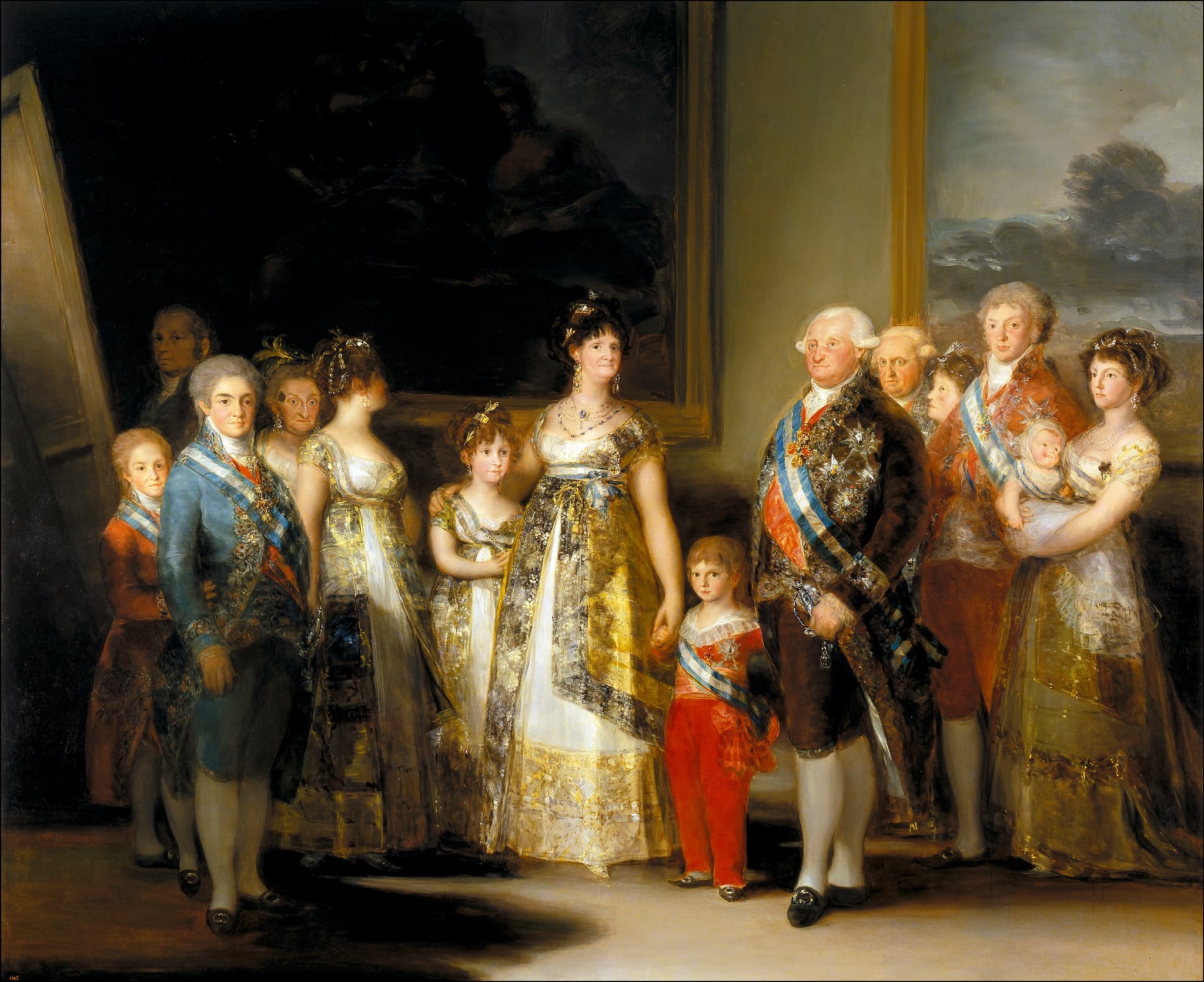
Charles IV of Spain and His Family is a canonical masterpiece by Francisco Goya, commissioned for the Spanish court and held by the Museo del Prado. Although inalienable and never market-traded, its hypothetical open‑market value is estimated at $150–300 million, reflecting its apex status within Goya’s oeuvre and the broader Old Master canon. This range assumes legal alienability and international competition.
Valuation Analysis
Work and status. Francisco Goya’s Charles IV of Spain and His Family (c. 1800–1801) is a career‑defining state portrait and one of the Prado’s signature holdings. Commissioned for the Spanish court, it entered the Royal Collection and is now in the Museo Nacional del Prado, Madrid, where it is part of Spain’s inalienable national patrimony [1][2][3]. As such, it is not a market‑traded object. This valuation models a hypothetical, internationally marketed sale.
Estimate and approach. We estimate $150–300 million, derived by extrapolating from artist‑ and category‑level benchmarks at the very top of the Old Master market. Goya’s current public auction record for paintings—$16.42 million for a pair of 1805 portraits—underscores scarcity rather than a ceiling for an apex, museum‑defining canvas [4]. Category comparables show established willingness to pay nine figures for universally recognized masterpieces: Botticelli’s Young Man Holding a Roundel achieved $92.2 million (2021) [5], while Leonardo’s Salvator Mundi realized $450.3 million (2017) [6]. Positioned between these poles, Goya’s royal family portrait, among his most famous works, supports a mid‑to‑high nine‑figure valuation.
Qualitative drivers. The painting stands at or near the apex of Goya’s public commissions, frequently discussed alongside Velázquez’s Las Meninas for its courtly choreography and psychological nuance. Its scale, ambition, and art‑historical centrality create a museum‑trophy premium distinct from typical portrait valuations. Market evidence tied directly to this composition—such as the 2024 sale of a preparatory study of the Infanta María Isabel—confirms active demand even for related works on a far smaller scale [7].
Supply, demand, and buyer base. True trophy‑caliber Goya oils are virtually unavailable; most reside in institutions. When major Old Masters with universal name recognition do appear, deep institutional and private demand coalesces, driving competition. Cross‑category trophy buyers (foundations, museums, and UHNW collectors) that pursued Botticelli and Leonardo would plausibly engage for this picture, applying a “national icon” premium given its status in Spain and global art history [5][6].
Assumptions and caveats. Our range assumes the work could be legally deaccessioned, exported, and offered in a marquee evening sale with full international participation. Under current Spanish law and the Prado’s statute, it is inalienable and not exportable, which in reality precludes a transaction and would depress price formation in any constrained scenario [3]. Insurance valuations, if disclosed, could reasonably exceed transactional expectations due to irreplaceability and state‑heritage considerations.
Key Valuation Factors
Art Historical Significance
High ImpactThis canvas is a cornerstone of Goya’s oeuvre and of European portraiture, often positioned in dialogue with Velázquez’s Las Meninas for its sophisticated orchestration of a ruling household and its meta‑pictorial awareness. It synthesizes Goya’s technical mastery with a psychologically acute reading of monarchy at the dawn of the 19th century, making it one of the most discussed and reproduced images in Spanish art. Such canonical status commands a museum‑trophy premium that pushes value well beyond the artist’s ordinary record, anchoring our estimate firmly in the nine‑figure range even before considering scarcity or market momentum.
Market Rarity and Supply
High ImpactApex Goya oils—large, fully realized masterpieces with unassailable provenance—rarely, if ever, reach the market; most are locked in institutions. The artist’s public auction record of $16.42 million for a strong but comparatively modest pair of portraits highlights the paucity of supply rather than demand limits. Even related studies for this royal family composition have drawn significant interest, signaling deep collector appetite across price tiers. In such a supply‑starved environment, an emblematic state portrait by Goya would trigger intense competition from the limited global pool of buyers able to transact at the top end, supporting nine‑figure pricing.
Legal/Patrimonial Constraints
High ImpactAs part of Spain’s national collections in the Museo del Prado, the painting is public property that is inalienable and non‑exportable under Spanish heritage law and the Prado’s statute. In practice, these constraints eliminate ordinary marketability. Our valuation therefore explicitly models a counterfactual: a legally permitted, internationally marketed sale with cross‑border bidding. If sale or export constraints remained, realized pricing would be materially lower, reflecting a restricted buyer pool and execution risk; conversely, insurance or indemnity values for state patrimony works often exceed transactional expectations due to irreplaceability and cultural‑heritage considerations.
Comparative Benchmarks and Scale
High ImpactCategory benchmarks establish the market’s readiness to pay for universally recognized Old Masters: Botticelli’s Roundel portrait sold for $92.2 million (2021), while Leonardo’s Salvator Mundi achieved $450.3 million (2017). Goya’s royal family portrait—monumental in scale (c. 280 × 336 cm), celebrated, and central to his legacy—sits between these poles. Its ambition and fame justify a premium above typical Old Master portraiture and well ahead of the artist’s own auction record, yet below the singularity of Leonardo. Together, these comparables, adjusted for stature and relevance, support a $150–300 million range for a fully globalized sale event.
Sale History
Charles IV of Spain and His Family has never been sold at public auction.
Francisco Goya's Market
Francisco Goya is a blue‑chip Old Master whose market is defined by extreme scarcity of important paintings and deep institutional and private demand. Strong portraits and genre scenes can reach many millions, while the current public auction record for a painting is $16.42 million (Christie’s New York, 2023) for a pair of 1805 portraits. Works on paper—drawings and complete first‑edition print series such as Los Caprichos and The Disasters of War—are more frequently traded, with top sets achieving mid‑six to seven figures. Market depth is international, with European and American buyers particularly active. For apex, museum‑grade oils, pricing must be extrapolated upward from limited precedents, reflecting trophy‑level competition when such works surface.
Comparable Sales
Portrait of Doña María Vicenta Barruso Valdés and Portrait of Doña Leonora Antonia Valdés de Barruso (pair)
Francisco Goya
Same artist; mature-period court portraits (1805) close in date to the Prado royal family portrait; current auction record for Goya paintings and best recent anchor for major Goya oils.
$16.4M
2023, Christie's New York
~$17.4M adjusted
Portrait-sketch of the Infanta María Isabel (study for La familia de Carlos IV)
Francisco Goya
Same artist and directly related to the target painting (a preparatory study for Charles IV and His Family). Offers a rare, concrete market datapoint tied to the composition and sitters.
$770K
2024, Dorotheum, Vienna
~$793K adjusted
Portrait of the young Duke of Alba (bust-length, c. 1783)
Francisco Goya
Same artist; aristocratic portrait from Goya’s earlier courtly phase, showing current demand for smaller, well‑provenanced Goya oils. Useful for scaling relative to apex state commissions.
$603K
2025, Dorotheum, Vienna
Young Man Holding a Roundel
Sandro Botticelli
Category benchmark: universally recognized Old Master portrait achieving nine figures. Calibrates trophy‑level demand for iconic, museum‑quality historical portraits.
$92.2M
2021, Sotheby's New York
~$109.7M adjusted
Salvator Mundi
Leonardo da Vinci
Ultimate Old Master trophy sale; shows the ceiling for uniquely important historical pictures. Serves as an upper‑bound market reference for cross‑category masterpieces.
$450.3M
2017, Christie's New York
~$594.4M adjusted
Rest on the Flight into Egypt
Titian
Record-setting Old Master sale in 2024; demonstrates robust, competitive bidding for canonical names. Useful category yardstick even if subject differs from a state portrait.
$22.2M
2024, Christie's London
~$22.8M adjusted
Current Market Trends
The Old Master market remains supply‑constrained at the top, but it continues to demonstrate strong appetite for universally recognized, museum‑quality pictures with ironclad provenance. High‑profile sales since 2017—including Leonardo’s Salvator Mundi and Botticelli’s Roundel portrait—reaffirm a deep, cross‑category buyer base for masterpieces. In this context, an apex Goya would likely attract broad institutional and UHNW interest. While portraits often price below religious or historical narratives, this composition’s fame, scale, and scholarly standing counteract that tendency, positioning it for a nine‑figure outcome in an unrestricted, internationally marketed sale.
Sources
- Museo del Prado – La familia de Carlos IV (object page, inv. P000726)
- Fundación Goya en Aragón – La familia de Carlos IV (provenance overview)
- Boletín Oficial del Estado – Real Decreto 433/2004 (Estatuto del Museo del Prado)
- Christie’s – Press release: Record Goya portraits, 25 Jan 2023
- Sotheby’s – Botticelli’s Young Man Holding a Roundel achieves $92.2m (2021)
- Christie’s – Press release: Leonardo da Vinci’s Salvator Mundi sells for $450.3m (2017)
- Dorotheum – Goya, Portrait-sketch of the Infanta María Isabel (study for La familia de Carlos IV), 24 Apr 2024