How Much Is The Third of May 1808 Worth?
Last updated: June 24, 2026
Quick Facts
- Methodology
- comparable analysis
Hypothetical open‑market value: $400 million–$1.0 billion (midpoint ≈$650 million). Goya’s The Third of May 1808 is a museum‑defining, globally canonical image that would command a record‑level Old Master price if ever freely tradable. It is Spanish state patrimony at the Prado and not legally deaccessionable or exportable; this valuation is for comparative/insurance purposes only.
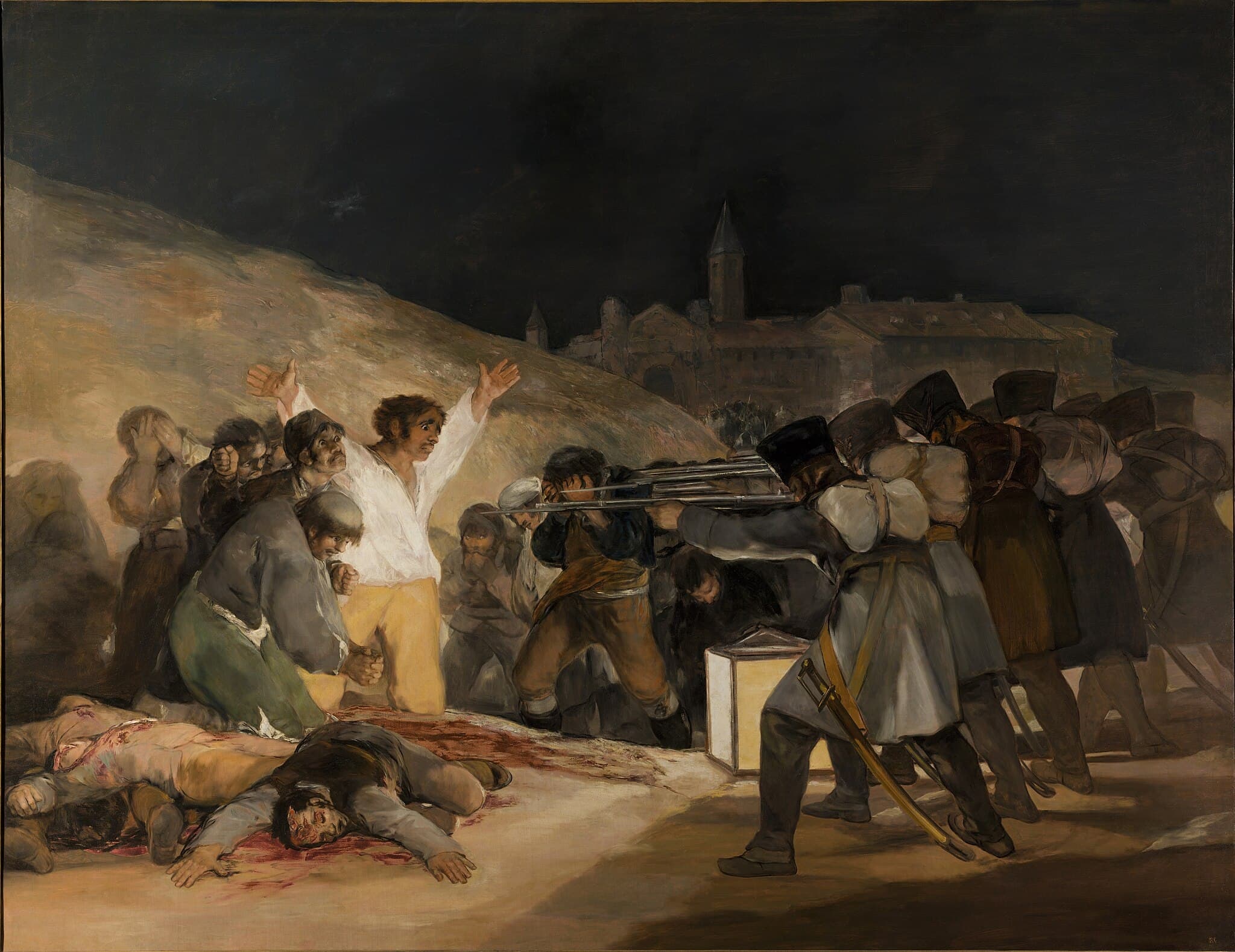
The Third of May 1808
Francisco Goya, 1814 • Oil on canvas
Read full analysis of The Third of May 1808 →Valuation Analysis
Conclusion: If offered without legal constraints and with global bidding, Francisco Goya’s The Third of May 1808 would warrant a record‑level Old Master price in the range of $400 million–$1.0 billion. The painting is a cornerstone of Western art, housed at the Museo Nacional del Prado, and was never privately traded; it remains Spanish state patrimony and is effectively inalienable and inexportable under Spanish law [1][2].
Method: This estimate is derived by comparable analysis against the established trophy ceiling for pre‑modern masterpieces and the painting’s singular status. Leonardo da Vinci’s Salvator Mundi set the modern auction apex at $450.3 million, demonstrating top‑end demand for a unique Old Master icon [3]. Botticelli’s Portrait of a Young Man Holding a Roundel achieved $92.2 million, evidencing nine‑figure depth for canonical pre‑19th‑century works in today’s market [4]. Rubens’s The Massacre of the Innocents long stood as a benchmark for large‑scale, violent history painting—a thematically proximate category—before the Leonardo reset [5].
Positioning within the oeuvre and art history: The Third of May 1808 is widely regarded as Goya’s most important painting—an early modern anti‑war manifesto whose formal and moral force directly shaped 19th‑ and 20th‑century history painting. Its universal resonance far exceeds the specificity of the Spanish subject, making it a museum‑defining image on par with the Prado’s greatest holdings [1]. While Goya’s published auction record for paintings (~$16.4 million in 2023 for two portraits) is modest, that figure reflects a near‑total absence of top‑tier masterpieces on the market rather than demand constraints; a singular, universally taught Goya of this magnitude would reset the artist’s price regime by orders of magnitude [6].
Range rationale: The lower bound ($400 million) recognizes the current Old Master trophy ceiling and the painting’s unmatched stature within Goya’s oeuvre. The midpoint (~$650 million) reflects upward pressure from extreme scarcity, cross‑category institutional demand, global recognition, and the picture’s foundational role in art history. The upper bound ($1.0 billion) captures potential competition among museums, sovereign buyers, and foundations were legal barriers hypothetically removed, alongside the sustained willingness of the market to stretch for singular, civilization‑level icons. Countervailing factors include thinner Old Master market depth relative to postwar/contemporary; however, the universality and iconicity of this image mitigate category headwinds.
Legal note: Spanish heritage statutes render state‑held national treasures effectively non‑marketable; any figure here is for comparative valuation, insurance, or indemnity planning only [2].
Key Valuation Factors
Art Historical Significance
High ImpactThis is arguably Goya’s most important painting and a foundational image of modern anti‑war consciousness. Its stark staging, moral clarity, and radical empathy paved the way for later history painting and politically charged modernism, resonating from Manet’s Execution of Maximilian to Picasso’s Guernica. The work is endlessly reproduced in textbooks and exhibitions, and it is a defining cultural icon of the Prado. This degree of canonical status materially elevates value by broadening the buyer universe to leading museums, cultural foundations, and nation‑state actors in any hypothetical sale context. Few Old Masters possess comparable fame, which supports pricing near the category’s absolute ceiling.
Cultural/Institutional Icon Status and Legal Constraints
High ImpactThe painting belongs to the Spanish state and is held by the Prado; under Spain’s heritage law, such works are non‑alienable and non‑exportable except under narrow, intra‑public transfers. This suppresses real‑world price discovery but simultaneously amplifies perceived scarcity and desirability. In a hypothetical scenario where legal barriers were removed, the pent‑up institutional and sovereign demand for an emblematic, museum‑defining image would likely produce an aggressive bidding environment. Conversely, the current legal framework means any valuation serves only as an insurance/indemnity benchmark rather than a forecast of an actual transaction.
Market Scarcity and Demand
High ImpactMasterpieces by Goya of this caliber almost never appear on the market; most are institutionalized. The artist’s published auction record for paintings is modest relative to modern and contemporary stars, but it reflects limited supply rather than constrained demand. For a universally taught, marquee‑quality icon, the relevant demand pool expands beyond traditional Old Master collectors to cross‑category trophy buyers, leading museums, and private foundations. This extreme scarcity paired with broad, global demand materially pushes the valuation toward the top of the Old Master spectrum.
Category Benchmarks and Trophy Ceiling
Medium_high ImpactThe modern auction ceiling for Old Masters was reset by Leonardo’s Salvator Mundi at $450.3 million, confirming that singular pre‑modern masterpieces can command postwar‑level prices. Additional nine‑figure evidence includes Botticelli’s $92.2 million portrait, while Rubens’s Massacre of the Innocents remains a touchstone for large, emotive history painting at scale. Against these markers, The Third of May 1808—given its fame, art‑historical weight, and subject—merits placement near the top of the category’s range, with reasonable upside should sovereign or institutional bidders compete.
Scale, Visual Impact, and Condition Considerations
Medium ImpactThe painting’s monumental scale and unforgettable composition—the anonymous firing squad confronting the illuminated martyr—deliver overwhelming gallery impact, a trait that commands premiums for museum centerpieces. While there is no recent public conservation report widely cited, any future insurance valuation or hypothetical sale would hinge on updated condition assessment (support, paint layer stability, past restorations). Given the work’s constant prominence at the Prado and sustained curatorial care, baseline expectations are strong; nonetheless, condition uncertainty is a moderating factor that keeps the estimate as a range rather than a single point.
Sale History
The Third of May 1808 has never been sold at public auction.
Francisco Goya's Market
Francisco Goya (1746–1828) is a blue‑chip Old Master whose market is characterized by extreme scarcity of high‑end paintings and steadily liquid demand for drawings and prints. The artist’s public auction record for paintings is $16.42 million (Christie’s, 2023, for two portraits), a figure shaped by the rarity of top‑tier works entering public sale rather than a cap on demand. Early impressions of the major print series (Caprichos, Disasters, Disparates, Tauromaquia) remain actively collected. For masterpieces, competition from institutions and foundations is decisive; the handful of museum‑grade Goyas that might surface privately would be expected to sell at a substantial premium to the artist’s historical auction benchmarks.
Comparable Sales
Salvator Mundi
Leonardo da Vinci
Category ceiling: a singular, museum-grade Old Master that established the modern auction record; frames the upper bound for an iconic pre‑modern masterpiece.
$450.3M
2017, Christie's New York
~$589.9M adjusted
Portrait of a Young Man Holding a Roundel
Sandro Botticelli
Top-tier Old Master trophy achieving a nine‑figure price in the current cycle; shows depth of demand for canonical pre‑19th‑century images.
$92.2M
2021, Sotheby's New York
~$109.7M adjusted
The Massacre of the Innocents
Peter Paul Rubens
Large‑scale, violent historical subject by a blue‑chip Old Master; thematically closest public auction analogue to Goya’s execution scene and long a benchmark before Leonardo.
$76.0M
2002, Sotheby's London
~$136.8M adjusted
Rest on the Flight into Egypt
Titian
Recent Renaissance master record (2024), evidencing renewed appetite for blue‑chip Old Masters; helps gauge current category liquidity and headroom.
$22.2M
2024, Christie's London
~$22.8M adjusted
Portrait of Doña María Vicenta Barruso Valdés; and Portrait of her mother Doña Leonora Antonia Valdés de Barruso
Francisco Goya
Same artist; current auction record for Goya paintings. Anchors the artist’s public market despite far lesser scale/subject than The Third of May.
$16.4M
2023, Christie's New York
~$17.4M adjusted
Portrait of the Marquis de Caballero, seated three‑quarter length
Francisco Goya
Same artist; strong portrait result that further illustrates the gap between routine Goya portraits and a singular, museum‑defining history painting.
$2.2M
2022, Sotheby's New York
~$2.4M adjusted
Current Market Trends
At the very top of the market, appetite for singular, museum‑grade works remains resilient even as overall art‑market volumes fluctuate. Old Masters transact less frequently than postwar/contemporary but have demonstrated the capacity for nine‑figure results when truly exceptional material appears. Category strength relies on connoisseurship, provenance clarity, and institutional demand; in this context, globally iconic images with cross‑cultural resonance can command prices near the trophy ceiling. Against these dynamics, a universally recognized Goya of paramount importance would attract deep, cross‑category bidding and price discovery at or above historic Old Master benchmarks.
Study print
Study this painting as a print
Pair the full artwork with a museum-style study sheet focused on one meaningful detail.

Sources
- Museo Nacional del Prado – The 3rd of May 1808 in Madrid (The Executions)
- Spanish Historical Heritage Law 16/1985 (BOE)
- The Guardian – Leonardo da Vinci painting Salvator Mundi sells for record $450m
- Sotheby’s – Marquee Masters sale achieves $114.5 million, led by Botticelli’s Portrait
- The Guardian – Rubens masterpiece sells for record £49.5m
- The Art Newspaper – Christie’s Old Masters: record-breaking Goya portraits