How Much Is Saturn Devouring His Son Worth?
Last updated: April 20, 2026
Quick Facts
- Methodology
- comparable analysis
Hypothetically, in a fully unconstrained international sale, Goya’s Saturn Devouring His Son would command approximately $120–180 million. This range extrapolates far above the artist’s auction record and triangulates against the apex of the Old Master market, while accounting for the work’s transferred-mural medium and condition.
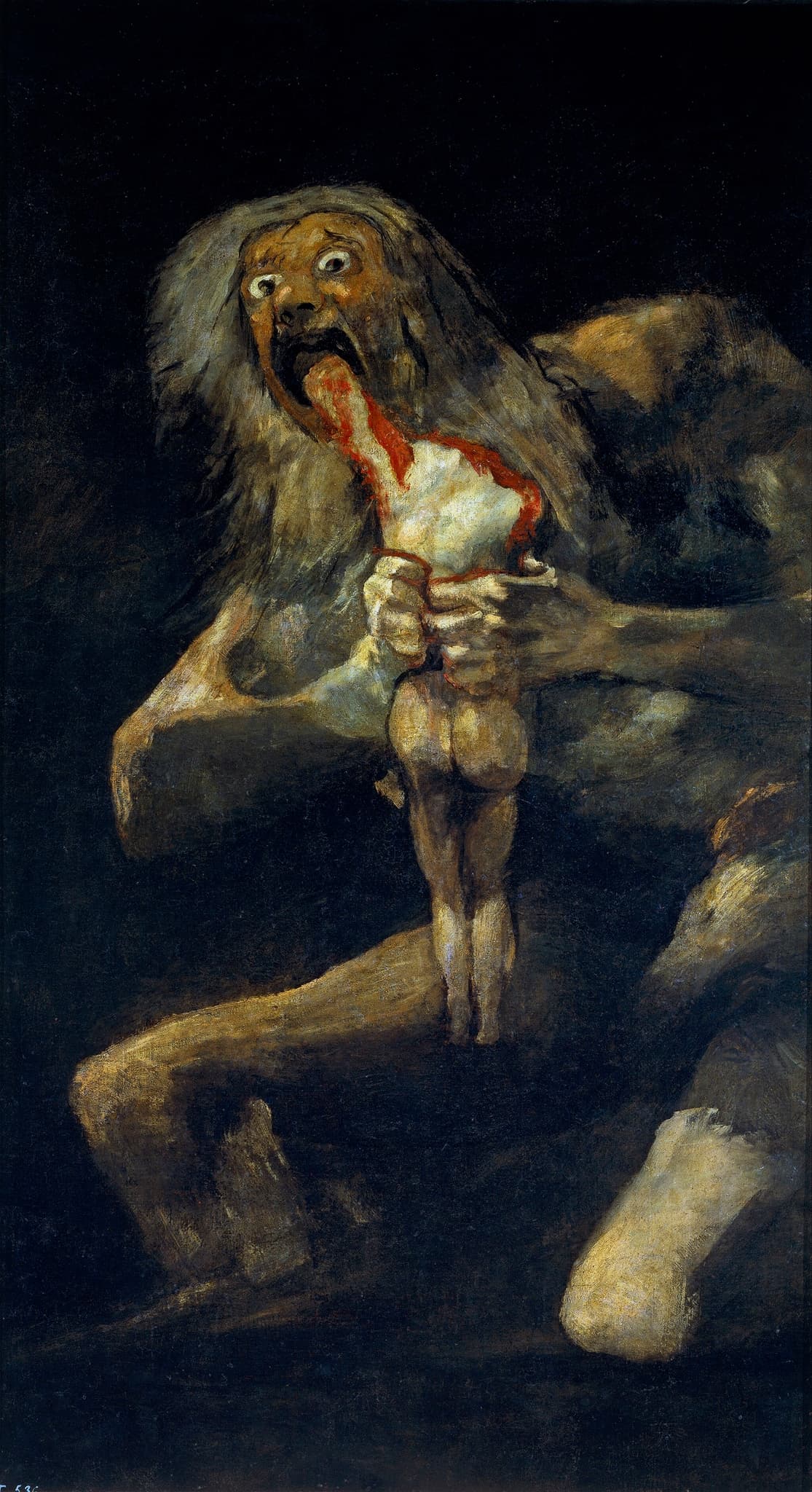
Saturn Devouring His Son
Francisco Goya, 1820–1823 • Mixed technique on plaster (mural), transferred to canvas; oil and pigments
Read full analysis of Saturn Devouring His Son →Valuation Analysis
Conclusion. In a hypothetical, fully unconstrained international sale (clear title, export permitted, marquee evening auction), Francisco Goya’s Saturn Devouring His Son would plausibly achieve $120–180 million. This bracket sits well above Goya’s market-tested auction record yet is grounded in apex Old Master comparables and the work’s singular cultural standing. By Spanish law and museum policy the painting is inalienable, so this is a theoretical market estimate; for insurance/indemnity, the same range provides a reasoned guidepost [1][2].
Comparables and triangulation. Direct same-artist comparables do not exist—no Black Painting is privately held—but Goya’s current auction peak is $16.4 million for a prime pair of portraits (Christie’s New York, 2023) [3]. For cross-artist anchors at the very top of the category, Botticelli’s Portrait of a Young Man Holding a Roundel realized $92.2 million (Sotheby’s New York, 2021) [4], and the Rijksmuseum/Louvre’s joint private acquisition of Rembrandt’s pendant portraits reached roughly €160 million (~$180 million) in 2016 [5]. Saturn’s estimate is positioned between these public and private apex references: above Botticelli’s public benchmark given Saturn’s 19th‑century modernity-defining status, yet broadly consistent with the Rembrandt private ceiling for uniquely canonical Old Masters.
Art-historical primacy. Saturn Devouring His Son is arguably Goya’s most iconic image and the emblem of the Black Paintings—works that anticipate modern expression and existential angst. Painted c. 1819–1823 on the walls of the Quinta del Sordo and transferred to canvas in 1874, it ranks at the absolute summit of the artist’s oeuvre and of 19th‑century painting more generally [1]. Its cultural ubiquity and scholarly centrality justify a valuation at the apex of the Old Master market despite the narrower ultra‑high‑end buyer pool relative to modern/contemporary art.
Condition and medium. The painting was executed as a mural on plaster and later detached and mounted to canvas, a process that the Prado acknowledges caused significant losses [1]. In most valuations this would moderate price. Here, the work’s canonical status and image-power decisively offset the medium/condition caveats; the estimate reflects a modest discount versus a theoretical price for an untransferred, pristine panel or canvas of equal celebrity.
Marketability and legal status. The painting belongs to the Spanish State (Museo del Prado) and is, by statute, inalienable; in practice, it is not for sale and rarely travels [2]. The valuation therefore functions as a theoretical auction estimate and a sensible range for insurance or state indemnity planning. On balance—weighting art-historical significance, extreme rarity, market precedents at the category’s top end, and condition—the $120–180 million range is a defensible synthesis.
Key Valuation Factors
Art Historical Significance
High ImpactSaturn Devouring His Son is a cornerstone of Western art and the emblematic image of Goya’s Black Paintings, which foreshadow modernism’s psychological intensity and existential themes. Within Goya’s oeuvre, it stands alongside (and arguably above) The Third of May 1808 and The Dog in terms of cultural resonance. Its persistent reproduction in scholarship and popular media has made it one of the world’s most recognizable Old Master images. This level of canonicity is an independent value driver at the nine‑figure tier, as buyers (including institutions and top private collectors) pay premiums for works that define an artist’s achievement and a broad art‑historical epoch.
Rarity and Market Comparables
High ImpactNo Black Painting resides in private hands, and there are no true like‑for‑like market comparables. Goya’s public auction record—$16.4m for a pair of portraits—reflects supply constraints rather than the ceiling for his absolute masterpieces. Cross‑artist anchors therefore matter: Botticelli’s $92.2m portrait demonstrates public auction depth for canonical Old Masters, while the Rembrandt pendant portraits’ €160m (~$180m) private sale shows institutional willingness to transact at mid‑nine figures for singular works. Saturn’s $120–180m bracket triangulates sensibly between these, assigning a premium for its iconic status yet acknowledging its medium/condition and the narrower ultra‑high‑end Old Master buyer universe.
Condition and Medium (Transferred Mural)
Medium ImpactPainted as a mural c. 1819–1823 and transferred to canvas in 1874, the work suffered documented paint losses and restorations during detachment. Such factors typically compress value versus pristine canvases or panels. Here, however, the image’s primacy and the work’s near‑mythic status outweigh the condition penalty. The valuation range embeds a conservative discount for medium/condition relative to equally iconic works on original supports. Put simply, while condition tempers the very top of the potential range, it does not dislodge Saturn from the apex band of Old Master valuations owing to its unrivaled cultural weight.
Provenance, Legal Status, and Marketability
High ImpactOwned by the Spanish State and housed at the Museo del Prado, the work is inalienable under the Prado’s statutory framework, effectively removing it from the market. This limits real-world saleability but is consistent with using a hypothetical estimate for planning and insurance. If legal/export constraints were lifted in a thought experiment, global demand, trophy competition, and the picture’s cultural status justify a mid‑nine‑figure range. Conversely, in any real scenario restricted to domestic transfer or state indemnity, the upper end could be constrained by practical buyer access rather than intrinsic value. The proposed range reconciles these dynamics.
Sale History
Saturn Devouring His Son has never been sold at public auction.
Francisco Goya's Market
Francisco Goya is a blue‑chip Old Master with extremely limited supply of major autograph paintings. His current auction record is $16.4 million for a pair of 1805 portraits sold at Christie’s New York in 2023, underscoring robust demand for high‑quality oils with strong narratives and provenance. Fully accepted drawings can reach seven figures, while the best early print sets (Caprichos, Desastres, Tauromaquia) often command mid‑five to mid‑six figures. Many of Goya’s greatest works are in museums and will not trade, so public prices understate the value of his most iconic images. As a result, valuations for singular, museum‑defining Goyas require upward extrapolation from record auction data and cross‑artist comparables.
Comparable Sales
Portrait of Doña María Vicenta Barruso Valdés; and Portrait of Doña Leonora Antonia Valdés de Barruso (pair)
Francisco Goya
Same artist; museum‑quality oils and current auction record for Goya. Calibrates top-of-market demand for autograph Goya paintings (albeit earlier, conventional portraits rather than late ‘Black Paintings’).
$16.4M
2023, Christie's New York
~$17.6M adjusted
Portrait of a Young Man Holding a Roundel
Sandro Botticelli
Marquee Old Master benchmark for a canonically famous, museum‑caliber portrait. Sets a modern, public nine‑figure reference point for pre‑modern masterpieces.
$92.2M
2021, Sotheby's New York
~$108.0M adjusted
The Massacre of the Innocents
Peter Paul Rubens
Category high‑water mark for a dramatic, large‑scale Baroque masterpiece. Useful for gauging what the market has paid for an iconic Old Master with visceral power akin to Goya’s ‘Black Paintings.’
$76.7M
2002, Sotheby's London
~$134.0M adjusted
Portraits of Maerten Soolmans and Oopjen Coppit (pair)
Rembrandt van Rijn
Top-tier private benchmark for canonical Old Masters acquired by major museums. Demonstrates that institutions will pay near‑two‑hundred‑million-level prices for singular, culturally pivotal works.
$180.0M
2016, Private sale (joint acquisition by Rijksmuseum and Louvre)
~$238.0M adjusted
Venice: The Grand Canal (record Canaletto)
Canaletto
Recent (2025) blue‑chip Old Master record in a robust market, evidencing current depth and global liquidity for top‑tier pre‑modern pictures even outside the very apex names.
$43.9M
2025, Christie's London
Current Market Trends
At the apex, the Old Master market has shown renewed depth since 2025–26, with strong marquee results for fresh, canonical works and competitive institutional/private bidding. Supply remains thin, creating polarized demand that rewards the very best names and images while leaving middling material behind. Public benchmarks like Botticelli’s $92.2m portrait and major private transactions (e.g., Rembrandt’s pendant portraits to the Louvre/Rijksmuseum) illustrate a low‑ to mid‑nine‑figure ceiling for masterpieces with global recognition. Against this backdrop, uniquely iconic, museum‑grade pictures—despite condition caveats—can justify nine‑figure valuations in hypothetical, unconstrained scenarios.
Study print
Study this painting as a print
Pair the full artwork with a museum-style study sheet focused on one meaningful detail.
Sources
- Museo del Prado – Saturn Devouring His Son
- Real Decreto 433/2004 (Estatuto del Museo Nacional del Prado)
- The Art Newspaper – Christie's Old Masters sale sets Goya record
- Sotheby’s – Botticelli portrait achieves $92.2m in New York
- The New York Times – Louvre and Rijksmuseum buy Rembrandts for €160 million