How Much Is The Disasters of War (Plate 44: Yo lo vi) Worth?
Last updated: June 4, 2026
Quick Facts
- Insurance Value
- $12K (Replacement cost at high retail for later editions; based on dealer asks and auction comparables [2][3][5])
- Methodology
- comparable analysis
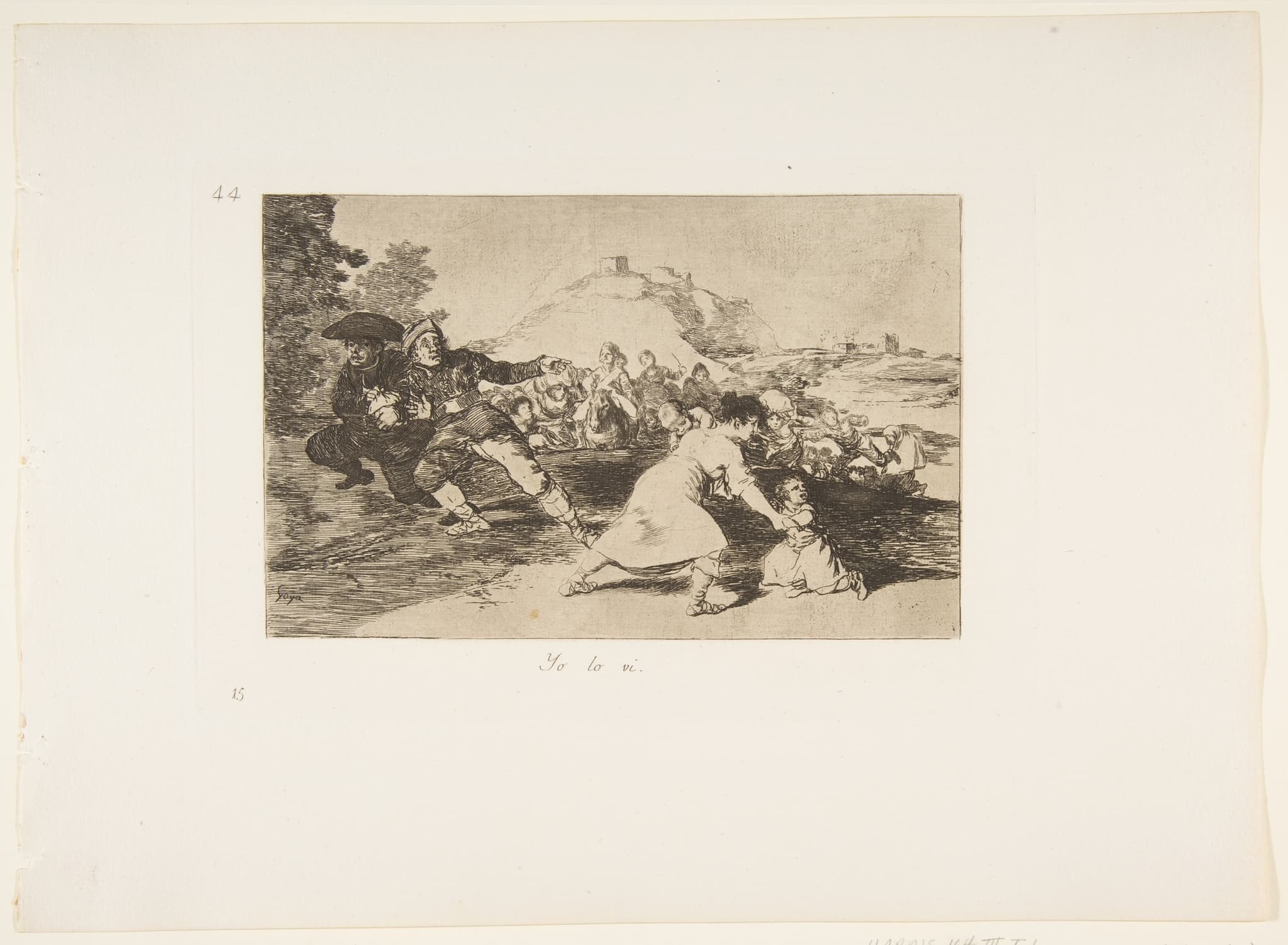
Fair market value for a single-plate impression of Goya’s The Disasters of War, Plate 44: Yo lo vi is estimated at $4,000–9,000, assuming a later 19th-/early 20th-century posthumous edition in very good condition with full margins. If confirmed as a first-edition (1863) impression with strong tone and condition, value rises materially to roughly $30,000–80,000. Edition, watermark, margins, and condition are determinative.
Valuation Analysis
Work and significance. Yo lo vi (I saw it) is Plate 44 of Goya’s seminal Los desastres de la guerra, etched circa 1810–20 and first published posthumously in 1863. Multiple impressions are held by major museums, underscoring the plate’s canonical status within the series and Western printmaking at large [1]. While respected, Plate 44 is not among the handful of most iconic images of the set, so pricing tracks edition, impression quality, and condition more than plate-specific fame.
How this estimate was derived. The $4,000–9,000 range reflects recent market behavior for single-plate impressions from later 19th-/early 20th-century editions in good condition. Retail asks for 4th-edition examples cluster in the low four figures (e.g., a 4th edition offered around $3,000), and competitive auction outcomes for later editions typically sit in the low four to low five figures depending on margins and freshness [3]. Positioning mid-range at $4,000–9,000 provides a realistic fair-market window for a clean, full-margined later edition, with upside if inking and paper are above average.
First-edition and proof premiums. If your impression proves to be a first edition (Real Academia, 1863) with full margins and a rich aquatint surface, the market supports a substantially higher valuation—approximately $30,000–80,000 for strong singles, with exceptional examples higher. Ultra-rare working or trial proofs can command high five figures or more; for example, a pre-publication trial proof of Plate 44 carried a CHF 45,000 estimate at Kornfeld, reflecting the scarcity premium attached to early states [2]. Robust demand for top-tier Goya prints is reinforced by strong results for complete early sets (e.g., Caprichos), which signal collector appetite for best-in-class impressions [5].
Determinants of value. Edition and state (Harris), paper and watermark, margins, condition, and inking are decisive. First editions typically appear on fine laid papers consistent with the 1863 issue; later editions differ. Full margins, minimal foxing/staining, crisp plate edges, and intact aquatint grain lift value; trimming, repairs, paper discoloration, and worn aquatint depress it. Watermark identification and precise measurements matched to the catalogue raisonné will solidify edition and narrow the value band [1].
Market positioning. Goya’s top-tier market strength across media—eight-figure paintings and seven-figure drawings—supports sustained demand for significant prints. Within that context, a fine Yo lo vi impression prices as a desirable but not trophy plate: compelling for connoisseurs of the series and Old Master prints, and highly sensitive to edition and condition. This valuation takes a prudent, comps-led view anchored to transparent retail and auction benchmarks for single-plate Desastres impressions and series-adjacent signals of demand [2–5].
Key Valuation Factors
Edition, State, and Impression Quality
High ImpactEdition is the single biggest value driver for Yo lo vi. First-edition (1863) impressions printed by the Real Academia are scarcer, typically exhibit richer aquatint tone and finer paper, and trade at multiples of later editions. Within any edition, impression quality matters: crisp plate edges, strong aquatint grain, and intentional plate tone elevate desirability, as do clean, evenly inked passages without muddiness or wear. Rare pre-publication proofs and early working states command significant premiums due to extreme scarcity and their importance to scholarship. To fix edition and state with confidence, match platemark and sheet dimensions to the catalogue raisonné and inspect the paper for the correct watermark(s); this step can shift value from low four figures to high five figures or more.
Condition and Margins
High ImpactCondition can amplify or halve value. Full, untrimmed margins are prized; trimming into or near the platemark materially reduces desirability. Foxing, staining, toning, scuffs, creases, tears, and restorations all weigh against price, particularly if they encroach on the image. For aquatint prints such as Desastres, retention of the grain and subtle tonal passages is critical: plate wear or plate rework that dulls these effects lowers appeal. A fresh, well-preserved sheet with full margins, minimal discoloration, and no structural repairs will sit toward the top of the range; conversely, condition issues or evident plate wear will push the work to the lower end or below.
Provenance, Documentation, and Institutional Context
Medium ImpactNamed provenance (distinguished private collections, curators, or trustees), exhibition history, and literature citations can produce meaningful premiums by reducing attribution risk and boosting confidence. Works traced through reputable dealers and auction houses with detailed condition reports typically transact faster and stronger. While Yo lo vi is widely represented in major museums, institutional holdings primarily validate the series’ art-historical importance rather than directly inflating price for a single impression. That said, an impression tied to a notable scholar or collection—particularly for early or proof states—can see outsized competition at auction due to connoisseur interest and the comparative scarcity of such examples.
Plate-Specific Desirability Within the Series
Medium ImpactWithin Los desastres de la guerra, a handful of images are especially iconic and may attract broader demand. Plate 44, Yo lo vi, is respected—its caption ‘I saw it’ reinforces the eyewitness gravity of the series—but it is not typically the single most sought-after image. As a result, plate-specific premiums tend to be modest compared with the stronger role played by edition, impression, and condition. Collectors who aim for representative selections or full runs will still prize the plate, and a particularly fine early impression can command strong competition, but pricing for Yo lo vi generally follows the edition/condition hierarchy rather than exceptional plate-level fame.
Sale History
The Disasters of War (Plate 44: Yo lo vi) has never been sold at public auction.
Francisco Goya's Market
Francisco Goya remains a blue-chip Old Master with deep cross-category demand. At the top of the market, paintings have achieved eight-figure prices; notably, Christie’s set the artist’s auction record at $16.42 million in January 2023 for a pair of portraits, underscoring sustained appetite for masterworks. Significant drawings routinely command six to seven figures when fresh and well documented. In prints, complete early sets of the major series (Caprichos, Desastres, Disparates, Tauromaquia) and exceptional early impressions continue to attract international bidders, with standout results for top-quality portfolios in late 2025 signaling healthy demand. Individual plates price primarily by edition, impression, and condition; strong first-edition singles trade in the mid- to high-five figures, while later editions provide accessible entry points for collectors.
Comparable Sales
Los desastres de la guerra, Plate 44: Yo lo vi (trial proof; Harris 164/I/1 of III/7)
Francisco Goya
Exact plate and ultra‑rare pre‑publication state; directly informs the high end for Plate 44. Estimate CHF 45,000 (~$49,000) cited; realized price not publicly posted. More significant than a standard 1863 first‑edition impression due to rarity and proof status.
Price unknown
2025, Galerie Kornfeld, Bern
Los desastres de la guerra (complete set, first edition, issue 1b)
Francisco Goya
Same series and medium; portfolio‑level benchmark close in time. While a complete set is not a single‑plate comp, it anchors 2025 demand and pricing context for early impressions.
$32K
2025, Il Ponte, Milan (Auction 724)
Los desastres de la guerra (set/portfolio lot; edition not specified in recap)
Francisco Goya
Same series and medium; a top Desastres lot from late 2025 reported at £50,800 (fees incl.) provides a portfolio‑level comp for market strength at year‑end 2025.
$65K
2025, Sotheby's London, Old Master Prints
Los caprichos (complete early set)
Francisco Goya
Same artist and printmaking practice (etching/aquatint), complete early set. Though a different series, it’s the clearest late‑2025 benchmark for top‑tier Goya print portfolios and underscores premiums for early, choice impressions.
$474K
2025, Sotheby's London, Old Master Prints
Capricho: “La Filiación” (single plate; ex‑Ceausescu provenance)
Francisco Goya
Same artist and medium; single‑plate auction result with notable provenance in late 2025. While from Caprichos (not Desastres), it is a plate‑level datapoint for what individual Goya etching/aquatints can command.
$20K
2025, Artmark (A10), Bucharest
Current Market Trends
Old Master prints remain active and globally collected, with buyers highly selective and quality-sensitive. From 2024 into 2025, supply scarcity at the top end tempered total auction volumes, yet best-in-class works and early, choice impressions performed strongly when offered. Within Goya’s print oeuvre, early or proof impressions and complete early sets drew robust competition, while later editions were price-sensitive but liquid at transparent four-figure levels. The market rewards clear edition attribution (watermarks, measurements), fresh-to-market provenance, and outstanding condition. In this environment, a well-preserved Yo lo vi priced to its edition and quality should find ready buyers, with material upside if confirmed as a first edition or an unusually rich impression.
Sources
- The Metropolitan Museum of Art – Los desastres de la guerra, Plate 44: Yo lo vi
- Galerie Kornfeld – Goya, Yo lo vi (trial proof) listing and estimate
- Spaightwood Galleries – Goya, Desastres (Plate 44, 4th edition) retail listing
- Christie’s Press – Old Masters sales (January 2023) and Goya record
- HENI News – Sotheby’s Old Master Prints (December 2025) highlights