How Much Is The Two Fridas Worth?
Last updated: February 15, 2026
Quick Facts
- Last Sale
- $825 (1947, Instituto Nacional de Bellas Artes (INBA), Mexico City — direct institutional purchase from the artist)
- Methodology
- extrapolation
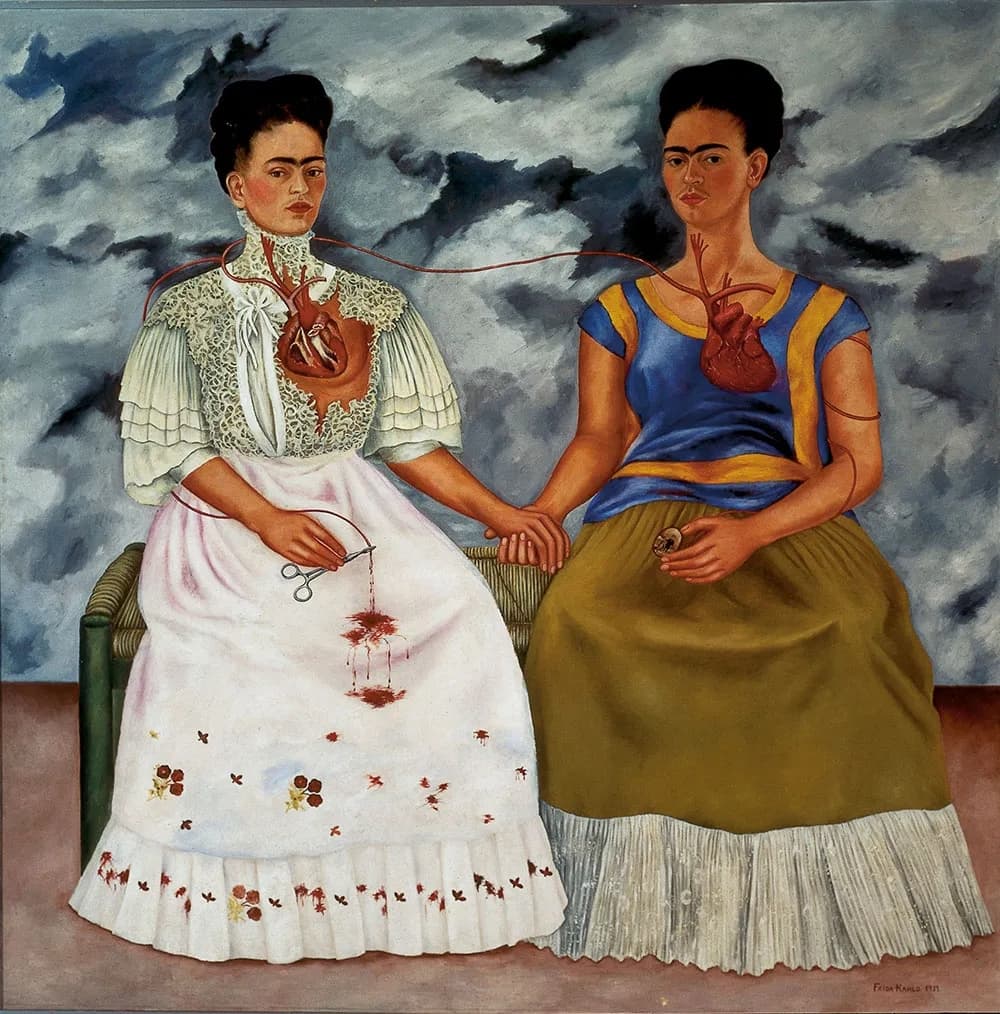
We estimate The Two Fridas (1939) at $180–240 million in a freely marketable, international sale. This reflects its status as Kahlo’s signature, large‑scale masterpiece and a cultural icon, warranting a multiple of the artist’s $54.7 million auction record. In practice, the work is Mexican national patrimony and not for sale; any valuation is necessarily hypothetical.
Valuation Analysis
Estimate: $180–240 million (hypothetical, if legally deaccessionable and freely exportable). This value reflects The Two Fridas’ singular place in Frida Kahlo’s oeuvre—arguably her most famous painting—and its outsized cultural resonance. It is a canonical double self‑portrait of exceptional scale and art‑historical impact, qualities that now command nine‑figure pricing in the ultra‑trophy segment.
Market anchors and upward extrapolation: The top of Kahlo’s public market was reset in November 2025, when El sueño (La cama) (1940) sold for $54.7 million at Sotheby’s, establishing a new record for the artist and for any woman at auction [1]. The Two Fridas (1939) is more iconic, larger, and more central to Kahlo’s narrative than any work that has reached the market. In today’s trophy environment—where era‑defining masterpieces by canonical 20th‑century artists routinely achieve nine figures (e.g., Klimt at ~$236 million in 2025) [4]—a step‑change multiple over Kahlo’s record is justified. Our $180–240 million range positions the work alongside globally recognized cultural touchstones.
Rarity, demand, and supply constraints: Blue‑chip Kahlo oils are vanishingly scarce at auction, and institutional ownership dominates. The 2025 record demonstrated deep cross‑category demand for prime, autobiographical Kahlo paintings, with guarantees and active competition supporting pricing [1]. The Two Fridas combines the most coveted attributes—authorship, subject, and scale—making it the single most attractive Kahlo that could conceivably trade. On a pure market basis, this scarcity premium is decisive.
Ownership and legal framework: The painting is a cornerstone of Mexico’s Museo de Arte Moderno (INBAL/MAM). Kahlo’s oeuvre is protected as “Monumento Artístico,” subjecting works to stringent export controls that, in practice, remove them from normal commercial circulation [2]. This valuation therefore assumes a counterfactual scenario in which sale and international circulation are permitted. If a transaction were constrained to remain in Mexico or within a restricted framework, practical fair‑market value would be materially lower due to a narrower buyer pool and legal friction.
Provenance and condition notes: The work was purchased directly from Kahlo by Mexico’s Instituto Nacional de Bellas Artes in 1947 for 4,000 pesos (≈$825 at the official parity), a landmark lifetime sale reflecting early institutional recognition [3]. As with any nine‑figure valuation, a current condition and conservation dossier would be prerequisite; our range assumes stable, museum‑kept condition consistent with its status. In sum, on art‑historical importance, market momentum, and trophy comparables, The Two Fridas supports a confident $180–240 million estimate.
Key Valuation Factors
Art Historical Significance
High ImpactThe Two Fridas is widely regarded as Kahlo’s signature work: a monumental double self‑portrait that crystallizes her themes of identity, duality, and personal mythology. It is among her largest canvases and one of the most reproduced images of 20th‑century art. Within the artist’s canon it consistently ranks at the very top for scholarly importance and public recognition, shaping the global image of Kahlo as both painter and cultural icon. Works of this emblematic status occupy a rare echelon where art‑historical weight exerts an outsized pricing effect, particularly in the current “trophy” market. The painting’s interpretive centrality to Kahlo studies and its enduring popular resonance create a sustained, global demand premium.
Rarity and Supply Constraints
High ImpactMajor Kahlo oils are exceedingly scarce on the open market, with museum holdings and patrimony protections keeping supply tightly constrained. The 2025 record for a prime 1940 oil underscored deep, cross‑category demand for top Kahlo works despite low turnover. The Two Fridas is not merely rare—it is the single most coveted Kahlo that could theoretically trade, combining authorship, date, scale, and image recognition. Scarcity premiums at the top of the market are non‑linear: when an artist’s most iconic image is potentially available, bidders bid for cultural primacy as much as for the object, pushing prices to multiples of prior records. This structural scarcity is a primary driver of the $180–240 million range.
Scale, Imagery, and Condition Assumptions
High ImpactScale and image matter profoundly in pricing. The Two Fridas’ large format and indelible double self‑portrait imagery set it apart from smaller, later self‑portraits that have set records to date. The composition’s psychological complexity, technical control, and instant recognizability position it squarely in the ultra‑trophy tier where nine‑figure prices are now common. Our valuation assumes stable, museum‑level condition in line with its continuous institutional care; at this level, a current conservation report and technical imaging would be required to confirm no material issues that would impair value. Assuming such confirmation, the painting’s scale and iconic imagery justify a substantial multiple over Kahlo’s current auction record.
Provenance, Institutional Status, and Legal Context
High ImpactThe painting’s direct sale from Kahlo to Mexico’s INBA in 1947 confers impeccable provenance and unbroken institutional care, both value‑positive signals at the top end. However, its status as part of Mexico’s national patrimony and Kahlo’s designation as a “Monumento Artístico” introduce export restrictions that, in practice, remove the work from normal market circulation. Our figure is therefore explicitly hypothetical and assumes a legal pathway to deaccession and free international sale. In a constrained scenario—e.g., required retention in Mexico or limitations on export/resale—the effective pool of buyers shrinks and legal friction increases, implying a materially lower practical fair‑market value than our headline range despite the same art‑historical merits.
Sale History
Instituto Nacional de Bellas Artes (INBA), Mexico City (direct purchase)
Institutional acquisition from the artist for 4,000 Mexican pesos (plus 36 pesos for the frame); US$ figure shown at the 1947 official parity of MXN 4.85 = US$1. Date approximate; not an auction.
Frida Kahlo's Market
Frida Kahlo sits at the apex of Latin American Modernism and among the most coveted 20th‑century artists globally. Her market is defined by extreme scarcity of major oils, deep cross‑category demand, and strong institutional participation. Prices have accelerated at the top: Diego y yo (1949) achieved $34.9 million in 2021, and El sueño (La cama) (1940) reset the artist and female‑artist auction record at $54.7 million in 2025. Works on paper and rarer media (e.g., fresco) provide liquidity in the six‑ to low‑eight‑figure range, but the market’s true power concentrates in autobiographical oil paintings from the late 1930s–40s. When pivotal works emerge, houses employ guarantees and global marketing, producing highly competitive bidding.
Comparable Sales
El sueño (La cama) [The Dream (The Bed)]
Frida Kahlo
Same artist; painted one year after The Two Fridas; major, autobiographical Surrealist oil; current auction record that anchors top-of-market demand for prime Kahlo paintings.
$54.7M
2025, Sotheby's New York
Diego y yo (Diego and I)
Frida Kahlo
Same artist; iconic late-1940s self‑portrait—core autobiographical subject matter; former record that demonstrates trophy pricing for smaller Kahlo oils.
$34.9M
2021, Sotheby's New York
~$40.9M adjusted
Dos desnudos en el bosque (La tierra misma) [Two Nudes in a Forest (The Earth Itself)]
Frida Kahlo
Same artist; same year (1939) as The Two Fridas; intimate Surrealist double‑figure composition probing identity—highly relevant thematically and chronologically.
$8.0M
2016, Christie's New York
~$10.6M adjusted
Roots
Frida Kahlo
Same artist; prime‑period 1940s Surrealist/autobiographical painting and former auction record—useful longer‑term market anchor for major Kahlo oils.
$5.6M
2006, Sotheby's New York
~$8.9M adjusted
Autorretrato. Muy feo (Self‑Portrait. Very Ugly)
Frida Kahlo
Same artist; self‑portrait subject central to Kahlo’s market; earlier 1930s work showing demand for autobiographical images (different medium: fresco, so slightly less direct as a comp).
$8.6M
2022, Christie's New York
~$9.4M adjusted
Current Market Trends
The Surrealism centenary (2024–26) and a reassessment of women artists have concentrated global demand at the top of the Modern/Surrealist market. Dedicated Surrealism evening sales have delivered white‑glove results, and multiple records for women Surrealists (Kahlo, Carrington, Tanning) signal broad, international depth. Trophy pricing remains resilient even as the wider market is selective: blue‑chip, museum‑quality works with impeccable provenance command premiums, often supported by irrevocable bids. Within this context, culturally defining icons—especially from underrepresented canons—are achieving non‑linear price jumps, aligning with nine‑figure outcomes seen for era‑defining Modern masterpieces. Supply remains the limiting factor, reinforcing scarcity premiums when true icons surface.
Study print
Study this painting as a print
Pair the full artwork with a museum-style study sheet focused on one meaningful detail.
Sources
- The Art Newspaper — Frida Kahlo sets new auction record at Sotheby’s (Nov 21, 2025)
- INBAL — El INBAL da seguimiento a la subasta… (Monumento Artístico/export restrictions)
- Los Angeles Times (en español) — Carlos Chávez… y Frida Kahlo (on 4,000‑peso 1947 purchase)
- Sotheby’s — The New York Sales, November 2025: Breuer Results (includes Klimt trophy result)