How Much Is The Broken Column Worth?
Last updated: February 16, 2026
Quick Facts
- Methodology
- comparable analysis
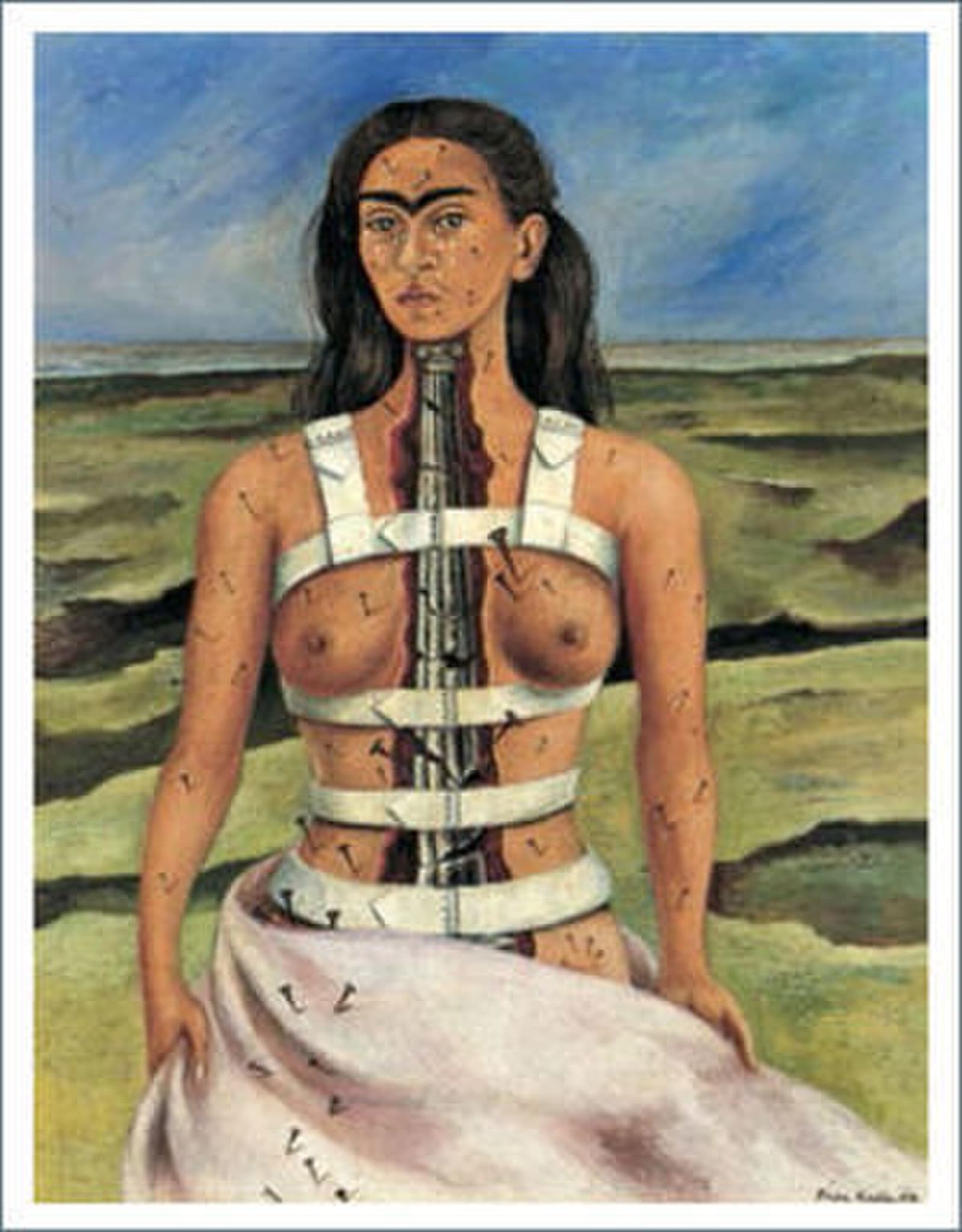
Under internationally accessible, marquee-auction conditions, Frida Kahlo’s The Broken Column (1944) is estimated at $100–150 million. This range extrapolates from Kahlo’s 2025 auction record and applies a substantial trophy premium to a work widely regarded as one of the artist’s most iconic self-portraits.
Valuation Analysis
Estimate: $100–150 million (USD). This valuation synthesizes recent top-end auction benchmarks for Frida Kahlo, the work’s singular art-historical stature, and current demand dynamics for Surrealism and Latin American Modernism at the marquee level. The range represents what the painting could achieve under ideal conditions—global marketing, a prime evening-sale slot, and robust third‑party support—with international bidding access.
Work significance. The Broken Column (1944) is a canonical Kahlo self‑portrait and among her most reproduced images, distilling the central themes of pain, bodily trauma, and resilience that define her oeuvre. Painted in oil on masonite at an intimate scale (approx. 39.8 × 30.6 cm), its art‑historical and cultural resonance places it in the artist’s top tier alongside The Two Fridas and a handful of other masterworks. The painting is museum‑held at the Museo Dolores Olmedo, Mexico City, and has no public auction history, underscoring its rarity in the marketplace [3].
Market comparables and extrapolation. Kahlo’s auction market has reset materially at the top end: El sueño (La cama) realized $54.66 million with fees at Sotheby’s New York in November 2025, establishing a new peak for the artist and setting the auction record for any woman artist [1]. The prior high was $34.88 million for Diego y yo in 2021, also at Sotheby’s [2]. While neither sold work matches The Broken Column in art‑historical centrality, they anchor a step‑change in pricing for blue‑chip Kahlo paintings. Cross‑category momentum for women Surrealists—exemplified by Leonora Carrington’s $28.5 million record in 2024—further supports heightened demand for the very best Surrealist icons [5].
Trophy premium and scarcity. Supply of masterpiece‑level Kahlo paintings is exceptionally scarce, particularly those held by institutions. For a work of this cultural magnitude—arguably top five in the oeuvre—a pronounced trophy premium over the 2025 record is warranted. In a marquee evening sale with global previews and an irrevocable bid, we would expect deep competition from international collectors and institutions, pushing pricing into the low‑to‑mid nine figures.
Constraints and execution risks. Mexico’s 1984 decree designates all Kahlo works as Artistic Monuments, and authorities do not authorize definitive export; only temporary export may be possible [4]. A sale restricted to Mexico would narrow the buyer base and could compress the realized price versus a fully international offering. Additionally, while the painting’s moderate scale does not diminish its status, independent condition due diligence is recommended for works on masonite.
Conclusion. Balancing unmatched art‑historical significance with current market evidence and recognizing legal/export constraints, a confident, globally accessible sale framework should support $100–150 million for The Broken Column, with potential to outperform at the top of the range if competitive tension materializes.
Key Valuation Factors
Art Historical Significance
High ImpactThe Broken Column is a touchstone of Kahlo’s oeuvre and one of the most cited self‑portraits in 20th‑century art. It condenses her defining themes—physical pain, psychological endurance, and identity—into an unforgettable image that anchors the scholarship surrounding her work. Within Kahlo’s corpus, only a very small handful of paintings rival its centrality (e.g., The Two Fridas). Works at this level command a meaningful premium because they are the ones reproduced in textbooks, featured in major retrospectives, and used by museums to articulate the artist’s legacy. That deep, cross‑cultural recognition translates directly to demand at the pinnacle of the market, where collectors prize art‑historical inevitability over everything else.
Iconicity and Cultural Impact
High ImpactBeyond art history, The Broken Column operates as a global cultural icon. Its imagery has been widely reproduced in exhibitions, scholarship, and popular media, making it instantly legible to broad audiences. This recognizability enhances its trophy appeal: buyers at the nine‑figure level often prioritize works that serve as definitive emblems of an artist’s vision. The painting’s narrative of resilience and embodiment resonates across generations and geographies, expanding the pool of potential bidders to include institutional patrons, collectors with ties to Mexico and Latin America, and global buyers seeking universally recognized masterpieces. Such transcendent visibility justifies a significant premium over even strong same‑artist comparables.
Market Comps and Trophy Premium
High ImpactKahlo’s market has recalibrated at the top: El sueño (La cama) achieved $54.66m with fees at Sotheby’s in 2025, eclipsing the prior 2021 high of $34.88m for Diego y yo. These results confirm deep, global demand for blue‑chip Kahlo paintings and signal headroom for the very best works. Cross‑category momentum in women Surrealists (e.g., Carrington’s $28.5m record) reinforces a supportive backdrop for Kahlo’s icons. Given The Broken Column’s superior art‑historical weight relative to the sold comparables, a substantial trophy premium is appropriate. The $100–150m range extrapolates directly from these anchors, assuming a marquee evening sale with global previews and third‑party underwriting to catalyze competitive bidding.
Legal/Export Constraints and Execution
Medium ImpactMexico’s 1984 designation of all Kahlo works as Artistic Monuments materially affects market logistics by restricting definitive export from Mexico and placing oversight with cultural authorities. While temporary export for exhibition is sometimes permitted, a transaction requiring delivery within Mexico could narrow the effective buyer pool and temper price discovery compared with an internationally accessible sale. This factor is execution‑dependent: the right legal structure, venue, and guarantee can mitigate constraints, but uncertainty around export can still influence bidder confidence and limit participation. Accordingly, while we ascribe a medium impact to this risk, it is reflected in the range and underscores the importance of sale strategy to realize the estimate.
Sale History
The Broken Column has never been sold at public auction.
Frida Kahlo's Market
Frida Kahlo’s market sits among the strongest in Modern art, defined by extreme scarcity of museum‑caliber paintings and intense global demand. A new auction record was set in November 2025 when El sueño (La cama) realized $54.66 million with fees at Sotheby’s New York, surpassing the prior $34.88 million record for Diego y yo in 2021. Supply constraints are structural—many masterpieces are institutionally held and Mexico’s cultural patrimony protections restrict definitive export—so when significant works surface, competition is fierce and often pre‑underwritten. The confluence of expanded interest in women artists, the renewed focus on Surrealism, and the broad cultural resonance of Kahlo’s imagery continues to support upward pressure on pricing for her top‑tier works.
Comparable Sales
El sueño (La cama)
Frida Kahlo
Same artist; canonical 1940 Surrealist oil with strong autobiographical content; rare trophy-level Kahlo painting to appear recently; closest market signal for a museum-caliber masterpiece.
$54.7M
2025, Sotheby's New York
Diego y yo (Diego and I)
Frida Kahlo
Same artist; intimate late self-portrait (1949); high-profile, museum-validated image and prior auction record before 2025; close in subject/format to The Broken Column’s iconic self-portraiture.
$34.9M
2021, Sotheby's New York
~$41.2M adjusted
Dos desnudos en el bosque (La tierra misma)
Frida Kahlo
Same artist; 1939 Surrealist oil from core period; intimate scale and iconic subject matter (though not a self-portrait); useful historical benchmark for major pre-2020 Kahlo pricing.
$8.0M
2016, Christie's New York
~$10.7M adjusted
Roots
Frida Kahlo
Same artist; 1943 oil closely contemporaneous with The Broken Column (1944); emblematic Surrealist imagery; long-standing historical comp showing trophy interest in mid-2000s.
$5.6M
2006, Sotheby's New York
~$8.9M adjusted
Les Distractions de Dagobert
Leonora Carrington
Cross-artist market anchor within women Surrealists; 1945 oil and new artist record; helps bracket broader Surrealism demand when Kahlo supply is scarce.
$28.5M
2024, Sotheby's New York
~$29.4M adjusted
Current Market Trends
The upper tier of the Modern market has pivoted toward historically validated, scarcity‑driven material, with Surrealism—especially women artists—showing outsized momentum. The 2024–2025 cycle saw multiple records, curated evening sales for Surrealism, and heavy use of guarantees, all of which concentrate bidder demand on a handful of trophy lots. Cross‑category buyers increasingly prioritize canonical images with global recognition, while institutional interest remains strong. In this context, a masterpiece‑level Kahlo benefits from both category momentum and near‑zero supply, supporting nine‑figure pricing when presented with international access and best‑in‑class sale execution.
Study print
Study this painting as a print
Pair the full artwork with a museum-style study sheet focused on one meaningful detail.
Sources
- The Art Newspaper – Frida Kahlo sets new auction record, Nov 2025
- TheValue – Frida Kahlo, Diego y yo (2021 Sotheby’s record)
- Wikipedia – The Broken Column (work entry; location and details)
- UAM – 1984 Decree declaring Frida Kahlo’s works Artistic Monuments (export framework)
- The Guardian – Leonora Carrington record price, May 2024