How Much Is Oriental Poppies Worth?
Last updated: May 18, 2026
Quick Facts
- Methodology
- comparable analysis
For the canonical, museum‑quality 1927 oil 'Oriental Poppies' (CR 595) by Georgia O’Keeffe, a reasonable market estimate today is approximately USD 15–50 million assuming flawless authentication, excellent condition, and strong provenance. If the work is a smaller studio variant, study, or has attribution/provenance gaps, a more realistic market band is roughly USD 1–8 million.
Valuation Analysis
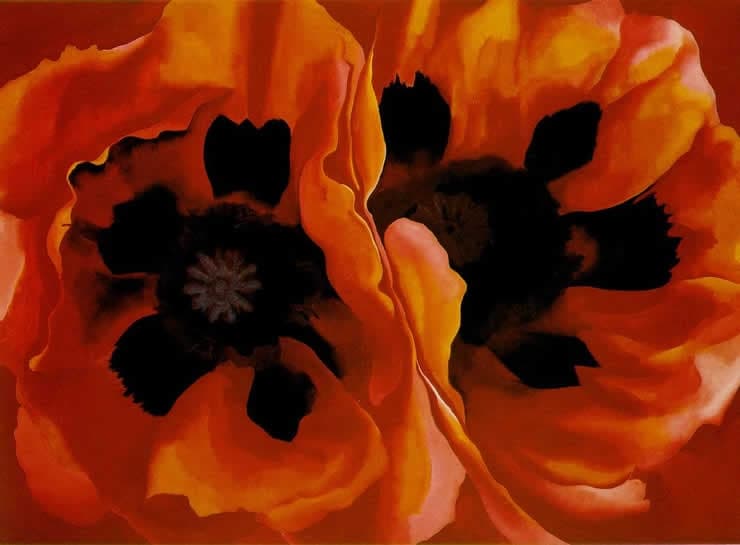
Headline valuation: The canonical 1927 oil 'Oriental Poppies' (catalogue raisonné CR 595), if offered on the open market today with unimpeachable authentication, excellent condition, and robust provenance (Alfred Stieglitz → Frederick R. Weisman Art Museum acquisition), would reasonably be expected to realize in the range of USD 15,000,000–50,000,000. The work has been museum‑held since 1937 and therefore has not been exposed to modern auction discovery; a sale would be exceptional in both rarity and market interest [1].
Market context and comparables: Georgia O’Keeffe’s market ceiling for a universally iconic flower picture was established by Jimson Weed/White Flower No. 1 (Sotheby’s, 2014; $44.4M) and recent marquee results for museum‑quality flower canvases (Black Iris VI, Christie’s 2023; Red Poppy, Christie’s 2024) have realized in the mid‑teens to low‑twenties of millions. These outcomes anchor a practical mid‑teens baseline and demonstrate a plausible upside above $40M for a once‑in‑a‑generation offering with intense competitive bidding [2][3].
Key value drivers and risks: The upper estimate assumes the canonical ~30”×40” composition, inclusion in the catalogue raisonné, an early and documented chain of ownership (notably sale through Stieglitz and institutional acquisition), and an excellent conservation record. Any deviation — smaller dimension, sketch/study status, condition problems, gaps or disputes in provenance, or restrictions tied to museum ownership/donor terms — would materially reduce value (commonly to a lower band of roughly USD 1–8M). The sale venue and marketing strategy are also decisive: New York spring evening sales typically yield the deepest competitive bidding and highest results.
Practical next steps: Before market placement, obtain high‑resolution recto/verso imagery, a full conservator’s condition report, documentary provenance (invoices, correspondence, exhibition labels), and formal confirmation of catalogue‑raisonné entry. Engage specialists at Christie’s and Sotheby’s for preliminary estimates and discuss optimal timing/venue. I can compile a detailed dossier of comparables and draft outreach language to auction‑house specialists on request.
Key Valuation Factors
Art Historical Significance
High ImpactThe 1927 'Oriental Poppies' is situated at the heart of O'Keeffe's signature late‑1920s flower series, a period when she enlarged floral motifs to near‑monumental scale and moved toward a more abstracted, formal vocabulary. These canvases play a central role in scholarship on her engagement with scale, form, and modernist coloration, and the poppy motif is among her most widely reproduced images. That art‑historical prominence translates directly into market premium: canonical period works attract museums and major private collectors seeking emblematic examples, and inclusion in authoritative scholarship reduces attribution risk and broadens the competitive buyer pool.
Provenance & Exhibition History
High ImpactProvenance is a decisive price factor. The Weisman accession (purchase from Alfred Stieglitz; institutional acquisition 1937) is a demonstrably strong early provenance that materially increases market confidence and supports top‑band valuation. A documented exhibition and publication record—appearances in major retrospectives, catalogue raisonné entry, and early institutional display—further amplifies demand by providing visible institutional validation. Conversely, gaps in ownership history, unverified private transfers, or donor restrictions can suppress competitive bidding and reduce the achievable price even for a visually similar canvas.
Condition & Conservation
High ImpactA full, qualified conservation assessment is essential. Issues that affect value include paint layer stability, varnish discoloration, lining or relining history, structural canvas problems, and any extensive overpainting or restoration. Documented, tasteful conservation can preserve value; extensive or invasive repairs and heavy retouching can materially depress price and deter institutional buyers. Orientation and cropping history — matters discussed in O'Keeffe scholarship for some works — also affect scholarly interpretation and marketability. A clean conservation record supports the high estimate band.
Comparables & Auction Results
High ImpactComparable auction results anchor the estimate. The Jimson Weed record ($44.4M, 2014) demonstrates the market ceiling for an iconic floral O'Keeffe, while Black Iris VI (Christie’s, 2023, ~USD 21.1M) and Red Poppy (Christie’s, 2024, ~USD 16.5M) illustrate the practical market range for museum‑quality flower pictures today. Differences in subject prominence, size, condition, and provenance explain why otherwise similar works sell across a wide band. These comparables justify a mid‑teens baseline with plausible upside to the low‑forties under exceptional sale conditions [2][3].
Rarity / Museum Ownership & Market Supply
Medium ImpactMany of O'Keeffe's canonical large florals are in institutional collections, which reduces market supply and can elevate prices for the rare examples that do appear. However, museum ownership also means such works are unlikely to come to market; when institutions deaccession, legal, donor, and reputational constraints can affect sale mechanics and buyer appetite. Scarcity of high‑quality, unencumbered canvases supports price resilience, but the real‑world chance of an offered canonical canvas remains low, which is an important practical limiting factor for liquidity and timing.
Sale History
Oriental Poppies has never been sold at public auction.
Georgia O’Keeffe's Market
Georgia O’Keeffe is one of the most important and consistently collectible American modernists. Her market is characterized by strong institutional demand, limited supply of canonical works, and a small number of marquee auction results that define the artist’s ceiling (notably Jimson Weed at $44.4M in 2014). Museum‑quality, well‑provenanced works from her peak periods typically achieve mid‑to‑high seven figures or low‑eight figures; only a handful have realized the tens of millions. O'Keeffe benefits from sustained scholarly attention and growing market interest in female modernists, which supports robust pricing for top examples.
Comparable Sales
Jimson Weed / White Flower No. 1
Georgia O'Keeffe
Record public auction for a canonical, large O'Keeffe flower painting; establishes the market ceiling for an iconic, museum‑quality floral work.
$44.4M
2014, Sotheby's New York
~$58.6M adjusted
Black Iris VI
Georgia O'Keeffe
Recent marquee‑sale result for a museum‑quality O'Keeffe flower (Paul G. Allen sale); close subject/market positioning and strong provenance—good direct comparable for scale/importance.
$21.1M
2023, Christie's New York
~$22.4M adjusted
Red Poppy
Georgia O'Keeffe
Close subject (poppy), near‑date (late 1920s) comparable sold in May 2024; supports a mid‑teens‑millions baseline for high‑quality poppy/flower pictures.
$16.5M
2024, Christie's New York
~$17.0M adjusted
Current Market Trends
The blue‑chip market remains selective but resilient: well‑documented, museum‑quality works by major modernists continue to attract strong bids from institutions and private collectors. Recent O'Keeffe sales in 2023–2024 show steady mid‑teens results for comparable flower works; macroeconomic uncertainty can dampen marginal bidders but scarcity of high‑quality canvases and targeted sale strategies (New York evening auctions) generally support strong outcomes.