How Much Is Red Canna Worth?
Last updated: May 18, 2026
Quick Facts
- Methodology
- comparable analysis
If offered on the open market today, the University of Arizona’s Red Canna (CR513) would most likely fall in the $3,000,000–$10,000,000 range based on recent auction comparables for O’Keeffe florals and subject‑specific sales. This estimate assumes the listed dimensions (~35 3/4 x 29 3/4 in), sound condition, and standard museum provenance; museum ownership and lack of a recent sale are the principal sources of uncertainty.
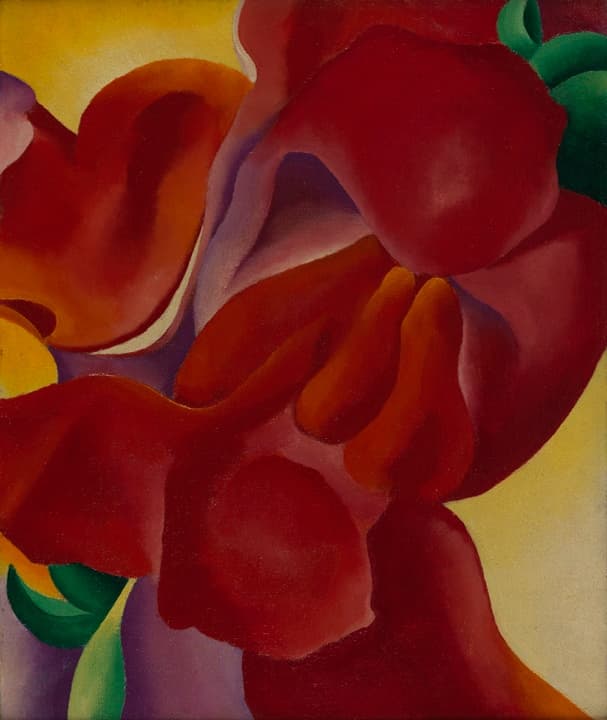
Red Canna
Georgia O’Keeffe, 1925–1928 • Oil on canvas mounted to Masonite
Read full analysis of Red Canna →Valuation Analysis
Valuation conclusion: Based on a comparable‑analysis of recent realized prices for Georgia O’Keeffe flower paintings and the specific facts known about the University of Arizona’s Red Canna (CR513), my reasoned market range for a sale scenario today is $3,000,000–$10,000,000. This assumes the accessioned work described in the museum catalogue (oil on canvas mounted on Masonite, approx. 35 3/4 x 29 3/4 in., accessioned 1950) and that the painting is in stable, saleable condition [1].
Comparables and anchors: O’Keeffe’s market is sharply tiered. Top canonical florals have realized tens of millions (Jimson Weed remains the ceiling), while other large, published florals in the 1920s–30s have recently achieved mid‑seven to low‑eight figure results. Examples include high‑profile sales that pushed comparable florals into the $10M–$22M band, while smaller board studies and lesser‑circulated variants have sold in the low single‑millions to mid‑seven figures. These outcomes frame a practical window for a mid‑large museum canvas of this subject and era, and therefore underpin the $3M–$10M range offered here [2].
Key value drivers: The principal determinants that would move a realized price within this range are: documented condition and any conservation history (including the fact the canvas is mounted on Masonite), the strength and clarity of provenance and catalogue raisonné citations, and the degree of publication and exhibition history. A well‑published work with major loans and excellent condition would trend to the top end; an otherwise identical work with conservation needs or weak literature would fall to the bottom end.
Museum ownership and market probability: Because CR513 is museum‑held (gift of Oliver B. James, accession 1950), there is no modern auction anchor price for this specific canvas and an actual market transaction is unlikely without a formal deaccession. Deaccession scenarios are rare and typically proceed with institutional oversight; when they do occur, houses and buyers prize the story, provenance, and scholarly framing — all of which can lift price. Conversely, absence of institutional promotion or gaps in provenance will depress competitive bidding and realized price.
Practical next steps: To firm this estimate into a formal written valuation, obtain the University of Arizona accession/provenance file and the catalogue raisonné entry, commission a full conservator condition report with high‑resolution photography, and brief a major auction house specialist for a pre‑sale estimate. With those materials, a more tightly bounded reserve or insurance replacement value can be provided. At present, given the comparables and the painting’s museum status, $3,000,000–$10,000,000 is a reasoned market valuation for a sale scenario today [1][2].
Key Valuation Factors
Art Historical Significance
High ImpactRed Canna is part of Georgia O’Keeffe’s seminal flower series, a body of work central to her critical reputation and to 20th‑century American modernism. While CR513 is not the unique iconography of Jimson Weed, the subject is artistically important and widely collected; examples from the series have formed the backbone of major exhibitions and scholarship. The painting’s inclusion in the catalogue raisonné (CR513) and long museum ownership both increase curatorial interest and the work’s scholarly standing, which in turn supports stronger market demand and higher realized prices for comparable canvases. For these reasons art‑historical significance is a major positive driver of value.
Condition & Conservation
High ImpactCondition is a primary determinant of value for O’Keeffe florals. The University of Arizona record notes the work is an oil on canvas mounted on Masonite—an aspect that raises specific conservation considerations (adhesion, panel movement, past relining or inpainting). Any structural intervention, significant restoration, or active deterioration will materially reduce buyer confidence and realized price; conversely, documented, stable conservation and recent conservation treatment will preserve or enhance value. A professional condition report is therefore essential before insurance, sale, or reserve decisions can be finalized.
Provenance & Exhibition History
High ImpactProvenance and exhibition/publication history strongly influence buyer willingness to pay a premium. CR513’s long tenure in the University of Arizona Museum of Art (gift of Oliver B. James, accession 1950) provides institutional provenance that is attractive to bidders when well documented. Loan history to major exhibitions, inclusion in authoritative monographs or catalogue entries, and illustrated reproduction in scholarship materially increase marketability. Gaps or ambiguities in provenance, or lack of exhibition citation, will suppress value; strong documentation will push the painting toward the top of the estimated range.
Size & Medium
Medium ImpactAt approximately 35 3/4 x 29 3/4 in, CR513 sits in the mid‑to‑large category for O’Keeffe florals. Size is a consistent price driver: the largest and most dramatic florals typically command the highest multiples, while small board studies trade in lower bands. The support (canvas mounted on Masonite) and the painting’s scale will therefore place it above small studies but typically below the marquee oversized works that hit the highest market ceiling. Size and medium together create a reliably positive, but not dominant, price influence.
Market Liquidity & Institutional Ownership
Medium ImpactMarket liquidity for top O’Keeffes is strong but concentrated among a modest set of institutional and private buyers. Museum ownership improves provenance but reduces immediate liquidity: deaccession is uncommon and often attracts institutional restrictions. When museum works do come to market, they can attract intense competition from major private collectors and institutions, producing premium outcomes; however, the scarcity of similar market offerings means results are event‑driven and can vary. Institutional ownership is therefore a double‑edged factor—supportive of value but reducing the probability (and timing) of a sale.
Sale History
Sotheby's New York
Christie's New York
Christie's New York
Sotheby's New York
Christie's New York
Georgia O’Keeffe's Market
Georgia O’Keeffe is a blue‑chip, museum‑anchored artist whose auction market is strongly tiered. Her single‑work auction record remains in the tens of millions (Jimson Weed / White Flower No. 1), and recent years have produced multiple seven‑figure realizations for large, published florals and landscape works. Demand concentrates on well‑documented, exhibition‑worthy canvases; smaller studies and board works trade substantially lower. Overall, O’Keeffe maintains strong institutional and private demand, and high quality, well‑provenanced works continue to perform well relative to the broader American Modernist market.
Comparable Sales
Jimson Weed / White Flower No. 1
Georgia O'Keeffe
Artist's canonical large floral masterpiece; sets the market ceiling for O'Keeffe florals and useful as an upper‑bound anchor.
$44.4M
2014, Sotheby's New York
~$59.5M adjusted
Black Iris VI (1936)
Georgia O'Keeffe
Large, museum‑quality floral sold from a major estate (Paul G. Allen) in 2023; strong recent headline comparable for high‑end florals.
$21.1M
2023, Christie's New York
~$22.3M adjusted
Red Poppy (1928)
Georgia O'Keeffe
Large, published O'Keeffe floral from the late 1920s sold in 2024; a close-era, high‑quality floral comparable that indicates mid‑seven‑figure realized prices.
$16.5M
2024, Christie's New York
~$16.9M adjusted
Pink Spotted Lily (1936)
Georgia O'Keeffe
Small flower study (12 x 10 in.); demonstrates pricing for smaller, board‑mounted or study works—useful for the lower tier of floral studies.
$6.8M
2021, Sotheby's New York
~$7.8M adjusted
Red Canna (1919, oil on board)
Georgia O'Keeffe
Direct subject match (same title) but a smaller, earlier board work; provides a direct subject precedent and shows how small Red Canna studies price versus larger canvases.
$2.8M
2025, Christie's New York
Current Market Trends
Current market conditions (2023–2025) show selective buoyancy for high‑quality American Modernism: marquee works and estate dispersals have produced strong results even during broader market softness. Scholarly activity and major retrospectives (which increased O’Keeffe’s visibility) have supported demand, but macroeconomic volatility and liquidity constraints keep outcomes event‑sensitive. Works with strong provenance, publication, and exhibition histories continue to attract the most competitive bidding.
Study print
Study this painting as a print
Pair the full artwork with a museum-style study sheet focused on one meaningful detail.