How Much Is Pelvis with the Distance Worth?
Last updated: May 18, 2026
Quick Facts
- Methodology
- comparable analysis
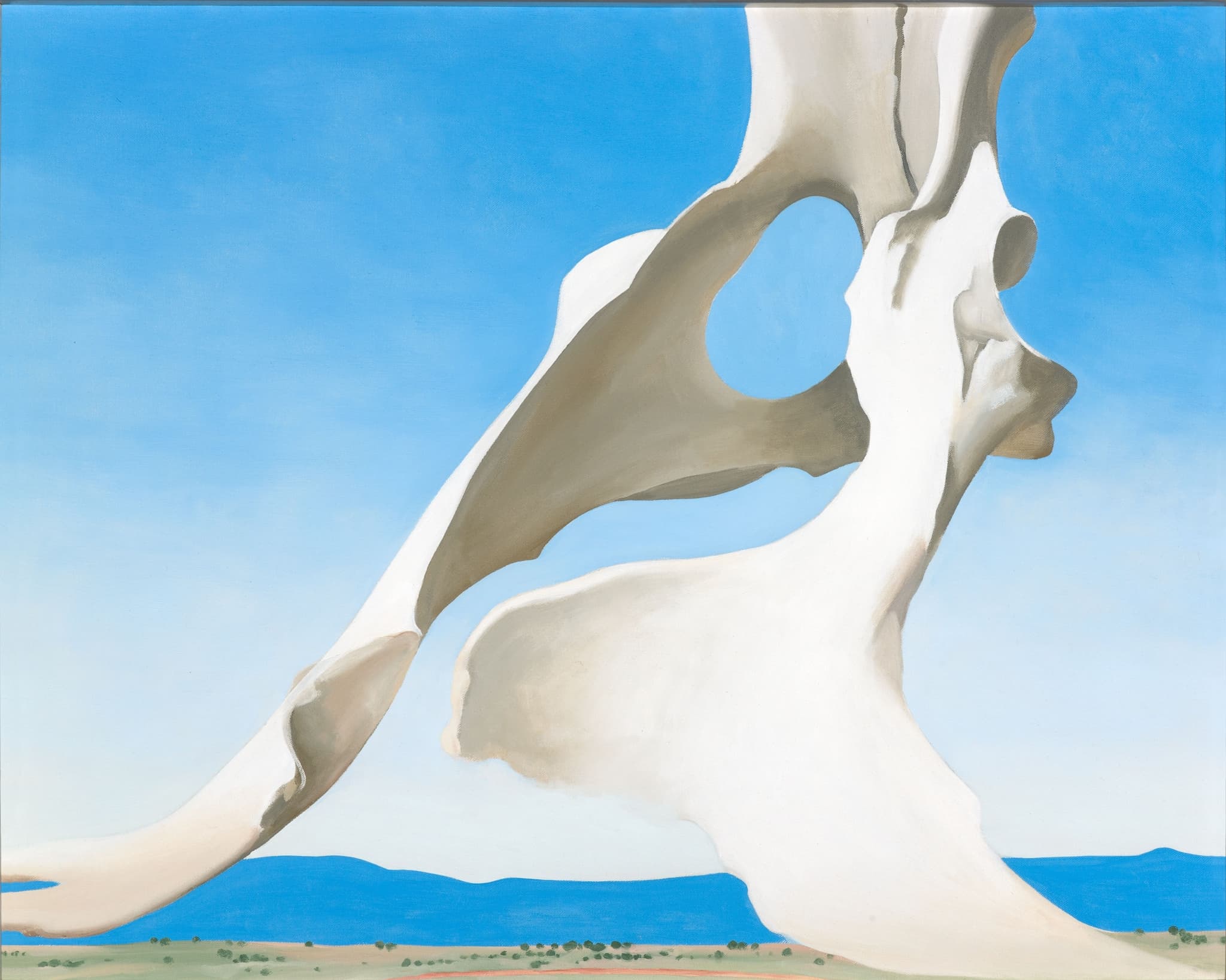
The original oil-on-canvas Pelvis with the Distance (1943), CR No. 1049, is museum-held at the Indianapolis Museum of Art (Newfields) and has no public auction record; if offered under normal market conditions, a realistic, evidence-based estimate is $300,000–$1,500,000. Upside to $1.5M–$5M+ is possible only in rare, exceptional sale circumstances (major retrospective/publication, unusually competitive bidding, or other strong catalysts).
Valuation Analysis
Valuation conclusion: The original oil-on-canvas Pelvis with the Distance (1943), catalogued as CR No. 1049 and recorded in the Indianapolis Museum of Art (Newfields), is museum-held (accession 77.229) and has no public auction record; if it were to come to market under ordinary conditions, a realistic, evidence-based estimate is $300,000–$1,500,000. This range reflects market behavior for mid‑career pelvis/bone works by O’Keeffe, the work’s moderate physical scale (23 7/8 × 29 3/4 in), and its museum provenance, with an upside toward $1.5M–$5M only in exceptional scenarios involving outstanding condition, extended exhibition/publication history, or highly competitive bidding. [1]
Provenance and documentation: The painting’s provenance — from the artist to Caroline Marmon Fesler and by descent to Anne Marmon Greenleaf before donation to Newfields in 1977 — and its acceptance in the standard catalogue raisonné materially strengthen authenticity and institutional value. Museum ownership and documented exhibition history increase confidence for buyers, but because the object has not been traded publicly, there is no auction-based market reference for the original to produce a firm hammer-price estimate. A formal condition report and access to museum conservation records would narrow uncertainty. [1]
Comparables and market logic: I derived the range by comparing subject-equivalent pelvis/bone canvases and similarly sized mid‑career O’Keeffe oils. The artist’s top market examples (e.g., Jimson Weed/White Flower No. 1) command multi‑ten‑million dollar prices and set the ceiling for the artist’s market, but those works are exceptional in subject, scale and provenance [2]. Recent high‑value flower sales (e.g., Black Iris VI) confirm demand for canonical works, while pelvis compositions have historically realized lower outcomes and sometimes underperformed expectations—an illustrative historical case is a pelvis lot that failed to sell at Christie’s despite bids near US$800,000 [3][4]. Secondary-market lithographs and offset prints titled "Pelvis with the Distance" trade at very modest levels and should not be conflated with the oil original.
Upside and downside drivers: Upside into the US$1.5M–$5M band would require unusually strong competitive bidding, a major retrospective or publication that recontextualizes the work, or rare collector urgency. Downside risks include limited buyer pools for bone imagery, any conservation/restoration issues, and the practical barrier that museums rarely deaccession major works—sale logistics and institutional restrictions typically suppress transaction frequency and price discovery. Sale timing, marketing, and the choice of auction house or private-sale intermediary will materially affect outcome probability.
Practical recommendations: For a market-ready valuation and to improve confidence: obtain a current condition report, secure full provenance and exhibition documentation from Newfields, and solicit preliminary interest from major-house American-art specialists. Given the current information, I place the conservative working estimate at $300,000–$1,500,000 (confidence: moderate), with a clear path to revise upward if new documentation, an institutional deaccession, or a high-profile exhibition accelerates demand. [1][2]
Key Valuation Factors
Art Historical Significance
Medium ImpactThe pelvis/bone motif is a recognized and thematically important strand in O’Keeffe’s oeuvre—linking organic form to landscape and abstraction. However, individual pelvis works typically do not achieve the iconic status of her large flower paintings or landmark New Mexico landscapes. The painting therefore benefits from clear scholarly interest and curatorial relevance, supporting institutional bids and collector appreciation, but this significance alone is unlikely to push the work into the top-tier price band without complementary attributes (major exhibition history, exceptional condition, or particularly strong provenance). As a result, art-historical importance is a medium-strength positive in valuation.
Provenance & Exhibition History
High ImpactStrong provenance—in this case purchase by Caroline Marmon Fesler, descent to Anne Marmon Greenleaf, and donation to the Indianapolis Museum of Art (Newfields) in 1977—materially reduces ownership risk and enhances buyer confidence. Museum accession and documented exhibition loans heighten scholarly visibility and typically increase marketability and price realizability. Institutional provenance is one of the most reliable value multipliers for 20th‑century works because it signals curatorial vetting and conservation oversight. The museum holding also produces a practical liquidity constraint: a sale would likely require formal deaccession procedures, which are infrequent and governed by institutional policy.
Authentication & Catalogue Raisonné Status
High ImpactEntry in the standard catalogue raisonné (CR No. 1049) and recognition by O’Keeffe scholars substantially lower attribution risk—a key determinant of price at the top and mid tiers of the market. Catalogue acceptance streamlines due diligence and encourages major houses and institutional buyers to participate, which supports higher estimates than for unattributed works. Nevertheless, a full scholarly and conservation dossier (signature verification, pigment analysis if needed, conservation history) is still required for any listing or formal appraisal to achieve the most favorable market outcome.
Condition & Physical Attributes (size, medium)
High ImpactAt approximately 23 7/8 x 29 3/4 in (ca. 61 x 76 cm), the painting is modest-to-medium in scale and attractive to both private collectors and smaller institutions. Oil on canvas is a market-friendly medium, and museum custody implies likely conservation oversight. However, any evidence of relining, overpaint, or significant restoration would reduce the achievable price materially. Scale moderates the ceiling: monumental O’Keeffe canvases command premiums that this work’s dimensions do not inherently justify, placing it more squarely in a mid-range price band absent other exceptional attributes.
Market Comparables & Demand
Medium ImpactComparables establish the realistic price band: headline O’Keeffe flower and landscape sales set the ceiling (multi‑ten‑million dollars), but pelvis/bone subjects have historically realized substantially lower sums and display outcome variability. Auction evidence shows some pelvis works underperform relative to expectations and that buyer appetite is more specialized for bone imagery. Recent high-profile O’Keeffe sales underscore strong demand for canonical subjects, but the comparative record supports a conservative working range of $300K–$1.5M for a museum‑documented, medium‑scale pelvis canvas, with the potential to exceed that range only under exceptional sale conditions.
Sale History
Pelvis with the Distance has never been sold at public auction.
Georgia O’Keeffe's Market
Georgia O’Keeffe is a central figure in American modernism and one of the artist market’s blue-chip names. Her most iconic works (large flowers, landmark landscapes) have achieved headline multi‑million to multi‑ten‑million dollar results at major houses, which creates a high market ceiling for the artist. That said, her oeuvre is varied; subject, size, date, condition and provenance produce wide price dispersion. Mid‑career subject paintings and bone/pelvis motifs, while important, generally trade below her most famous works, so appraisals require careful subject- and size-matched comparables rather than reliance on headline sales alone. [2][3]
Comparable Sales
Jimson Weed/White Flower No. 1
Georgia O'Keeffe
Artist's market benchmark: a large, canonical flower painting that defines the top of O'Keeffe's auction market. Different subject and much larger/more iconic than Pelvis with the Distance, but useful as a ceiling reference for demand in peak markets.
$44.4M
2014, Sotheby's New York
~$59.0M adjusted
Black Iris VI
Georgia O'Keeffe
Recent high‑value sale of a canonical flower painting demonstrating continued strong demand for major O'Keeffe works. Still materially more significant (subject, market interest) than typical pelvis/bone paintings.
$21.1M
2023, Christie's New York
~$22.0M adjusted
Pelvis With Shadow and Moon (offered at auction, unsold)
Georgia O'Keeffe
Directly comparable subject (pelvis/bone) offered at a major house; bidding reportedly reached about $800k but the lot failed to sell—illustrates that pelvis works often trade well below the artist's flower/landscape masterpieces and can underperform expectations.
$800K
1987, Christie's (1987 sale; lot failed to meet reserve)
~$2.3M adjusted
Current Market Trends
Blue‑chip modernist works continue to attract institutional and private demand, with the highest-quality, well-provenanced examples performing best. Recent cycles show strong results for canonical O’Keeffe works while secondary-market pieces can be more volatile and sensitive to provenance and condition. For a museum-held work to realize top value, sale timing, an appropriate venue, and robust specialist marketing are critical. Overall, documented provenance and catalogue‑raisonné status remain decisive in converting scholarly value into market value.
Sources
- Access O'Keeffe — Pelvis with Distance (CR 1049), Indianapolis Museum of Art (Newfields)
- CNBC — Georgia O'Keeffe painting sets record (Jimson Weed/White Flower No. 1 sale)
- Christie's — Black Iris VI (sale reference)
- Los Angeles Times — Coverage of a Christie’s pelvis lot that failed to meet reserve (historical context)